In the spring of 1951, a 13-year-old Jane Fonda sat in a school study hall when a classmate slid a movie magazine across her desk. What she read there would reshape everything she believed about her family. The magazine reported that her mother, Frances Seymour Fonda, had not died of a heart attack, as her father had told her just two years earlier. She had killed herself at a psychiatric hospital in Beacon, New York, using a razor blade.
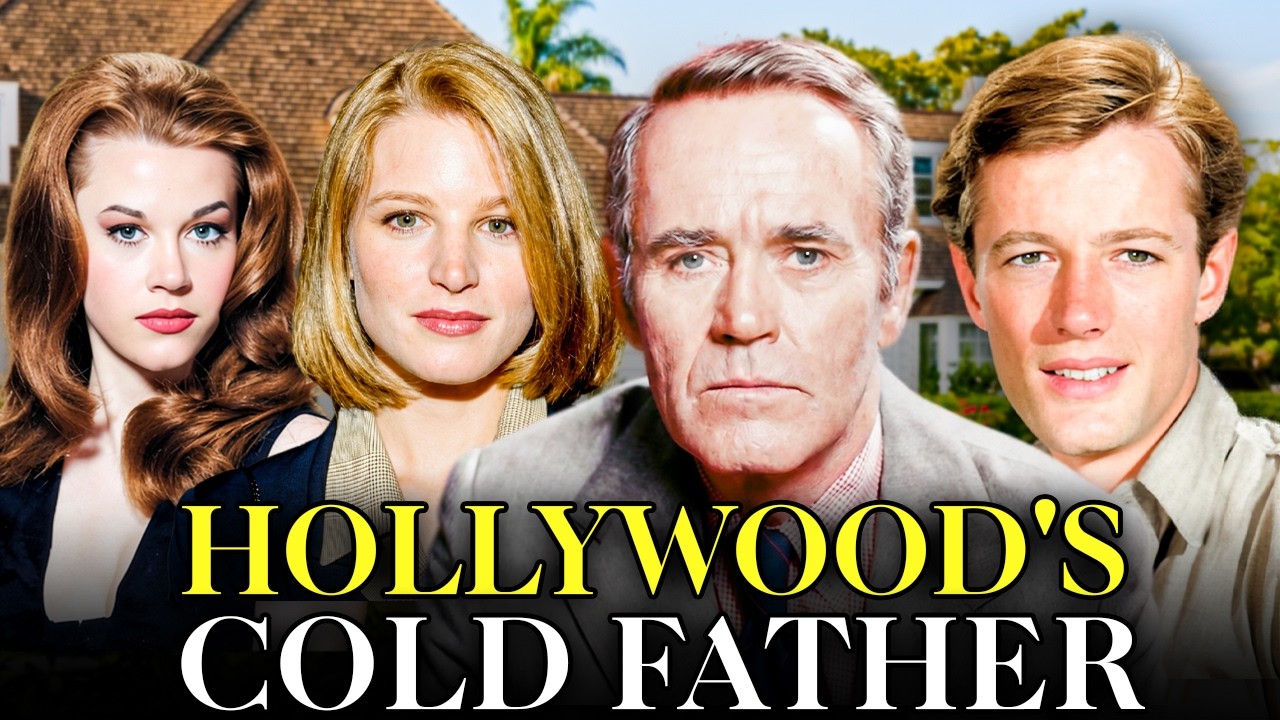
Strangers across America had been reading that truth since the day Frances died. Only her own children had been told a different story. Henry Fonda’s public image was built on decency and moral weight. He was the face of American integrity, an actor whose presence told audiences that honesty existed and could be trusted.
That image made the private contradiction all the more devastating. Inside his household, the truth was treated as something that needed to be managed, especially when it concerned his children. Frances Ford Seymour was born in 1908 and raised in East Coast social circles. In 1931 she married George Tuttle Brokaw, a wealthy New York lawyer more than two decades her senior.
Their daughter, Frances de Villers Brokaw, called Pan, was born the same year. Brokaw died in 1935, leaving Frances a young widow with social standing and a small child. She met Henry Fonda in England during the filming of Wings of the Morning. They married on September 16, 1936, in New York City.
Frances brought her daughter Pan into the new household, along with her beauty and composure. Jane later came to believe her mother had suffered severe childhood sexual abuse and years of psychological damage long before meeting Henry. Frances entered a marriage organized around emotional restraint with injuries that required the opposite. Jane Seymour Fonda was born on December 21, 1937.
Peter Henry Fonda followed on February 23, 1940. The family moved to Greenwich, Connecticut, planting itself in the landscape of East Coast respectability. Henry’s career continued to climb while the household grew heavier with unspoken feeling. By every later account from those who knew him best, Henry Fonda disliked overt displays of emotion.
He could be cold and withholding, retreating into silences that felt like punishment. Jane’s public reflections and Peter’s memoirs describe the same absence: a man who could embody warmth on screen while offering almost none at the dinner table. The children grew up with a void rather than a villain, and a void is harder for a child to fight. By the late 1940s, the marriage was deteriorating.
Henry was often absent. Frances’s mental health was worsening under the pressure of a marriage that offered status but no emotional partnership. In 1949, Henry told Frances he wanted a divorce. Multiple accounts place his request in that year, with some sources citing August specifically.
Frances was devastated. Her entire architecture of stability was pulled out from under her. By early 1950, Frances was in psychiatric care. On February 3, she became a patient at Craig House Sanitarium in Beacon, New York, a facility for affluent patients where breakdowns could happen behind beautiful grounds and closed doors.
The children were told their mother was unwell. They were not told the full picture. During a brief visit home while still a patient, Frances returned to the house. Ten-year-old Peter went downstairs to see her.
Jane stayed upstairs, refusing to come down. She did not see her mother that day. She would never see her mother again. Years later, Jane wrote that she came to believe Frances had returned partly to retrieve a small razor kept in a black enamel box.
Frances appeared to be improving at Craig House. Staff described her as cheerful when last seen. There was talk of discharge and prospects that she might soon return home. The visible indicators all pointed toward stability.
On April 14, 1950, a Friday, Frances Seymour Fonda was found dead at Craig House. She had cut her throat with a razor blade. She was 42 years old. There was no note that has entered the public record.
The public reality was reported promptly. On April 15, 1950, an Australian newspaper ran the headline “Wife of film star commits suicide. ” The reporting stated that Frances had been a patient at Craig House, that she had been suffering a nervous breakdown, that she appeared to be improving, and that she had used a razor blade. The truth was available to any stranger with a few cents and a newsstand.
The private reality was entirely different. Inside the Fonda household, the children were told their mother had died of a heart attack. Henry Fonda looked at his 12-year-old daughter and 10-year-old son and told them a lie. He may have believed he was protecting them.
But the fiction had a cost that would be paid for the rest of their lives. A heart attack invites sadness but not guilt. It does not raise the question of whether a child could have done something differently. The lie denied Jane and Peter the right kind of pain, the kind that corresponds to what actually happened and can eventually be carried honestly.
The floor gave way in the spring of 1951. Jane, then 13, learned the truth from a movie magazine in a study hall, surrounded by classmates. Her mother had taken her own life in a psychiatric hospital. The world had known before she did.
The humiliation was woven into the grief. To learn your mother’s death was a suicide is one kind of devastation. To learn it from a magazine in front of classmates because your father chose concealment is another entirely. Henry, meanwhile, was already constructing the next version of his life.
Later in 1950, he secretly married Susan Blanchard, the stepdaughter of Oscar Hammerstein II. She was 23 years younger. The marriage was not publicly announced at the time. Frances died in April.
Henry remarried before the year was out. In 1953, Henry and Susan adopted a daughter, Amy Fishman. Amy became the third child in the Fonda household, though her experience was fundamentally different. She had not known Frances or lived through the years of emotional withdrawal.
Amy did not become famous, did not write a memoir, and largely disappeared from the public narrative. In a family organized around one of the most recognizable surnames in American culture, the adopted daughter stepped out of the frame. Jane Fonda went on to become one of the most famous women in the world. She won two Academy Awards and married three times: to director Roger Vadim, activist Tom Hayden, and media executive Ted Turner.
She reinvented herself repeatedly, from ingenue to sex symbol to political radical to fitness entrepreneur and memoirist. Her later accounts connect nearly every thread back to the childhood wound. She spoke publicly about an eating disorder rooted in the need to control her body because she could not control her family. She described growing up without a parent who could reflect her through eyes of love.
She acknowledged that she had spent much of her adult life seeking the emotional validation her father could not provide. Peter Fonda’s trajectory was the sibling counterpoint. He became a counterculture icon through Easy Rider in 1969, the outlaw on the motorcycle who rejected his father’s generation. His rebellion ran deeper than ideology.
His memoir, Don’t Tell Dad, made the connection explicit. The title alone was an accusation, a child’s plea reworded as an adult’s manifesto. Peter did not become a rebel because the 1960s made rebellion fashionable. He became a rebel because rebellion was the only language available to a boy whose feelings had been treated as inconvenient his entire life.
The reconciliation arrived late and incompletely. During the filming of Wanda Nevada in 1979, a film in which he appeared with his father, Peter recalled Henry turning to him and saying, “I love you very much, son. ” Six words from a man who had almost never said them. Before Henry’s death in August 1982, Jane told him she loved him and forgave him.
She saw him weep for the first time in her life. Henry Fonda died on August 12, 1982, at the age of 77. Peter Collier’s book The Fondas: A Hollywood Dynasty framed the family as a multi-generational American saga. The HBO documentary Jane Fonda in Five Acts gave Jane the chance to narrate the wound from the inside, though it told one child’s version of the story.
Peter Fonda died on August 16, 2019, at age 79. The cause was respiratory failure due to lung cancer. Pan Brokaw, Frances’s older daughter, died in Rome in 2008. Her death received little public attention.
She was not a Fonda by blood, and the narrative machinery of dynasty storytelling had long since moved past her. Jane Fonda is 88 years old and remains publicly active, engaged in political and climate work. She is not frozen in the study hall where a magazine told her the truth. She has built a life vast enough to contain both that moment and everything that followed.
What the Fonda story reveals is that a revered public image can become, inside a home, the very structure that prevents honesty. The children raised inside such a structure inherit not just the name and its advantages. They inherit the silence, the unfinished grief, and the performances they were never told were performances. When Jane finally saw her father cry, it was in the last days, when almost everything had already been spent.
What remained was not resolution but proof that the feeling had been there all along, locked behind a door he could not open until there was almost no time left.