Just after sunrise on June 22, 1967, a young paratrooper named Cook stepped a few feet from his position on a ridgeline in Vietnam’s Central Highlands. He never returned. He was killed by friendly fire from his own ranks before the enemy fired a single shot. But that accidental death turned out to be the good news that day, because three hours later, an entire American rifle company was nearly wiped out.
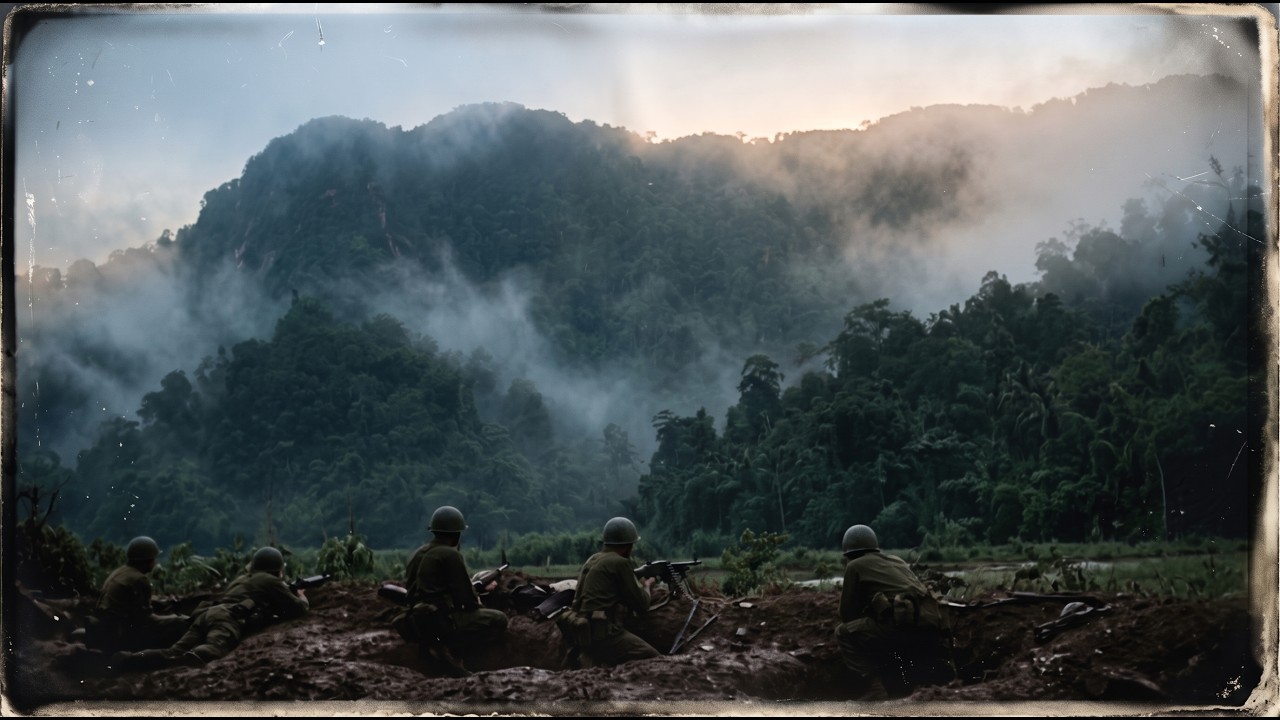
A total of 131 men entered the battlefield that morning. By the time the shooting stopped, 76 of them were dead. Some were later found with gunshot wounds to the back of the head, executed where they fell. That morning remains the worst single day for the U.
S. Army in the entire Vietnam War. Almost no one outside those who were there has ever heard of it. The unit was the 173rd Airborne Brigade, known as the Sky Soldiers—all volunteer paratroopers and the first major U.
S. Army formation sent to Vietnam in 1965. Their nickname told you exactly how the high command saw them: Westmoreland’s Fire Brigade. Whenever a fire broke out somewhere in the country, the 173rd was sent, fast-moving and airlifted by helicopter to wherever the problem was worst.
In June 1967, the problem was at a place called Dak To. It sits in Kontum Province, near the junction of the borders of Vietnam, Laos, and Cambodia. The jungle there was dense, tangled, and triple-canopied, so thick that daylight barely reached the ground in some places. Near a Special Forces camp, North Vietnamese mortar crews began dropping rounds from above the trees—probing, testing, daring anyone to find them.
Then something worse was found. A patrol stumbled upon the bodies of local fighters missing from a Special Forces strike unit, men who had disappeared days earlier. It became clear the North Vietnamese were not just harassing the camp; they were present in strength. So the Fire Brigade was called in.
Two companies of the 2nd Battalion, 503rd Infantry, were lifted by Huey helicopters onto the slopes near the high ground. The maps simply called it Hill 1338, the highest peak overlooking Dak To. Their mission seemed simple when stated quickly: find and destroy the enemy. But the warning that almost got lost to history came before they set foot on the hill.
A colonel from the 4th Infantry Division, accompanied by men who had been fighting in those highlands, pulled the brigade leadership aside and warned them. This was not the Sacramento River Delta, he said. These were not rice farmers with old rifles. These were professional soldiers who knew how to fight.
Then he said the words history would later confirm: never let a company go out alone. Alone out there, it would be easy prey for the North Vietnamese Army. Easy prey. For two days, the paratroopers did the brutal, unglamorous work of jungle warfare.
They fought through vines and bamboo on slopes steep enough to exhaust their leg muscles, chasing an enemy that seemed to vanish every time they got close. On June 18, nothing. On June 20, nothing but those grim bodies. On June 21, still nothing.
That evening, two companies, Alpha and Charlie, dug in together on a hilltop about 2,000 meters from the base, sharing one perimeter overnight. Unknown to them, a North Vietnamese battalion of around 500 men had quietly settled in for the night on the other side of that same hilltop. Close enough that some accounts say, under different conditions, you could have shouted to them. Two forces in the darkness, in the fog, nearly touching.
One of them knew exactly where the other was. Guess which one. Morning came wrapped in thick fog that muffled sound. Alpha Company men wrapped their ponchos, ate cold C-rations, and allowed themselves a dangerous feeling: relief.
That day’s plan was almost a gift. Alpha was to be pulled back to the base for palace guard duty, perimeter security, light tasks, and a short rest. They had every reason to move quickly, and that is where decisions start to matter. Orders sent Alpha Company back overland alone.
One company split off from the rest, making its way down the hill toward the base. The young lieutenant leading the point platoon, a West Point graduate named Judd who had only been in the field for two days, faced a choice every infantryman knows by heart. The rulebook says never use an existing trail; trails are ambush sites. But cutting a new route through that jungle would cost a full extra day.
He took the trail. At precisely 6:58 a. m. , Judd’s reconnaissance team walked straight into 10 or 15 North Vietnamese soldiers coming the opposite way on the same trail.
For a fleeting moment, two groups of armed men stared at each other through the fog. The North Vietnamese fired first. At the company command post, the gunfire was not initially seen as a crisis. One man said it sounded like the platoon conducting routine reconnaissance by fire.
Another answered, nonsense. He was right. This was not a brush with a stray patrol. Alpha Company had hit the lead element of that battalion, and the North Vietnamese were waiting, dug in on the high ground on both sides of the trail.
Within minutes, the volume of fire was unlike anything most of these men had experienced. AK-47 fire, automatic and continuous, rained down from the slopes. Lieutenant Judd pulled his men into a tight formation and reported the attack. Captain Milton, Alpha’s commander, did the standard thing.
He sent another platoon, Hud’s men, charging down the trail to reinforce. Hud and Judd were friends, fellow West Point graduates. Hud did not hesitate. And so the trap began to close.
Every platoon Milton sent down that hill fed more Americans into a kill zone the enemy had already marked, measured, and zeroed in. The North Vietnamese advanced along the ridgeline, surrounding the pinned-down platoon from both flanks. Leaders fell one by one. All three platoon leaders were killed.
Every platoon sergeant was seriously wounded. The chain of command, and the steady voices that were supposed to hold a unit together under fire, vanished within one hour. The firepower that was supposed to save them never reached them. Artillery rounds came in, but the dense jungle absorbed the blasts or scattered them uselessly among the trees.
Forward observers could not even see the enemy positions to adjust fire. Close air support faced the same green wall. The jungle itself erased the U. S.
military’s greatest advantage in Vietnam. On that slope, all they had were rifles, grenades, and courage. The ground was level, and the enemy held the upper half of it. As the situation collapsed, the surviving senior sergeant of the trapped group made the hardest decision a man can make.
He ordered everyone who could still crawl, and could drag a wounded comrade, to head to the command position higher up the hill. Leave the rest behind. There was no other option. By noon, Milton’s trapped men were down to about 30 still fighting, guarding around 35 wounded.
Charlie Company tried to break through to reach them, but they dug in and were themselves pinned down. Relief was close but did not arrive in time. It was not until mid-afternoon, when fresh reinforcements finally arrived, that the North Vietnamese pulled back into the jungle as they always did. That night at Dak To, they did a roll call.
Seventy-five men did not answer. The next morning, June 23, relief companies returned to comb the battlefield and find them. What they discovered is why the men who were there never forgot that morning. Of the Alpha Company dead, 43 soldiers had been killed with close-range shots to the head.
The North Vietnamese had moved across the battlefield after the fighting and executed the wounded Americans where they lay. There was one exception. One man hit by an execution round only suffered a mild shock. He played dead all night and survived, found alive the next day.
One out of all those men. These were young men, nineteen, twenty, and twenty-one years old. Most had been in the country for weeks. Some of their platoon leaders had been in the field for days.
When the storm quieted, the losses were counted. Alpha Company: 76 killed and 23 wounded out of roughly 131 men. Three out of every four men in the company had been killed or wounded in a single morning. To this day, that remains the highest casualty rate suffered by any American rifle company, Army or Marine, in a single battle during the entire Vietnam War.
Then there is another number, one no one likes to talk about. In the aftermath, official statistics claimed roughly 475 North Vietnamese soldiers had been killed in action. A stunning number, one that would turn the massacre into at least what looked like a costly victory. But when search teams combed the battlefield to find enemy bodies and confirm the claim, they found between nine and twelve corpses in shallow graves.
Nine, maybe twelve. The bitter irony behind all this is that it was not luck that favored the North Vietnamese; it was a well-planned operation. Lure the Americans into the mountains with light mortar fire and a threat to an outpost. Wait in terrain that neutralized their aircraft and artillery.
Ambush an isolated unit, deliver a knockout blow, then withdraw across the border into Laos or Cambodia before the full U. S. force arrived. They had done it before.
They would do it again at Dak To just months later in battles that made headlines. But this battle, the Battle of the Slopes, as the Sky Soldiers called it, stayed in the shadows. And remember that warning: never let a company go out alone. It is easy prey.
That warning was spoken aloud to the right people days before Alpha Company stepped onto that trail alone. So the question remains: was this a tragedy or a preventable error? An understrength company sent alone through a known jungle corridor, explicitly warned against by a veteran colonel, walking into an enemy that had chosen the battlefield. Was it the fog of war?
Or a leadership failure that turned 76 young Americans into exactly what they had been warned about, easy prey? There may be no single definitive answer. The men of Alpha Company, 2nd Battalion, 503rd Infantry deserve to be remembered.