When Confederate Brigadier General Albert Sidney Johnston was killed at the Battle of Shiloh in April 1862, the Confederacy lost one of its most respected commanders at a critical moment in the war. Historians have long debated the effectiveness of the South’s senior military leadership, with some generals remembered for brilliance and others for catastrophic decisions that hastened Confederate defeat. Among the most controversial figures was John Bell Hood, who joined the Confederate Army at the start of the war and rose quickly because of his bold, aggressive command style. He was promoted to temporary full general on July 18, 1864, and placed in command of the Army of Tennessee during the Atlanta campaign at just 33 years old, making him the youngest officer on either side to command an entire army.
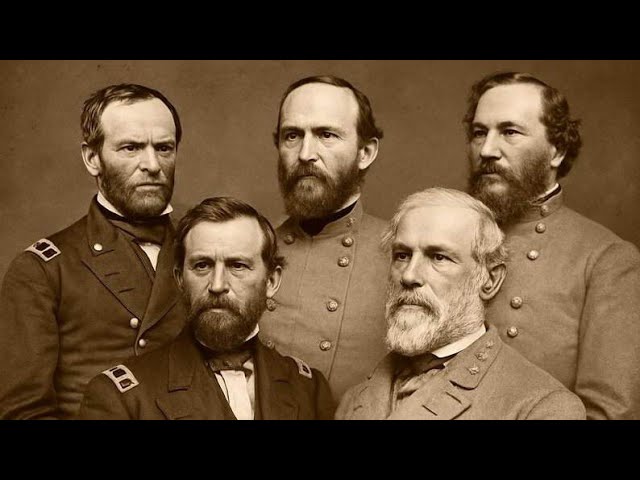
Historian Bruce Catton argued that replacing General Joseph E. Johnston with Hood was one of the most disastrous decisions of the war. Catton stated that “the decision to replace Johnston with Hood was probably the single largest mistake that either government made during the war period. ”
Hood’s aggressive strategies led to devastating losses, including the failed defense of Atlanta and the catastrophic Franklin-Nashville campaign, which effectively destroyed the Army of Tennessee as a fighting force.
His decisions accelerated the collapse of Confederate resistance in the western theater and contributed significantly to the South’s eventual defeat. Hood receives only an honorable mention because his promotion to full general was never confirmed by the Confederate Senate, and he was reduced back to lieutenant general on January 23, 1865. Ranked at number seven among the most prominent Confederate generals is Samuel Cooper. Born in 1798, Cooper was a West Point graduate who resigned his U.
S. Army commission in March 1861 to join the Confederate Army, where he became adjutant and inspector general, the highest-ranking officer in the Confederate military. Despite holding the rank of general, Cooper never commanded troops in the field or took part in combat operations, and he is remembered primarily as a behind-the-scenes administrator rather than a battlefield leader. At number six is Braxton Bragg, who had a long military background before the war and aligned himself with the Confederacy when hostilities broke out.
His early success organizing and training troops in Pensacola, Florida, earned him promotion to major general and later to full general in 1862. Although Bragg possessed notable strategic knowledge, his leadership was undermined by constant conflicts with subordinates and an inability to capitalize on battlefield victories. Private Sam Watkins, who later became a writer, described Bragg unfavorably in his memoirs, reflecting widespread dissatisfaction among soldiers. Bragg’s rigid, authoritarian leadership style damaged morale and fueled tension with both officers and enlisted men.
Entering the top five at number five is P. G. T. Beauregard.
Born in Louisiana in 1818, Beauregard graduated from West Point in 1838 and became the Confederacy’s first brigadier general. He became its first major military figure after leading the successful bombardment of Fort Sumter in April 1861, the opening engagement of the Civil War. He continued his early success at the First Battle of Bull Run, where his forces, alongside those of General Joseph E. Johnston, secured a critical Confederate victory.
Transferred to the Western Theater, Beauregard played a significant role at the Battle of Shiloh in 1862, but his failure to exploit an early advantage resulted in defeat and drew heavy criticism. Ongoing disagreements with superiors and inconsistent performance limited his long-term influence. At number four is Joseph E. Johnston, who held the position of quartermaster general in the U.
S. Army before resigning to join the Confederacy in 1861. As one of the highest-ranking officers to defect, he played a major role in the Confederate victory at the First Battle of Bull Run. His overly cautious approach and frequent disputes with President Jefferson Davis weakened his effectiveness.
After being wounded during the Peninsula campaign in 1862, he was replaced by Robert E. Lee. Johnston later commanded the Army of Tennessee, where his defensive strategy slowed Union advances but failed to produce decisive victories. His reluctance to engage aggressively led to his removal during the Atlanta campaign in 1864.
He was reinstated in early 1865 to command Confederate forces in the Carolinas but surrendered to William T. Sherman in April, just weeks after Lee’s surrender at Appomattox. Ranked at number three is Edmund Kirby Smith. Born in 1824, Smith was assigned command of the Trans-Mississippi Department, one of the most isolated regions of the Confederacy.
Despite being cut off from the main theaters of war, he successfully repelled several Union advances and maintained Confederate control in the region longer than expected. He was among the final Confederate generals to surrender, capitulating in May 1865, nearly two months after Lee’s defeat. Holding the number two position is Albert Sidney Johnston, regarded at the start of the war as one of the South’s most capable officers, known for discipline, strategic insight, and leadership. He was appointed commander of Confederate forces in the Western Department and later led the Army of the Mississippi to early successes before being killed in action at Shiloh.
At number one is the most recognizable Confederate general of all: Robert E. Lee. When Virginia seceded from the Union in 1861, Lee faced a defining choice. Though offered command of the Union Army, he resigned his commission and joined the Confederacy.
As commander of the Army of Northern Virginia, Lee became the Confederacy’s most successful military leader. His victories at Fredericksburg, Chancellorsville, and Second Bull Run remain among the most studied battles in American military history. However, his defeat at Gettysburg in 1863 marked a major turning point, ending Confederate hopes of invading the North and dealing a severe blow to Southern morale.
Despite ultimate defeat, Lee is widely regarded as one of the finest military tacticians in American history, and his legacy continues to be examined and debated.