In the spring of 1972, Coca-Cola sent a brand-new product to Waco, Texas, the birthplace of Dr. Pepper. The choice was deliberate: the soft drink giant wanted to challenge a regional rival on its home turf. The plan was to copy the popular pepper-style soda, undersell it, and use Coca-Cola’s massive distribution network to bury Dr.
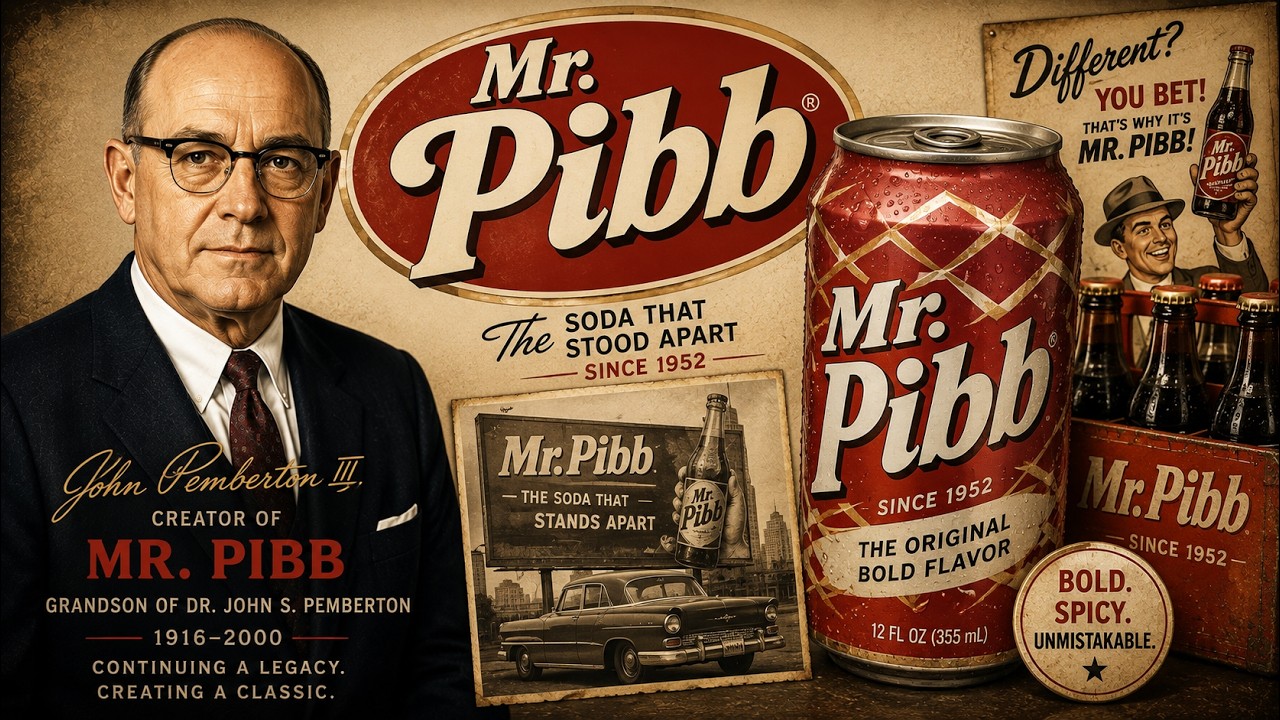
Pepper for good. Half a century later, that wager failed spectacularly. In 2023, Dr. Pepper surpassed Pepsi to become the second most popular soda in the United States.
Coca-Cola’s copy, Mr. Pibb, never came close to displacing the original, and it spent decades living in the shadow of the very drink it was designed to replace. The story begins in Waco in 1885, a year before Coca-Cola was even invented. A young pharmacist named Charles Alderton, working at Morrison’s Old Corner Drugstore, experimented with fruit syrups and created a dark, spiced flavor that customers began requesting by name.
They called it Dr. Pepper. For decades, Dr. Pepper remained a regional southern favorite, but it earned something Coca-Cola could not manufacture: loyalty.
Generations of drinkers passed the habit down, creating a devoted fan base that treated the soda as part of their identity. By the late 1960s, Coca-Cola dominated the American beverage market with the largest distribution network the industry had ever seen. Yet there was one gap in its empire: the pepper-flavored soda slot on fountains across the country, a space Dr. Pepper had invented and owned.
Every Dr. Pepper sold represented money that did not flow back to Atlanta. Coca-Cola decided to close that gap. In early 1972, its food scientists went to work, aiming not to invent but to imitate.
They created a dark, sweet soda with a spiced kick, slightly sharper than Dr. Pepper and missing its softer vanilla note. The first version was named Peppo and launched quietly in Memphis, Tennessee. The name did not survive the year.
The Dr. Pepper company sued Coca-Cola for trademark infringement, arguing the name was too close and the intent too obvious. Coca-Cola responded by tweaking the formula and renaming the product Mr. Pibb, a careful legal maneuver that echoed the original just enough without copying it outright.
Mr. Pibb was then rolled out into Jackson, Mississippi, and Waco, Texas, the birthplace of Dr. Pepper. Coca-Cola put its copy directly on the fountains of the city where the original was born.
The company did not need to out-invent anyone, it simply used its unmatched distribution network to put the drink everywhere at once. The early marketing was aggressive. Mr. Pibb launched with the slogan “Show ’em who’s boss,” aimed at rebellious youth.
The campaign drew sharp criticism from educators and parents, and Coca-Cola dropped it by 1974, barely two years into the product’s existence. In 1980, Coca-Cola reworked the formula and marketed it with the words “New Taste” on the packaging. The drink kept adjusting, but it never found the identity that would make people choose it on purpose. By the 1990s, Mr.
Pibb found its most memorable voice in a series of strange, cartoonish commercials filled with odd creatures and pop culture references aimed at younger viewers. The real strength of Mr. Pibb was never an ad campaign. It was pure distribution.
Coca-Cola placed the drink in movie theaters, fast food counters, gas station fountains, and mall food courts, anywhere the company controlled the machines. The soda became famous for one recurring moment: when a customer reached for Dr. Pepper and found the fountain empty, their hand slid over and Mr. Pibb poured instead.
This created a structural paradox. Mr. Pibb was succeeding at distribution, but every sale of Mr. Pibb was a hand that was not reaching for Coke or Sprite, the brands that actually mattered to the company.
Mr. Pibb existed to deny Dr. Pepper a sale, not to become a beloved product in its own right. It was kept alive just enough to block a rival, but never given the marketing support needed to become a cultural icon.
Dr. Pepper, by contrast, answered to no corporate empire. It had no flagship to protect, so it poured everything it had into being itself. Its “I’m a Pepper” anthem generated genuine pride and identity.
Nobody ever called themselves a Pibb. That distinction, between a product that is merely available and one that is actually loved, proved unbridgeable. In 2001, Coca-Cola changed the formula and renamed the drink Pibb Xtra, pushing harder toward cinnamon and spice. The original Mr.
Pibb vanished from fountains in many parts of the country. The change unsettled the small loyal core of drinkers who had actually grown fond of the original taste. Through the 2010s and into the 2020s, Pibb Xtra faded further. It slipped off fountains and out of coolers, surviving in fewer and fewer places.
Many people who grew up with it assumed it was gone entirely. Then came the turning point. In 2023, Dr. Pepper passed Pepsi to become the second most popular soda in the United States, behind only Coca-Cola itself.
By the following year, Dr. Pepper and Pepsi each held about 8. 3% of the market by volume, with Dr. Pepper edging ahead.
The drink that started at a single drugstore fountain in Waco now stood second in the entire country. Against that backdrop, the 1972 plan looked startlingly unsuccessful. Coca-Cola built a copy, sent it into Waco itself, and backed it with the largest distribution network on the planet. After 50 years, the target of all that effort had not just survived, it had climbed past Pepsi and now trailed only Coke.
The weapon built to win never won. There was no press release marking the failure, no executive admitting defeat. The failure was quietly absorbed into the record. But in October 2025, Coca-Cola brought the old name back.
Pibb Xtra was retired in select markets and rebranded as Mr. Pibb once again, with a nationwide rollout planned for early 2026. This time, the product was repositioned with higher caffeine, between 41 and 54 milligrams per 12-ounce can, roughly 30% more than Pibb Xtra. Coca-Cola was pushing Mr.
Pibb toward the energy drink shelf, chasing a younger buyer with no memory of the 1970s fountain wars. The timing was significant. For years, Coca-Cola had actually handled fountain distribution of Dr. Pepper in parts of the country, an unusual arrangement between corporate rivals.
In 2025, Keurig Dr. Pepper moved to take that distribution back onto its own trucks, leaving a gap in the pepper-flavored slot on some fountains. Coca-Cola reached once more for Mr. Pibb to fill that gap, not because the copy had won, but because the original had chosen to walk away.
Today, vintage Mr. Pibb cans and old fountain signs are traded by collectors who grew up in the era of theater fountains and mall food courts. For them, Mr. Pibb is not a rival to anything.
It is a piece of a specific American childhood, the taste of a Saturday afternoon movie, the drink that filled the cup when the button you wanted was empty. The final detail frames the whole story: Dr. Pepper was invented in 1885, a year before Coca-Cola. The drink Coca-Cola spent 50 years trying to copy and crush was older than Coca-Cola itself.
A copy can imitate a taste, but it cannot inherit a memory.