Lone Star Beer still calls itself the national beer of Texas. The label says Texas, the longneck bottles say Texas, the country songs written in its honor say Texas. But in 2026, the beer inside the can is brewed in Houston at a factory owned by a company headquartered nearly 5,000 miles away in Belgium. Before Houston, it was Fort Worth.
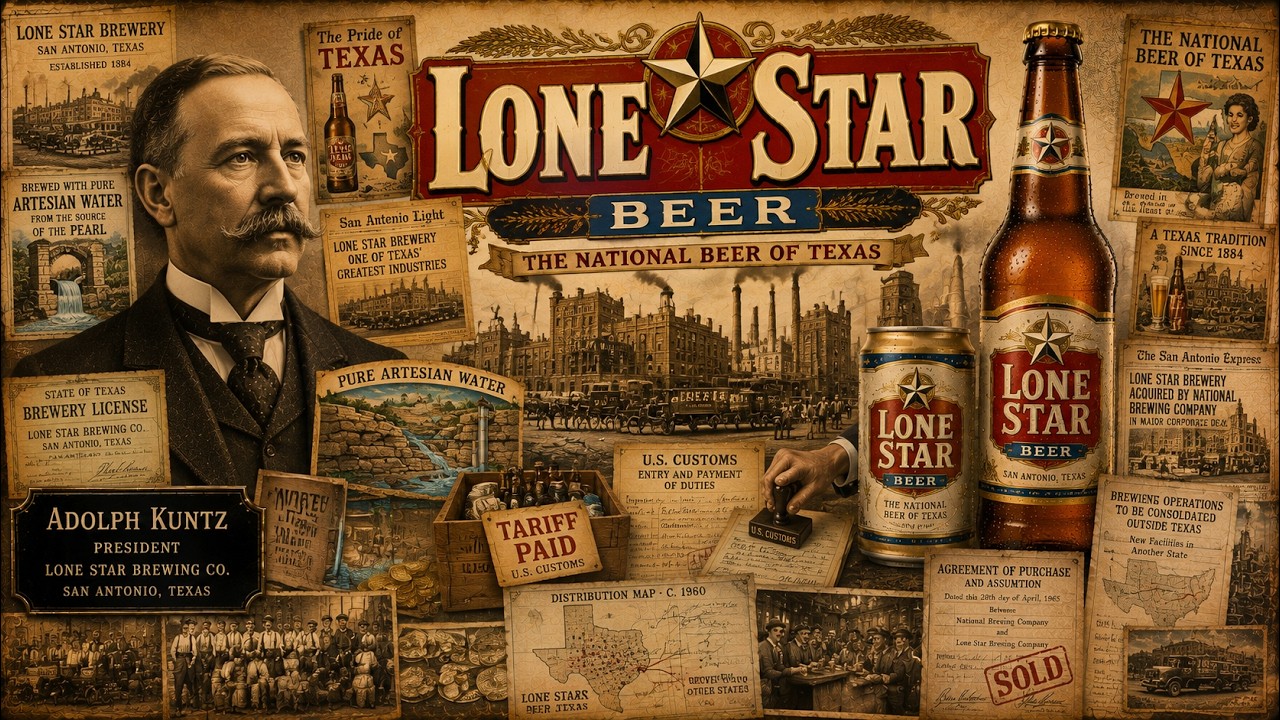
Before Fort Worth, it was Longview. Before any of them, it was San Antonio, until 1996, when the gates closed there for good and Lone Star Beer stopped being made in the city whose name it borrowed its swagger from. The name survived. The company that built it did not.
The real story of Lone Star Beer is not the story of a factory that closed. It is the story of who was allowed to own a piece of Texas identity. Passed from Washington state to Wisconsin to Detroit to a boardroom that never once sat inside the state of Texas, and how many hands a symbol can pass through before it stops belonging to the place it claims to represent. The story begins in San Antonio, Texas, though not exactly when the label wants you to believe.
In 1883, Adolphus Busch from St. Louis walked the banks of the San Antonio River and decided the city needed something it had never seen before. He was already building an empire 600 miles away, but Texas had a problem he recognized instantly: dozens of small breweries, none of them capable of producing at scale. Busch partnered with local businessmen John Kampmann and Edward Hope, and together they built the Lone Star Brewery on Jones Avenue.
It was not a modest operation. It was a fortress with towers, battlements, and parapets, built like something out of a European storybook dropped into the Texas heat. Underneath the theater was real engineering: the first large mechanized brewery the state of Texas had ever seen. By 1903, that brewery was selling 65,000 barrels a year.
By 1904, nine separate buildings stood on the property, including bottling halls, blacksmith shops, stables, and its own railroad spur running straight to the loading docks. The beer it made was not called Lone Star. It was called Alamo Beer. Here is where the story almost ends before it begins.
In 1920, federal agents shut the doors. Prohibition did not just pause the Lone Star Brewery; it killed it. No comeback, no second act. For a while the building housed a cotton mill, then an ice factory, then an auto repair shop.
Decades later, the San Antonio Museum Association bought the property, spent years and millions of dollars restoring it, and turned the old brewhouse into the San Antonio Museum of Art. The name on the first company’s charter, Lone Star Brewing Company of 1884, would eventually be resurrected by an entirely different set of owners on an entirely different piece of land, brewing an entirely different beer. The real beginning was quieter than a castle on a riverbank. After prohibition ended in 1933, a brewer named Karl Heileman relocated his operation, Sabinas Brewing Company, from Sabinas, Mexico, into San Antonio, setting up on a stretch of road that would later be renamed in the beer’s honor, Lone Star Boulevard.
For a few years, the plant brewed under the Sabinas name. Then in 1939, ownership shifted again, and it became Champion Brewing. Champion did not last long either. In 1940, the Muehlebach Brewing Company of Kansas City, Missouri, bought the operation outright, and with it, the rights to a name that had been sitting unused since 1919: Lone Star.
The trademark did not come easily. Company records show a legal fight over who actually had the right to use it. A rival claimant named Drummond pursued the same three words, and it took Muehlebach’s own lawyers to settle the matter in the new owner’s favor. Once the name was secured, a master brewer named Peter Kreil was handed the job of building the formula from scratch: a light, fizzy American lager suited to a state where summer temperatures made anything heavier feel like a punishment.
In April 1940, Lone Star Beer went on sale for the first time in its history. Not in 1884, not under Adolphus Busch, but under a Kansas City brewing company in a plant built by a Mexican-German immigrant brewer on a road that hadn’t existed a decade earlier. The first year’s production came to roughly 39,000 barrels, a fraction of what the old 1884 brewery had once produced in a single season, and a number so small that almost nothing about this new company suggested it would ever be called national anything. By 1949, the company had gone public.
By 1956, it was confident enough in its own future to buy the Buckhorn Saloon outright, cabinets of taxidermy and all, and turn it into a hospitality showcase for visitors. A man named Harry Jersig, a big game hunter and former state wildlife commissioner, would spend the next 27 years at the head of the company, steering it from a 39,000 barrel curiosity into something Texans would eventually treat as a birthright. 39,000 barrels does not build a legend. It barely fills a warehouse.
So the men running Lone Star Brewing Company in the 1940s did not try to out-brew Anheuser-Busch or out-market Pabst. They went where the giants weren’t looking. It was not the big cities that built Lone Star first. It was the gas stations.
It was not the department store shelves of Houston and Dallas that made the beer a household name. It was the ice box behind the counter at a rural filling station, the cooler at a roadside diner two counties from the nearest interstate, the cases stacked in the back room of a feed store where a national distributor would never bother sending a truck. The national brewers were fighting each other for Chicago, for New York, for the big metro accounts. Lone Star let them have it.
Instead, the company built something the giants couldn’t easily copy: a distribution network stitched together county by county, filling station by filling station, across a state so large that reaching its edges was itself a competitive advantage. If you lived far enough from a major Texas city, Lone Star wasn’t the beer you chose. It was often the only beer you could get cold. That strategy paid off in a way that outlasted the men who built it.
By 1949, the company felt secure enough in its footing to take itself public. A company that nine years earlier hadn’t existed was now selling shares to the public on the strength of a beer brewed from a formula less than a decade old. Growth compounded through the 1950s and into the 1960s, as Harry Jersig, the big game hunter turned brewery president, quietly expanded the operation year after year without ever chasing the national spotlight the way Anheuser-Busch or Schlitz did. By the time Jersig’s 27 years at the helm came to an end in 1977, the company he had inherited as a 39,000 barrel curiosity had grown into a 1.
4 million barrel operation. A 35-fold increase built almost entirely on Texas soil without a single national ad campaign to rival the industry’s biggest players. Distribution alone doesn’t explain why Texans stayed loyal once the national brands finally did come looking for their business. That answer came down to price and to a decision Lone Star made early and never really abandoned: stay the affordable option even as competitors leaned harder into premium positioning.
Through the 1950s and ’60s, as Anheuser-Busch and Miller poured money into glossy national advertising campaigns built around prestige, Lone Star kept its identity working-class by design. It was not a beer trying to convince you it belonged at a formal dinner. It was the beer waiting in the cooler after a shift ended, priced to be bought by the case without a second thought. The exact cent-for-cent pricing gap between Lone Star and its national competitors in any given decade isn’t fully documented in the historical record.
But every account of the era agrees on the positioning: Lone Star was the beer a working Texan could afford without hesitation, consistently priced to stay below the national labels stocking the same coolers. Geography told the same story from a different angle. While the company never became a true national brand, and decades later would still draw an estimated 80% of its sales from inside Texas alone, it did push its reach further than a purely regional beer typically manages. At one point, Lone Star’s owners licensed the brand internationally, contracting with Asia Brewery Inc.
to brew and distribute Lone Star beer in the Philippines. The cans stamped with the same “national beer of Texas” slogan even 7,000 miles from San Antonio. It was a strange kind of expansion: not into new American markets, but into a country that had never seen a Texas gas station, buying into a piece of Texas mythology anyway. It was not the biggest brewery in America.
It was not even, by national standards, a particularly large one. But by the mid-1970s, Lone Star had built something harder to replicate than volume: a beer whose identity was inseparable from the state it claimed to represent. That identity was about to become the company’s most valuable asset. And within a matter of years, the very thing outside owners would pay millions of dollars to acquire.
By the early 1970s, Lone Star had a problem most breweries would have killed for. It was popular with the wrong generation. The beer’s loyal drinkers were older, rural, and set in their ways. Exactly the customers a company could count on, but not the ones who’d keep a brand alive for another 50 years.
Texas was changing. Austin was filling up with longhairs, songwriters, and a counterculture that didn’t look anything like the ranch hands and gas station regulars Lone Star had built its business on. The easy assumption inside most corporate boardrooms would have been to write that new crowd off entirely. Lone Star did the opposite.
And the decision that changed everything happened not in a boardroom, but in a parking lot. In 1974, outside the Armadillo World Headquarters, Austin’s ground zero for outlaw country, cosmic cowboys, and a music scene that had no interest in Nashville’s rules, a conversation among Lone Star’s own marketing team turned into a slogan nobody had planned to write: “Long live Longnecks. ”
It wasn’t polished. It wasn’t tested in a focus group.
It came out of a beer garden next to a concert hall, where the same brand was already being poured into paper cups by the thousands, night after night, whether the company was paying attention or not. The company started paying attention. Lone Star leaned directly into the same Austin counterculture that had until then simply adopted the beer on its own. The brand didn’t try to sanitize the association or push it toward a more mainstream audience.
It embraced the very drinkers who looked nothing like Lone Star’s traditional base. And in doing so, it found something no amount of national advertising could buy: authenticity that the beer hadn’t manufactured, only recognized. The music scene did the rest of the work. Willie Nelson, Jerry Jeff Walker, and Waylon Jennings, the architects of the outlaw country movement, became loosely, informally associated with the brand simply by being part of the same rooms, the same tours, the same late nights where Lone Star Longnecks were already the drink of choice.
It wasn’t a paid endorsement deal built in a law office. It was a beer that happened to be standing next to a cultural revolution at exactly the right moment and had the good sense not to get in its way. That single parking lot slogan would end up outliving the decade that produced it, the executives who approved it, and eventually the very ownership structure of the company that coined it. The advertising that followed matched the tone the armadillo crowd had set.
Loud, a little absurd, unmistakably Texan. Lone Star’s marketing team built an entire promotional identity around exaggerated, over-the-top Texas imagery: campaigns featuring giant cartoon armadillos attacking the company’s own delivery trucks, sponsorships of armadillo beauty contests, greased pig catches, cow chip tossing competitions, and watermelon seed spitting contests. None of it was subtle. All of it was deliberate.
This was a brand that understood its customers didn’t want polish. They wanted a beer company that took Texas seriously enough to also make fun of it. The strategy worked because it never contradicted the beer’s original pricing identity. This wasn’t a company suddenly repositioning itself as premium or exclusive to chase a younger, hipper audience.
The same working-class price point that had built Lone Star’s distribution network in the 1940s was still the price point pouring out of paper cups at outlaw country shows in the 1970s. By 1977, one report noted that 20 different singers and musical groups had mentioned Lone Star by name in their songs, a number no marketing department could have manufactured on command, and one that no amount of national ad spending from Anheuser-Busch or Miller had managed to buy for their own brands. Lone Star had become something more durable than a regional best-seller. It had become shorthand for a version of Texas that was self-aware, unpretentious, and loud about both.
That kind of cultural footing doesn’t show up on a balance sheet, but it was about to become the exact reason outside investors, thousands of miles from San Antonio, decided the company was worth buying. Every brewery in this story eventually has to answer the same question: what happens when the giants finally show up in your backyard? For most breweries born before 1920, that test was prohibition. Lone Star never faced that version of the story.
Its national test came later, and it looked less like a single catastrophic law and more like a slow siege. In 1878, Texas had roughly 37 breweries and ranked 28th among all states in beer production. A fragmented, small-scale industry serving local counties and little else. Consolidation crept in for decades, but the real turning point arrived in the 1960s, when the national brewers decided Texas was worth fighting for directly.
In 1966, Anheuser-Busch opened its own plant in Houston. That same year, Miller Brewing bought the Carling Brewing Company, and by 1969, it had built a 9-million-barrel capacity brewery of its own in Fort Worth. A facility so large it would eventually employ more workers than Lone Star’s entire operation ever had. This was not a hostile raid on a single company.
It was the arrival of an entirely different scale of competitor, one capable of building a brewery in Fort Worth solely to flood a state that regional operators had spent generations serving county by county. The industry consolidation that followed was brutal. By 1983, Texas had climbed to become the second-largest beer-producing state in the country. But that production was now concentrated in just six breweries statewide: Anheuser-Busch, Miller, Schlitz, Lone Star, Pearl, and Spoetzl.
37 independent Texas breweries in 1878 had been whittled down to six survivors a century later. The other regional names that had once shared shelf space with Lone Star had either closed, sold out, or been swallowed whole. Lone Star survived not by matching the national brewers dollar for dollar in advertising, and not by expanding beyond its Texas base to chase volume. It survived by doing the opposite: doubling down on precisely the identity the national brands couldn’t replicate.
While Anheuser-Busch built glass and steel efficiency in Houston, and Miller trucked in 9 million barrels a year from Fort Worth, Lone Star kept its price low, kept its distribution rooted in the rural counties the giants still weren’t chasing hard, and let its cultural footing in places like the Armadillo World Headquarters do work no ad budget could buy. It was not a war fought with matching weapons. Lone Star didn’t try to outproduce Anheuser-Busch or outspend Miller. It couldn’t have, not at the scale those companies now operated at inside the state.
What it had instead was something no Fort Worth production line the size of a small city could manufacture: an identity that Texans had already decided was theirs. That was enough to survive the national brewers’ arrival. It would not, however, be enough to survive what came next. Because the very qualities that had carried Lone Star through this test were about to make it an attractive, undervalued target for buyers who had never set foot in Texas at all.
By 1981, Lone Star Brewing Company was producing 1. 5 million barrels a year across its full lineup: Lone Star, Lone Star Light, and Buckhorn, and stood as one of only six breweries still operating in the second-largest beer-producing state in the country. This was the highest point the company would ever reach as an independently Texas-run business. And it arrived at almost the exact moment the company made the decision that would define everything that followed.
In January of 1977, shareholders approved a deal that turned Lone Star Brewing Company into a wholly-owned subsidiary of Olympia Brewing Company, the nation’s seventh largest brewer, headquartered not in Texas but in Olympia, Washington, nearly 2,000 miles from San Antonio. The same month, Harry Jersig stepped down. At the time, nobody framed the sale as a turning point. Newspaper coverage from that January focused almost entirely on reassurance.
Olympia’s own officials went out of their way to promise that nothing about the beer, the branding, or the Texas theatrics would change. One company spokesman, asked directly whether Lone Star would keep sponsoring armadillo beauty contests and chili cook-offs under its new out-of-state owner, didn’t hesitate: “You damn right we are. You bet. ”
That confidence wasn’t wrong, exactly.
The armadillo contest kept going. The longnecks kept selling. Lone Star’s cultural identity survived its first ownership change fully intact, which was precisely the problem nobody had thought to worry about yet. Because the innovation that made Lone Star valuable wasn’t a new formula, a new bottling technology, or a new distribution route.
It was the brand itself. An identity so tightly fused to a specific place that it had become, in the eyes of outside investors, a self-sustaining asset. A company could buy Lone Star Brewing Company without buying San Antonio, without buying Texas, without buying anything except the paperwork. And the beer would keep selling on the strength of a loyalty the new owner had done nothing to earn.
That was the turning invention nobody in 1977 recognized as dangerous. Lone Star had built a brand so powerful it could survive being owned by people who had never been to Texas. And if that was true once, there was no reason it couldn’t be true again. And again.
Within six years, Olympia itself would be gone from the picture, having sold Lone Star to yet another out-of-state buyer. In 1983, Olympia Brewing Company sold Lone Star to the G. Heileman Brewing Company of La Crosse, Wisconsin, a brewer nearly 1,500 miles from San Antonio, and the second out-of-state owner Lone Star had answered to in barely six years. Under Heileman, the numbers held steady for a while.
As late as 1995, the San Antonio plant still employed 230 people, still bottled Lone Star, Lone Star Light, and Buckhorn under one roof on the same ground the brand had occupied since 1933. But steady numbers were no longer the thing deciding Lone Star’s future. Ownership decisions were. In 1996, Heileman itself was absorbed, bought out by the Stroh Brewing Company of Detroit, Michigan.
A fourth city, a fourth state, now claiming a piece of a beer whose entire identity was built on never leaving Texas. Stroh did not inherit a single brewery it needed to protect. It inherited 10. Lone Star’s San Antonio plant was the smallest of them, and by Stroh’s own accounting, one of the least efficient.
A landmark building with towers and history was traded in the ledger against a newer facility three times its size sitting 200 miles away in Longview, Texas. The math wasn’t close. On September 27, 1996, the gates on Mission Road closed for good, and Lone Star beer production shifted entirely to Stroh’s Longview plant. Inside Texas, technically, but a facility with no connection to the brand’s history, run by a company headquartered in Michigan, making a decision that had nothing to do with San Antonio, and everything to do with a spreadsheet comparing capacity to cost.
Stroh itself didn’t last much longer as an independent company. By 1999, its beer brands, Lone Star included, had been split apart and sold off, with Pabst Brewing Company taking ownership of the Lone Star name. And Pabst’s business model made the distance between the brand and its brewer permanent in a way none of the previous sales had. Pabst didn’t own breweries anymore.
It owned labels, recipes, and contracts, and it began paying other companies, primarily Miller Brewing, to physically make the beer on its behalf. There was one brief, almost hopeful reversal in this pattern. In 2000, Lone Star production returned to San Antonio, brewed for a short stretch at the historic Pearl Brewery on the banks of the San Antonio River. It didn’t last.
In February of 2001, Pabst announced the Pearl plant would close more than two years ahead of schedule, laying off 82 workers and ending 115 years of continuous brewing on that site. Lone Star’s return to its own hometown had lasted less than a year. After that, the beer settled into a contract arrangement with Miller’s Fort Worth facility. Later MillerCoors, later still Molson Coors, after a series of corporate mergers, moved the brewery’s ultimate ownership to Colorado and eventually to a Canadian parent company.
For nearly two decades, Lone Star beer was made in Texas, on Texas soil, inside a plant employing hundreds of Texans, while every dollar of profit and every decision about how, when, and whether to keep making it answered to a boardroom outside the state. That arrangement ended, too. In 2025, Pabst, by then fully owned by an investment group led by beverage entrepreneur Eugene Kashper, signed a new contract brewing agreement, moving Lone Star’s production out of Fort Worth and into a Houston facility operated by Anheuser-Busch InBev, the same global company whose founder, more than a century earlier, had built the very first brewery to carry the Lone Star name. The circle wasn’t sentimental.
It was structural. From Olympia to La Crosse to Detroit to a private equity platform contracting a Belgian-owned brewery in Houston, Lone Star beer had spent nearly 50 years being bought, sold, and subcontracted by owners who shared exactly one thing in common: none of them were from Texas. The beer had never technically left the state. The people deciding its fate had left almost immediately and never really came back.
On September 27, 1996, the gates on Mission Road closed for the last time. There was no ceremony, no press conference marking 56 years of continuous brewing on that ground. Just a company memo, a two-month phase-out period, and 230 employees finding out that the plant where they’d spent their careers had lost a math problem to a bigger, cheaper facility 200 miles away in Longview. Of those 230 workers, 170 lost their jobs outright.
A Stroh Brewing Company spokesman delivering the news made a point of saying the decision in no way reflected on the work of the employees, that the men and women on the floor had, in his words, “worked diligently to keep producing high-quality beer right up until the end. ”
It was true. It also changed nothing. 20 to 25 workers were old enough to retire.
A handful of salaried staff found positions at other Stroh plants scattered across the country. The rest were given severance packages and sent home. The company was careful to note what would survive. The Buckhorn Saloon and Museum, occupying nearly a third of the 32-acre site and drawing roughly 850,000 visitors a year, would stay open.
Its 25 employees were kept on. A small sales office of seven people would remain in San Antonio, too. It was framed as good news. It was also unmistakably a smaller footprint than the one the plant had carried a decade earlier.
A brewery reduced to a gift shop and a mailing address. Lone Star Brewery had been the smallest of 10 breweries in Stroh’s national portfolio. Too small. Too inefficient.
Not worth the cost of keeping open. The gates closed. The armadillo statue stayed behind. The beer kept its name.
Today Lone Star beer is not discontinued. It is not a forgotten label gathering dust in a museum case. It is still on shelves across Texas, still sold in seven other states, still stamped with the words “National Beer of Texas” on every can. By any legal or commercial measure, the brand is alive.
But it is alive in the way a name can outlive the place that made it. Pabst Brewing Company, which has owned Lone Star since 1999, doesn’t operate a single brewery of its own. It owns labels, formulas, and contracts. And as of 2025, the actual liquid inside every can of Lone Star is brewed at a Houston facility run by Anheuser-Busch InBev, a company headquartered in Belgium.
The beer carries a Texas flag on its packaging and a foreign parent company’s fingerprints on its production schedule. What the corporation cannot buy, sell, or contract out is the ground where the story actually happened. And San Antonio has held on to pieces of it, even as the brewing itself moved on. The old 1884 brewery on Jones Avenue, the castle-like building Adolphus Busch commissioned before prohibition ever shut it down, still stands.
After decades as a cotton mill, an ice factory, and a storage unit, it was purchased by the San Antonio Museum Association, restored, and reopened in 1981 as the San Antonio Museum of Art. A building where visitors now walk past centuries of paintings inside walls originally built to hold beer vats. The Mission Road site, the one that actually closed in 1996, tells a messier story. For nearly three decades, the 32-acre property sat mostly abandoned.
Its buildings tagged with graffiti, its towers stripped of purpose, its future stuck behind at least three separate redevelopment attempts that collapsed under the weight of cost overruns, bankruptcies, and environmental cleanup requirements. It is only in recent years that a serious plan has taken hold. Architecture firm Lake Flato has drawn up a master plan to transform the site into a mixed-use development: offices, housing, public space built around and inside the historic brewery buildings, rather than erasing them. San Antonio has seen this pattern before.
The Pearl Brewery just a few miles away went through its own closure and eventual reinvention as one of the city’s most successful redevelopment projects. Lone Star’s Mission Road complex is now attempting the same second act decades behind schedule. And the Buckhorn Saloon and Museum, the collection of taxidermy, curiosities, and Texas kitsch that Lone Star bought back in 1956, is still open today, relocated from the brewery grounds to a spot near the Alamo in downtown San Antonio. It remains one of the city’s enduring tourist attractions, a living link to a company that in every practical sense no longer exists in the form that built it.
Even the small rituals survived the ownership changes. Since 2001, Lone Star has printed riddles under its bottle caps. 413 of them in rotation, cartoon puzzles spelling out phrases for anyone patient enough to collect them all. It’s a tradition inherited from parent company Pabst, kept alive through every contract brewing switch, every change of address, every boardroom a thousand miles from Texas that decided the beer’s fate.
That is the real thesis of Lone Star’s afterlife. A corporation can buy the name, it can buy the recipe, the trademark, the right to print “National Beer of Texas” on a can brewed in Houston under a Belgian parent company. What it cannot buy is the museum built from a Texas hunter’s personal collection, the riverfront brewery turned into an art gallery, or the vacant lot on Mission Road that San Antonio has spent 30 years trying to bring back to life. Those belong to the place.
Everything else has simply been passed along. Step back far enough, and Lone Star beer stops looking like an unusual story. It starts looking like the normal one. This was never really a story about a beer that was too Texan to survive or a product that lost to something better.
Lone Star didn’t fail the way some brands failed: out-competed on taste, buried by a smarter rival, killed by a single bad decision at the top. Lone Star won almost every fight that was actually about beer. It out-positioned the national brands in the rural counties they ignored. It found a price point working Texans never had to think twice about.
It built a cultural identity so authentic that outlaw country musicians adopted it without being paid to. By every measure that should matter, Lone Star beer succeeded at being exactly what it set out to be. What it never controlled was who got to own that success once it existed. The real story of Lone Star was never a war lost or a factory closed.
It was the story of who was allowed to hold a piece of Texas identity, and how far that identity could travel through boardrooms in Washington, Wisconsin, Michigan, and eventually a private equity platform contracting a Belgian-owned brewery in Houston before something of the original place inside it started to thin out. The product was rarely the problem. The capital was. A beer built by a small operation on a Texas road in 1940 didn’t need a better recipe to survive the next 80 years.
It needed an owner willing to keep deciding, year after year, that San Antonio was worth staying in. No single owner ever made that promise. Each one made a stronger promise to somewhere else.
To a spreadsheet in Detroit, to a shareholder in Wisconsin, to a contract that made more sense in Houston than in the city whose name was still printed on every can.