In October 1887, a 38-year-old telegraph operator named Vernon Caulfield was sent into the Ozark Mountains of Arkansas to repair a disrupted telegraph line in a remote area called Harrow Valley. His supervisor in Little Rock had ordered him to investigate the signal failure, authorize supplies, and report daily if possible. Before leaving the small settlement of Thorngrove, Caulfield was warned by the local station operator that the valley was avoided by hunters and that an entire mining settlement there had been abandoned before the Civil War. Residents had reportedly left everything behind, and locals claimed the forest went silent near the valley.
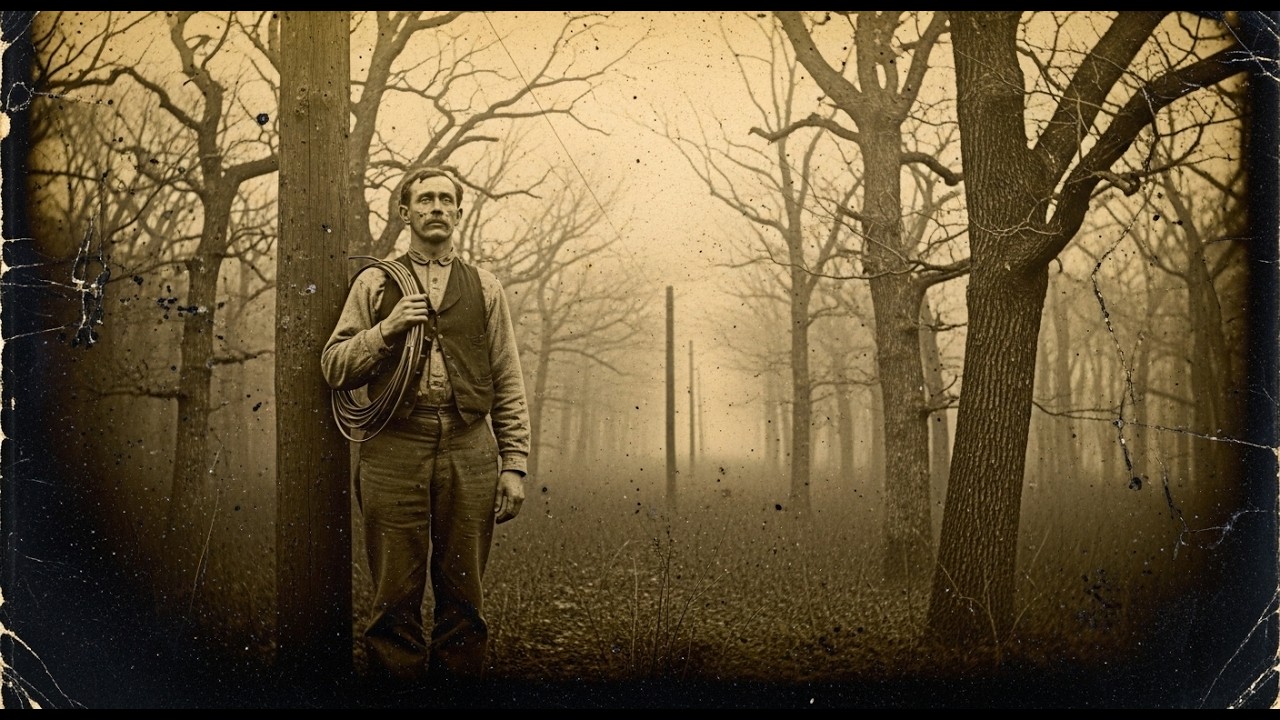
Caulfield packed his gear, loaded his horse Bess, and rode out. On the second day, he noticed the forest had become unnaturally quiet. Bess grew agitated and refused to continue when they reached a ridge overlooking the valley. The valley floor was covered in gray vegetation and thick, motionless mist, and the temperature dropped sharply as he descended on foot.
Arriving at the valley floor, Caulfield found the telegraph wire had been cut cleanly at pole after pole, not frayed or broken by weather. He soon encountered a seemingly abandoned town that did not appear on any map. Buildings stood intact, with furniture inside, tables set for uneaten meals, and laundry still hanging on lines. Inside what appeared to be a hotel, Caulfield found the floors covered with books.
Every book was blank. On the walls, he reported seeing handprints with too many fingers and digits of inconsistent number, all pointing toward the staircase. He then heard slow footsteps moving back and forth on the second floor, at a rhythm slightly off from human walking. Caulfield ran from the building and out of the town.
When he looked back, the town had vanished into the mist, as if it had never existed. He spent the night against a telegraph pole, watching shapes move in the mist around him, which he described as human-sized but with wrong, unnatural movement. He fired his rifle at one shape, but the shot was swallowed with no apparent effect. At dawn, he escaped the valley and rode back to Thorngrove, arriving after four days looking haggard.
He reported the line could not be repaired and should be permanently abandoned, then requested reassignment. He sold his horse, left town by train, and settled in St. Louis, where he worked as a telegraph operator and never spoke openly of what he had found. While still in Thorngrove, Caulfield searched local records and found a survey from 1862 that described the valley as the site of a settlement of an estimated 83 people, abandoned in autumn 1861, cause unknown, with the area considered dangerous.
He also found an 1857 journal entry from a circuit preacher who reported that locals considered the valley cursed and that a hunter had seen shapes moving in the mist that looked human but were not. Caulfield then discovered a letter dated 1883 from a J. Mordecai, identified as Chief Engineer for the Department of the Interior, to Colonel Ashford Thorne of the War Department. The letter discussed containment measures at a site referred to as “Site Seven,” or Harrow Valley, including the construction of structures intended to attract and centralize anomalous entities and the installation of a telegraph-based warning system.
The letter recommended the site be classified and civilian access prevented. In 1902, fifteen years after his experience, Caulfield received an unsigned telegram in St. Louis, sent from a station in Little Rock, containing only the words: “The wire has gone silent again. ” He burned the message, then began following Arkansas news for reports of disappearances and unusual occurrences, but found nothing that could be definitively connected to the valley.
Caulfield died in 1923 at age 74 in his room at a boardinghouse. The doctor recorded heart failure, but those who found him said his face was twisted in terror and his eyes were open, staring at something no one else could see. Among his belongings, the boardinghouse owner found maps of the Ozarks with the Harrow Valley circled in red and pages of notes containing descriptions and warnings. She burned them, believing they were the confused scribbles of an old man.
According to the report, in 1938 the federal government purchased the entire region under the auspices of the National Park Service and declared it a protected wilderness permanently closed to public access, officially for conservation. The account goes on to reference classified reports from park rangers stationed at the boundary, describing unexplained signal disruptions, wildlife avoiding entire sections of forest, and mist that moves against the wind. A memo from 1987, exactly one hundred years after Caulfield’s visit, reportedly recommended expanding the exclusion zone and increasing surveillance, without explaining what necessitated the measures.
The source also notes a missing hikers’ narrative and unverified claims of an undocumented government classification history, framed as local legend rather than confirmed record.