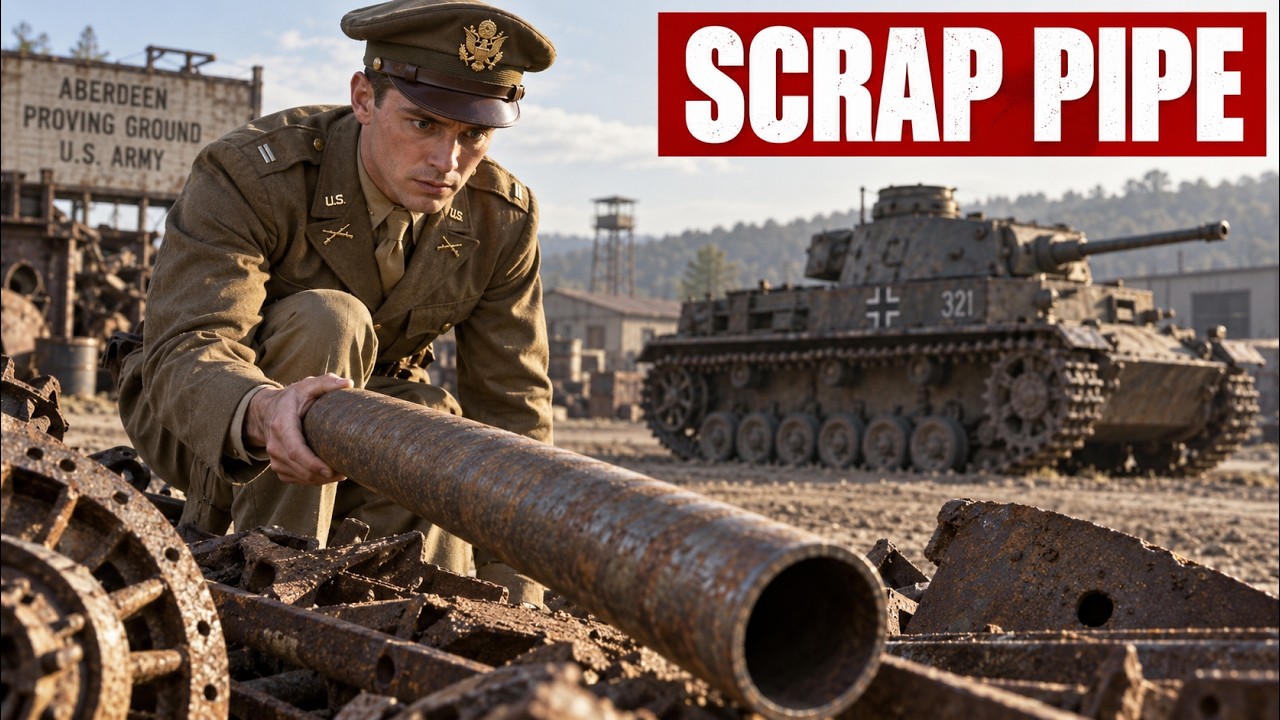
In the spring of 1942, at the Aberdeen Proving Ground in Maryland, a young lieutenant named Edward Uhl stopped beside a scrap pile and picked up a piece of steel tubing. For two years, the U. S. Army had failed to solve a problem that was costing infantrymen their lives: how to give an American foot soldier a fair chance against a German tank.
The solution’s two halves already existed. One was a shaped-charge warhead capable of penetrating the frontal armor of any German tank then in service. The other was the engineering plan for a recoilless launcher first fired at Aberdeen in 1918. Both had been signed, filed, and stored.
No one had put them together. The science behind the answer dated to the 1880s, when American physicist Charles Munro observed that a hollow cone in the face of an explosive charge focused the blast inward. Lined with metal, that cone would collapse and shoot forward as a jet of metal traveling at kilometers per second. It did not burn through armor.
It punched through steel faster than the plate could respond. A Swiss engineer named Henry Mohaupt built his own version and spent two years trying to sell it. The Swiss army rejected it in 1938 because it did not fit their expectations of how a tank-killing weapon should work. The British saw a demonstration in Zurich in 1939, suspected the effect matched their own research, balked at the licensing fee, and built their own version.
The Americans had earlier dismissed a similar proposal from inventor Neville Monroe Hopkins. Mohaupt eventually worked for the French arms firm Edgar Brandt. As France collapsed in 1940, the government allowed his information to reach Washington, drawings included. Tests at Aberdeen followed.
By 1941, America had the technology: the M10 anti-tank grenade, with Mohaupt’s warhead inside. At three and a half pounds, it could destroy any German tank in service, from any angle. The United States had the best infantry anti-armor weapon in the Western world—and no way to deliver it. A hand grenade weighed about a pound and a half; a strong man could throw it 40 yards.
The M10 was more than twice that weight and had to hit nose-first. Hand-throwing was impossible. Firing it from a rifle broke the rifle and the shooter’s shoulder. So the Ordnance Department did the only thing left: they made the warhead worse.
The M9 version was deliberately smaller and weaker, sized down so a rifle could launch it. The M10, the good one, was officially meant to be placed by hand on the hull of a moving tank. Army histories later called this an unlikely method of delivery in most combat situations. An obscure footnote to Mohaupt’s role: he came to America and stayed, working in Washington for the Navy, but remained a Swiss citizen.
That citizenship reportedly blocked the security clearance he needed to work on secret American weapons. The man who held the Allies’ shaped-charge patents spent most of the war outside the weapons he helped create. The link was finally made by a lawyer. Colonel Gregory J.
Kessenich, assigned to the Ordnance Department’s patent section in summer 1941, was reading about the M10 program when an idea occurred to him. Put the M10 warhead on a rocket, and both problems disappear at once: the rocket removes the recoil, and the warhead gives the rocket something worth carrying. Kessenich brought the idea to Colonel Wiley T. Moore, who assigned the work to a captain who had spent the previous decade running the Army’s rocket research program from a basement, in his own time and at his own expense—Leslie Alfred Skinner.
Skinner was born in San Francisco in April 1900, the only son of an Army surgeon. He had been trying to interest the U. S. Army in rockets since he was 15.
He was court-martialed after setting fire to a hospital roof at Fort Strong in 1915 with his own experiment. He briefly studied medicine at Harvard, then transferred to West Point, graduating in 1924. In 1932, he was assigned to Aberdeen, where he began experimenting with solid-fuel rockets. Army records noted quietly that his work was the only rocket research in the entire U.
S. armed forces at the time. He built engines in his own time, from discarded materials and whatever the proving ground was throwing away. In 1933, the army formalized the arrangement by creating a one-man rocket unit and assigning him to it.
The official Army history of wartime ordnance planning summarized his position in two phrases worth repeating in full: “Limited funding and the indifference of fellow officers. ”
In December 1940, Skinner submitted drawings for a tube-launched anti-tank rocket. He was told there was no warhead worth launching from it. In June 1941, the American rocket program doubled in size—from one man to two.
The newcomer was Second Lieutenant Edward G. Uhl, born in 1918 in Elizabeth, New Jersey, an engineering graduate of Lehigh University. Assigned to the Ordnance Corps in 1941, Uhl arrived at Aberdeen with a strong background in physics and mechanics. The two men began working with Navy jet-propulsion specialists, the National Defense Research Committee, and Bell Laboratories.
Equipment was primitive and mostly hand-made. Skinner was still building experimental engines in his basement. By spring 1942, Uhl had a working rocket motor and a working warhead, and two questions nobody had officially asked anyone: how would a man aim this weapon, and how would he avoid being burned by the exhaust? There was a scrap pile at Aberdeen, the kind found at every large military installation.
Uhl had gotten into the habit of searching it first whenever he needed a metal part. Lying there that spring was a steel tube about five feet long, with an inner diameter of 60 millimeters—the same caliber as the projectile he and Skinner were turning into a rocket. Uhl told the story for the rest of his life, and it always ended the same way. He looked at it and thought: “This is the answer.
” Put it on a soldier’s shoulder, put a rocket inside, and it would fly away. The tube did more than one job. It directed the exhaust, sending the flame straight back through a channel behind the soldier instead of beside his face. It provided guidance; a rocket leaving an open rail goes roughly where it pleases, but a rocket leaving five feet of closed steel goes where that steel is pointed.
It gave the soldier something to mount a sight on. And it solved the fourth problem, the one almost nobody mentions. The rocket motor burned for about 1/50 of a second. That was not a metaphor; it was the design specification.
In that 1/50 of a second, the rocket traveled a calculable distance—roughly 54 inches. Cut the tube at 54 inches, and the burn finishes before the projectile leaves the muzzle. By the time the rocket left the front of the tube, combustion had stopped. The man behind it was holding a piece of warm steel instead of standing in front of a flame.
The Frankford Arsenal built a launcher from Skinner’s drawings and Uhl’s raw tube. It was designated the T1: 54 inches of thin steel, the length determined by the burn time of experimental rockets; a wooden handle below; an electric trigger; two battery compartments in the grip, one charged and one spare; and a small bulb on the side so the operator could check the firing circuit. Total weight: 13 pounds. It required a two-man crew.
One man loaded the rocket from the rear and connected a wire hanging from the tail; the other aimed and pulled the trigger to send current to the igniter. The first actual firing occurred at a National Defense Research Committee test site the day before a scheduled demonstration at Aberdeen. Uhl fired it from his shoulder wearing a welder’s helmet because premature explosions had been observed in earlier tests. He braced for a blast that never came—the exhaust was so mild that the protective gear was unnecessary.
Aberdeen, the next morning. A 54-inch steel tube, a wooden handle, no sight. Uhl improvised one from a wire coat hanger and a piece of nail he found on the ground. The test was a competitive comparison with five different mortars, considered at the time the most promising way to launch a shaped charge.
All five mortars were fired. None hit the moving tank in the field. The tube hit it. Then it hit it again.
The senior officer present was Major General Glatthon M. Barnes, chief of the Ordnance Department’s research and engineering division. Barnes took the launcher himself and hit the tank on his first attempt. Visiting officers soon fired every available rocket.
A colonel whose name Skinner did not record looked at the five-foot piece of plumbing with its wooden handle and said it looked like Bob Burns’s “bazooka. ”
Around 1903, in the back of a plumbing shop in Van Buren, Arkansas, a 13-year-old boy named Rubin Burns picked up a piece of gas pipe and blew into it. The sound reminded listeners of a wounded moose, but he liked it. He turned that noise into a musical instrument: two tubes sliding over each other like a trombone, with a whiskey funnel as a bell.
He called it a bazooka, registered the name as a trademark in 1920, and grew up to be Bob Burns, one of the most famous voices on American radio in the 1930s. Forty years apart, two Americans picked up plumbing pipe and made something nobody had asked for. One was 13 and wanted to tell a joke. The other was in his early 20s and wanted a way to stop a tank.
The joke gave the weapon its name. Days after the Aberdeen test came the real demonstration: an official showing at Camp Sims in the District of Columbia. The audience included senior War and Navy Department officials, representatives of allied governments, and the National Defense Research Committee. Live warheads were fired against a medium tank.
The room emptied in a scramble. British observers began negotiating for samples on the spot. Russian staff officers present asked to be supplied immediately, despite the fact that development was clearly still underway. General George C.
Marshall, Chief of Staff of the U. S. Army, gave oral orders for 5,000 launchers, 25,000 anti-tank rockets, and 5,000 practice rockets. On May 19, 1942, a contract was signed with General Electric.
Edward G. Budd Manufacturing would build the rockets; the metal-stamping division of Philco would produce components. General Electric was given 30 days to design the prototype, set up tooling, test, and deliver the entire initial order. They did it.
The batch was ready on June 24, 1942, the full order finished 89 minutes ahead of schedule. The weapon was formally adopted as the 2. 36-inch rocket launcher M1 and first issued on June 14, 1942. Later General Electric contracts would eventually exceed 450,000 units.
It took less than two months to go from a scrap pile to a signed federal contract. What was not done was a training program: no school, no doctrine, no manual worth mentioning, not a single qualified instructor. The crates were on their way to ships, and someone put printed instruction sheets inside because that was the training program. In September 1942, a ship docked at Suez carrying 600 new launchers under the code name “Whip.
” British ordnance officers looked at them, placed one against the frontal armor of a captured Panzer III, and the rocket penetrated the armor directly. Then they refused to use it. Their reasoning was not foolish: a weapon that forced its user to close to under 150 yards was useless in a desert where visibility stretched for ten miles. The 600 pieces sat parked.
Then came November 8, 1942, Operation Torch, the American landings in North Africa. General Dwight Eisenhower was informed the night before that no soldier in his command had received any training on the new weapon. Historian Rick Atkinson described what the troops found: crates of strange, open-ended 54-inch tubes and 3-pound projectiles sent with printed instructions because nobody in the force had ever heard of the thing. Officers sat in the ship’s hold reading the papers aloud to each other, then went on deck and read them aloud to their men.
What followed was not success but chaos. The M6 rocket proved notoriously unreliable. Its battery firing circuit was fragile and damaged by rough handling—by being carried, essentially. Motors failed in heat, humidity, and salty air.
The sharply pointed nose was wrong: at a shallow impact angle, it slid off sloped armor instead of biting in. The long fins bent during transport. During 1943, reports reached depots of rockets jamming in the launch tube and exploding there in the operator’s hands. Aberdeen tried reinforcing the thin sheet metal with collars and wrapped wire.
Problems persisted until someone built bore gauges to verify each rocket would clear the tube. The field verdict was the worst possible. Major General Jacob Devers toured the Tunisian front in spring 1943 looking for evidence. He could not find a single soldier who told him the weapon had stopped a tank—not one.
In May 1943, further issue was suspended. Ten months after Marshall’s order for 5,000 units, the army stopped distributing them. The Soviets reached the same conclusion independently. About 3,000 launchers and 8,500 rockets were sent east under Lend-Lease.
Soviet testing was ruthless: penetration was 50 to 55 millimeters, about a third below American specifications; accuracy fell off completely beyond 50 meters; the flame and smoke revealed the operator’s position instantly; the propellant burned unevenly in cold weather. The Soviets rejected further shipments and kept their own 14. 5mm anti-tank rifles. Then the angle of view changed.
While American officers read disappointing reports, German soldiers were picking these weapons up off the ground—some from Soviet units in late 1942, some from inexperienced American units in Tunisia in early 1943. Germany now had working examples of this weapon. They gave captured launchers their own catalog designation: 6-cm Raketenpanzerbüchse 788A. Then German engineers did something that should have troubled the Americans.
Germany already had an excellent 88mm shaped-charge rocket, fired from a wheeled launcher called the Raketenwerfer 43, nicknamed “Püppchen,” which operated like a light artillery piece. Real power and good range, but useless for the one purpose the American weapon had been designed for: giving a dismounted soldier a weapon where the guns did not reach. The Germans combined the captured concept with their own warhead. They kept the 88mm caliber, so the warhead needed no redesign.
They lengthened the motor housing to fit a larger motor. They replaced impact ignition with electrical, borrowing from the Americans—then improved it with a magnet compressed by the trigger. The Americans later made exactly the same change on their own weapon. A German report dated September 9, 1943, said the new launcher would reach Eastern Front troops soon.
In November 1943, the name entered official documents: Panzerschreck, “terror of tanks. ”
The numbers were brutal. The Püppchen penetrated 64 millimeters of armor at 100 meters. The new shoulder-fired launcher penetrated 160 millimeters at the same distance.
Manufacturing cost: 70 Reichsmarks. Total production: 314,895 units. The Germans copied the tube, but not the measurements. The larger motor burned longer; the rocket was still burning for about two meters past the muzzle, behind the soldier’s shoulder.
They mounted a blast shield at the front of the tube with the rear sight built in, and the manual instructed the operator to wear heavy gloves, a protective coat, and a gas mask with the filter removed. A gas mask to fire your own weapon. The final weapon was 164 centimeters long, weighed over 20 pounds with the shield, and put out smoke that revealed the position for a mile. Crews nicknamed it Ofenrohr, “stovepipe.
” German engineering understood the American design as armor—and it was armor, but only because it was the right length. Repairs began on the American side. In July 1943 came the M1A1: the front grip was removed, the electrical system improved, old launchers upgraded to the new standard. The improved M6A1 rocket followed.
In October 1943 came the M6A3 with a rounded, blunt nose that embedded in sloped armor instead of sliding off, and a short circular tail fin that would not bend inside a supply truck. The M9 launcher followed with a proper sight opening, battery ignition replaced by a trigger-actuated magnet, and a safety that prevented firing when the trigger was released. In June 1944 came the M9A1, which split in two so a paratrooper could jump with it. In September 1944, a Polaroid optical sight with an etched reticle replaced the folding sight that kept breaking.
Fourteen months of grinding, unglamorous engineering. Nobody won a medal for a tail fin. In October 1944, after reading field complaints and examining captured German launchers, Ordnance began development of a 3. 5-inch replacement.
That decision would matter greatly five years later, to men who had never heard of any of these people. By the third week of December 1944, all that patient repair work was done. The sights worked. The fuses worked.
The fins did not bend. In two Belgian villages in the snow, the weapon was about to face its only real test. Krinkelt and Rocherath were so close together that locals called them the twins. On December 17 and 18, 1944, the first two days of Adolf Hitler’s last offensive in the west, they held the northern shoulder of what Americans would call the Battle of the Bulge.
Outside them, at a crossroads called Losheimergraben, men of the 2nd and 99th Infantry Divisions stood in the snow waiting for the 12th SS Panzer Division. Sherman tanks fought there, as did M10 tank destroyers, artillery, mines, and riflemen holding ground they were not supposed to hold. But when the reckoning was done, postwar reports credited the infantry rocket teams with destroying about 21 German armored vehicles, with another 27 credited to guns and mines. Together, enough to disrupt the timetable of the SS Panzer Corps and force a change of plans on the northern flank of the offensive.
Twenty-one vehicles destroyed by infantrymen on foot in the snow, 20 months after a general toured the Tunisian front asking whether this weapon had ever stopped a tank, and returned home without an answer. The campaign-wide math is sobering. During the Northwest Europe campaign, American forces fired approximately 1,300,000 of these rockets. Those are not the statistics of a weapon held in reserve for a specific target; they are the statistics of a weapon a soldier reached for constantly—against bunkers, fortifications, houses, machine-gun positions, anything that needed a hole.
Against tanks specifically, the numbers are more modest. The theoretical effective range was 300 yards. The average range at which an American soldier successfully engaged an enemy tank was 55 yards. In a letter dated May 20, 1944, General George Patton downplayed it further, telling a colleague the weapon was not meant for tank hunting at all.
Its purpose was to keep armor away from the infantry as a last resort, and he wrote that the practical range should be limited to about 30 yards. Close enough to read the lettering on the tank’s hull. Close enough that an open-hatch tank commander could see the shape of the man aiming at him. The engineering required a man to move toward the thing he was trying to kill until he was close enough to be sure.
More than a dozen Americans received the Medal of Honor for actions involving this weapon—a few in the Pacific, one in Italy, most in Europe, with three in the Ardennes. One of them was a boy from Berlin. Isidor Siegfried Jackman was born in Berlin on December 14, 1922, the eldest son of Leo and Lotte Jackman. The family emigrated to America when he was two.
He grew up on Primrose Street in Baltimore, where his father ran a delivery route for the Baltimore Sun. He finished City College in 1939 and spent a year studying physical education at the University of Baltimore. Friends called him Izzy. He was Jewish.
Six of his aunts and uncles died in the Holocaust. On January 4, 1945, Sergeant Jackman was with Company B, 513th Parachute Infantry Regiment, 17th Airborne Division, in Flamierge, Belgium. His company was pinned down under artillery, mortar, and small-arms fire. Two German tanks advanced and began inflicting casualties.
Machine-gun fire had already wiped out the company’s rocket teams. Jackman left his covered position, ran across open ground under fire, reached a fallen soldier, took his launcher, and advanced toward the tanks. Both tanks swung their guns on him. Firing alone, he damaged one and forced both to withdraw.
The German attack broke apart. He was wounded in the process. He died of his wounds. He was 22 years old.
Years later, the town of Flamierge erected a memorial to an American soldier who had stood and fought there. They did not know his identity. Research in army records confirmed it was Jackman, and his name was added to the stone. A boy born in Berlin, whose family fled and whose relatives were killed in his country of birth, walking toward German tanks with a piece of steel pulled from a scrap pile by an American engineer at a Maryland base—and a Belgian village erecting a memorial to a man they had to research to name.
After the war, General Dwight Eisenhower identified four tools he said won the war for the Allies: the atomic bomb, the jeep, the C-47 transport, and this weapon. The postwar Army evaluation gave it a distinction no other American design achieved: the only truly new weapon to reach the battlefield early enough to be used everywhere. Three of the items on Eisenhower’s list were massive industrial projects, employing hundreds of thousands of workers and consuming a large share of the national economy. One had begun as garbage.
The final scale was almost unbelievable: 476,628 launchers of all models, and 15,603,000 rockets. Free French forces received about 11,350. Brazil, 2,876. China, 2,018.
Canada, 177. More went to the French Resistance and the Yugoslav partisans—men fighting in the forests with a design made possible by a surplus piece of pipe—and then the tracking stopped. After 1945, budget cuts driven by Secretary of Defense Louis Johnson effectively canceled general distribution of the 3. 5-inch launcher that Ordnance had begun designing in October 1944.
It existed. It worked. But it was not distributed. So units sent to Korea in summer 1950 carried the 2.
36-inch launcher and warehouse stocks of wartime rockets that had sat in storage for five years. July 5, 1950, a hill overlooking the road between Osan and Suwon. Lieutenant Colonel Charles B. Smith led about 540 infantrymen; two of his four companies were still at sea.
At 8:16 that morning, the first American artillery round of the Korean War was fired. A flow of 33 Soviet-made T-34 tanks with 85mm guns followed. One gunner in a ditch beside the road fired 22 rounds at the rear of those tanks, where armor is thinnest, from about 15 yards. The official Army history recorded the result plainly: “It is doubtful that it had any effect.
” One North Korean tank took 22 hits on its sides and rear from 10 meters and kept going. Three days later, on July 8, 1950, Colonel Robert R. Martin, commander of the 34th Infantry Regiment, was killed while using a 2. 36-inch launcher himself to try to stop the incoming tanks.
Then ammunition reports explained part of it. The old warheads were failing to explode. The cause was traced to five years of exposure to humid, salty air. They had rotted in their crates.
The Army flew 3. 5-inch launchers in from the mainland. They reached the battlefield at Taejon on July 20, 1950, and that day destroyed North Korean tanks in the city streets. By the time the Pusan Perimeter was secured, there were over 900 launchers in the theater.
Fifteen days from Osan to Taejon—that was how fast the weapon moved once someone started measuring its effectiveness again. In 1944, the weapon worked because inspections never stopped. In 1950, it failed because nobody had inspected it for five years. Measuring was not a one-time event; it was a habit, and habits can be defunded.
The scrap pile did not give America the bazooka. What gave America the bazooka was a program small enough that the two men handling the tube were the same two men who had built the rocket motor themselves and knew exactly how long its flame lasted. That is the answer to the question posed at the start. Two of the hardest problems of infantry war—penetration and delivery—had been solved by other people in other countries years before that morning at Aberdeen.
What had not been solved was the connection between them. That connection was made by a lawyer reading paperwork, and carried out by a captain who had spent a decade on his own dime, and a fresh Lehigh graduate working with both hands in a laboratory that could be doubled in size by hiring one man. Edward G. Uhl left the Army as a lieutenant colonel in 1947.
He worked in rocketry at Glenn L. Martin, became head of Fairchild in 1961, and retired as its chairman in 1985. Among the aircraft built during his tenure was the A-10, designed from front to back around a gun dedicated to killing tanks. The man who gave the infantryman a way to kill armor spent his second career giving that job to pilots.
Late in life, he summed up the whole story. American institutions, he said, had fallen into the bad habit of massing people on projects, trapped in the belief that a thousand incompetent people, properly organized, could do the work of a few dozen competent ones. He said this as the retired chairman of a major defense company. He had earned the standing, and he had every business reason not to say it.
That morning at Aberdeen in May 1942 remains the clearest summary of what happened. Five funded, scheduled, approved weapons missed a moving tank. Two men on nobody’s list—with a piece of pipe, a wooden handle, and a sight made that morning from a wire coat hanger and a broken nail found in the dirt—hit the target. The tube did not win the war alone.
It was one of the tools that did, and its story is the smallest because it happened on a scale small enough that one lieutenant’s afternoon became important. That is the historical fact. The country’s best anti-tank weapon of World War II was the product of two men and their habit of measuring. When that habit ended after five years, the weapon ended with it.
When the habit resumed, tanks burned within two weeks.