The sun had barely cleared the horizon on the morning of April 9, 1865, when the last desperate gamble of the Army of Northern Virginia collapsed in the fields outside a quiet crossroads village. The sound of cannon fire that had echoed through the Virginia countryside for days fell eerily silent, replaced by the somber murmur of thousands of starving, exhausted men who knew the end had finally come. General Robert E.
Lee, the man who had become the living embodiment of the Confederate cause, faced a choice that would define his legacy forever, a choice that history books have often reduced to a simple footnote of military defeat, but which was in reality a maelstrom of personal anguish, strategic blindness, and a desperate fight for dignity in the face of absolute ruin.
 The road to this moment of surrender was not a straight line of inevitable collapse, but a harrowing path paved with miscalculations and a stubborn refusal to accept reality. In the weeks leading up to that fateful day, the Confederacy was not just losing a war; it was disintegrating from within. The fall of Richmond on April 3rd had sent shockwaves through the Southern psyche, shattering the illusion that the capital could be held at all costs.
Lee’s army, the pride of the South, was no longer a cohesive fighting force but a ragged collection of hollow-eyed specters, marching west with no clear destination other than the vague hope of linking up with General Joseph E. Johnston’s forces in North Carolina. The winter had been brutal, and the supply lines that were the lifeblood of any army had been severed.
Men who had once charged into battle with rebel yells now stumbled forward in silence, their boots worn through, their rations nonexistent, their faith in their commander’s promise of victory waning with every mile.
Despite the overwhelming evidence of impending doom, Lee’s initial reaction to the crisis was not surrender, but a desperate attempt to cling to the notion of honor through continued resistance. On April 7th, Union General Ulysses S. Grant, recognizing the futility of further bloodshed, dispatched a note to his adversary.
The message was not a taunt, but a pragmatic plea, stating, “I regard it as my duty to shift from myself the responsibility of any further effusion of blood.” This was a pivotal moment, a chance for Lee to end the slaughter with a modicum of grace. Yet, Lee’s response was evasive, a stalling tactic that revealed his internal conflict.
He insisted that he did not yet see the necessity of surrender, demanding to know Grant’s terms before he would even consider the proposition. This was not the action of a man who was merely strategizing; it was the reaction of a leader grappling with the profound personal failure that capitulation represented.
The pressure on Lee intensified as his closest advisors, men who had stood by him through countless battles, began to voice their grave concerns. General James Longstreet, his “Old War Horse,” was blunt in his assessment, warning Lee that further resistance was not just futile, but suicidal. “The beginning of the end is now at hand,” Longstreet urged, pleading with his commander to consider the fate of the men who had sacrificed everything for him.
These were not the words of cowards, but of realists who could see that the Confederate army was being systematically destroyed. Yet, Lee pressed on, driven by a deeply ingrained sense of duty to the principles of states’ rights and Southern independence. He viewed surrender not as a military necessity, but as a betrayal of the very ideology that had spurred the secession crisis.
This stubbornness, born of pride and a rigid interpretation of honor, would cost the lives of hundreds more soldiers in the final skirmishes before the end.
 As dawn broke on April 9th, Lee’s army made its last attempt to break free from the tightening noose of Union forces. The plan was to attack the Union cavalry blocking the road at Appomattox Station, hoping to punch a hole through and escape to the west. It was a desperate gamble, and it failed catastrophically.
The Union cavalry, under the relentless command of General Philip Sheridan, did not merely hold their ground; they swarmed the Confederate positions, while the infantry of the Army of the Potomac, marching with a speed born of victory, arrived to seal the trap. Lee’s army was completely surrounded. The attack that was supposed to secure their freedom had instead sealed their fate.
It was in this moment of utter chaos and despair that Lee finally acknowledged the grim reality that had been staring him in the face for days. He had run out of options, out of time, and out of men.
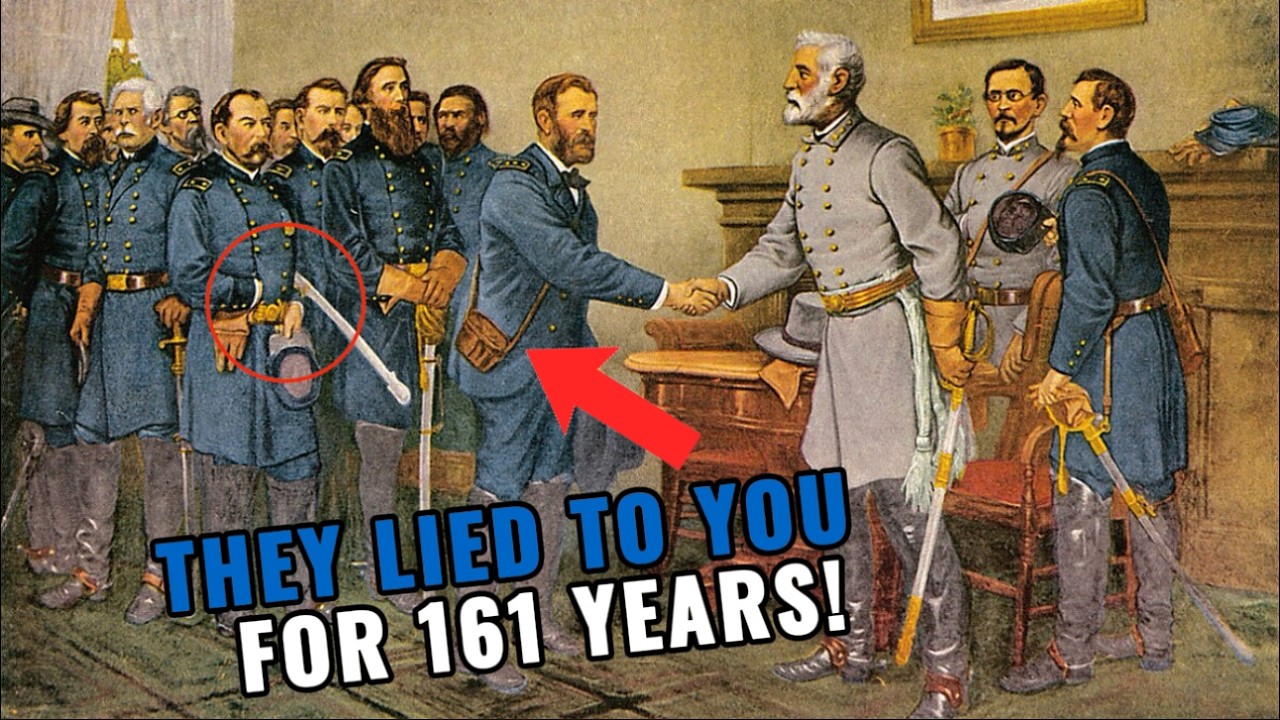
The historic meeting at Wilmer McLean’s house was a study in stark contrasts, a visual representation of the two sides of the American conflict. Grant arrived in a mud-splattered uniform, his boots and coat bearing the grime of the campaign, a stark contrast to Lee, who arrived in his immaculate dress uniform, complete with a finely crafted presentation sword. This was not just a matter of personal style; it was a reflection of their respective positions.
Grant was the victor, secure in his position, able to afford the casualness of a man who has nothing left to prove. Lee, on the other hand, was the vanquished, clinging to the last vestiges of military formality as a shield against the humiliation of the moment. The conversation began not with the harsh terms of capitulation, but with Grant recalling their shared service during the Mexican-American War.
This deliberate attempt to find common ground set a tone of mutual respect that would define the negotiations.
The terms of surrender that Grant presented were surprisingly lenient, a decision that would have profound implications for the future of the nation. Grant understood that the goal was not to humiliate the defeated South, but to begin the process of reunification. He allowed Confederate officers to keep their side arms and their personal horses, a gesture of compassion that acknowledged the dignity of the men who had fought so hard.
Furthermore, he allowed enlisted men to keep their horses and mules for the spring plowing, recognizing that these men were not just soldiers, but farmers who needed to return to their land to rebuild their lives. This was not the act of a vengeful conqueror, but of a pragmatic leader who understood that healing the nation required a foundation of respect, not retribution. Lee, upon reading the terms, expressed his gratitude, noting that this act of generosity would do much toward conciliating the country.
 Yet, the emotional weight of the moment was far heavier than the ink on the surrender documents. As Lee stepped out onto the porch of the McLean house, he looked out at the remnants of his once-mighty army, a sea of gaunt faces and tattered uniforms. He mounted his horse, Traveller, and rode back to his men, a solitary figure carrying the crushing burden of defeat.
The scene that followed was one of profound sorrow. As Lee delivered the news, his soldiers, many of them weeping openly, crowded around him. They did not blame him; they revered him.
The surrender was not just a military defeat; it was the death of a dream. The men who had fought for four years, who had endured unimaginable hardship, now faced the prospect of returning home to a land that was physically and economically devastated, with no clear future. The cheers that erupted from the Union lines were met with a somber silence from the Confederates, a silence that spoke volumes about the depth of their loss.
The aftermath of Appomattox was not a simple transition to peace, but the beginning of a complex and often contradictory era of Reconstruction. In Washington, President Abraham Lincoln, who had been assassinated just days later, had envisioned a policy of “malice toward none, with charity for all.” He saw the surrender not as a victory to be celebrated with vengeance, but as an opportunity to bind up the nation’s wounds.
However, Lincoln’s vision was not universally shared. A powerful faction in Congress, known as the Radical Republicans, sought harsher penalties for the former Confederates, demanding that the South be remade in the image of the North. This clash of ideologies, between reconciliation and retribution, would define the political landscape for years to come, creating a legacy of bitterness and resentment that would linger for generations.
What history often glosses over is the deeply personal nature of this surrender for both generals. For Lee, it was a moment of profound personal failure. He had dedicated his life to the military, and his decision to side with his home state of Virginia had cost him everything.
He was now a man without a country, a traitor in the eyes of the federal government, and a defeated leader in the eyes of the world. His pride, which had been his greatest strength and his most significant weakness, was shattered. He spent the remainder of his life not in political defiance, but in the quiet pursuit of education, serving as the president of Washington College, where he sought to heal the wounds of the South by educating its youth.
This was his redemption, a quiet acknowledgment that the future lay not in the battlefield, but in the classroom.
 For Grant, the surrender was a vindication of his relentless strategy of attrition, but it was not a moment of triumphalism. He was a man who had seen the horrors of war firsthand, from the slaughter at Shiloh to the brutal siege of Vicksburg. He understood that the victory at Appomattox was not a glorious triumph, but a tragic necessity.
His generous terms were not just a political calculation; they were a reflection of his own character. He had a deep empathy for the common soldier, having been one himself before the war. He knew that the men surrendering were not demons, but Americans who had been caught up in a conflict beyond their control.
His goal was not to punish them, but to send them home so that the nation could begin the arduous task of rebuilding.
The legacy of Appomattox is therefore not one of simple victory and defeat, but of the complex interplay between honor, humanity, and the harsh realities of war. The meeting at McLean’s house was a microcosm of the entire conflict, a moment where two men, representing two vastly different visions of America, came face to face to negotiate the terms of a new future. The decision to allow the defeated army to return home with their dignity intact set a precedent for reconciliation that was remarkable for its time.
It stood in stark contrast to the brutal conquests that had characterized European wars, and it laid the groundwork for the possibility of a united nation, even if that unity would be tested for decades to come.
As we reflect on this pivotal moment in history, we must look beyond the simple narrative of a military surrender. We must consider the psychological torment of a leader who had to admit that his cause was lost, the strategic miscalculations that led to the final trap, and the profound humanity displayed by the victor in his moment of triumph. The story of Appomattox is a story about the cost of pride, the weight of responsibility, and the difficult path toward healing.
It is a reminder that even in the most bitter conflicts, there is room for compassion, and that the true measure of a nation is not in how it wins its wars, but in how it treats its enemies in the aftermath of defeat. The echoes of that day are not just the fading sounds of cannon fire, but the enduring questions about what it means to find dignity in defeat and to build a future from the ashes of the past.