Alice Keppel spent 12 years as the mistress of King Edward VII. She was, by many accounts, the most powerful woman in England who held no official title. Ministers sought her ear. Hostesses competed for her presence. The king himself could not be at ease for long without her.
When the king died in May 1910, that world collapsed. On the day of his funeral, she was admitted to the service through a side door, apart from the family, apart from the grief that was permitted to be seen. The court that had adored her quietly erased her.
History, however, kept a strange account. A century later, the crown Alice Keppel could never touch was placed on the head of her own great-granddaughter, Queen Camilla.
Alice Frederica Edmonstone was born in 1868 at Duntreath Castle in Scotland. She was the youngest of a large family. Her father was Admiral Sir William Edmonstone, a baronet and a man of the Royal Navy. It was a good name, but the family was not rich in the way the truly great families were rich.
What Alice had instead was a genius for attention. She could make the person in front of her feel like the only person in the world. She listened. She remembered names and worries. She made anxious men feel clever and powerful men feel understood.
In 1891, at 22, she married George Keppel. He was the third son of the Earl of Albemarle. On paper, it was a fine match. In practice, a third son inherited the manners of a great house and almost none of its money. He was kind, charming, and by most accounts, complacent.
By the late 1890s, the Honorable Mrs. George Keppel was one of the most sought-after young women in London. She had everything the part required: looks, wit, discretion, and the gift of making the great feel greater.
In early 1898, she met Albert Edward, Prince of Wales. He was 56 and had been heir to the throne for a very long time. She was 29. Within weeks, it was understood that Alice Keppel had become his favorite.
There had been other women before her. The prince collected them and discarded them with about as much ceremony. But Alice was different. She did not flaunt her position. She managed it. She made herself not a diversion but a necessity.
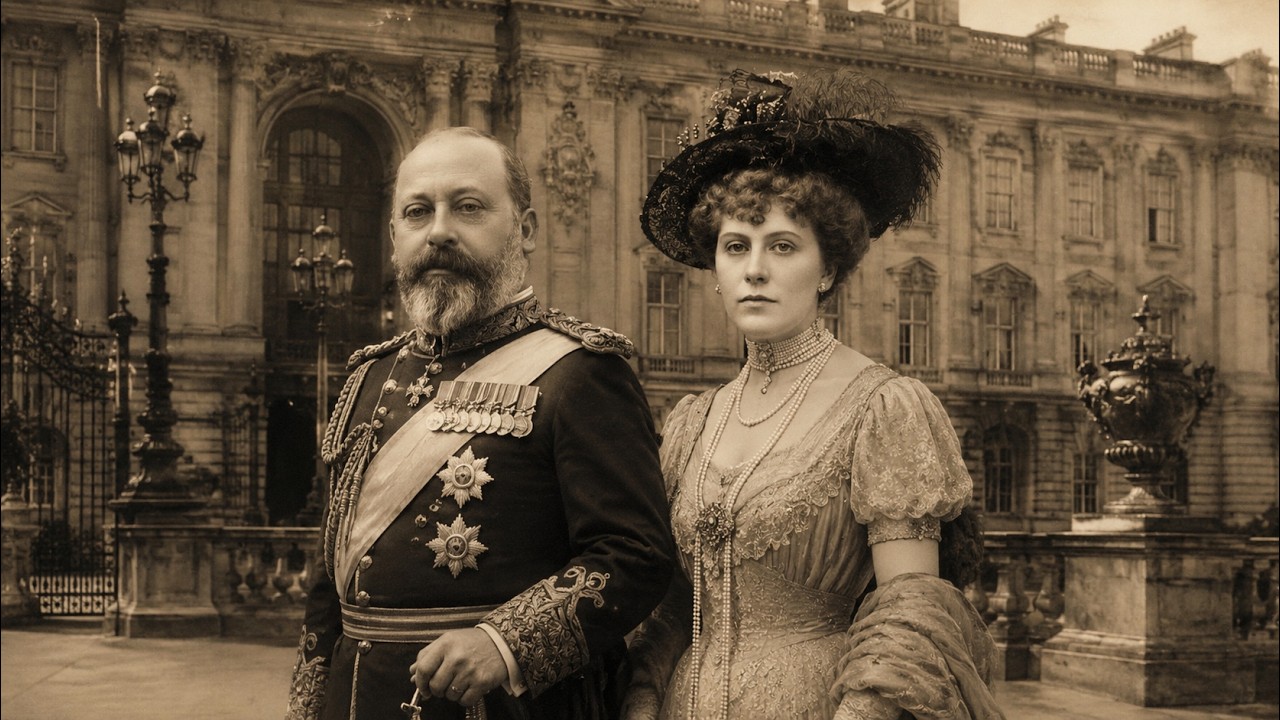
The arrangement had a shape. She lived at 30 Portman Square. The prince came to her in the late afternoons. When his carriage drew up, her husband would already have found somewhere else to be. George Keppel did not make scenes. Asked about his wife, he reportedly said he did not mind what she did, so long as she came back to him in the end.
The couple had two daughters, Sonia and Violet. The children called the heavy, bearded heir to the British Empire "Kingy." He would lower himself onto the floor for them, and they would race buttered bread and butter slices down his trouser leg.
The gifts came generously. Edward gave Alice money through friends and financiers, never directly from the public purse. A good position was found for George Keppel, conveniently demanding of his time. The king paid the husband to be elsewhere.
When Queen Victoria died in 1901, the bored old prince became king. Alice Keppel rose with him. The court had a name for her position, borrowed from the French: la favorite.
Her power was real. Sir Charles Hardinge, a senior Foreign Office official, recorded that there were occasions when the king was at odds with his own government. Hardinge was able through her to advise the king so that the government's policy might be accepted in the end. The foreign policy of the British Empire was, on more than one occasion, steered through a mistress in a drawing room.
Around 1909, the king arranged a gift of shares in a rubber company. The shares climbed. By the accounts of her biographers, the arrangement was eventually worth something in the order of $50,000, several million in today's money.
But every piece of it rested on the health of one man. There were no settlements in her name that the crown could not unmake. No title that would outlive him. No legal claim. No pension. No protection.
In the spring of 1910, the king traveled with Alice to Biarritz, as they did every year. He arrived unwell. A chill had settled into his chest and would not lift. Alice wrote to a friend that she was quite worried.
The king came home at the end of April. He did not get better. He refused to rest. On May 2, he went out to dine in public for the last time. Alice was there. She saw how ill he was and quietly sent him home to the palace.

On May 6, the king asked for Alice. The queen, Alexandra, permitted her to come. What happened next is contested. In the gentler version, the two women wept together, and the queen was kind. In the version most biographers accept, Alice became distraught and inconsolable, and the household had to lead the weeping mistress from the room. Some accounts put a sharp command in the queen's mouth: "Get that woman away."
Just after 11 that night, the king died. He was 68.
Eleven days later, they buried him. She was granted a place at the funeral, but by the account of her biographers, she was admitted through a side door. For 12 years, she had mastered the front door of every great house in England. On the single day it mattered most, she was let in quietly, where no one would be troubled by the sight of her grief.
The new king, George V, had no use for his father's favorite. The court closed to her. The invitations thinned and then stopped. In November 1910, the Keppels closed up their English life and left. The reason they gave was the education of their daughters. The truer reason needed no announcement.
The hardest test was still ahead. It came from her own daughter.
Violet Keppel fell in love, helplessly and all-consumingly, with Vita Sackville-West. They had known each other since childhood. Now they were grown women, and what had begun as a schoolroom friendship had become the central fact of Violet's existence. They ran away together to France openly, recklessly. Violet did not want to be discreet. Violet wanted to be free.
That was the one thing her mother could not allow.
Alice Keppel set out to destroy the affair. She used charm, manipulation, determination, and money. Violet was steered into a marriage with a young officer named Denys Trefusis. It did not hold her. Again and again, she tried to break free.
So her mother cut off her allowance. It was a calculated cruelty from a woman who knew precisely what money meant. Take it away, and a woman of Violet's class had nothing. When Violet talked of divorce and escape, her mother is said to have told her she would be a laughingstock, reduced to plain Miss Keppel, a nobody.

Alice Keppel was not protecting an abstract idea of respectability. She was protecting the only thing that had ever protected her. Her entire life had rested on one rule: you may do anything, but you must never be caught doing it. Discretion was her religion.
In the end, the mother won. The affair was crushed. Vita went back to her husband. Violet was the one left broken. She lived a long time, but something in her went quiet. In her later years, she became a parody of her own mother, living in grand houses, giving lavish parties, telling flamboyant lies.
In 1925, Alice and George Keppel bought a villa above Florence. It was called the Villa dell'Umbrellino. Galileo was said to have lived there once. Here, Alice gave perfect parties. Exiled kings and queens of half of Europe came to her terrace. A young Winston Churchill came to paint.
In December 1936, when Edward VIII gave up the throne to marry a divorced woman, the old mistress of his grandfather was overheard delivering her verdict: "Things," she said, "were done much better in my day."
Alice Keppel died in Florence in September 1947 at 79. George died just over two months later. After 56 years of making way for her, he could not find the way to go once she was gone. They were buried together beneath the cypresses, an ocean away from the country where she had reigned.
The story was allowed to rest. A scandalous footnote to a king's reign. A name the great families preferred to leave unspoken.
But history keeps strange accounts. Alice had two daughters. Violet had no children. But the quiet one, Sonia, had a daughter of her own. And that daughter had a daughter, a girl born in the very year Alice Keppel died.
That girl grew up to fall in love with a Prince of Wales. She waited through decades of scandal and exile. And at last, against every prediction, she married her king.
A century after the side door, Alice Keppel's own great-granddaughter stood in Westminster Abbey and was crowned Queen of England. The position the mistress could never have. The dignity she was denied at a funeral. History gave it, in the end, to the blood of the woman it had cast out. And gave it openly, and gave it a crown.