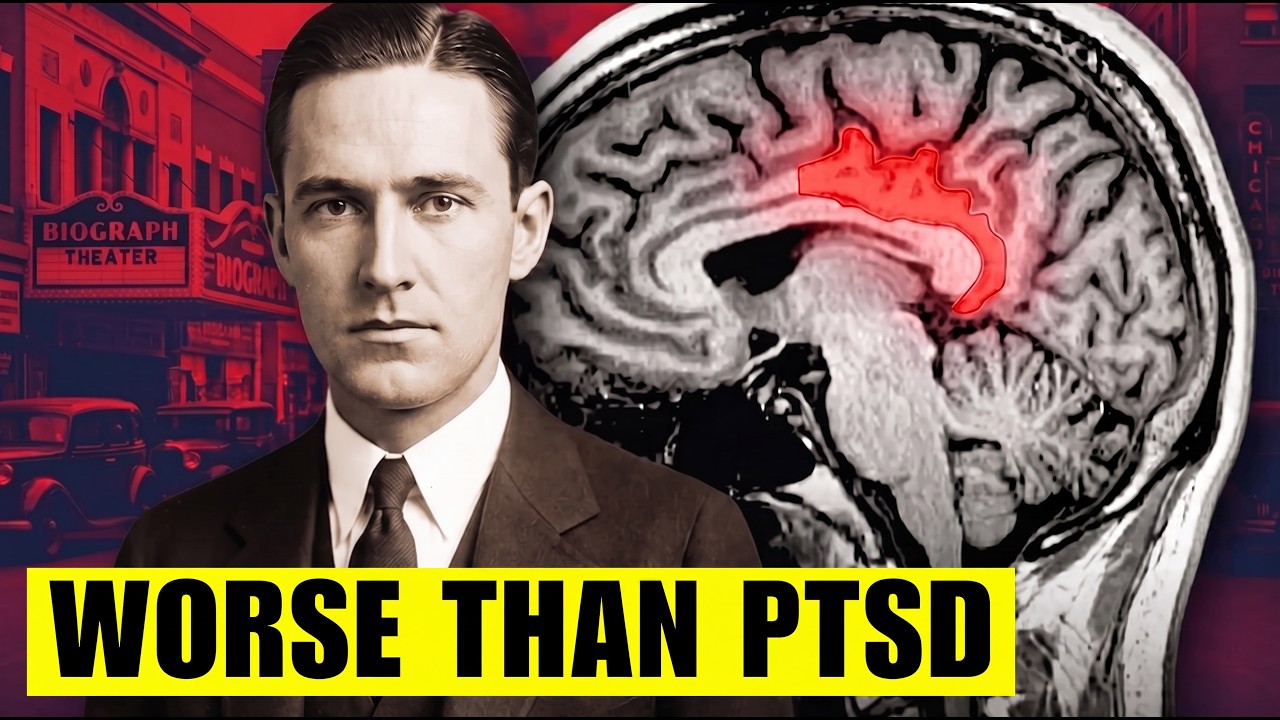
On the evening of July 22, 1934, a man stepped out of the Biograph Theater in Chicago after watching a gangster picture. He didn’t make it thirty feet down the sidewalk before three federal agents moved in behind him and fired five shots in under three seconds. One round entered the back of his neck and exited beneath his right eye. John Dillinger dropped face down on the concrete. Before the scene was even roped off, civilians were already dipping handkerchiefs into his blood for souvenirs.
That ambush became the origin story of the modern FBI. It is how J. Edgar Hoover sold Washington on the idea of a federal police force. Overnight, the G-men became American heroes. But the press releases left something out. The man widely credited with firing the kill shot resigned eight years later, telling Hoover to go to hell on his way out. The agent who got all the Dillinger headlines wasn’t even the shooter. He died in 1960 from a gunshot wound to the head, fired from a pistol that once belonged to a Chicago gangster. The inspector who brought down Baby Face Nelson died on a hospital cot thirteen hours after his gunfight. And the Texas Ranger who killed Bonnie and Clyde gave one interview within twenty-four hours of the ambush, then never spoke of it again.
This is the story of what really happened to the four men who pulled the triggers on America’s public enemies.
Melvin Purvis was running the FBI’s Chicago field office in 1934. He was thirty-one years old when Hoover picked him to coordinate the Dillinger manhunt. He stood five foot four, a soft-spoken South Carolina lawyer with a slight stutter. The press loved him. By the time Dillinger fell in front of the Biograph, Purvis was on the cover of Time magazine. Three months later, after Pretty Boy Floyd died in an Ohio cornfield, Purvis was second in fame only to the president.
But his own colleagues had a nickname for him: Nervous Purvis. He was visibly shaking during operations. He wrote about it himself. After the Little Bohemia Lodge disaster in April 1934, when the Bureau raided the wrong cabin and Dillinger escaped out the back window, Purvis was trembling on the job. By the end of the year, Hoover had stripped him of his Chicago command. The official reason was administrative restructuring. The paper trail tells a different story.
Hoover started running surprise inspections on the Chicago office, citing Purvis for procedural violations that didn’t matter. Cases beneath his rank piled up on his desk. By July 1935, one year to the month after Dillinger died, Purvis resigned. What followed was a twenty-five-year vendetta. Hoover blocked every job Purvis tried to get in law enforcement. He killed a federal judgeship appointment. Purvis ended up endorsing cereal and shaving razors just to feed his family. Even when Purvis served in Europe during World War II and helped investigate Hitler’s suicide, Hoover kept a surveillance file open on him the whole time.
Every newspaper clipping mentioning Purvis’s name went into a secret file in Washington. The Bureau watched his health, his travels, everything. On February 29, 1960, Purvis was found dead in an upstairs hallway of his home in Florence, South Carolina. He had been killed by a single .45 caliber shot beneath his jaw. The pistol was a Colt that fellow agents had given him as a resignation gift back in 1935. That same pistol had originally been seized from Gus Winkler, a Chicago gangster who had been Purvis’s informant before the syndicate killed him in October 1933.
The Bureau sent a memo to Hoover declaring the death a suicide. The local coroner refused to put suicide on the certificate. A later examination suggested a tracer round had jammed in the chamber and gone off while Purvis was working on the gun. No condolence telegram came from the Bureau or from Hoover. When former agents asked where to send flowers, the Bureau claimed they thought Purvis might have lived in Florence, South Carolina. They had his complete address on file the whole time.
A month after the funeral, Purvis’s widow dictated a telegram to Hoover. She said, “We’re honored that you ignored Melvin’s death. Your jealousy hurt him very much, but until the end, I think he loved you.” Hoover never responded. He just filed the telegram.
The man who actually fired the kill shot at the Biograph never got a magazine cover. He never wanted one. His name was Charles Winstead. He was forty-three years old in 1934, a former Texas deputy sheriff that Hoover pulled into the Bureau after Little Bohemia made it clear the Chicago agents couldn’t handle a gunfight. Winstead had killed men before. He didn’t shake. Hoover credited him with two of the three shots that hit Dillinger that night, including the one through the back of his skull.
Winstead received a written commendation. His own memoir records his exact words about the shooting: “I didn’t read him his rights.” Eight years later, Winstead got into an argument with a female reporter in El Paso and called her a communist sympathizer. Hoover ordered him to apologize and transferred him to Oklahoma City as punishment. Winstead’s written reply told the director he could go to hell. He resigned in December 1942.
After that, silence. Winstead never sat down with a reporter again. No book was published about his role at the Biograph. He moved to Albuquerque and joined Army Intelligence as a captain. For thirty more years, he didn’t say a word about Dillinger. When the United Press ran his obituary on August 6, 1973, most papers buried it on the inside pages. The man who shot John Dillinger died as a private citizen.

Samuel Parkinson Cowley was a Mormon deskman from Franklin, Idaho. He was thirty-five years old, a Bureau lawyer who had never been in a gunfight in his life. Hoover sent him to Chicago because Purvis was becoming a political problem after Little Bohemia. Hoover needed someone whose loyalty was beyond question. On November 27, 1934, Cowley took a call in the Chicago office. Baby Face Nelson had been spotted on a county road outside of Barrington, Illinois.
Cowley and Special Agent Herman Hollis drove out to intercept him. They ran into a man who would end up credited with more FBI deaths than any other Depression-era outlaw. Nelson stood in the middle of a country road with a Browning automatic rifle. He shot Hollis through the face. Hollis died on the scene. Cowley returned fire with his submachine gun, hitting Nelson across the legs and torso. Nelson took a rifle round through the abdomen and kept walking. He shot Cowley through the stomach with his BAR, then walked another half mile down the road before dropping into a roadside ditch. That’s where he died.
Cowley survived thirteen hours after the gunfight. He stayed conscious long enough to identify Nelson from photographs and give a statement to Purvis. At two in the morning on November 28, 1934, he passed away. Hoover called Cowley the bravest man he ever knew at the funeral. What he didn’t mention publicly was that he was already using Cowley’s reputation to rewrite the public account of 1934. The official Bureau narrative soon had Cowley as the primary architect of the anti-gang campaign. Purvis was demoted in the history books to a press-hungry deputy. Cowley was useful to Hoover because he was a famous dead agent who couldn’t talk back.
Frank Hamer doesn’t quite fit the pattern. He was never an FBI agent. Hoover had no control over him. Hamer was pulled out of semi-retirement at age fifty by the Texas prison system to hunt down Bonnie and Clyde. The Federal Bureau had spent over a year trying to catch them and failed. By the time Hamer set up the Louisiana ambush on May 23, 1934, he had been in more than fifty documented gunfights. He carried seventeen bullet scars on his body and had been left for dead four times. By his own private count, he had killed sixty-five people across his career.
The Louisiana ambush lasted under thirty seconds. Hamer and five other lawmen had been waiting in a concealed position in the pines since two in the morning. The job was done at 9:15 in the morning. When the Ford V8 came down the road, they fired roughly 150 rounds into it. Clyde Barrow took at least seventeen hits. Bonnie Parker took at least twenty-six. Witnesses said the bodies were nearly cut in half. Folks miles away thought a logging crew had been setting off dynamite.
But Hamer parts company with the FBI men here. Within twenty-four hours of the ambush, he sat down with one journalist he trusted. That was the only press interview he gave for the rest of his life. A $10,000 movie rights offer came across his desk. Hamer turned it down flat. The city of Austin tried to throw a Hamer-Gault Hero Day in his honor. He wouldn’t even show up. In 1937, when magazine articles portrayed him as an American hero, he ignored them. When the 1967 Bonnie and Clyde film portrayed him as a fool, his family sued the producers and won a settlement.

Hamer died in his sleep on July 10, 1955, twenty years after the Gibson ambush. According to his brother, he would have been embarrassed by all the attention. People who knew him in his last decade said he wouldn’t discuss Gibson with anyone, not even his own sons or fellow Rangers. The man survived over fifty gunfights and chose to spend the rest of his life in silence so complete that seventy years later, we still don’t know what he saw out on that road.
Look at the documented record across all four men. Purvis was visibly shaking through the manhunt and dead at fifty-six from a gangster’s pistol after twenty-five years of Hoover’s vendetta. Winstead turned down every offer of fame the Bureau ever made. He resigned in fury and vanished into Army Intelligence for thirty years. Cowley was dead on a hospital cot thirteen hours after the gunfight, and his corpse got used as a propaganda tool against his own commanding officer. Hamer earned one of the most famous lawman titles in American history while spending the rest of his days refusing to talk about how he earned it.
The official narrative says the G-men crushed the public enemies and built modern federal law enforcement. That version is on every FBI museum exhibit and every cable documentary. But the documented record across these four men shows something else. Hoover was running a publicity machine that converted dead criminals into federal authority. The agents who pulled the triggers were input to that machine. The machine didn’t need them to be whole afterwards. It just needed them famous and then quiet.
Purvis wouldn’t stay quiet, so Hoover spent twenty-five years taking him apart. Winstead walked out the door under his own steam, and Hoover quietly erased him from the record. Cowley was already dead by the end of 1934, which turned out to be the most useful condition Hoover could ask for. And Hamer was famous and completely beyond Hoover’s reach, so the Bureau just pretended he wasn’t there.
The FBI became the most powerful domestic law enforcement agency in American history on the strength of what those four men did between January and November of 1934. But the cost of what it took out of them isn’t anywhere in the Bureau’s official history. Purvis’s family had to dig out the FBI’s own files years later to make any of it public. A widow sent a telegram in 1960 that Hoover never bothered to answer. And out in Albuquerque, the man who actually fired the kill shot at the Biograph spent thirty more years not saying a single word.
The first draft of that history made sure we’d remember the gangsters on Chicago sidewalks. The men who put them down got remembered for something entirely different.