On July 18, 1933, the Barrow Gang was driving a stolen Ford V8 through Iowa. Inside were Bonnie Parker, Clyde Barrow, his brother Buck, Buck’s wife Blanche, and teenager W.D. Jones. They spent the day committing small robberies near Fort Dodge, hitting three gas stations in about 15 minutes.
They took cash and coins, even stealing from bubble gum machines. At each station, they forced the workers into the car as temporary hostages so they couldn’t call police. By the third stop, the back seat was full of people they had robbed. They eventually released everyone but kept about $150, which would be worth over $3,800 today.
The gang then drove toward Kansas City, covering roughly 250 miles in under four hours. Clyde favored Ford V8s for their speed and reliability. The car they were driving had a license plate stolen from a doctor in Enid, Oklahoma, whose vehicle had been taken on June 26.
Buck was uneasy about going to Kansas City. The Union Station massacre had happened just weeks earlier, on June 17, 1933, and federal agents were swarming the area. Clyde agreed to stop before reaching the city limits.
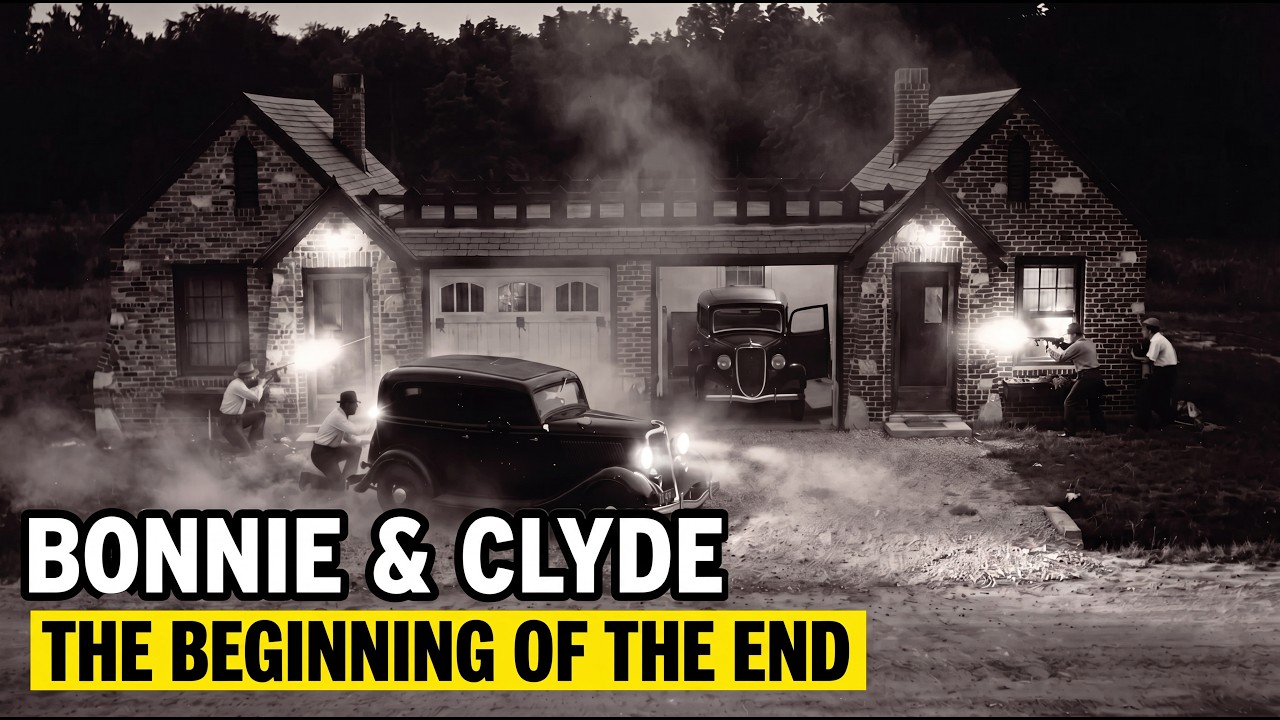
Just before midnight, they pulled into Slim Castle’s gas station in Platte County, about 15 miles north of downtown Kansas City. From the parking lot, Clyde spotted the Red Crown Tourist Court. He was drawn to its solid brick construction, which made him feel safe. He told the group they would stay there for the night.
The main building of the Red Crown complex was a popular tavern and dance hall. Behind it sat two small brick cabins connected by a double garage. The manager was Neil Houser. What Clyde didn’t know was that the Red Crown was a regular gathering spot for law enforcement. Missouri Highway Patrol officers and the Platte County sheriff ate there almost daily.
Before entering, Clyde made W.D. Jones lie down in the back seat and covered him with blankets. Blanche went to the office to rent the cabins, telling Houser there were only three people in their group. The ruse failed for several reasons.
Blanche was wearing jodhpurs, tight riding pants that were flashy and out of place for a small Missouri town in 1933. Houser had watched from his window and clearly saw five people get out of the car. The driver backed the car into the garage, a style called the “gangster method.” Regular guests parked normally.
Blanche paid for the cabins with coins. The room cost four dollars for both cabins for the night. She handed Houser a handful of change, which was heavy and unusual. Then she ordered dinner for everyone at the tavern: five chicken dinners and five beers for a group she claimed was three people. She paid with coins again.
The coins came from the cash registers and gum machines at the Fort Dodge gas stations the gang had robbed earlier. Blanche was getting rid of the heavy coins first. Houser tried to write down the license plate number, but Clyde wouldn’t let him near the garage. Houser walked around the back and looked through cracks in the wood to read the plate.
The next morning, Clyde had pasted newspapers over the cabin windows to block the view. The Red Crown only had two cabins, and the gang had rented both. There were no other guests. When staff couldn’t get in and only one person showed their face, it drew suspicion.
Houser reported his concerns to two regular customers: Highway Patrol Captain Baxter and Sheriff Halk Coffey. He gave them the license plate information. By noon, they learned the car was stolen from Enid, Oklahoma.
That afternoon, a pharmacist named Louis Bernstein called Sheriff Coffey. A woman in fancy riding pants had bought bandages and atropine sulfate at his store. Atropine sulfate was used to dilate pupils and treat burn wounds. Bonnie had suffered severe burns in a car accident on June 10, and the gang had been buying medical supplies across several states. Pharmacies had been put on alert.
Bernstein’s call confirmed it. The people in the cabins were the Barrow Gang.
Sheriff Coffey drove to Kansas City to ask Jackson County Sheriff Tom Bash for help. Bash initially refused, tired of rural sheriffs asking for equipment. Coffey insisted, and Bash eventually lent him weapons, bulletproof shields, tear gas, and an armored car.
By sunset on July 19, the lawmen had Thompson submachine guns, steel shields, an armored sedan, and at least one shotgun. The Barrow Gang had Browning Automatic Rifles, or BARs, military .30-06 weapons, plus pistols and shotguns. Clyde had stockpiled them from a National Guard armory raid in Enid, Oklahoma.

The final force included 13 men: Sheriff Coffey, his deputy son Clarence, Platte County deputies, Captain Baxter, Sergeant White Cotton, Trooper Leonard Ellis, and a Jackson County squad with the armored car.
Around 10 p.m., W.D. Jones left the cabin and bought five sandwiches and five sodas. It was the only time anyone left the building. The lawmen waited until about 1 a.m., when the tavern crowd had gone home, so no innocent bystanders would be in the line of fire.
Two deputies were positioned on the tavern roof. The armored car was pushed into the driveway and parked in front of the garage doors, blocking the gang’s only exit. White Cotton and another deputy stood at the end of the driveway. The rest of the officers surrounded the cabins.
Sheriff Coffey and Captain Baxter, carrying Thompsons and protected by steel shields, walked across the open ground toward the cabin. Coffey knocked on the door of Buck and Blanche’s cabin. Blanche said she wasn’t dressed. Coffey told her to get dressed and come out. She shouted that the men were in the other cabin, loud enough for Clyde to hear.
Clyde grabbed his weapon and went to the garage door. Through a glass pane, he saw Coffey. Clyde shouted, “Who’s there?” Coffey replied, “Sheriff, open the door.” Clyde said, “Just a minute,” then fired several shots through the closed garage door. Captain Baxter took the rounds on his steel shield and stumbled back, unhurt. Coffey ran for cover.
White Cotton, watching from the far end of the driveway, saw a man running toward him. He couldn’t identify him in the dark and assumed it was a gang member. He shouted to Trooper Leonard Ellis, who raised his shotgun and fired. The pellets hit Sheriff Coffey in the neck. Coffey was wounded by his own men.
Clarence Coffey ran into the open to draw fire away from his father. A bullet from inside the cabin passed through the tavern wall, through two kitchen stove walls, and lodged in Clarence’s arm.
Inside the cabin, Bonnie, Clyde, and Jones moved through the interior door into the garage where the car waited. Buck came out of his cabin, carrying his BAR and firing heavily. Captain Baxter took the opportunity and shot Buck with his Thompson. A bullet hit Buck in the left temple and exited his forehead.
Blanche, weighing about 81 pounds, crossed the open ground, grabbed her wounded husband, and pulled him into the car. She climbed in with him.
The armored car was still blocking the garage. Clyde opened fire on it. The armor wasn’t designed to stop .30-06 rounds. Bullets pierced the plating and hit the driver, Deputy George Highfield, in both knees. One bullet hit the horn, which blared continuously. Some officers heard it as a signal to stop firing and began to retreat.
Highfield, wounded and seeing officers pull back, reversed the armored car away from the garage doors. Another officer launched a tear gas canister, but it flew over the cabins and landed across the road at Slim Castle’s. The wind blew the gas back into the faces of the lawmen.
Clyde drove the Ford V8 out of the garage, past Coffey and the other officers, and onto Highway 71. As they fled, officers fired a final volley. A Thompson round shattered the rear window, spraying glass across Blanche’s face. Shards entered both her eyes, and a bullet fragment hit her head at the hairline. Her left eye was permanently blinded.
The lawmen assessed the damage. Sheriff Coffey had two scratches on his neck from Ellis’s shotgun. Deputy Clarence Coffey had a bullet wound in his arm. Deputy George Highfield had gunshot wounds in both knees. No lawmen were killed.
When officers searched the cabins, they found the five sandwiches Jones had bought three hours earlier still on the table, next to five empty soda bottles. They also found a hypodermic kit, briefly sparking rumors of drug use. It was actually the remains of a medical bag stolen from a doctor in Enid.
The officers recovered a Browning Automatic Rifle, five Colt .45 automatics, and 47 empty cartridges. Some of the Colts were linked to the National Guard armory raid. One pistol had a darker history: Buck and Jones had taken it from the body of Marshal Henry Humphreys after Buck shot him in Alma, Arkansas, on June 23.
Somewhere on Highway 71, heading north into the Iowa darkness, a bullet-riddled Ford V8 carried a dying brother, a half-blind sister-in-law, a teenager in the passenger seat, and a man who had just driven through what should have been an impossible trap. They escaped this time, but the end was already in motion.