Bonnie Parker and Clyde Barrow spent nearly two years evading law enforcement across the American South. They crisscrossed state lines, robbed small businesses, and became the most famous outlaws of the Depression era. Yet they never did the one thing that seemed most logical: they never left.
Why didn’t they simply drive to California, the Pacific Northwest, or Canada? Why did they stay in the same few states until their deaths on May 23, 1934?
The answer is complicated, but it comes down to money, injury, family, and a fatal preference for the easy path.
In the early 1930s, local law enforcement was strictly bound by geography. A county sheriff or state trooper could not chase suspects beyond their jurisdiction. Crossing a state line effectively ended a pursuit because it was not yet a federal crime.
Bonnie and Clyde exploited this aggressively. They drove fast, reliable cars like the Ford Model 6 or the Ford Model 18 V8. They would commit robberies and then cross into neighboring territories before local police could coordinate.
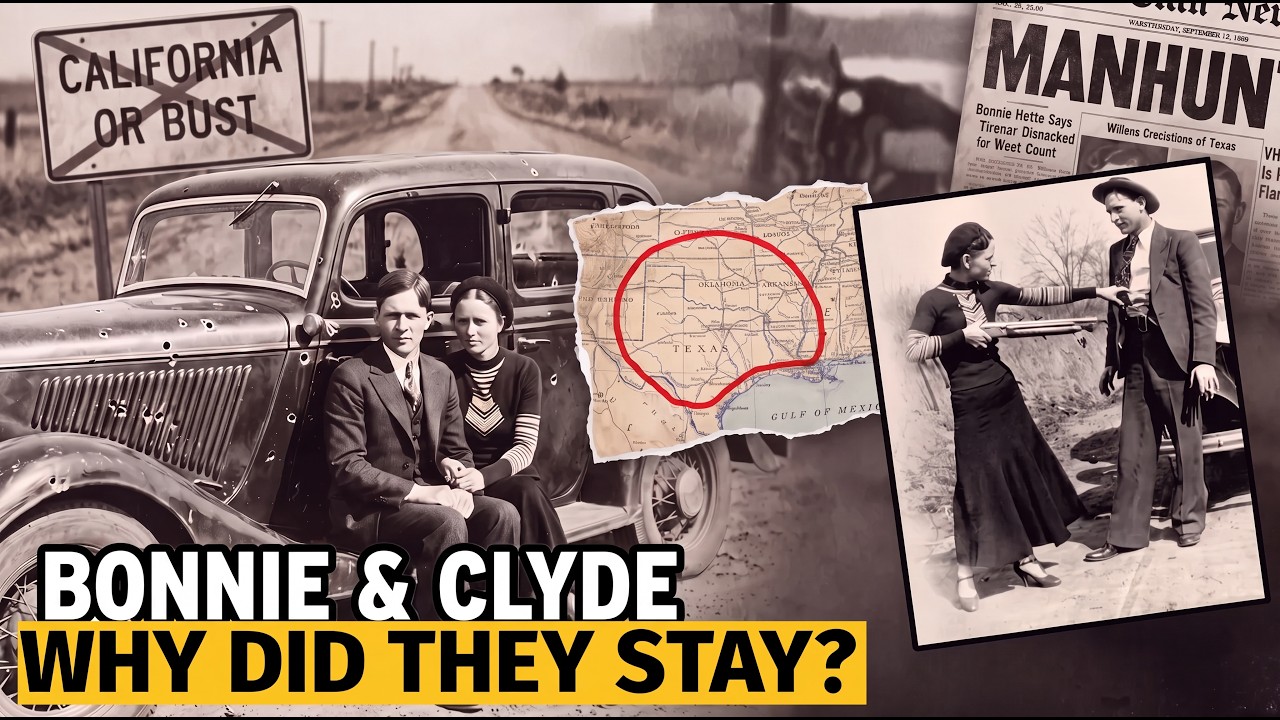
Their loop ran along and around the borders of Texas, Oklahoma, Missouri, Arkansas, and Louisiana. The Barrow Gang used rural roads and boundary zones to hop between jurisdictions constantly, making standard police chases useless.
Clyde Barrow had a severe physical disability that shaped his entire life on the run. He had lost his left big toe and part of another toe. During the Great Depression, nearly all working-class jobs required heavy manual labor.
Clyde could not do farm work, construction, or factory labor because his foot could not handle standing and lifting all day. Regular leather shoes were painfully unbearable. He often drove getaway cars wearing only socks because shoes threw off his balance on the pedals.
No foreman would hire a limping man who could not wear proper footwear, especially when so many healthy men were desperate for work. To earn an honest living, he would have needed rare, non-labor jobs like shoe repair or clerical work. Those jobs were nearly impossible to find.
Bonnie Parker was also severely injured. During a high-speed chase, battery acid spilled onto her leg when the car crashed. The acid burned her flesh down to the bone in places and destroyed the muscle entirely.
Her right leg stiffened and became permanently bent at the knee. She could barely walk. She either had to hop on one foot or rely on Clyde to carry her.
In the 1930s, there were no accommodations for disabled workers. Every available job for a working-class woman required standing for long hours in factories, restaurants, or shops. Bonnie had worked in a diner before, but she could no longer stand on her own. No employer would hire her.
Unlike most outlaws who cut ties and fled, Bonnie and Clyde stayed deeply connected to their families. They were so homesick and attached to their mothers that they risked their lives every few weeks to sneak into Dallas for secret visits.
They used a careful system. They would drive past their families’ homes and toss a bottle or cigarette pack from the window with a message wrapped around it. The message would specify a time and a secluded road outside town for a meeting.
When they met, it was like a family reunion. They brought groceries and fried chicken. They cooked the chicken on the roadside. They took pictures and complained to their mothers about how tired and miserable they were while running.
Clyde gave his family stolen money to help pay rent and buy food during the Depression. The families were fiercely loyal. They lied to police, hid messages, and never betrayed the couple. Even when police began round-the-clock surveillance, the families stayed silent.

Bonnie and Clyde were completely broke. Most of their robberies targeted small grocery stores, gas stations, and tiny rural banks that rarely had more than a few dollars. Although they stole cars and guns from armories, they lived a hand-to-mouth existence.
The little money they got went to gas, food, and medicine for their severe injuries. They could not afford a safe hideout, so they camped in woods or slept in the backseats of stolen cars. Their families were too poor to help financially, living in crowded slums west of Dallas.
The couple became nationally famous in 1933 after police found an undeveloped roll of film at a hideout in Joplin, Missouri. After a shootout there, the film was developed and newspapers published photos of the gang posing with guns and joking around.
One famous image showed Bonnie smoking a cigar. The photos also captured other gang members, including Clyde’s brother Buck Barrow, his wife Blanche, and young accomplice W.D. Jones. The public became obsessed.
But if you had seen them in person, they were not glamorous. Bonnie was under five feet tall and weighed only 90 pounds. Clyde was short and thin too. Both had severe disabilities from their injuries.
By 1934, their end was inevitable. First, they turned public opinion against themselves. In April 1934, they shot and killed two young highway patrol officers in Grapevine, Texas.
False witness reports claimed Bonnie laughed coldly and shot one dying officer in the face at close range. The story was fabricated, but the public was disgusted. People stopped seeing them as romantic heroes and started seeing them as brutal killers. They lost the protection of ordinary citizens who had once looked the other way.
Second, the rules changed. Lee Simmons, the Texas prison director, personally authorized a pursuit and appointed a legendary retired Texas Ranger named Frank Hamer to track them down.

Unlike regular police, Hamer had a special multi-state commission. He was not required to stop at state lines. He could chase them anywhere. Hamer assembled a team of fellow lawmen, including Ted Hinton and Bob Alcorn, giving the pursuit a coordinated authority Bonnie and Clyde had never faced.
The federal government was also pursuing them. Because Clyde habitually drove stolen cars across state lines, he violated the federal law against interstate auto theft. This gave federal agents legal authority to intervene and chase them anywhere.
To understand their situation, consider the economics of the time. In the 1930s, an average worker needed about $1,300 a year to maintain a decent middle-class lifestyle. That was roughly $25 a week.
That steady income would easily rent a decent home, provide groceries and clothing, and leave some money for comfort at the end of the month. But for Bonnie and Clyde, that basic level was completely out of reach.
Between the massive job losses of the Depression and Clyde’s severe foot injury, their families fell below that income level into extreme poverty.
Bonnie and Clyde did not fail to move somewhere else because they could not. They failed because Clyde Barrow was at the bottom of this poverty, a man who always sought easy solutions. When honest work meant standing in a field or on a factory floor, he was not ready for it.
When a straight life required anything of him, he chose a gun instead. Robbing a grocery store was faster than earning a paycheck. He could have driven west and started over with nothing, as millions of broke men did in those years.
But starting over was hard. Stealing and running were easy until they were not.
Bonnie followed him through all of it. She was nineteen when she met him and fell in love with a man who had no future and no intention of building one. She had every chance to leave. Her family begged her to go, but she stayed.
She chose the outlaw path over the honest path, just as he did. That is why they never left. Leaving would have meant choosing the hard, honest road, and neither of them ever did.