In April 2021, the doors of St. George’s Chapel in Windsor closed for the funeral of Prince Philip. Attendance was limited to just 30 people. There was no grand state ceremony, only the closest circle, in a moment when even the monarchy had to appear quieter than usual.
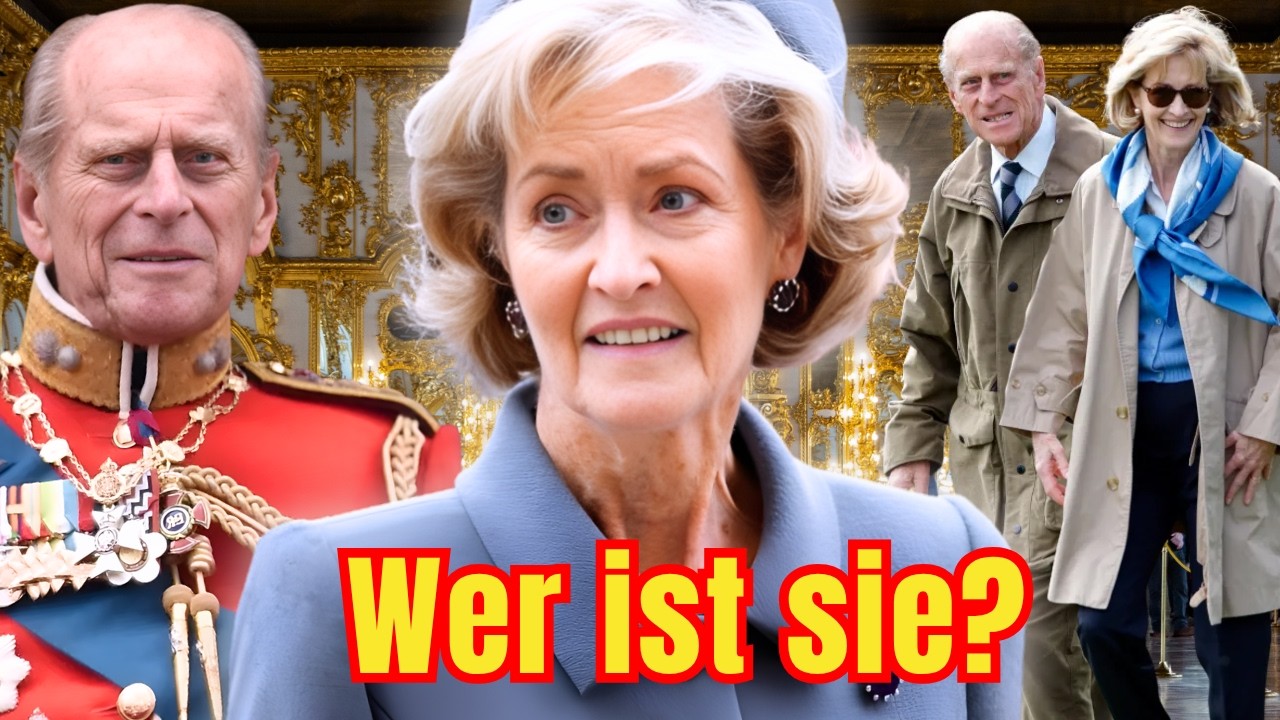
In that small, strictly limited group, one name stood out to many observers: Penny Knatchbull. She was not a daughter, not a granddaughter, and not part of the direct core family. Yet she was present at a moment when every invitation carried more weight than simple protocol.
Why did she belong to that final, quiet circle around the Duke of Edinburgh? The story does not begin with scandal or cheap revelation. It begins with something harder to define: trust, shared loss, and a discreet form of closeness that often speaks louder than any official statement in the British royal family.
To understand Prince Philip, one must look beyond his public role. One must look at the few people who remained near him in the decisive moments of his life.
Philip was far more than just the man at the Queen’s side. Behind the public figure was a life shaped early by upheaval, loss, and adaptation. He was born a Prince of Greece and Denmark but left Greece as a small child after political turmoil. His childhood was not stable or sheltered. It was marked by separation, constant moves, and family fragmentation.
Later came his education, service in the Royal Navy, and a path where discipline became not just posture but a principle of survival. This background is crucial. Philip often seemed direct, cool, sometimes even brusque. But beneath that surface was a man who had learned early not to rely on grand gestures, but on structure, reliability, and self-control.
He was not someone who defined closeness through words, pathos, or visible emotion. He preferred concrete tasks, clear routines, physical activity, and people who did not push themselves into the spotlight. To remain close to him, one did not need to be loud. What mattered was composure, the ability to endure strain, and trust earned through behavior rather than words.
His later role within the monarchy reinforced this character. After marrying the future Queen, Philip entered a historical position that looked brilliant from the outside but required a particular form of self-restraint. For decades, he stood beside the most visible woman in the country without being the central figure himself. For an energetic, proud, and practical man, that was no small task.
He sought spaces where competence, activity, and personal ease remained possible. He found them in naval tradition, technical interests, nature, riding, and later carriage driving.
This explains a pattern that ran through his later life. Philip seemed to deepen relationships where shared activity mattered more than publicly demonstrated affection. Trust grew not through sentimental language but through shared experience, consistency, and the quiet knowledge that the other person would maintain composure even in difficult moments.
To understand this story fully, one name is unavoidable: Mountbatten. Long before Penny Knatchbull became visible in this environment, there was already a close connection between Prince Philip and the Mountbatten family.
Lord Louis Mountbatten was far more than a prominent relative for Philip. In the early years of Philip’s life, marked by uncertainty and family fractures, Mountbatten became a reference point, a mentor, and someone who guided Philip into the British world that would later become his framework. For Philip, such bonds were never merely decorative. They represented orientation, loyalty, and continuity.
This is why the name Knatchbull is not incidental. When Penny married into the Knatchbull-Mountbatten family, she did not simply enter the house of a traditional aristocratic family. She entered a web of memories, relationships, and historical lines that had held special meaning for Philip for decades.
A central place in this web was Broadlands. On the surface, it is an elegant English country estate, shaped by tradition and quiet representation. For Philip, however, Broadlands was more than a beautiful property with history. It was connected to a very private chapter of his life.
After their wedding in 1947, Princess Elizabeth and Philip spent part of their honeymoon there. Broadlands became a place where family history and personal memory came together. It was a scene of beginnings, not just dynastic but human.
Penny later appeared in this environment with added weight. She was not entering a world where Philip first had to build a connection. She moved in a space already charged with meaning for him, through people, shared history, and memories reaching far back.
When Penelope Eastwood married Norton Knatchbull in 1979, she did not enter a world of festive lightness. On paper, it could have seemed like the classic entry into a great aristocratic family. An old name, a traditional estate, close connections to the royal family, and a social environment radiating exclusivity and continuity.
But reality in that year looked different. Before the wedding even took place, the family had been struck by a blow that shook not only the public but left deep private wounds.
In August 1979, Lord Louis Mountbatten was killed by an IRA bomb off the Irish coast. His young grandson Nicholas Knatchbull and other relatives also died. Patricia Knatchbull survived, seriously injured. For the public, it was a politically charged shock. For the family, it was a loss that struck at the core of their lives.
For Prince Philip, who had experienced Mountbatten as a defining figure since his youth, the attack was not a distant historical event. It was a personal turning point. Penny entered the family in this atmosphere of grief, injury, and inner turmoil.

The wedding of Penelope and Norton Knatchbull in October of that same year carried a different mood than one might expect. Prince Charles stood as best man at Norton’s side, but the day did not feel like a carefree new beginning. It seemed as if a family that had just suffered a heavy blow had to maintain composure before they had even found time to grasp the loss.
Penny did not come into a world of fairy-tale elegance. She came into a house that was learning to keep functioning with pain. This changes the view of her role from the start. She appears not as a glamorous young woman marrying into privilege, but as someone entering an environment where dignity, self-control, and carrying on despite private wounds played a central role.
The old aristocratic life often looked flawless from the outside. Behind that facade stood grief, duty, and the expectation to show composure even in exceptional circumstances.
If there is a moment in this story where the inner tone shifts, it is 1991. By then, Penny Knatchbull had already learned what it meant to hold her own in a traditional family, to take responsibility in a large house, and to show the composure expected in old British circles. But all of that was overshadowed by a private loss against which background, status, and social routine were powerless.
The youngest daughter of the family, Leonora, died in 1991 at the age of five from kidney cancer. For Penny and Norton, this was not simply a heavy blow within an already demanding life. It was a turning point that changed everything: the perception of daily life, the atmosphere in the house, the view of the future, and likely the relationships of those who had to carry this loss together.
This point is essential to understanding the later closeness between Penny and Prince Philip. In later profiles and background reports, this year is described as a turning point. There is no talk of a sudden romantic shift. Rather, the picture emerges that Philip became a reliable, practically minded companion for Penny during this time.
Not through grand words, but through shared activity, structure, and the possibility of finding oneself again in a demanding discipline. This fits his character remarkably well. Philip was not a man who expressed comfort in sweet language or publicly celebrated sensitivity. Those close to him experienced care in a different form: through presence, through clarity, through the offer to do something concrete when words had become too small.
This is where carriage driving comes in. Long before it became significant for Penny, Philip had found a world in carriage driving that suited him. Technical, disciplined, physically demanding, focused, and free of sentimental backdrop. According to serious sources, it was this world he introduced Penny to more deeply. Not as superficial distraction, but as a form of support that worked through routine, skill, and attention.
For a grieving person, this can be far more than a hobby. It can be a way to arrive back in the present for certain hours. After the death of her daughter, a deeper foundation of trust seems to have formed between Penny and Philip. It consisted less of declarations than of shared practice.
For outsiders, carriage driving might seem like a marginal topic of aristocratic life. Something traditional, decorative, perhaps even outdated. For Philip, it never was. After giving up polo, he found in carriage driving a field that matched his nature with rare clarity. Precise, technical, physically demanding, weather-dependent, risk-aware, and free of false sentimentality.

Those who seriously practice this discipline need calm hands, a clear head, a feel for tempo, distance, and reaction, and above all the ability to remain controlled under pressure. This is what made the sport so fitting for Philip.
The imagery of this part of the story is strong. Wheels in wet ground, leather reins in tense hands, horses reacting to the smallest uncertainty, tight corners, deep mud, uneven terrain, obstacles demanding concentration until the last moment. In this world, titles and courtly roles count for nothing. What counts is whether someone is alert, disciplined, and resilient.
Penny gradually entered this world. It is not about automatically turning shared time into a romance. A more credible observation is this: between the two, over years, a familiarity grew that fed on shared activity. Training, competitions, conversations about technique, horses, routines, and concentration. A form of closeness that did not arise through grand words but through repetition, reliability, and the quiet knowledge of how the other reacts under pressure.
For two people who both mastered restraint better than public displays of emotion, this was perhaps the most natural language of all. Carriage driving became a space where character showed without needing to be explained. Philip could teach, demand, correct, and take seriously, all in a way that suited him. Penny, in turn, could prevail in that same world not through appearance but through concentration, learning ability, and endurance.
This likely carried weight for Philip. He rarely respected people for their social surface. He respected them when they proved themselves in a concrete matter. Their closeness grew not through grand gestures but through a shared rhythm. Not loud, not publicly staged, but step by step, through weather, paths, horses, and that form of quiet agreement that is often more durable than any dramatic explanation.
One does not need to exaggerate this story to understand why the closeness between Prince Philip and Penny Knatchbull still raises questions. Three facts suffice.
First, Penny belonged through the Knatchbull-Mountbatten family to an environment that had been closely tied to Philip for decades through memory, family, and personal history. Second, between the two existed a shared practice over many years, especially in carriage driving. Not just occasional encounters, but recurring closeness in daily life. Third, at Philip’s funeral in April, where pandemic restrictions allowed only 30 people, Penny was present.
In the British royal family, closeness is often not publicly explained. It becomes visible quietly. Not through grand words, but through consistency, through repeated presence, and through the question of who belongs to the innermost circle in decisive moments.
When Prince Philip withdrew from public life in 2017, a quieter final chapter began. For decades he had stood at the center of official engagements and royal duties. With retirement, the public lost weight and the private became more visible. In such years, it often becomes clear who truly belongs to the inner circle. In old age, it is not scandal that becomes clearer, but selection. The circle grows smaller, encounters become rarer, and presence gains new meaning.
Penny Knatchbull’s attendance at Philip’s funeral was therefore remarkable. In a frame limited to 30 people, her presence seemed like a quiet sign that she belonged to his trusted people even in his final years.
Perhaps this is the strength of this story. It needs no dramatic label to explain why it still resonates. Not every royal connection needs a scandal to have meaning. Sometimes what is most impressive is what has remained quiet for years. Closeness that grew through shared experience, loss, and consistency.
At the end, one open question remains. Was Penny Knatchbull just a close friend, or was she one of the last people with whom Prince Philip could simply be himself?