On November 17, 1972, police climbed the stairs of a penthouse on Kdogan Square in London and found a 51-year-old woman dead on her kitchen floor.
The man who answered the door was her own son. He was on the telephone, calmly ordering Chinese food.
Eighteen days earlier, a doctor had warned her in plain words that this son was capable of killing her. She had money enough to buy any help on earth. She bought none of it.
This is the story of Barbara Bakeland, the fortune that built her world, and the walls it built around her.
The fortune began in a barn. A cobbler's son in Yonkers, New York, cooked carbolic acid and formaldehyde into the modern world. His name was Leo Bakeland.
Born in Ghent, Belgium in 1863, he was a chemistry prodigy. He crossed the Atlantic to America, where a clever immigrant could turn a laboratory bench into an empire.
He did it twice. First came photography. In the 1890s, he developed Velox, a photographic paper that could be printed under artificial light. George Eastman of Kodak bought it in 1899 for a reported $750,000.
The average American worker then earned roughly $500 a year. One sale handed Leo Bakeland the equivalent of some 1,500 years of an ordinary man's wages. He was 35 years old and never needed to work again.
Instead, he built a laboratory in a converted barn and went looking for something bigger. He found it in 1907.
Chemists had tried for years to tame the violent reaction between phenol and formaldehyde. Bakeland tamed it with heat and pressure. What came out was a material that was not wood, not metal, not rubber, not glass.
It could be molded into any shape. Once set, it stayed. It did not burn easily. It did not conduct electricity. He named it Bakelite, after himself.
The 20th century was about to be wired, plugged in, and mass-produced. Nearly all of it needed Bakelite. Telephones were made of it. Radio cabinets were made of it. Automobile electrical systems depended on it.
In September 1924, Time magazine put Leo Bakeland on its cover. He is remembered today as the father of the plastics industry.
In 1939, Leo sold the Bakelite Corporation to Union Carbide. The price was $16.5 million in stock, worth roughly $285 million in modern money.
The cobbler's son had built one of the great American fortunes of the century. It now sat in trusts and shareholdings, waiting for the generations who had not built it.
Leo died in 1944. He left behind the material, the money, and a family temperament that ran toward brilliance and instability.
Her name was Barbara Daly. In 1933, she was an 11-year-old girl in Massachusetts about to learn how suddenly a family can break.
It was January 1933, the worst winter of the Great Depression. Frank Daly died by suicide in the family garage, by carbon monoxide poisoning from the exhaust of his own car.
There was no counseling for a child in 1933. There was only the lesson stamped into an 11-year-old that despair was something a parent could simply disappear into.
After the death, Barbara and her mother, Nina Daly, left Massachusetts for New York City. Nina devoted herself to her daughter with a fierceness that never faded.
In New York, Barbara became one of the most beautiful young women in the city. She was a redhead with a vivid theatrical presence. Contemporary accounts ranked her among the 10 most beautiful girls in New York.
She modeled for Vogue and Harper's Bazaar. Society columns noticed her. Invitations arrived.
What the magazines did not photograph was her mind. Mental illness ran through the Daly family. Barbara suffered from instability that those around her would later describe in detail.
As a young woman, she became a private patient of Foster Kennedy, one of the most prominent neurologists and psychiatrists in New York. From the very start, the people around Barbara Daly knew she needed help.
Because there was some money and then a great deal of money, the help was always private, always discreet, and always optional. Nothing was ever allowed to interrupt the picture.
Hollywood called. Barbara was invited to a screen test opposite Dana Andrews. The test did not make her a star, but through that Hollywood detour, she befriended another aspiring actress named Cornelia Bakeland, called Dicki.
Dicki had a younger brother. His name was Brooks Bakeland.
He was tall, strikingly handsome, and formidably clever, a trainee pilot with the Royal Canadian Air Force. He was the grandson of Leo Bakeland, which meant he carried one of the most famous industrial names in America and a share of the fortune behind it.
He had never needed a job. He never would.
She was the most beautiful girl in the room with a dead father, a fragile mind, and a hunger to be somebody. He was the heir of the plastics age with a restless vanity and a hunger to be admired.
They would be married within months. The marriage, according to the family record, began with a lie.
By that account, Brooks hesitated, and Barbara told him she was pregnant when she was not. The wedding followed quickly in California in the early 1940s, reportedly 1942.
On the marriage certificate, she listed her profession as painter. He listed his as writer. Both declarations were aspirational.
After the war, the couple installed themselves in a luxury apartment on the Upper East Side of Manhattan and began giving dinner parties that made them famous.
Greta Garbo sat at their table. So did Tennessee Williams. So did William Styron. The Bakelands collected brilliant people the way other rich couples collected paintings.
On August 28, 1946, the performance gained its most important cast member. Barbara gave birth to a son, Anthony, called Tony.
He was their only child, and he was, everyone agreed, a beautiful boy, blonde and delicate and quick.
The fine print was this. Barbara's instability had not gone away because a ring went on her finger. Friends remembered her rude outbursts, her sudden rages, her crashes into depression, her heavy drinking.
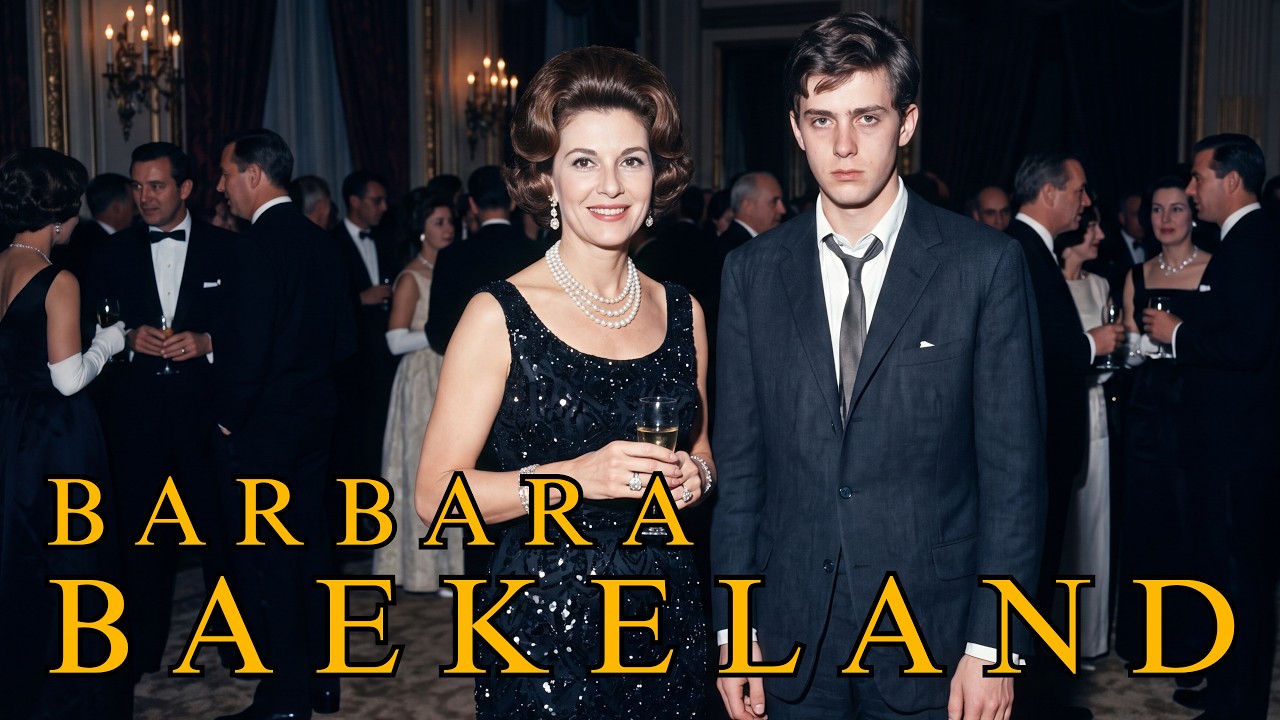
Brooks had discovered that being married to the most beautiful girl in the room did not cure his restlessness. Both of them within years were conducting affairs.
In the summer of 1954, the Bakelands stepped onto an ocean liner and effectively never came home again. Their life became European and seasonal.
Autumn and winter might mean Paris or London or the Swiss Alps. Summer meant the Mediterranean. They rented houses and villas the way other families rented beach umbrellas.
London, Paris, Gstaad, Klosters, Italy, Spain. From 1960 onward, their main base was an apartment in Paris. But the word base is generous. The Bakelands lived in motion.
The family fortune sat in stock and trusts that no Bakeland needed to touch with labor. Across two decades, the family kept the Manhattan apartment while renting in at least five countries.
Tony would attend schools in multiple nations before he was 15. No address in his childhood lasted longer than a season or two.
Brooks perfected the role of the writer who does not write. He was genuinely brilliant. He spoke of the great books he carried in his head. They stayed in his head.
In 1963, with his friend Peter Gimbel, Brooks Bakeland parachuted out of an airplane onto an unexplored grassy plateau 10,500 feet up in the Cordillera Vilcabamba of the Peruvian Andes. National Geographic published his account in 1964.
Brooks Bakeland would spend any sum and risk his life for an adventure that proved his superiority. The same man would later refuse on principle to pay for his son's psychiatric care.
Tony Bakeland grew up inside this gorgeous machine. A new house every season. Schools picked up and dropped. Friendships measured in weeks.
He was a beautiful, artistic, sensitive child. The people who met him remembered his gentleness. But no single adult outside the family watched Tony Bakeland grow up.
Around 1960, Brooks fell in love with a diplomat's daughter 15 years younger. He asked his wife for a divorce.
For Barbara, divorce was annihilation. Her entire identity was built on the marriage. Faced with losing it, she reached for the weapon her own father had taught her about in a Massachusetts garage.
She attempted to take her own life. Brooks ended the affair and stayed.
Barbara learned that her self-destruction was the one lever that could hold her husband. Brooks learned that he was hostage to her despair.
Both husband and wife took lovers through the 50s and 60s. The marriage had become an arrangement of mutual punishment held together by money, image, and Barbara's threats against her own life.
Tony was in the middle of it at every age from 8 to 20. His mother made him her companion, her confidant, her project, and her audience.
His father looked at this dreamy, fragile, artistic boy and found him wanting. One parent loved Tony like property. The other graded him like an examination.
In 1967, the season's villa was in Cadaqués, a fishing town on the Spanish coast that had become a Bohemian colony. Tony was 20 years old.
Tony fell in with a magnetic Australian named Jake Cooper. Cooper introduced Tony to hallucinogenic drugs. There were trips to Morocco to obtain them.
For a 20-year-old whose grip on reality was already loosening, heavy hallucinogen use was kerosene on a banked fire.
Barbara drove to Spain to bring Tony back to Switzerland herself. At the French border, the trip collapsed into farce. Tony had no passport. An argument boiled over, and mother and son were both arrested and briefly jailed.
Part of the problem was Tony's sexuality. He was gay or bisexual, and Barbara could not bear it.
Barbara's first solution was to find the right girl. A girl arrived. Her name was Sylvie. She entered the family's orbit as a companion for Tony with Barbara's encouragement.
Sylvie did become entangled with a Bakeland. It was not Tony. It was Brooks.
In February 1968, Barbara learned the truth. Her husband of a quarter century was leaving her, and the rival was a girl young enough to be her daughter.
Barbara attempted suicide again. This time she nearly succeeded. She was saved by her friend Gloria Jones.
The old lever was thrown one last time. This time it failed. Brooks did not come back.
He proceeded with the divorce, married Sylvie, and in time had a son with her.
The divorce settled into place in 1968. Money continued to flow enough to keep the villas and the appearances going. What stopped flowing was attention.
Barbara Daly Bakeland, 46 years old, divorced, her identity demolished, her drinking heavy, her depressions deepening. Anthony Bakeland, 21 years old, a mind beginning to fracture in earnest.
Tony Bakeland was gay or bisexual, and he came of age in a world that officially classified that as a disease. Until 1973, one year after Barbara's death, the American Psychiatric Association listed homosexuality as a mental disorder.
Barbara refused to accept her son's sexuality and set out to change it. The accounts collected from the family's circle state that she hired prostitutes to sleep with Tony.
Each failed attempt left Tony more humiliated and left Barbara more frantic.
The oral history of this family, the book Savage Grace, contains witness accounts alleging that in the summer of 1968 on the island of Majorca, Barbara took the final step in her so-called cure and had incestuous relations with her own son.
The principal source for the claim was Barbara herself. She told friends about it more than once in terms that framed it as therapy.
Not everyone believed her. Samuel Adams Green, the art curator who became Barbara's lover the following year, rejected the story outright. He acknowledged that Barbara told people she had slept with her son, but he wrote decades later that he did not believe she ever actually did.
The truth is unrecoverable. Both possibilities are devastating. Either a mother committed the deepest violation a parent can commit, or a mother found her son's sexuality so unbearable that she invented that violation as table talk.

Anthony Bakeland was developing schizophrenia. Through his early 20s, the signs accumulated. The paranoid turns, the voices and visions, the unraveling letters.
Schizophrenia is an illness, not a character. It was treatable even then. Proper care existed in 1970. It simply had to be paid for and pursued and sustained.
It was not. Brooks Bakeland regarded psychiatry with contempt. He called the profession amoral and would not support sustained treatment for his son.
By 1969, the people in their circle had stopped wondering whether something was wrong. They started wondering quietly how it would end.
In 1969, Barbara met Samuel Adams Green, the fashionable curator who had helped bring pop art and Andy Warhol to prominence. They began an affair. After roughly six weeks, he ended it.
That fall, back in New York, came the scene that everyone remembered. Barbara Daly Bakeland walked barefoot across Central Park in the snow, wearing nothing but a mink fur coat, to pound on Sam Green's door.
By the early 1970s, mother and son had settled in London in a penthouse at 81 Kdogan Square. The household's private record from these months includes knives, chokings, and terrors.
Then came late July 1972. On Kdogan Square itself, in public, Tony tried to throw his mother into oncoming traffic.
A friend of Barbara's, Susan Guinness, was there to pull them apart. The Metropolitan Police arrested Anthony Bakeland for attempted murder.
Four months before Barbara died, the British state had her son in custody, charged with trying to kill her. Barbara refused to press charges. The case evaporated.
Tony was admitted to the Priory, the famous private psychiatric hospital in southwest London. He was released soon afterward into the same flat with the same mother and the same unmedicated illness.
After the Priory, Tony was seeing a psychiatrist as an outpatient. The doctor watched his patient deteriorate.
On October 30, 1972, he warned Barbara directly that her son was capable of killing her. Not in code. He told her that Tony was capable of murder.
The record states that she dismissed it.
On her last evening alive, Barbara Bakeland told a dinner companion how happy her life with her son had become. The friend remembered her as radiant, full of plans.
By the end of the day, November 17, 1972, it was over.
At the penthouse, mother and son argued. The trigger, by Tony's own account, was almost nothing. He had invited a friend over. His mother did not want to see the friend.
The argument escalated. It turned physical. Tony struck his mother. Barbara ran for the kitchen. He followed her.
There was a kitchen knife. Anthony Bakeland, 26 years old, took it up and stabbed his mother.
Barbara Daly Bakeland, 51 years old, died on her kitchen floor almost instantly.
What happened next is the detail that has haunted everyone who has ever studied this case. Tony picked up the telephone.
When the Metropolitan Police arrived, Barbara was dead on her back on the kitchen floor. Her son was on the line, calm and unhurried, ordering Chinese food.
"My mind was slightly wacky," he told the police, "and I was very much under my mother's influence. I felt she was controlling my mind."
Tony was charged with murder and held at Brixton Prison to await trial.
Friends who came to see him reported the same unbearable detail. Tony would ask them courteously how his mother was doing. The man who had killed her did not consistently know she was dead.
The trial took place at the Old Bailey in June 1973. Tony's barrister was John Mortimer, one of the most celebrated defense advocates in Britain.
Mortimer met his client and found, in his words, a young man who was very gentle, calm, and nice.
The defense claimed that Tony's abnormality of mind substantially impaired his responsibility for the act. The evidence was overwhelming.
Anthony Bakeland was found guilty not of murder but of manslaughter on the grounds of diminished responsibility. He was committed indefinitely to Broadmoor, the high-security psychiatric hospital in Berkshire.
For the first time in his 26 years, Tony Bakeland was somewhere he could not leave under the continuous observation of doctors.
By the accounts that survive, Tony settled. He worked in the hospital's handicrafts shop. The gentle Tony predominated.
His father drew the opposite conclusion. Brooks Bakeland believed his son should have been convicted of murder in the first degree. He spoke of Tony as evil.
But there was one person who had never stopped believing that Tony could come home. She was Nina Daly, Barbara's mother, the grandmother from the Delmonico Hotel.
She was in her 80s. She was devoted. She was about to make the most catastrophic act of forgiveness in this entire story.
In July 1980, influence and good intentions opened Broadmoor's gates. Nina Daly anchored the campaign with her unconditional love. Strings were pulled at the American embassy.
On July 21, 1980, Broadmoor released him.
Anthony Bakeland was a 33-year-old man with schizophrenia who had killed his mother during psychosis. He was discharged with no meaningful plan for his care.
The household receiving him consisted of one person. Nina Daly. His grandmother was 87 years old. She lived alone in her apartment on New York's Upper East Side.
Tony's Broadmoor consultant would later concede the release had been a mistake.
In the apartment, Tony's behavior turned alarming almost at once. He had carried his mother's ashes home. Around them, he built a kind of shrine.
On July 27, 1980, six days after Broadmoor opened its doors, the pattern completed itself.
Tony wanted to place a telephone call to England. His grandmother said no. The argument rose, and Tony took up a kitchen knife and stabbed Nina Daly eight times.
She did not die. Nina Daly, who had forgiven her daughter's killer and staked everything on his redemption, survived her grandson's knife.
Tony was charged with attempted murder and sent to Riker's Island.
On March 20, 1981, he was brought to a hearing expecting release. The judge adjourned the case because Tony's medical records had still not arrived from England.
Tony was returned to his cell at 3:30 in the afternoon. Half an hour later, he was found dead.
He had suffocated himself with a plastic bag. The finding was suicide. He was 34 years old.
The substance that ended the Bakeland story was the same one that had begun it. Plastic.
Bakelite is still everywhere. It sits in museum cases and antique markets. Leo Bakeland is honored as the father of plastics.
The story itself survived because two writers refused to let it disappear. In 1985, Natalie Robins and Steven Aronson published Savage Grace, an oral history of the Bakeland family. It won the Edgar Award for the best fact crime book of its year.
In 2007, it became a film of the same name with Julianne Moore as Barbara and Eddie Redmayne as Tony.
Count the chances one last time.
A girl who watched suicide take her father in 1933 and was never helped to carry it.
A bride whose instability was known to one of New York's leading psychiatrists before the war.
A wife whose suicide attempts punctuated three decades without ever producing sustained treatment.
A boy who belonged to no school, no town, and no doctor long enough to be seen.
A father who would fund a parachute drop into the Andes but called psychiatry amoral and would not fund his son's mind.
A diagnosis of schizophrenia left to run wild.
An arrest for attempted murder withdrawn by the victim.
A private hospital that released him in weeks.
A doctor's warning given in plain words on October 30, 1972, that her son was capable of murder. Eighteen days.
A kitchen knife.
Seven years in Broadmoor.
A release bought by connections and sealed with no care plan at all. Six days.
Another knife. An 87-year-old woman stabbed eight times.
A plastic bag in a cell on Riker's Island.
Not one of those events was hidden. Every one of them was known at the time to people with the power and the money to act.
Barbara Daly Bakeland. 51 years at her death. Eleven of them lived before her father's garage. Thirty of them spent performing a happiness she rarely felt.
Anthony Bakeland. 34 years at his death. Perhaps ten of them lived inside an untreated illness. Seven of them the calmest he ever knew, spent behind the walls of Broadmoor.
Nina Daly. 87 years old when her grandson's knife found her. The survivor of a husband's suicide, a daughter's murder, and eight stab wounds. Still unwilling to stop loving any of them.
Whatever else this story is, it is not a story about people who did not love each other. It is a story about what love becomes when nothing outside it is ever allowed in.
Money bought the Bakelands an exemption from scrutiny, from intervention, from consequence, and finally from rescue. The same walls keep out both.
Barbara Bakeland did not die for lack of resources. She died of perfect insulation.
Her son did not deteriorate in darkness. He deteriorated in full view behind glass too expensive to break.
The plastic her family gave the world was celebrated as the material of a thousand uses. The fortune it earned had only ever won one use.
To keep the world out.
It worked until the end.