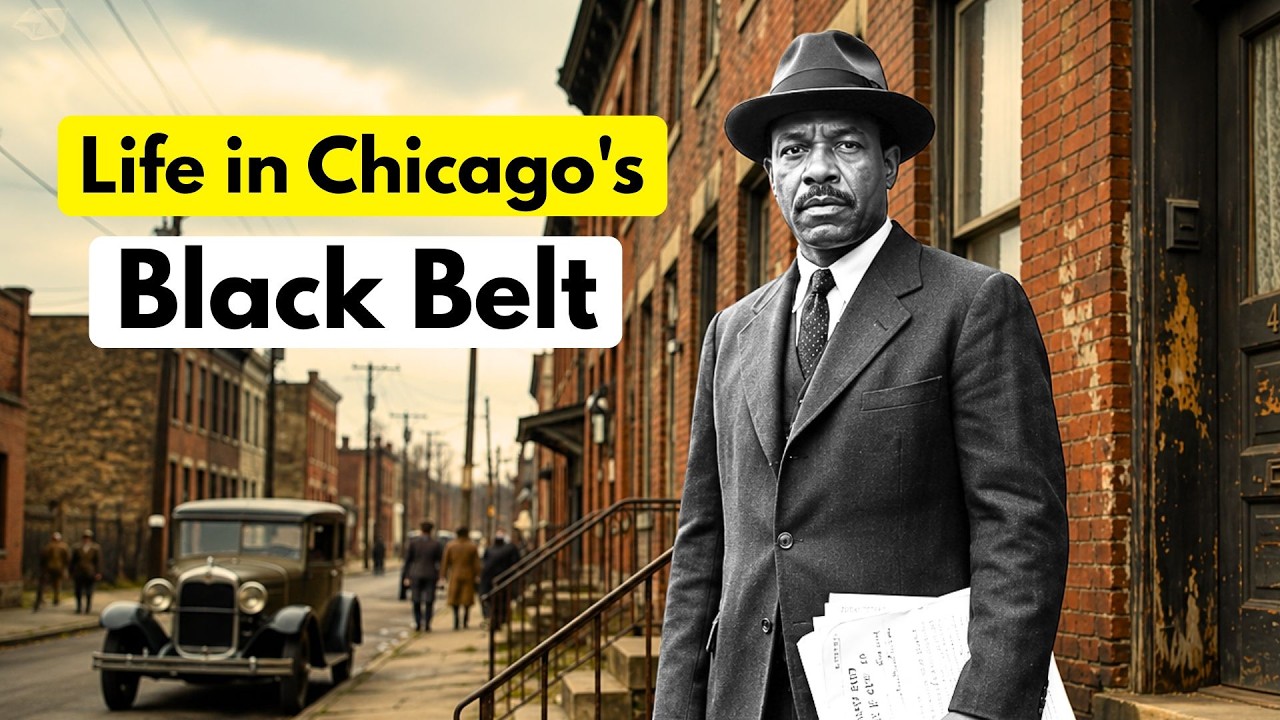
By 1932, roughly 234,000 Black residents of Chicago were confined to a narrow strip of aging housing on the South Side known as the Black Belt. The corridor stretched about 40 blocks along State Street, rarely more than seven blocks wide, despite the fact that the city’s Black population had grown from just over 30,000 in 1900 to nearly 110,000 by 1920 and 233,903 by 1930. Almost all of those new arrivals had been steered by law and practice into the same cramped district, a ghetto built not by segregationist law alone, but by private contracts enforced through the courts. Racial restrictive covenants were the legal mechanism that turned the Black Belt into a trap.
In 1926, the U. S. Supreme Court ruled in Corrigan v. Buckley that it had no authority to invalidate such agreements because they were private contracts between individuals, not government action.
Within months of that ruling, restrictive covenants spread rapidly and in coordinated fashion through the neighborhoods surrounding the Black Belt. Property owners signed agreements pledging not to sell or rent homes to Black families. These agreements were recorded in the county registry, enforceable in court, and entirely public. They surrounded the Black Belt on every side.
The district could not expand; it could only become more crowded. The case of Carl Hansberry, father of playwright Lorraine Hansberry, demonstrated how the covenants worked in practice. Hansberry purchased a property at 6140 South Rhodes Avenue in 1937, despite the fact that the property was covered by a restrictive covenant. White neighbors immediately sued to force the family out.
The case reached the U. S. Supreme Court, which ruled in Hansberry’s favor in 1940 on a technicality: not enough property owners had signed that particular agreement for it to be legally valid. The Court did not declare the covenants unconstitutional.
Racially restrictive covenants remained legally enforceable in Chicago until the Supreme Court’s 1948 ruling in Shelley v. Kraemer. Inside the Black Belt, the results of this confinement were documented in exhaustive detail. The Chicago Housing Authority’s surveys of kitchenette buildings in the late 1930s found that nearly 45 percent of tenants were paying more than 30 percent of their income in rent, at a time when financial advisors recommended spending no more than 20 percent.
White tenants in comparable buildings paid roughly half of what Black families were charged for similar space. Landlords did not justify the higher rates with better conditions; the buildings were older, worse maintained, and less costly to acquire than equivalent housing in white neighborhoods. The higher rents were possible simply because Black tenants had no legal alternative. Landlords subdivided apartments into illegal kitchenettes, thin-walled units carved out of larger flats.
A single three-bedroom apartment could be divided into three separate units, each with a small electric stove placed in a closet and access only to a shared hallway bathroom. The landlord could collect three times the rent the original apartment would have generated. Thousands of buildings across the Black Belt were converted this way. The buildings often lacked central heating, so tenants relied on kerosene lamps and makeshift stoves that overheated dangerously.
Approximately 750 fires occurred in the Black Belt in a single year during this period, many of them deadly. The city’s building codes existed, but fines were so small that paying them proved more profitable than making repairs. Federal photographers documented the physical reality of this housing. Farm Security Administration photographer Russell Lee visited the Black Belt in April 1941 and photographed interiors showing concrete floors, unmade mattresses, multiple children sharing one bed, and a basement toilet described in the caption as a bathroom for an apartment building rented to Black tenants.
Richard Wright, who lived in the Black Belt and wrote about it in his 1941 book “12 Million Black Voices,” described the kitchenettes as places where five or six people sometimes lived in a single room, and as a funnel through which crushed lives flowed toward ruin and death on the city’s sidewalks for the sake of profit. The economic toll extended beyond rent. In 1932, while the national unemployment rate stood around 24 percent, unemployment in the Black Belt ranged from 40 to 50 percent. Black professionals in Chicago faced unemployment five times higher than white professionals; skilled and clerical Black workers faced rates three times higher; unskilled workers, twice as high.
Between 30 and 50 percent of Black Belt families received public relief, compared with 10 to 20 percent in surrounding white immigrant neighborhoods. Relief payments themselves were often unequal: in Chicago, as in other cities, white families received higher allocations than Black families of the same size. The consequences of mass unemployment and unpayable doubled rents exploded into open violence on August 2, 1931. When police arrived to evict 72-year-old Diana Gross from her South Side apartment for nonpayment of rent, a crowd had already gathered outside her building.
The crowd began carrying her furniture back inside. Police responded, and in the confrontation that followed, two Black men were shot dead and a third died later. Their bodies were taken to a railway station for shipment, accompanied by six Black and white workers wearing red armbands and followed by thousands of mourners carrying wreaths and, according to contemporary newspapers, inflammatory placards. Gross was returned to her apartment.
The evictions continued. The protests were not spontaneous. The Communist Party USA had organized resistance to evictions through local branches called Unemployment Councils, which met in church halls and storefronts across the Black Belt. By 1932, the Party claimed 150,000 members in such councils across 340 American cities.
In 1932, the Chicago city government ordered the anti-eviction movement to cease. A representative of the Chicago Real Estate Board was quoted in press coverage at the time as saying, “Real estate men are sympathetic with the situation of the unemployed in the Black Belt. ”
Sociologists St. Clair Drake and Horace Cayton, whose 1945 study “Black Metropolis” remains the definitive account of the community, described the Black Belt as a city within a city, a place geographically inside Chicago but denied equal access to the city’s parks, beaches, hospitals, schools, and labor market.
What residents had was each other, the forty blocks, and the institutions they built inside those boundaries because the institutions outside refused to serve them. Within those forty blocks, a remarkable institutional infrastructure emerged under extreme strain. Jesse Binga ran Binga State Bank, one of the few Chicago financial institutions that extended loans to Black borrowers. Anthony Overton built a cosmetics and manufacturing empire from Bronzeville that employed hundreds and distributed nationally.
The Chicago Defender, founded by Robert Abbott in 1905, became the most influential Black newspaper in the country, its circulation reaching deep into the South, where it was distributed secretly because some Southern states considered its content dangerous. The policy racket, an illegal numbers lottery that operated openly throughout the Black Belt with the tolerance of city authorities, employed thousands during the Depression when legitimate jobs collapsed. Drake and Cayton estimated that about 20 percent of the large Black-owned businesses in Bronzeville were owned by policy operators, with the profits reinvested in the clubs, theaters, and enterprises that provided employment when nothing else did. DuSable High School, located in the Black Belt, enrolled more than 2,000 students by 1935.
It was overcrowded and received a fraction of the resources that comparable white Chicago schools received. Its graduates went on to become musicians, writers, athletes, and professionals who shaped American culture for the rest of the century. The wall finally cracked on May 3, 1948, when the U. S.
Supreme Court ruled in Shelley v. Kraemer. The case began in St. Louis, where a Black family named Shelley purchased a home covered by a racial restrictive covenant.
White neighbors sued to enforce the agreement and remove the family. The Missouri Supreme Court ruled in favor of the neighbors. The U. S.
Supreme Court reversed that decision. Chief Justice Fred Vinson wrote for a unanimous Court that while individuals could enter into restrictive agreements, courts could not enforce them without violating the Equal Protection Clause of the Fourteenth Amendment. Judicial enforcement of a private discriminatory agreement constituted government action, and government action discriminating on the basis of race was unconstitutional. The covenants that had confined more than 200,000 people to forty blocks were no longer legally enforceable.
Integration did not follow immediately. White homeowners in Chicago organized neighborhood associations, deployed violence and intimidation, and later used new financial mechanisms, scare tactics by real estate agents, and discriminatory mortgage practices by banks and the Federal Housing Administration to maintain residential segregation by informal means after the formal legal tools were removed. Shelley cracked the wall; it did not demolish it. The crack created movement.
In 1944, only 10 percent of the 337,000 Black Americans in Chicago lived outside the Black Belt. After 1948, that percentage began to shift. Families who had spent decades confined to those forty blocks slowly, and despite continued resistance, began moving into adjacent neighborhoods. By 1960, 850,000 Black residents lived in Cook County, a population the old Black Belt could no longer physically contain, regardless of what the covenants had once required.
The Black Belt of 1932—with its kitchenettes, fires, rats, doubled rents, the Regal Theater, the Chicago Defender, policy kings, Unemployment Councils, and the two men shot dead over an elderly woman’s furniture—was the product of a deliberate, legal, continuous, and profitable policy. The law that created it changed more slowly than the people who lived within it deserved.