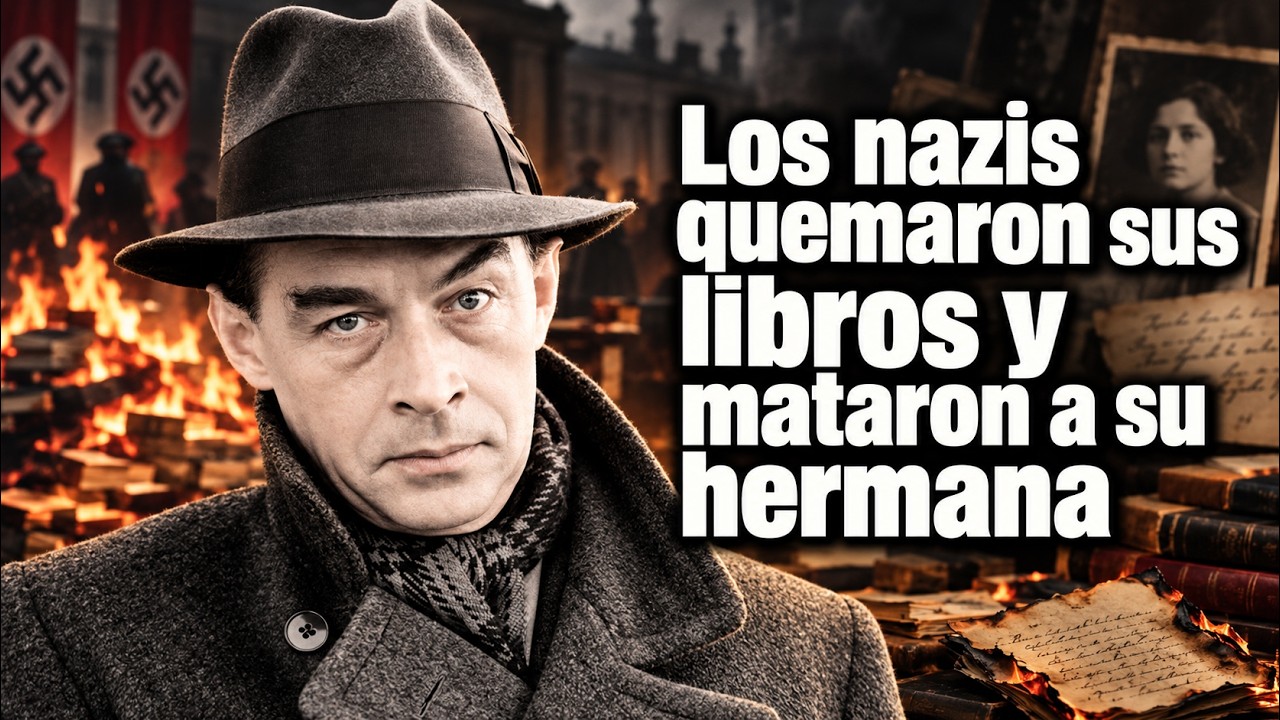
On the night of May 10, 1933, tens of thousands of people gathered around a bonfire in Berlin’s Opera Square. Bands played, torches crackled, and trucks unloaded mountains of books seized from libraries and bookshops. A young man in uniform stepped forward, raised a volume, and proclaimed he was surrendering it to the flames for literary betrayal of the soldiers of the Great War.
The book fell into the embers. Its author was not there. He was living on the other side of the Alps, beside a Swiss lake. That night, works by dozens of writers burned, but this book was different. Millions of readers around the world had recognized in its pages the truth of the trenches, and the new regime needed to reduce that memory to ashes.
The author was Erich Maria Remarque, and the book was “All Quiet on the Western Front.”
Remarque was born Erich Paul Remark on June 22, 1898, in Osnabrück, Germany. He grew up in a modest Catholic household. His father, Peter Franz Remark, was a bookbinder, and his mother, Anna Maria Remark, devoted much of her attention to his older brother Theodor, who was sickly from birth. Theodor died in 1901 at age five, and Erich, then three, suddenly became the eldest child.
The family moved often, always in search of cheaper rent. But the father’s trade meant books were always present in the home. Erich grew up surrounded by paper and leather, and he found refuge in reading. He was a quiet student with no special brilliance, but he developed a deep passion for literature, music, and painting.
In 1912, at age 14, Erich entered a Catholic teacher-training school in Osnabrück. The discipline was strict, and the program was demanding. But what truly mattered to him happened outside the classroom. He joined a small circle of young artists who met in the attic of a painter and poet named Fritz Hörstemeier. They called it the “attic of dreams.” There, Erich found the first adult who took his ambitions seriously.
Fritz encouraged him to write. Under that influence, Erich began composing poems and short stories. In 1916, one of his first texts appeared in a local newspaper.
The war changed everything. Erich received his call-up papers in November 1916, just after turning 18. He was sent to the Western Front in June 1917, assigned to a reserve division in Flanders. His unit was engaged in construction and repair work behind the lines, digging trenches and laying wire under constant artillery fire.
On July 31, 1917, during the opening of the Third Battle of Ypres, shrapnel struck him in the left leg, right arm, and neck. He was 19 years old and had been at the front for barely seven weeks. He was evacuated to a hospital in Duisburg, where he spent more than a year recovering.
While he was in the hospital, his mother died of cancer on September 9, 1917. She was not yet 50. Erich could not be at her side. Shortly afterward, Fritz Hörstemeier also died. Within months, Remarque had lost his mother, his mentor, and many comrades.
In grief, he made a decision that carried deep meaning. He began signing his writings with a new name. He dropped the middle name Paul and adopted his mother’s name, Maria. From then on, he was Erich Maria Remarque.
The war ended in November 1918. Remarque returned to Osnabrück, completed his teaching certificate, and worked briefly in rural schools. But he clashed with authorities and left teaching in 1920. That year, he published his first novel, “The Dream Room,” a sentimental book dedicated to the memory of Fritz Hörstemeier. It attracted little attention, and Remarque later tried to buy back remaining copies.
He drifted through a series of jobs. He sold tombstones, gave piano lessons, played the organ at a psychiatric hospital, and wrote theater reviews. In 1922, he moved to Hanover and found work as a copywriter for Continental, a rubber and tire company. He learned to write clearly and efficiently. He also developed a lifelong passion for fast cars.
In 1925, Remarque moved to Berlin and became a journalist for the magazine “Sport im Bild.” He reinvented himself as a dandy. He wore a monocle, dressed in expensive suits, and even paid a bankrupt nobleman to adopt him so he could use a title. He married Jutta Zambona, a dancer, in 1925. The marriage was stormy from the start.
Beneath the mask, Remarque was gathering material. He kept notebooks filled with gestures, conversations, and details of the people he observed. In 1927, he published a novel about a race car driver, “Station at the Horizon.” It was not a success.
In late 1927, Remarque sat down at a typewriter in his Berlin apartment and began writing something different. He wrote about a group of 19-year-old soldiers resting behind the front line, their bellies full for the first time in weeks because half their company had died and the cook had prepared food for everyone.
He wrote quickly, almost without stopping. The manuscript was finished in about six weeks.
The novel was “All Quiet on the Western Front.” Its protagonist, Paul Bäumer, is a student who enlists with his classmates, pushed by patriotic speeches from their teacher. On the front, he discovers that everything he was taught is worthless. One by one, his friends die from shrapnel, gas, and infection. There are no heroic battles, no generals, no grand strategies. There is only mud, hunger, rats, lice, fear, and absurd, unpredictable death.
The book was first rejected by the prestigious publisher S. Fischer, whose editor believed no one wanted to read about the war ten years later. It was then accepted by Ullstein, a large publishing group, which published it in serial form in a newspaper beginning November 10, 1928, on the eve of the armistice anniversary.
The reaction was immediate. Newspaper sales multiplied. Letters arrived from veterans who recognized themselves in every page. The book was published in volume form on January 29, 1929, and sold more than a million copies in Germany in its first year. Translations appeared around the world. In Spain, it was published the same year as “Sin novedad en el frente.”
The success transformed Remarque’s life. He left journalism, bought luxury cars, and began collecting Impressionist and Post-Impressionist paintings. He acquired works by Renoir, Degas, Cézanne, Van Gogh, Monet, and Pissarro. He divorced Jutta in 1930 but continued to support her.
The success also brought hatred. Nationalist newspapers and right-wing veterans’ groups attacked Remarque, accusing him of defiling the memory of German soldiers. Rumors spread that he had never been at the front, that he had stolen a dead comrade’s diary, that his real name was Kramer, that he was Jewish. None of it was true. His family was Catholic, and his war wounds were documented in military archives.
In 1931, Remarque’s name was proposed for the Nobel Prize in Literature. The German Officers’ Association protested. The prize went to someone else.
The American film adaptation of “All Quiet on the Western Front,” directed by Lewis Milestone, won the Academy Awards for Best Picture and Best Director in 1930. When it reached Germany, Joseph Goebbels, then the Nazi Party leader in Berlin, organized disturbances at screenings. On December 11, 1930, German censors withdrew the film’s authorization, claiming it damaged Germany’s prestige.
Remarque published a second novel, “The Road Back,” in 1931. It told the story of soldiers returning home in 1918, unable to adapt to civilian life. It was another success and brought more fury.
His position in Germany became increasingly uncomfortable. In 1931, he bought a villa in Porto Ronco, a small Swiss village on Lake Maggiore. He began spending more time there, away from Berlin.
On January 30, 1933, Adolf Hitler was appointed chancellor. Remarque left Germany around that time, driving south across the Swiss border. He never lived in Germany again.
In the months that followed, the Nazi regime moved quickly. Books were seized and burned in cities across Germany. On the night of May 10, 1933, in Berlin, Goebbels spoke to the crowd gathered around the fire. Students threw books into the flames, each with a prepared formula. For Remarque, the formula denounced “literary betrayal to the soldiers of the Great War.”
From his house by the lake, Remarque watched his country transform. He drank heavily, slept poorly, and wrote in his diary about the despair of the situation. He helped German exiles who crossed into Switzerland, often providing financial support discreetly.
In 1936, he finished “Three Comrades,” a novel about three former soldiers running a small auto repair shop in a German city hit by crisis. One of them falls in love with a young woman named Pat who has tuberculosis. The book was first published in Danish because it could not appear in Germany.

In January 1938, Remarque married Jutta Zambona for a second time. It was a marriage of convenience, intended to protect her from being sent back to Germany. The couple later obtained Panamanian passports.
In 1938, Remarque was stripped of his German citizenship. He noted the news in his diary with irony, saying it was practical because no one could intern him as a German when the next war came.
In September 1937, at the Venice Film Festival, Remarque met Marlene Dietrich. The German actress, who had also rejected the Nazi regime, was in the company of director Josef von Sternberg. They began a passionate and tormented relationship that would last for years.
Dietrich was surrounded by a circle she called her family, including her husband, her lover, her daughter, and former lovers. Remarque became part of that strange entourage. He wrote her letters filled with devotion, calling her “Puma.” She called him “Ravik,” after the protagonist of the novel he was writing.
The relationship was marked by jealousy and humiliation. Dietrich had affairs with other men, including James Stewart and later Jean Gabin. Remarque suffered, drank, and continued writing.
In August 1939, Remarque sailed from Europe to New York as war broke out. He moved to California to be near Dietrich, but Hollywood made him feel like a stranger. After Pearl Harbor, he was subject to restrictions as a German national, despite having lost his citizenship. He tried to join the U.S. Army but was rejected due to his old war wounds.
In 1941, Remarque published “Love Thy Neighbor,” a novel about refugees without papers in the 1930s. His major work of those years was “Arch of Triumph,” published in 1945. It is set in Paris before the war and follows Ravik, a German surgeon living without papers, and his love for Joan Madou, a beautiful and elusive actress. Readers recognized Dietrich in the character.
The relationship with Dietrich ended for good when she began living with Jean Gabin. Remarque wrote her a farewell letter in 1941. In his diary, he described seeing her doing housework at Gabin’s home and wrote a single word of contempt: “housewife.”
Remarque moved to New York, where he found a community of European exiles. He continued writing and drinking.
In 1943, his younger sister, Elfriede Scholz, was arrested in Dresden. She had made comments about the war being lost and about Hitler. She was denounced by people in her circle. On October 29, 1943, she was tried before the People’s Court in Berlin, presided over by Roland Freisler, known for his brutality. She was sentenced to death and executed by guillotine on December 16, 1943. She was 40 years old.
Her family later received a bill from the Reich for the costs of the trial, imprisonment, and execution. The amount was 495 marks and 80 pfennigs.
Remarque did not learn of his sister’s death until after the war. The news devastated him. He was convinced she had died because of his books. He had escaped, lived in villas and hotels, while she remained in Germany and died in his place.
In 1947, Remarque became a U.S. citizen. He returned to his villa in Porto Ronco in 1948. He did not reclaim German citizenship.
In 1952, he published “Spark of Life,” a novel set in a concentration camp in the final weeks of the war. He dedicated it to his sister Elfriede. The book was based on years of research and testimony from survivors. In Germany, it was received coldly. Many readers did not want to confront the recent past.
In the early 1950s, Remarque began psychoanalysis with Dr. Karen Horney in New York. He explored his childhood, his need for love, and his tendency to fall for women who made him suffer.

Around this time, Paulette Goddard re-entered his life. The actress, known for her roles in Charlie Chaplin’s “Modern Times” and “The Great Dictator,” was warm, practical, and cheerful. She helped Remarque drink less, find routine, and rediscover simple pleasures. He described her in his diary as a joy and as the woman who had saved him.
In 1954, Remarque published “A Time to Love and a Time to Die,” his first novel set on the Eastern Front of World War II. It follows a young German soldier who returns home on leave to find his city destroyed. In 1958, the novel was made into a film, and Remarque played a small role as a teacher who hides persecuted people.
In 1956, he published “The Black Obelisk,” set in 1923 during the hyperinflation. The protagonist works in a tombstone company, a clear echo of Remarque’s own years in Osnabrück.
In February 1958, Remarque married Paulette Goddard. He was 59. They settled in Porto Ronco, and the villa became a true home. Paulette filled it with friends, laughter, and flowers. She introduced him to Zen Buddhism, which helped calm his fear of death.
In 1962, Remarque published “The Night in Lisbon.” The novel is set in Lisbon in 1942, where refugees wait for ships to America. A stranger offers a destitute emigrant two tickets in exchange for listening to his story through one night. It is a story of love, loss, and fidelity, written with the restraint of maturity.
In the mid-1960s, Germany began to change. The generation born after the war started asking questions about the past. Remarque’s reputation improved. Osnabrück awarded him its highest honor, the Justus Möser Medal. In 1967, the Federal Republic of Germany gave him the Grand Cross of the Order of Merit. He accepted it politely but without enthusiasm. He remained a U.S. citizen.
In his final years, Remarque worked on a novel about European exiles in New York during World War II. It was published after his death in 1971 as “Shadows in Paradise.”
Remarque’s health declined steadily. He suffered heart problems, strokes, and the effects of decades of drinking. In the summer of 1970, he was admitted to a clinic in Locarno, near his home. He died on September 25, 1970, from an aortic aneurysm. He was 72.
He was buried in the small cemetery of Porto Ronco, on a hillside overlooking Lake Maggiore. Paulette Goddard died in 1990 and was buried beside him.
Remarque’s work outlived him. “All Quiet on the Western Front” remained one of the most widely read books about war. New film adaptations were made, including one in the 21st century that won Academy Awards. Osnabrück created a peace prize in his name and established a research center dedicated to his life and work.
Throughout his life, Remarque changed his name, his country, his profession, and his appearance. He bought a noble title, wore a monocle, and dressed like an aristocrat. He seemed to be a man in permanent flight.
But he never fled from one thing. Everything he wrote for nearly half a century returned to the same places and the same people. The young men who died in Flanders. The mother who died without a farewell. The friend from the attic of dreams. The comrades of the front. The refugees without papers. The sister executed in Berlin.
His changes of name and country were only the surface. In the depths, Remarque remained faithful to his dead. He never betrayed them in a single page.
When a journalist asked him, in his final years, what sense he found in his anti-war novel after an even more terrible war had followed it, Remarque did not answer with bitterness. He said he knew very well that his book had not prevented a new war. But precisely because of that, he said, one had to keep believing. If one stopped believing in the possibility of progress, nothing was left.
He was not speaking as a naive man. He knew firsthand the human capacity for destruction. His faith came not from optimism but from necessity.
The Nazis burned his books, took his homeland, and killed his sister. They wanted to erase him from history. Instead, he became part of it. Every time a reader opens “All Quiet on the Western Front,” the young men of Flanders live again for a few hours. That is the silent victory of Erich Maria Remarque.