The 1962 royal premiere of *Lawrence of Arabia* at the Odeon Leicester Square in London almost never happened. Days before the screening—set for December 10th, with members of the royal family expected and the world’s press assembled—one of the only existing 70mm prints was severely damaged in transit. Producer Sam Spiegel’s team coordinated an international race to secure a replacement in near-total secrecy, determined to avoid any hint the evening was in jeopardy. The replacement arrived just in time, and the audience never knew how close the night had come to collapse.
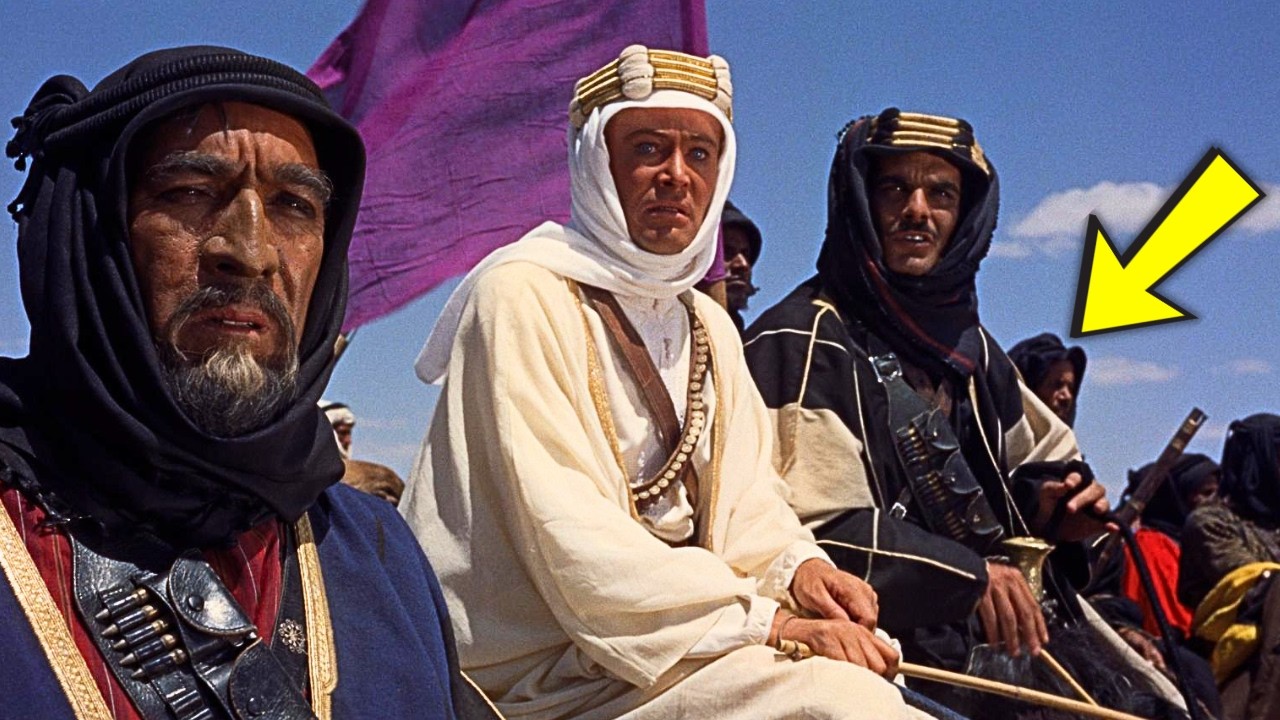
The film had tested the limits of endurance at every stage of its creation. Before Peter O’Toole ever set foot in the desert, the casting process had nearly produced a completely different picture. Marlon Brando was seriously considered for the lead, a prospect that fascinated those close to the project. Albert Finney went further, undergoing extensive screen tests and coming close to accepting the role before turning it down, reportedly unwilling to commit to the long-term contract Spiegel required.
Only then did the relatively unknown stage actor O’Toole enter the picture, with director David Lean seeing something others had missed. O’Toole brought an otherworldly quality—part charisma, part fragility—that a more established star might never have delivered. Cinematographer Freddie Young worked with lens manufacturers to create a custom telephoto lens for what became one of cinema’s most studied shots: a distant figure emerging from a shimmering heat haze. Standard lenses could not capture the mirage effect at the required distance.
The extraordinary lens, one of the longest ever used on a film set at the time, allowed the atmosphere between lens and subject to do the work, creating a result that felt less like photography and more like hallucination. Behind the celebrated screenplay lies a story of injustice that took decades to correct. Robert Bolt received sole screenwriting credit upon release, while the contributions of Michael Wilson—who had worked extensively on the script before Bolt’s involvement—were erased. Wilson had been blacklisted during the Hollywood Red Scare of the 1950s, and his name was considered too controversial for a prestige production of that scale.
The Writers Guild of America lacked jurisdiction over a British production, so Wilson’s contribution was deliberately buried. The Guild finally restored his credit in 1995. Wilson had died in 1978, never receiving public acknowledgement during his lifetime. Few challenges on location came close to the physical ordeal of camel riding.
Cast members had to learn to ride animals that were unpredictable, uncooperative, and significantly taller than horses. Peter O’Toole bore the brunt of it: scenes requiring speed across open desert were filmed repeatedly, and the camel’s distinctive rocking gait left cast members struggling between takes. Several actors developed serious saddle sores and muscle injuries, with some resorting to creative padding solutions. What looks effortless on screen was anything but.
Operating a film set in the Jordanian desert, hours from the nearest town and with hundreds of cast and crew needing three meals a day, was a logistical operation as remarkable as anything on screen. Temperatures regularly exceeded 120 degrees Fahrenheit, and water had to be imported in vast quantities and carefully rationed. Food supplies were transported by truck over terrain that barely qualified as road, and menus were planned around what could survive the journey without spoiling. A dedicated catering team prepared meals in open desert heat while managing supply chains that stretched back to civilization.
Production was split across multiple countries, with Spain chosen for several key sequences. Before filming could properly begin near Seville, the region was struck by catastrophic flooding—one of the worst in years. Roads were destroyed, equipment was placed at risk, and the schedule was thrown into disarray. Production designers and location managers worked quickly to assess the damage and identify what could still be used, forcing the production to reinvent itself against a changing landscape.
Editor Anne V. Coates discovered the film’s famous match cut—from a blown-out match to a blazing desert sunrise—during post-production, not in the original plan. The original intention had been a more conventional transition, but when she placed the two images together, something extraordinary emerged. David Lean recognized it immediately.
The cut went on to influence generations of filmmakers, and Coates won the Academy Award for her work, with the transition frequently cited as a central reason. When the script called for the assault on Aqaba, the real city no longer resembled the Ottoman-held town of World War I. The production built the entire location from scratch on the coast of southern Spain near Carboneras in Almería. Set designers and builders worked for months to erect a full-scale version of the town as it might have appeared in 1917, complete with period-accurate architecture and fortifications.
The finished set was so persuasive that many viewers still assume the Aqaba scenes were filmed in the Middle East. They were not. The on-screen charge on Aqaba reads as a vast military assault, but the sequence was achieved with a fraction of the forces it appears to depict. By filming the same groups of riders from multiple angles at varying distances and speeds, the editing room assembled a sequence that reads as far larger than it was.
Carefully chosen camera positions made small clusters of riders appear part of an endless wave. Dust, motion, and cutting rhythm did the rest. Spain’s authorities refused to allow the professional camel handlers who had worked with the animals in Jordan into the country, due to agricultural and livestock import regulations. The production found itself with camels and no one qualified to handle them.
Local Spanish workers were recruited and given crash courses in camel handling—an animal almost none had encountered before. The slight unpredictability of the animals gave certain scenes a rawness that rehearsed precision might have smoothed away. Omar Sharif’s role in the production extended well beyond his performance as Sharif Ali. Born in Egypt and fluent in Arabic, he became an indispensable communication link between the English-speaking production team and the Arabic-speaking extras, local crew, and hired workers.
David Lean needed instructions relayed quickly and accurately to large groups of extras who spoke no English. Sharif stepped into the gap naturally, moving between languages and cultures with an ease no one else on the production could match. Getting heavy 70mm camera equipment across soft sand and rocky desert required improvised solutions. Conventional vehicles couldn’t manage the ground, and fine sand particles found their way into everything.
Custom-built platforms were mounted on vehicles capable of handling desert terrain, and for static setups, equipment was sometimes carried by hand. The physical effort of placing a single camera for a single shot could take hours. Cinematographer Freddie Young later described the physical challenge as something no studio background could prepare crew for. Decades later, restoration teams discovered that the desert had physically burned its presence into the footage.
Heat-induced imperfections appeared as irregularities in the emulsion—subtle but unmistakable to trained eyes. The damage varied depending on how long specific reels had been stored in the field and whether they had been exposed to direct sunlight. Some described it as the desert leaving a fingerprint on the film, proof written into the image that the landscapes were not fabricated. At its world premiere, the film ran approximately 227 minutes, nearly four hours with an intermission.
Audiences responded with extraordinary praise, and the film won seven Academy Awards. But within months of release, approximately 20 minutes were cut before wider distribution—a decision made not by Lean but by the studio responding to commercial pressures. The original negative had been physically cut as well, meaning the missing material wasn’t simply sitting in a vault. A major restoration effort in the late 1980s, led by Steven Spielberg and producer Robert Harris, reconstructed the original version as closely as possible.
The restored version, released in 1989, came remarkably close to the 1962 premiere, but recovering it took years of detective work. Cameras rolled for well over a year across Jordan, Spain, and Morocco, generating enough raw material for multiple features. Editing was an act of radical reduction, with Anne V. Coates distilling months of footage into a coherent narrative.
Entire sequences that had taken days to shoot were set aside. The film that ended up on screen was not the only story the footage could have told. The score that became one of the most recognizable in cinema history was written under extraordinary pressure. Composer William Walton withdrew late in the process, and the relatively little-known French composer Maurice Jarre was brought in with an impossibly tight deadline.
He completed the entire score in approximately six weeks. Jarre won the Oscar for best original score. The urgency may have worked in the film’s favor: a longer gestation might have produced something more considered but less visceral. The famous desert sunrise sequence required the crew to be in position before dawn, waiting for conditions that could not be manufactured.
The first attempt failed, then another. Cloud cover, atmospheric haze, and incorrect positioning conspired to deny the crew the precise image Lean envisioned. The shot that eventually emerged became one of the defining images of the film. By the time of the royal premiere, Lean had not experienced the picture as a continuous whole in proper viewing conditions.
The editing process had been intense and fragmented, with reels reviewed in isolation. Lean walked into one of the most prestigious premieres in history without the certainty that usually accompanies a finished work. The premiere was, for its own director, partly a first viewing. The sound team deliberately challenged conventions of the era, using silence and spatial contrast in ways that felt to early audiences not bold but broken.
Some preview audiences assumed moments with reduced or absent ambient sound were technical errors. In time, those choices came to be understood as among the film’s most sophisticated achievements. Upon release, the film faced criticism from multiple directions. Arab audiences objected to the way their history had been interpreted through a Western lens.
Several Arab countries restricted or outright banned the film. The controversy never significantly damaged the film’s standing in Western critical circles, but it did ensure that its legacy remained complicated in the regions it depicted. Several Arab roles were cast with non-Arab actors. The most discussed example involves Alec Guinness portraying Prince Faisal, a central historical figure.
At the time, the practice was standard industry behavior. The shift in perspective has been significant enough that the casting is now routinely raised whenever the film is discussed in depth. For years, trivia circulated that David Lean had appeared in his own film. The claim is almost true but not as most assume.
Lean’s voice gives the command during the motorcycle scene near the opening. Screenwriter Robert Bolt, however, does actually appear in a small visible role, spotted as one of the characters in the background of a Cairo scene. When the decision was made in the late 1980s to restore the film, the original negative had been physically cut. Material removed from distribution had been separated, mislabeled, and in some cases lost within the studio archive system.
The restoration team functioned less like technicians and more like investigators, sourcing print elements from multiple countries. What emerged was not a perfect reconstruction but a remarkably close one. Some scenes had survived in picture but not in audio. For the most significant of these, the team re-recorded dialogue with the original actors where possible.
Peter O’Toole and other surviving cast members returned to the studio decades after filming to loop lines for sequences performed in the Jordanian desert in the early 1960s. The results, while impressive, are audible to careful listeners as a subtle disconnect between image and sound. Somewhere between the desert where it was filmed and the present day, small pieces were lost that no amount of effort could fully recover.