At dawn, a girl was found standing in the icy stream, feet sunk in water so dark it seemed to drink the light, singing a hymn in no language found in any book. Behind her, on the slope, the windows of an old convent glowed warmly, lit as though the building were full of people preparing for morning prayer—except no one had lived there in forty years. The doors had been chained shut long before the girl’s mother was born. This is the story of the Hill Hollow nuns, a religious order that entered those mountains in the winter of 1878, buried far more than they ever admitted, and vanished within a single season.
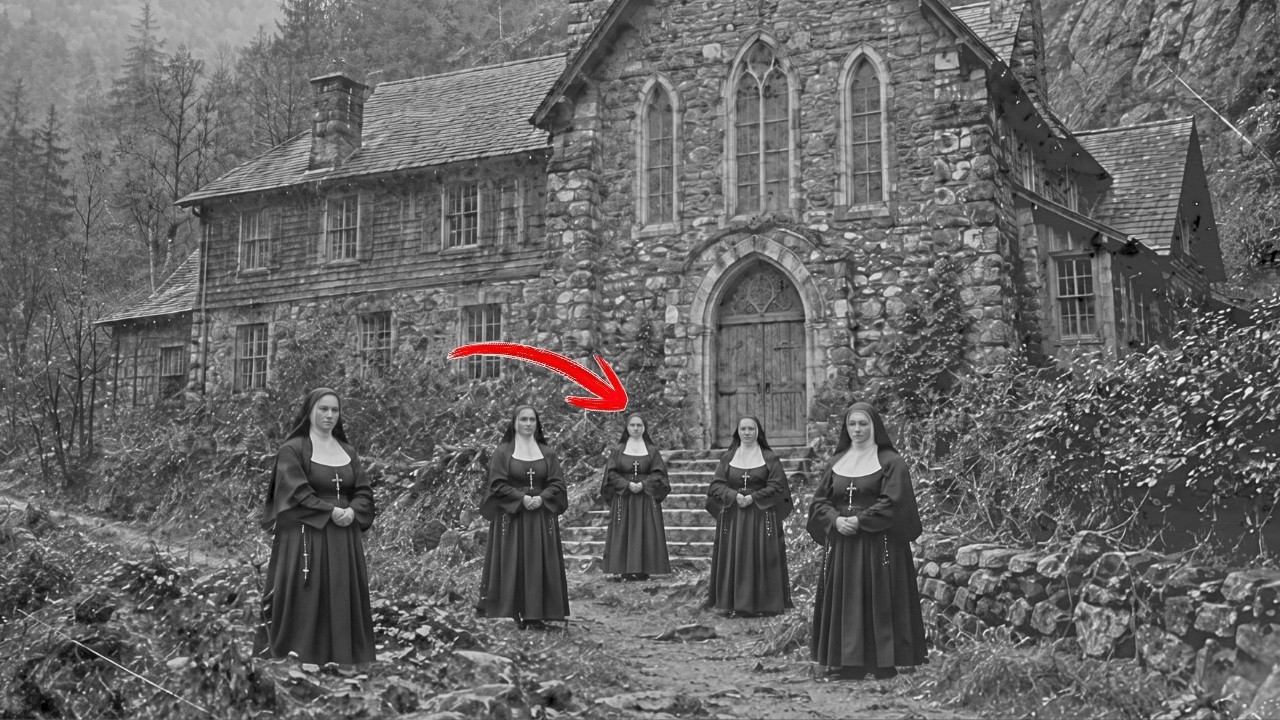
County records for that year have simply disappeared. Survey maps were redrawn to leave the valley empty, a blank space within a green hillside. Even today, the families who farm the land a mile away refuse to speak its name aloud after dark—not because they think the story is foolish, but because they believe the valley itself can hear them. The valley sits at the edge of a county the narrator says he will not name, at the request of local residents.
In the oldest surveys, from the 1840s, it bore the name of an early settler. By the 1870s, however, cartographers began leaving the valley’s interior blank. One surveyor wrote a single word in the margin of his field notebook beside the empty space: “Avoid. ”
Most valleys in the Appalachians run roughly north to south, allowing sunlight to reach the bottom for much of the day.
This one runs east to west, so the valley floor receives fewer than two hours of direct sun even in midsummer. The rest of the time it sits in cold, blue shadow, and the creek that runs through it never warms. Locals say the water runs black because of iron in the rock and tannin from leaves, but those who have stood at the edge say it looks less like dark water and more like water that absorbs light. Trees in the valley grow stunted and twisted, leaning away from the center as if bent by wind—except that the air there is perfectly still.
Hunters who entered the valley in search of deer reported that their dogs would not track past the tree line. Good dogs, capable of chasing a bear to the river, would lower their heads, sit down, whine, and refuse to advance another step. Long before the sisters arrived, people tried to live in the valley. Land records show a series of families filing claims on the bottomland in the 1850s, then abandoning those claims within a year or two.
The first family, the Souders, arrived in a wagon with a dairy cow and simple mountain hopes. They buried two children during their first winter and left by the second. A widower named Tolliver lasted longer, nearly three years alone. According to one oral account, he came into town less and less, and when he did, he spoke of singing—he claimed to hear singing at night coming from the empty valley beyond his cabin, where there was no house, no church, no living soul.
The town decided he had grown strange and solitary, as men in deep hollows do, and no one went to check on him. One spring day, he was simply gone. The cabin stood open, the stove cold, cornmeal still in its bowl. No trace of Tolliver was ever found.
What stops the narrator cold is a simple observation: Tolliver heard singing in the 1850s, more than twenty years before the sisters arrived. The children the sisters would later bring to the valley had not yet been born. So who was singing in an empty valley above the cabin of a lonely man two decades before the order set foot on that ground? The building was already there.
If the structure already existed, its basement carved deep into the mountain—warm, filled with a low, unending hum—then perhaps the singing existed too. Perhaps it did not begin with the sisters at all. Perhaps the sisters came because of the singing, drawn to it the way iron is drawn to a magnet. This, the narrator notes, is one documented case within a much larger pattern.
He describes thirty-five documented cases—different towns, different decades, different types of evidence—each following the same sequence: discovery, documentation, acquisition, disappearance. What can be shown in one video, he says, is only the surface; the document containing the full pattern is linked in the pinned comment. After Tolliver, no one claimed the valley again for a quarter century. The land sat green, cold, and suspicious, where Black Creek emerges from the valley mouth to join the clear waters of the confluence.
The town grew, the railroad came, the world moved on. All that time, the valley waited. What makes the building far stranger than the land is what we know about its construction—or lack of it. The official story is that a group of nuns arrived at a remote valley in 1878 and built a convent.
They were said to have built it themselves, or with hired workers, in one of the most inaccessible parts of the state. The structure was made of fine-grained gray cut stone, the kind seen in cathedrals that took three hundred years and vast fortunes to complete. It was four stories tall with a bell tower rising a fifth, with arched windows and intricate gothic tracery—the kind of masonry that takes a master craftsman a lifetime to learn. It had vaulted ceilings and a full basement, a stone crypt with its own chapel, carved, lined, and finished.
It had a bell. Narrator’s central question: Who built it? The stone is not local. Geologists who examined the remaining foundations could not match them to any quarry within 150 miles.
There is no record of quarrying near that valley, no record of builders, no record of transport. Moving that quantity of cut stone to the valley in the 1870s by mule teams over those roads would have required months of constant shipping, hundreds of wagon loads, an army of workers, and endless paperwork—shipping receipts, payrolls, supply orders, a letter complaining about the mud. None exists. The building simply appeared in the records, fully complete, at the moment the nuns arrived.
As if it had always been there. As if they hadn’t built it at all. As if they found it. The local understanding, rarely spoken but widely implied, is that the nuns did not build the convent.
They moved into it. The structure had stood in that valley for a very long time—long enough for trees to grow around it and the creek to turn black at its feet. It belonged, in the narrator’s telling, to an older world that has been erased. The architectural style is the first clue.
Gothic Revival in America in the 1870s was found in wealthy churches in Boston, New York, and Philadelphia—institutions with money, in cities with money. It was never found in a remote convent in an Appalachian valley with no road worth mentioning. The architecture fits neither the place nor the time, but something older, grander, and far more deliberate. And it was built for a specific purpose connected to sound.
The whole building was a musical instrument. The vaulted ceilings, the stone, the proportions of the upper chapel nave, the shape of the crypt below—everyone who entered described the same phenomenon. A whisper at one end of the chapel reached the other end with perfect clarity, as if the person were standing beside you. But a shout in the middle of the room died within a few feet, swallowed by the stone.
The bell tower was worse. When the great bell rang, the sound did not merely travel; it settled in your chest and changed your breathing rhythm. Men who worked near the valley said they felt the bell’s ring in their teeth before they heard it with their ears. One account of the bell comes from a man with no reason to lie: a railroad engineer working a night line several miles away.
He filed a formal complaint with his company about a sound interfering with his work. On certain still nights, he wrote, a tone came across the hills from the direction of the valley, low and continuous, and it did something to the men in the cab. It made the fireman weep without knowing why. It made the engineer’s hands go slack on the controls.
It made the whole crew feel, in his words, a great and terrible peace—as if something wished for them to lie down, sleep, and never wake. He wanted the company to find the source and stop it. The company, of course, found nothing. But the complaint is recorded, dated, and real—a piece of railroad paper that accidentally documented that instrument reaching across mountains in the dark.
The narrator asks us to understand the bell as the key to everything that follows. A bell is the simplest resonator that exists. Strike it and it holds the note; a bell struck in the right way can carry for miles and make other things ring with it—glass, stone, the small bones of the inner ear. Imagine, he says, an entire building as a bell, each vault and column and carved chamber tuned as the great impossible old stone always seems to be, so that the entire structure becomes a vast musical instrument, its crypt its throat, its tower its mouth.
Strike that building and it would hold a tone not for miles but for centuries, as long as something remained to keep striking it. And the things that kept it struck—the hammers of that great stone bell—were children. This is the type of acoustic architecture researchers point to across the old world: cathedrals that ring like tuning forks, star forts with impossible geometries, old hospitals, poorhouses, and orphanages built like palaces in the same imposing stone, with the same attention to resonance, repeatedly handed over to institutions housing the weak, the orphaned, the mad, the poor, the outcast—as if someone had inherited a world full of buildings they did not understand and did not build, and found only one use for them: fill them with people no one would miss, and see what those buildings do. The winter of 1878 was brutal even by mountain standards.
The first mention of the sisters in any surviving document is a single line in a general store ledger from the nearest town, dated late November. It records a large order: flour, lamp oil, salt, candles, wool, and a quantity of quicklime that made the man who later found the ledger stop and read it twice. Quicklime has two common uses on farms: one is mortar for construction—but the building already existed, so they were not building anything. The other use for quicklime in that quantity is to cover the dead—to make bodies decompose faster and to limit the smell while doing so.
They ordered it by the barrel. The order was placed by a woman the storekeeper described only as “the Tall Sister. ” In later accounts from the handful of people who dealt with the order, she had a name: Mother Perpetua. Every description of her, from every source, independently agrees on details that should not agree.
She was extraordinarily tall—tall enough that men noticed, which in that time and place meant she stood well over six feet. Her face was smooth and unwrinkled in a way that made it impossible to guess her age; one man guessed thirty, another sixty. Her hands were strange, with long fingers, and she kept them hidden in her sleeves. When she did bring them out to count coins or sign her name, watching men found reasons to look away.
And her eyes did not follow the light—a phrase one witness used that the narrator says he has thought about a hundred times and still cannot fully understand, except that it terrifies him. She came with twelve others—thirteen nuns in total. They entered the valley in the last week of November, and most townspeople never saw them again. Who were they?
The mainstream answer, the one appearing in the only diocesan record that mentions them, is that they were a contemplative order, an enclosed order—meaning they isolated themselves from the world to pray. Enclosed orders were real and common; a group of nuns choosing isolation was not strange in 1878. That is the facade, and it is a good one, because it explains the isolation, the silence, and why no one was allowed in. But the diocesan record has a problem.
The order is not listed in any registry. No motherhouse sent them. No bishop appointed them. When researchers searched for the Order of the Sorrowful Descent—the name in the single document that mentions them—they found nothing.
No founding, no history, no other convent of that order anywhere in the country or in Europe. They appeared in that valley, thirteen fully formed women, exactly as the building appeared in the valley fully formed. No origin, no paper trail. Just present.
What did people actually see in the rare moments they saw the nuns at all? Very little, and everything about it was wrong in the same small ways. They moved wrong—that phrase recurs again and again from the storekeeper, the wagon boy, the few hunters who glimpsed them from a distance. They moved too smoothly, too regularly, the way water moves rather than the way people walk.
And they were always in a line, single file, and always seemed to arrive at the delivery stone from a direction that did not quite match the building’s location. They did not speak. In the entire record over two years and dozens of encounters, the nuns spoke audibly only three times. Each time, it was Mother Perpetua who spoke.
Each time, the adult man’s narration of the story dissolves into desperate attempts to find words his memory cannot grasp. They emerged mostly at dusk, most often in the cold. At the height of summer, during the two hours when the sun reached the valley floor, no one ever saw them. Goods left on the stone in the morning disappeared by evening without anyone catching a glimpse of whoever took them.
But in the blue shadows, in the long cold hours that made up most of the day in that valley bottom, they moved. On certain nights—nights when the tone was at its strongest, nights when railroad engineers felt their crews go slack—a man watching from the ridge, if he was foolish enough to watch from there, could see their entire line file out of the building and down to the black creek. Thirteen of them, standing at the water’s edge, facing the dark, raising their arms together in a gesture one witness described as like a woman lifting a child and holding it motionless for hours, while the tone rose from the ground behind them and the black water sat still as glass at their feet, reflecting no moonlight. One young witness who climbed there on a dare said he understood something in that moment that he could never put into words and never wanted to: the sisters were not worshiping anything.
There was nothing to worship—no idol, no altar, no fire. Only the black water, the dark, and the cold. They were working. He called it the most patient, relentless, terrible work he had ever seen, obviously older than any of their lives and obviously continuing long after, and that the sisters who raised their arms to the black creek in the blue dark were not the masters of that valley at all.
They were its servants. Then the children began to arrive. The narrator explains the Orphan Trains: between the 1850s and the 1920s, eastern American cities had too many children and too few people wanting to adopt them. Tens of thousands of orphans, half-orphans, children of the dead, the poor, and the desperate were packed into overflowing city institutions.
The reformers’ solution was to load them on trains and ship them west and south to rural areas where farm families would take them—sometimes as sons and daughters, more often as free labor. The children were lined up on a platform or church stage while locals examined and selected them; the rest returned to the train, headed to the next town to be presented again. The program moved a quarter of a million children and operated almost entirely on trust and paperwork no one ever reviewed. The Hill Hollow nuns took children off those trains.
At first, the numbers were small. The county poorhouse, chronically overcrowded and underfunded, had some arrangement with the convent. When a child arrived who was sickly, troublesome, or surplus—when no farm family would take them—the poorhouse had somewhere to send them: a convent in the valley run by nuns who had written requesting those specific children: the unwanted, the sick, the strange, those with no traceable name and no family who would come looking. The poorhouse supervisor believed this was merciful work.
In the only surviving letter of his, he wrote that the nuns were an answer to his prayers because they took the hardest cases and asked only for the children and monthly deliveries of supplies. He sent them fourteen children in the first two months, then twenty more. By the following spring, the number of children the county had delivered to the valley had passed sixty. Sixty children went up into that valley.
Not one ever came out. The county might have said this was normal—children die constantly in 1878, from winter, fever, water, bad luck. An institution taking the sickest children would naturally see many deaths, and no one would pay attention. That is exactly the cover, the narrator notes.
The advantage of taking children no one wants is that when they disappear, no one comes asking. The accounts only look like murder if someone bothers to do them, and no one did for a long time because the point of those children was that the world had already agreed to forget them. One man came closer than anyone before the surveyor and might have stopped everything if anyone had believed him: Dr. Amos Hill, the closest thing the county had to a real physician.
In the spring of the first year, a note came from the valley—something that had never happened before and would never happen again. One of the sisters, silent as always, left a note on the flat delivery stone, requesting in plain, precise handwriting that a doctor attend a sick child. The poorhouse sent Dr. Hill because a sick child is still a sick child, and because it again seemed as though the sisters were caring for their charges as they claimed.
Hill climbed up there. He is the only recorded outsider who was invited up, whom they wanted there. The narrator’s belief: it was not about the child at all. They wanted to be seen.
They wanted a respectable man to come back and tell people the children were being cared for, so the county would keep sending more. The child was real and sick, lying in a clean bed in an upstairs room. The sisters had done everything right. Hill examined her: a girl, maybe six or seven years old.
Feverish, weak, but recovering. He later wrote that his first feeling, standing in that quiet room, was relief, even a kind of shame about the stories he had half-believed. The room was warm. The child was clean.
A sister sat with her, hands folded, silent, patient. It was, he wrote, the gentlest sickroom he had entered in twenty years of practice. Then the child, fever-drifting, reached out and took his hand, looked at him, and asked a question. She asked what year it was.
Hill told her the date. The child began to cry, very quietly. She said that could not be right, and told him the year she thought it was—a year eleven years earlier. She told him her name, and the name of the city she had come from on the train.
She told him she had been in this room, in this bed, for what seemed like a few weeks, right after Christmas. And that the sister had promised her she would never have to grow up, never have to go out into the cold world, never have to be afraid again. Hill, holding the hand of the small hot child who thought she had been there a few weeks while by her own account she had been there over a decade without aging a day, felt the ground of certainty fall away beneath him. He tried to take her with him.
He told the sister the child needed care he could only provide in town—a lie—and moved to lift her from the bed. The sister, who had not moved or spoken throughout the visit, said a single word. He never wrote what that word was. He wrote that he could not write it, that it was not a word in any language he knew, but his body understood it perfectly: his arms went slack, his knees hit the floor, and he knelt there beside the bed, unable to rise, while the sister stood instead, stretching to a height that brought her head near the vaulted ceiling, and told him gently that it was time for him to go home now, that he would remember the child as recovered, and that he would tell the county the children were fine.
And he did tell the county the children were fine. He could not stop himself. For years, he told everyone who asked that the hollow was a place of mercy, that the children were cared for, that the stories were cruel nonsense—and he believed it while he said it. He wrote the truth only once, at the end of his life, in a confession he asked to be kept sealed until after his death because he could not bear that the child’s name should die with him.
Her name was Naomi. She came from Baltimore. She wanted to know what year it was. Somewhere under that mountain, Dr.
Hill wrote, she is still six or seven years old, still believing she has only been there a few weeks, still singing—and will keep singing until everyone who failed her, starting with himself, is dust. The confession is one of the primary sources, and it breaks people because it is the one in which a child is recognized by name, by town, and by the single human question she asked a stranger in the dark: “What year is it? ”
The person who finally did the arithmetic was a boy working deliveries named Elias Crane, sixteen years old, whose family ran a supply route through that part of the county. Once a month, the run included a delivery to the valley: flour, oil, salt, the requested goods, and occasionally another barrel of quicklime.
Elias’s father hated the run and refused to do it himself, so he sent the boy. Elias would drive the wagon to the mouth of the valley where the road ended, unload the goods onto a flat stone, ring a small handbell, then back away and wait with the wagon. After a while, the nuns would descend from the trees in silence, carry the goods up, and leave payment on the stone. That was the entire transaction.
He was not allowed up to the building. No one was. For most of the year, Elias made the run and saw nothing worse than the general strangeness of the place—the black creek, the still air, the way the nuns never spoke, never showed their faces fully, never came closer than they had to. He was a mountain boy raised hearing that the valley was cursed; he did not need convincing.
He just wanted to unload and leave. But Elias noticed things, and what he noticed over the months were the children. He sometimes glimpsed them on the slope, at the edge of the trees, and in the windows of the building when the light was right. Small shapes.
Children. The first time he saw them, he felt relieved, because it meant the stories were wrong—the nuns were caring for the children exactly as the county said. The children were alive. He had seen them.
The problem was that he kept seeing the same children. Elias had a good memory for faces, as happens when you are young, bored, and looking for anything to observe. Over a year of monthly deliveries, he began to realize that the children he saw in the windows in the spring were the same children he saw in the autumn. Same faces, same sizes.
A child who is six in the spring is not the same by autumn. Children grow. They change. Children of that age, especially, thin out or fill out visibly with seasons, food, and illness.
These children never changed at all. The same little girl stood in the same third-floor window on the same side of the building in the same gray dress in April and in October, exactly the same. Elias, who was not a fanciful boy, came home from that October run and could not eat or sleep, because on that same day he had also watched the sisters carry a fresh barrel of quicklime up the slope. And he had done the math.
More than sixty children had gone up into that valley over two years. He had counted from the orphan deliveries he sometimes carried partway. He knew the number approximately—sixty-odd. And you could only ever see the same eight or nine of them in the windows.
The same eight or nine, unchanging month after month. Where had the rest gone? Fifty children. Where do fifty children go in a building no one is allowed to enter, with a barrel of quicklime arriving every season?
Elias Crane went to the county surveyor, a man named Josiah Pruitt, because Pruitt was the only official the Crane family knew who was not under the control of the men running the orphanage. What Pruitt did next is the reason we know anything about this at all, because Pruitt wrote it down. Pruitt kept a field journal, as surveyors do, and that field journal survived—the closest thing we have to a primary source for what existed inside that building. Pruitt went up to the valley with a legitimate reason: a boundary dispute, an old survey error, a claim that the eastern line of the valley was in the wrong place.
It was thin but real enough to justify the county surveyor tramping over the ground. Pruitt used it. He went in early on a clear late-autumn morning, alone, on foot with his instruments, convincing himself he was there to map the boundary—and convincing himself he would take a look at the building while he was there, because a boy had come to him pale and shaking, talking about children who did not grow. The climb took longer than it should have.
That is the first thing in the journal that stops you. He writes that the distance from the valley mouth to the building—which he could see the whole way, which was perhaps a half-mile of slope—took him the better part of three hours. He was not injured. He was not lost.
He saw the building the whole time. He simply could not close the distance. When he finally reached the great front doors, the sun was beginning to fall behind the western hills—though he had started in the early morning, and according to his watch, only a short time had passed. His watch did not agree with the sun.
He recorded it in his calm, precise hand, like a man recording survey measurements, as though the collapse of time itself were just another feature of the terrain. The doors were iron. Not wood plated with iron—solid cast or wrought iron in one massive piece per side, taller than three men, decorated with a design Pruitt tried to sketch and then stopped because his hand, as he wrote, would not draw the shape correctly and he did not care to keep trying. Around the doors, carved into the stone, there was writing.
It was not Latin. Pruitt had enough education to know Latin when he saw it, and this was neither Latin nor Greek nor any alphabet he could name, and the longer he looked at it, the more it felt like a mistake to look at it. He copied three letters into his journal, then stopped. Those three letters are still in the journal.
The narrator says he has seen photographs of that page and will say only that those who study this material have connected its general form to inscriptions found on structures on three different continents—structures that cannot plausibly share a single alphabet, separated by oceans and thousands of years. Pruitt did not enter through the iron doors. He walked around the structure and found a smaller entrance, a servants’ door leading to the crypt—the stone basement level—and it was open. He descended into the dark with his lantern.
Here the journal changes. Up to this point it reads like a field survey record: measurements, times, distances, dry notes. From the moment he enters the crypt, his handwriting becomes larger and less controlled, and the sentences shorter. You can feel the man’s composure crumbling on the page.
The crypt was a chapel. He had expected storage, but instead found a full chapel, low and vaulted, its ceiling resting on rows of stone columns. It extended further back than any crypt under that building should have extended. It went into the hillside itself—carved into the rock of the hill, continuing room after room, deeper than the width of the building above.
And it was warm. That is the detail that made the narrator’s skin crawl: the entire valley was cold, the streams cold, the air cold. In that stone crypt cut into the mountain in late autumn, it was warm, like a room where a fire had recently burned—except there was no fire, no stove, no trace of either. Only warm stone, still air, and a faint smell of quicklime.
And there was a sound. Pruitt wrote that the deeper he went, the more he became aware of a sound—low, so low he felt it before he heard it, the same way men describe the bell’s ring. A constant tone, coming from further depths, from rooms carved deep into the rock—and he followed it, God only knows why. He followed it, and he writes that the closer he got, the more he began to realize the tone was not one sound but many.
Voices. Human voices, many of them, holding a single note, low and unending, from somewhere in the dark ahead of him. He stopped. He stood in that warm stone passage with his dim lantern and did the arithmetic the boy had done, and realized he was hearing more voices than there were sisters in that valley.
Many more. Dozens. And they were children. Pruitt did not go on to find them.
The narrator is honest about that, noting that the story would be better if he had. He turned back. He wrote, in nearly illegible hand, that he could not force himself to take another step toward the sound, that he was not ashamed of that then and was not ashamed now, and that any man who claimed he would have kept walking was either a liar or had never stood in a warm, dark place beneath a mountain listening to fifty children hold one note without taking a breath. He turned and came back the way he had come.
The way back was longer than the way in. Twice he passed openings leading to side rooms that he swore had not been there when he descended. From one of them, something watched him pass. He did not look at it.
He kept his eyes on the floor and walked, and did not look at it. And it let him go. He climbed out of the crypt into the last gray light of day. Mother Perpetua stood in the entrance of the building waiting for him.
She had not been there before. He would have seen her had she been. The entrance was empty. Now she filled it—all that impossible height, hands folded inside her sleeves, her smooth face turned toward him, her eyes not following the light.
And she spoke to him. It is the only recorded instance of her speaking more than a few words to anyone. Pruitt recorded what she said, as precisely as he remembered it. This is what she said.
“You came to count them,” she said. It was not a question. “Everyone comes to count them in the end. The boy counted them.
Now you count them. ”
She smiled, he says, and the smile did not reach her eyes. “But you have miscounted, Mr. Pruitt.
You think we take them. We do not take them. We keep them. There is a difference, and that difference is the only mercy left in this world.
And one day, when the water comes and takes everything else, you will wish someone had kept you. ”
Then she told him to go home. He went home, and never went up to that valley again. He lived another forty years and never spoke of it aloud to anyone.
But he wrote it in a field notebook, put the notebook in a box, put the box in a wall. When his old house was demolished in the 1950s, the box was found. That is how we came to know. The narrator asks us to consider what she meant by “when the water comes and takes everything else.
” The story stops being merely a horror tale about a bad convent and begins to take the shape of a much larger and stranger pattern. He references the audience’s familiarity with “Tartaria fear” and mud flood theories: buildings around the world with their first floors buried, ground-floor windows below modern street level, entrances you must descend steps to reach, grand old structures that look as though they are sinking into the earth up to their necks. As if a wave of mud and water swept across the world not so long ago and buried the ground floor of everything, and the survivors dug out the doors, paved over the rest, continued their lives, and told their children the cities were simply built that way. The Reset—the moment the old world ended and the new world was handed a collection of ruins and a false history to explain them.
Mother Perpetua knew that was coming, the narrator argues. That is what her words to Pruitt mean if taken seriously. And he has decided to take them seriously because everything else in this account is so specific and so well-supported. She spoke of the rushing water as an inevitability, a scheduled event, and described the children not as victims but as rescued.
“We keep them. ” She presented keeping them as the only mercy left. Whatever the Hill Hollow sisters were doing to those children in the warm dark beneath the mountain, she believed—or wanted to believe—that they were protecting them from something, holding them outside time, keeping them from growing, from changing, from dying, from being swept by the coming flood that takes everything that grows and changes and dies. That is why the children in the windows never aged.
She stopped them. She took them out of the river of time and set them on the bank, singing, and called it mercy. The narrator admits he does not know whether that makes it vastly better or vastly worse. He thinks a monster that knows it is a monster is easier to understand than an entity that convinced itself its cruelty was actually mercy—and possessed the machinery, the building, the architecture, the resonance, all the inherited tools of the old world, to make its conviction real.
Because the building was the machine. The architecture that treated sound strangely, the impossible deep crypt warm when all around was cold and filled with one unending note—that was not decoration. That was function. Whatever the old world built that structure for, it did so with sound, resonance, frequencies that great stone and vaulted air could hold and shape.
And the sisters knew how to operate the machine. Or perhaps they were shown how. Or perhaps they always knew. Perhaps the sisters were part of the old world too—thirteen of them appearing fully formed with no record or history, exactly like the building, exactly like everything else in that valley that has no beginning anyone can find.
Now: the winter of 1879 and the end of the Hill Hollow sisters. The diocese had begun to worry—not about the children. Those in authority never worried about the children. The narrator repeats this deliberately as the real horror beneath the supernatural horror, the ordinary human horror: the world’s machinery handing its most vulnerable people to anything, so long as it would not have to think about them afterward.
The diocese worried about the order not listed in any record. An unregistered convent attracting children and supplies, operating in the Church’s name without its approval, was a problem of authority and reputation. So, in late winter, the diocese sent a man to investigate: a priest named Father Kolum. He was neither a fool nor a coward—an investigator, a canon lawyer, the type the diocese sends when it needs a problem solved quietly and correctly.
He came to the county in February, through deep snow, and did what Pruitt had not done. He walked the full valley, entered through the iron doors, and stayed there overnight. Before that, he wrote a letter to his bishop. That letter is the second primary source—and the last thing Father Kolum ever wrote in his own hand.
The letter begins calmly. It describes the climb, the strange stretching of the road, the way the building seemed to recede. It describes the doors and the writing. Unlike Pruitt, Kolum recognized more of it, and what he recognized frightened him in a specific theological way a land surveyor could not feel.
He writes that some of the letters were a distorted form of liturgical scripts—the kind used in the oldest rites—but turned, reversed, inverted in the way something is inverted when it is meant to do the opposite of what it was made for. A rite of preservation performed inverted becomes a rite of imprisonment. A blessing spoken inverted becomes a binding. Standing at those doors, he realized the building was a sacred machine that had been reversed—and the sisters were running that reversal.
Yet he went inside, because he was the kind of man who believed that was his task. He met the children first. Alive, he insists, in the upper rooms—the eight or nine everyone had seen in the windows. He writes that they were beautiful and calm, that they smiled at him and sang for him, and that this was the most terrifying thing he had ever witnessed.
Because they were no longer children, not truly. They were held. They moved like children and spoke like children, and had not aged a day since they came. And behind their eyes there was nothing at all—or worse than nothing.
Patience, eternity, something looking out from behind a child’s shape at the priest who had come to save them, and finding him slow and small and late. Then he went down into the crypt, because he had realized the children in the windows were just the facade—the kept, the display. The rest, the fifty, were below. Father Kolum’s letter ends mid-sentence.
The narrator insists we understand this literally: the last page of the last letter Kolum ever wrote ends in the middle of a sentence, in the middle of a word, the ink running to the edge of the page in a way the diocesan archivist who catalogued it in the 1930s described as consistent with the writer being interrupted. The sentence he was writing, the final words in the handwriting of the man the church sent to Hill Hollow, are these: “I have found them and they are not dead and not alive, and they sing to hold back the water, and God help me, the singing works. ”
The singing is working. It has been working longer than this order has existed, longer than this country has existed, and now he understands what the building is for, who the sisters are, and why they can never be allowed to stop.
Because if they stop—if the tone ever breaks—the thing they are holding back will get out. And that is it. Here the story ends. Here the story of Father Kolum ends.
Three nights later, the valley burned. That is the official record, such as it is: a fire in the hollow seen from the hills, a glow described by people in the nearest town as lasting until dawn. Orange light reflected on the low winter clouds, and a sound—everyone in town that night reported that sound. The convent’s great bell rang without stopping for hours, all night.
Then, just before dawn, the bell made a sound no one had ever heard before. The witnesses’ descriptions vary, but the most common is that it cracked—they heard the bell crack, one enormous broken note, then silence. The light in the valley went out suddenly, like a held breath released. You need to know what that night was like from inside the town, the narrator says, because those who lived it never forgot it, and what they felt is evidence in itself.
The night began just after dusk with the bell. The bell had rung across the years before, but always from a distance, as something half-heard on a quiet night. This time it was different. This time the sound filled the valley, came down over the hills into the town, into the houses, into people’s chests—and would not stop.
Mothers took their children into back rooms and held them. Livestock broke through fences and ran, not away from the valley as you might expect, but in circles, in panic; some ran toward it, and had to be roped and dragged back. A preacher gathered whoever he could in the church, and they sang hymns as loud as they could, trying to drown out that note. They could not.
He said later that at some point he realized the congregation had all stopped singing their hymn and were drifting, involuntarily, unknowingly, toward that note—the single note coming from over the mountain. He said he slapped his own son across the face to snap him out of it, and had to be slapped himself, and that the shame of that night—the ease with which the note pierced the house of God and turned the faithful into part of itself—stayed with him longer than the fear. Then came the light: a cold white glow in the valley that crept over the western ridge, turning to the orange people mistook for fire only later. And as dawn approached, the note began to change.
It had been constant all night, one continuous tone. Now it began to waver and strain, and the townspeople knew, without understanding how they knew, that something was wrong—that the tone was struggling, and that whatever had kept it flawless and eternal for a hundred years or a thousand was losing its grip. Then, just before sunrise, it broke. The silence that followed was worse than the note itself, because every soul in that town realized in one moment, without a word passing between them, that something that was meant to continue had let go.
They waited for dawn holding each other’s hands like children and did not let go until they could see. In the morning, men from the town climbed up. It was the first time in the order’s history that strangers walked freely in that valley, because they knew, in the way these things are known in small places, that what had been keeping them out was gone. And they found the building standing—not burned.
That is the part that confuses people. The glow through the night, the light reflected on the clouds—in the morning the stone building stood exactly as it always had, no trace of fire, cold. Whatever had burned in that valley, it had not been the building. The building was empty.
The iron doors stood open. The upper rooms where the kept children had smiled for Father Kolum were empty. The nuns’ thirteen habits were found folded—thirteen garments, carefully arranged in the upper chapel, empty, as if the women inside them had simply vanished, leaving cloth collapsed into the shape of nothing. Mother Perpetua’s habit was the longest.
There was no one in any of them. And the crypt was sealed. The stairs leading down into the warm dark beneath the mountain—where Pruitt had heard the voices, where Father Kolum had gone and never returned—were gone. Not blocked.
Gone. The men who had been there before, or who knew where the stairs should be, walked across the ground floor and found only solid stone floor where the opening had been. The stone was seamless, cold. When some of them put their ears to it—God help them, the narrator says, some put their ears to that floor—they swore until their deaths that they could still hear it.
Faint, far below, under the stone and under the mountain: one low sustained note, fifty small voices, no pause for breath. The children were still down there. The children are still down there. The sisters had burned, or been taken, or risen, or whatever happened to the thirteen that night the bell cracked.
But the fifty they had kept—the fifty they had wrenched from time and set on the shore to sing—were sealed below, singing, still holding back the water. And the town understood it in the silent way mountain places understand things: the singing must not stop, and no one should ever go down there to try to stop it. The kindest thing, the only possible thing, was to leave it sealed and let it sing and never speak of it again. So they chained the iron doors.
They did not demolish the building, though many wanted to, because there was a fear—never spoken—that the building was part of the machine. That it was the resonator, the thing that carries the note from beneath the earth and turns it into something effective. That if you broke the building, you would break the note. And if you broke the note, the water would come.
So they left it as it was: chained and cold, standing at the head of a valley the maps had stopped describing, in a county that quietly agreed, as such places do, to let the whole thing sink into silence and rumor and the kind of story told half-true, so the shape of the warning would stand even after the facts were lost. The building was not entirely forgotten, of course. Nothing that strange is ever entirely forgotten. Over the decades, the valley attracted exactly the kind of people you would expect: the curious, the greedy, the brave, the foolish.
And the valley dealt with each of them in its own way. Each time, the town closed the story a little tighter around itself. In 1911, a photographer came—one of those itinerant men with a wagon full of glass plates and a taste for ruins. He had heard there was a strange old building at the head of the valley and intended to photograph it, because a picture of a gothic convent in the heart of the Appalachian wilderness would be profitable.
He went up alone with his camera and returned with his plates and developed them. This part is documented because he wrote to a fellow photographer about it in a letter that still exists. Every plate was fogged—not blank, but fogged in the same way, with the same pale shapes rising through the exposure. Dozens of them, small, pale, standing in rows where the building should have been, as though the camera had not been pointed at a building but at the children inside it.
The children had come through onto the glass instead of the stone. He destroyed the plates. He wrote that he could not keep them in his house, and he never photographed any ruin again. The worst event came in the 1920s, when a man decided he did not believe any of it and that he would prove the entire county a bunch of superstitious fools.
He was an outsider, a businessman, exactly the self-assured modern type who believes a story is just a story and a chain on a door is just a chain. He brought his tools and two hired men, went up to the valley, cut the chains off the iron doors, went inside, found the spot on the ground floor where the old people said the crypt stairs had been sealed—the cold, smooth stone—and ordered his men to break through and open it. They got only a few feet in. That’s all.
They opened a gap in the sealed stone, just wide enough. The account from the two hired men, who fled and refused to return for any money, is that the moment the stone gave way, the tone came out of the gap—that low, unending note, louder than any living person had ever heard it—and with it came a cold that covered the iron doors with frost in the middle of summer. The businessman, who had been leaning over the gap with a lantern, looking down, went silent and still, then slowly began to descend into it. His men caught him.
He fought them—fought like a man being dragged away from the only thing he had ever wanted—weeping, reaching toward the dark and the singing. It took both of them to pull him out of that building and down the valley. He was never the same. He spent his final years in a state institution—one of those great old institutions, the kind built of that same impossible stone—and the nurses said he sang.
One low, unending note, no pause for breath, as though, having heard it once, he had joined it and was only waiting for the rest of his body to catch up. After that, the county did what it should have done fifty years earlier. They went up in force, as a crowd, sealed the gap the businessman had opened with fresh mortar over the old seamless stone, replaced the chains on the iron doors with heavier ones, and did something they had never done before. They put a mark at the mouth of the valley.
Not a written sign—a written sign is something the curious read and then ignore. They put the mark the old way, the mountain way, the way land belonging to the dead is marked. Everyone in the region understood that mark, and understood that crossing it meant giving up the right to be searched for. The valley returned to its silence, and the message settled back into the stone.
A new generation grew up knowing only that no one should go up there, with no one telling them exactly why. Now the narrator addresses the erasure, the part he says should worry us most, where the story stops being about ghosts and starts being about the thing ghosts stand in front of. The 1880 census does not include the valley. He does not mean it recorded no one living there.
He means the route of the enumerator, which can still be traced on surviving maps, goes up the valley path, then turns around the valley mouth, and resumes on the other side. The valley itself was not walked, not counted, not entered. There is a gap in the housing numbers—a jump in the sequence, exactly one valley wide, as though someone had taken a knife to the record, cut out a strip, and pressed the edges back together. When researchers found the enumerator’s name and traced his life, he left the county within a year, never worked another census, and according to his descendants, refused to speak of his time in that valley—never, not once, not even to his children.
The diocese has no record of Father Kolum’s assignment. The letters exist in the diocesan archives—catalogued, physical, real—but the appointment order that sent him does not exist. There is no diocesan record of having sent a priest to investigate an unregistered order in that valley, because there is no record of the order because it was never registered. Officially, cleanly, in the eyes of the institution, none of this happened.
A priest wrote three letters from a place he was never sent to, about an order that never existed, then stopped writing. The church’s papers simply closed over the valley the way water closes. County records for 1878 and 1879—the two years the children were sent—are missing. Not damaged.
Not burned in an incidental courthouse fire (one did occur later, and took much else). Simply missing from a chain of records that is otherwise complete. Two years surrounding the Hill Hollow sisters have been entirely excised from the archive. The orphanage’s record of sixty children handed over to the sisters exists in no official form; it is known only because a private letter from the orphanage director survived the purge, and because a wagon boy remembered faces, and because a surveyor hid his journal inside a wall.
That is the pattern, the narrator says—the same pattern as the Reset itself. Something happens. Something that does not fit the story we are allowed to know. And then the records of that thing are not debated, not refuted, not justified.
They are removed. The census skips it. The church remembers nothing. Gaps appear in the county newspaper.
Maps go blank. Within a generation, only a warning without facts remains. A hollow with a bad name, a place dogs won’t enter and old people won’t discuss. If you ask, everyone will tell you it’s nothing—just an old story, just ruins.
They will ask you not to go there, change the subject, avoid your eyes. That is what erasure looks like when it succeeds: not a lie you can catch, but a silence you cannot fill. Hill Hollow, the narrator insists, is not a unique case. It is not even rare.
Once you know its shape, you begin to see it everywhere: a massive stone building that does not fit its surroundings, too old, too grand, or too impossible for that place—and the people who supposedly built it. Acoustics that behave strangely. A crypt or basement extending deeper than it should. Then, over all that inherited stone, an institution for the outcast is placed: an orphanage, an asylum, a poorhouse, a refuge, a hospital in the hills no one visits, a reformatory at the end of a long road.
Always the vulnerable. Always those no one is looking for. Always confined in buildings erected by a previous, greater civilization for a purpose we are told never to believe existed. Researchers have mapped these places, the narrator says, and the map is disturbing.
They cluster. They align on lines. They often sit atop or near old star forts—the geometric stone fortresses that encircle the world by the thousands, which no one can adequately explain, which we are told were purely military, and which were all, by coincidence, built to the same impossible stone standards and the same strange resonant geometry. The star forts are the framework.
The institutions are what was poured into the framework. And in each case, when something goes wrong at one of these places, when abuses come to light, when mass graves are discovered—and they are discovered consistently at old asylums, orphanages, and schools, unmarked graves in numbers that stagger—the response is always the same: records vanish, the institution quietly closes, the buildings are demolished, or left to rot, or sometimes converted into something charming. A hotel. A luxury apartment complex.
A wedding venue. So people can dance and drink on ground that once held those sounds rising from deep within the earth. The narrator is careful to say he is not telling us every old asylum is Hill Hollow. Most horror in those places was ordinary human horror—cruelty, neglect, the infinite capacity of institutions to crush the powerless—which is damnation enough on its own.
But he is telling us that the pattern Hill Hollow reveals in its purest, clearest form—the machine, the voices, the erasure—is faintly visible beneath many of them. Like the pale shapes rising through the photographer’s glass. As if Hill Hollow is not the exception, but the exception that reveals the rule. And if that is true, then the flood the Tall Sister spoke of—the coming water that takes everything that grows, and changes, and dies—is not a threat that ended with the last Reset.
It is a threat still being held back at this very moment, beneath thousands of ancient stone floors, by a chorus of voices we cast out and then agreed to forget.