In July 1945, the Japanese plant that had built more Zero fighters than any other in the country completed the month with just 15 aircraft. That total—not 15 per day, but 15 over 31 days—was produced by a workforce of roughly 43,000 people, a figure recorded by the United States Strategic Bombing Survey when investigators walked the factory floor in October 1945. The number explains, in stark terms, how Japan lost the air war. Eighteen months earlier and more than 3,000 kilometers to the south, a maintenance unit on the island of New Britain was doing the opposite arithmetic.
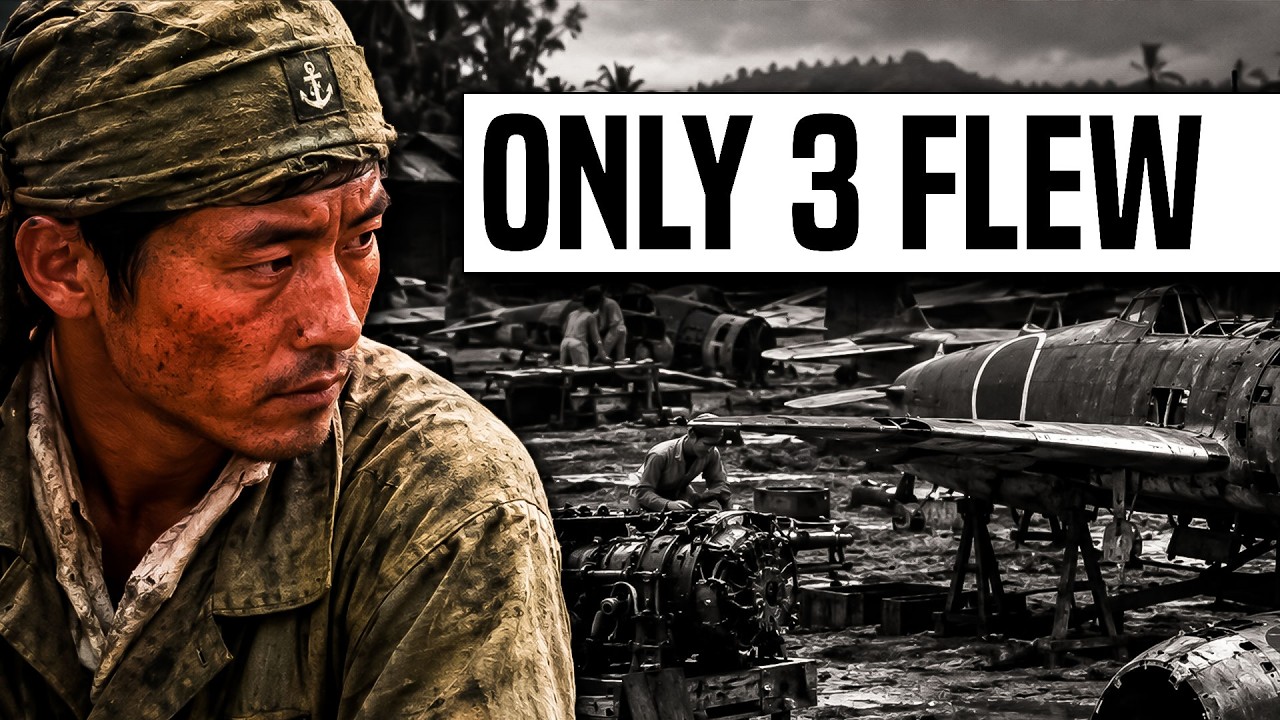
The Imperial Japanese Navy’s 1,005th Naval Base Unit, left at Rabaul after Allied forces bypassed the base in February 1944, kept three Zero fighters flyable for a year and a half with no supply line and no factory. They did it by cutting parts off wrecks. Rabaul had once been Japan’s great forward airbase in the South Pacific. By late 1943, it held more than 100,000 Imperial Army and Navy troops, along with an air group that had cycled through hundreds of Zeros and a repair depot capable of overhauling engines and patching battle damage.
General Douglas MacArthur and Admiral Chester Nimitz decided not to take the base. Instead, they would isolate it, bomb it, and leave it to run out of resources on its own. The phrase American staff officers used was “wither on the vine. ”
The American air campaign against Rabaul began in earnest in October 1943, when General George Kenney’s Fifth Air Force launched heavy bomber sweeps over Simpson Harbor.
It intensified in November, when the carriers Saratoga and Princeton struck the airfields. Army bombers returned week after week through the winter, and carrier raids returned in December. By February 1944, the Japanese air group had been worn down to a handful of flyable machines, and naval staff in Tokyo decided to pull the survivors out and leave the base to its own resources. The vine withered.
On February 20 and 25, 1944, the last Japanese air units flew out, leaving about 30 derelict Zero airframes behind at Vunakanau and Lakunai airfields. All were battle-damaged or picked over. None could fly. The mechanics had no spare engines, no spare propellers, no fabric for control surfaces, and no aluminum sheet.
What they had was 30 wrecks and the certainty that no resupply was coming. They pulled cylinders off dead Sakae radial engines and lapped them back to life by hand. They spliced wing sections from two ruined airframes into one flyable aircraft. They took instruments out of cockpits that had sat in the rain for months, dried them in the sun, and reinstalled them.
The Zero’s Nakajima Sakae engine was designed for an overhaul every 150 flight hours. Japanese ground crews routinely stretched that interval to 200 hours or more, often with unhappy results, according to the Pacific War Online Encyclopedia. At Rabaul, the interval was not stretched. It was forgotten.
The names of those mechanics are not recorded in standard histories. The unit designation and the airframe serials are documented by Pacific Wrecks, a charity that has spent 30 years documenting the theater’s missing. The men themselves are not named. The unit kept three Zeros flyable: two A6M5s, a late-war variant with a shorter wing, and one earlier A6M2.
The serials were 4043, 4444, and 4379. At war’s end, those three aircraft were the entire documented flyable inventory of the Rabaul garrison—out of a force that had once cycled through hundreds. The home islands were doing their own version of the same arithmetic. The Mitsubishi complex at Nagoya produced about 40 percent of Japan’s combat aircraft, including the Zero.
At the end of 1943, the plant employed 43,000 workers and had delivered 1,029 Zeros that year—less than half of what the military had demanded. Ian Toll, in The Conquering Tide, records that Japan’s aircraft plan for 1944 called for 40,000 new airframes, a target the industry was already missing in the second half of 1943. The airframes Mitsubishi finished could not even be flown out. The nearest usable runway was at Kagamigahara, 24 miles away, and the brand-new Zeros were too delicate to truck overland.
They were hauled by oxen. Twenty oxen died on the route, and 30 more were pulled from the job before they collapsed. The Navy eventually replaced them with Percheron horses. By 1944, the Zero should have been replaced.
Jiro Horikoshi, the aircraft’s chief designer, had drawn a successor, the A7M Reppu, a larger and faster fighter meant to address the Zero’s growing disadvantages against the American F6F Hellcat and F4U Corsair. But the Reppu’s engine, the Nakajima Homare, never produced the horsepower its designers had promised. The prototype flew in May 1944. By the end of the war, only eight prototypes existed, and no production run ever reached a squadron.
The Zero, designed in 1939 for a short war against an enemy who would not replace his losses, carried the air war into 1945 alone. The Zero’s design was a trade-off made in 1939 for a war Japan expected to win quickly. Horikoshi and his team stripped weight wherever they could to give the fighter its extraordinary range and maneuverability. The early Zero was built light, with no armor for the pilot and no self-sealing protection for its fuel tanks.
By 1943, the American F6F Hellcat, powered by a 2,000-horsepower engine the Sakae radial could not match, was arriving in the Pacific with armor and self-sealing tanks. The aircraft that had shocked the Americans in 1941 was, by 1943, the aircraft American pilots hoped to meet. The number that mattered most was the slope, not the floor. In October 1944, Mitsubishi Nagoya turned out 145 Zeros in the month.
By December, the figure had fallen to 62. By July 1945, it was 15. The cause was not a single event but a sequence, and it began with the ground. On December 7, 1944—three years to the day after Pearl Harbor—an earthquake of magnitude 8.
1 struck the Tokai region along the coast south of Nagoya. It killed 1,023 people and cracked the Aichi Atsuta engine plant that built the Sakae radial for the Zero. Six days later, on December 13, 90 B-29 Superfortresses of the 20th Air Force bombed the Mitsubishi aircraft engine works in Nagoya. Seventy-one bombers hit the target.
The raid destroyed 691,000 square feet of factory floor. In May 1945, American firebombing raids burned out the residential districts around the plant and killed 3,866 people in Nagoya. In the last nine months of the war, American aircraft dropped 14,054 tons of bombs on the city alone. The Navy’s answer to the bombing was dispersal: hide the factories, move the machine tools into tunnels, caves, and the basements of schools, build the aircraft underground, assemble them in the open, and fly them out.
It was an old idea and not a stupid one. The problem was timing. The dispersal order came in 1944, but the tunnels were not ready until 1945. By the time the Nakajima company’s Shiroyama underground plant began cutting metal in late April 1945, the war had four months left.
The Shiroyama plant produced, in its entire operational life, 400 fuselage assemblies and four wing assemblies—not 400 wing assemblies, but four. The United States Strategic Bombing Survey, after inspecting the site, concluded that Japanese underground installations were begun too late to save the production of aircraft. The investigators added that the tunnels could not have overcome the shortages of raw material and fuel in any case. The shortage of raw material was the third leg of the collapse and, in some ways, the first.
Aluminum is made from bauxite, and Japan had almost none. Through 1943, the empire ran on bauxite shipped from the Netherlands East Indies across waters that American submarines were learning to patrol. By 1944, submarines were sinking the ore carriers faster than the Navy could replace them. An aircraft industry without aluminum is a workshop with a drawing board and no metal.
By 1945, the Zero was being built with whatever the plant could find. Some late-war examples had wooden wing tips, and the exhaust ducting was sometimes sheet steel instead of the heat-resistant alloy the design called for. None of this is myth. It is in the USSBS record, written down by men who walked the floors of the plants after the surrender and picked up the evidence with their hands.
Back at Rabaul, the arithmetic was simpler and the answer was the same. The 1,005th Naval Base Unit kept three Zeros flying by spending the other 27. When the war ended on August 15, 1945, those three aircraft were the only flyable Japanese fighters on the base, alongside one Mitsubishi Dinah reconnaissance plane, one Nakajima Kate torpedo bomber, and one Aichi Jake float plane. Six aircraft total.
That was what remained of an air force that had once numbered in the thousands. On September 18, 1945, 34 days after the surrender, the three Zeros took off from Vunakanau airfield under orders to fly to Jacquinot Bay on New Ireland, where an Allied airfield had been prepared to receive them. Royal New Zealand Air Force Corsairs escorted them. The flight is documented.
The serials were 4043, 4444, and 4379. The New Zealand pilots who flew the escort left no recorded quote about the condition of the aircraft they were herding south. Pacific Wrecks lists the three as tested, examined, and scrapped. None of them survived the year.
Jiro Horikoshi, the Zero’s chief designer, spent the war watching the aircraft he had drawn in 1939 carry a burden it was never meant to carry alone. He was an engineer, not a strategist. After the war, he wrote that such poor management of technical policy created the situation where Japan had no other choice but to rely on the Zeros from the beginning of the war until its end. This, in turn, accelerated Japan’s defeat.
He was not talking about the mechanics at Rabaul. He was talking about the men above them who sent the Zero into 1945 with no successor, no spare parts, and no plan except to keep building the same airframe in smaller and smaller numbers. The Mitsubishi complex in Nagoya, after the surrender, was stripped for scrap under American direction. The Shiroyama tunnel was sealed and later reopened as a tourist attraction.
The oxen route to Kagamigahara is now a national highway. The total production run of the A6M Zero, across all variants and all factories, was 10,934 aircraft—more than any other Japanese aircraft of the war. The men who kept three of them flyable for 18 months with no parts and no supply line are not named in any file the Allied occupiers thought to copy or that the Japanese government thought to keep.
They went home in 1945, lived through what came after, and nobody asked them what they had done.