William Holden is often described as the father of four children, but contemporary records identify only three: Virginia, the daughter he legally adopted, Peter Westfield Holden, known as West, and Scott Porter Holden. One became his daughter by choice. Two were born into his marriage with actress Brenda Marshall. All three grew up beneath one of the most recognizable names in Hollywood, yet none became a star on William Holden’s scale.
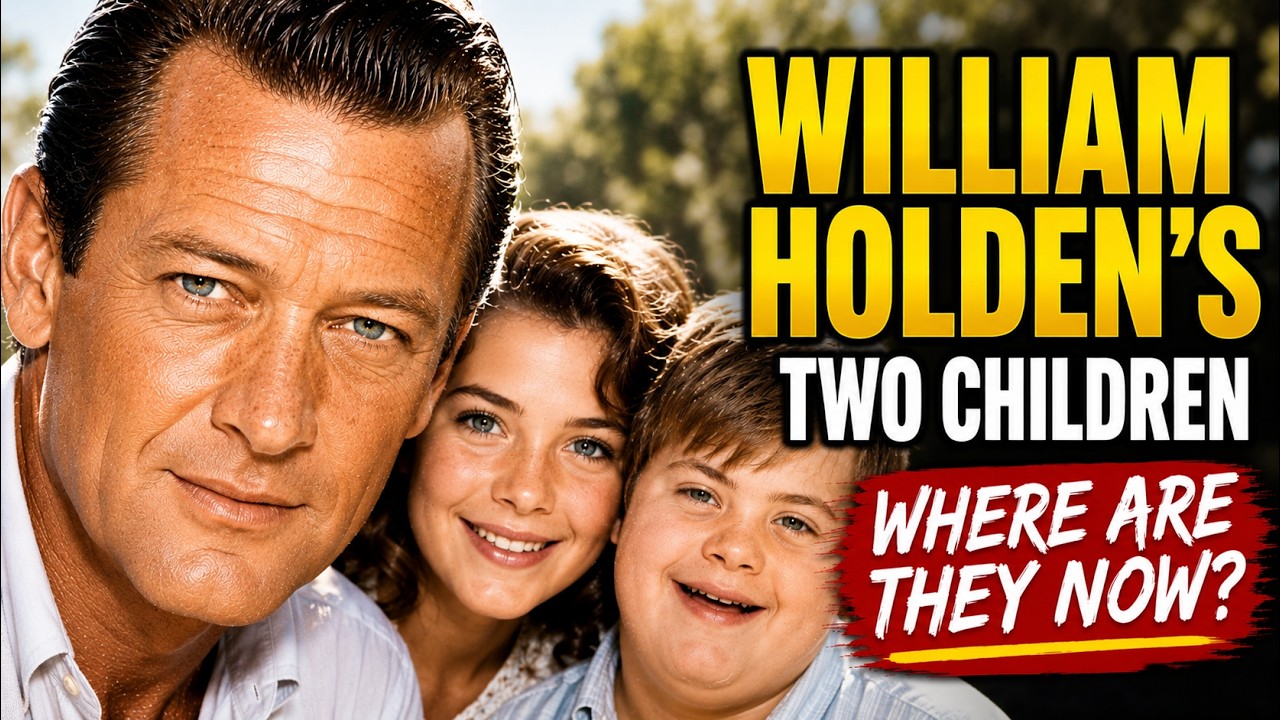
Their father seemed to belong everywhere at once—to Hollywood, to audiences around the world, to the women in his life, and eventually to Africa, where conservation became one of his deepest commitments. The question is not whether William Holden loved his children. The more difficult question is how much of him was ever truly available to them. William Holden was born William Franklin Beedle Jr.
in 1918. He did not arrive in Hollywood with a famous name. Hollywood gave him one. His breakthrough came with the 1939 film “Golden Boy,” a title that seemed almost designed for him.
He was handsome, athletic, and serious, with the kind of face studios believed could carry romance, danger, and regret at the same time. But Holden’s appeal was never based on looks alone. There was always a distance in him. Even when he smiled, he could seem as though part of him were watching from somewhere else.
That quality became his greatest strength. After serving during the Second World War, he returned to a film industry that was changing. The polished certainty of old Hollywood was beginning to crack, and Holden was perfectly suited to the men living inside those cracks. In “Sunset Boulevard,” he played Joe Gillis, a struggling screenwriter who knows the Hollywood dream is false but allows himself to be trapped by it anyway.
In “Stalag 17,” he played a prisoner whose cynicism was mistaken for betrayal—a role that earned him the Academy Award for Best Actor. Then came “Sabrina,” “Picnic,” “The Bridge on the River Kwai,” “The Wild Bunch,” and “Network. ” Across those films, Holden aged from the golden boy into something far more complicated: a man increasingly aware of what ambition, compromise, and survival could cost. While audiences watched that transformation on screen, his family was living through another version of it at home.
In 1941, Holden married actress Brenda Marshall. Brenda had been born Artis Ankerson and had already been married once to actor Richard Gaines. From that marriage, she had a daughter named Virginia. When Holden married Brenda, Virginia did not remain merely his wife’s child.
He legally adopted her. That fact is sometimes lost in modern family lists, which either leave Virginia out or treat her as separate from Holden’s two biological sons. But Virginia was his daughter. Before West and Scott were born, fatherhood began with her.
Photographs from the period show Virginia beside Brenda and Holden, later joined by the two boys. She also appeared with Holden at public events. Whatever the private complexities of the relationship, she was visibly part of the family. Unlike West and Scott, Virginia entered Holden’s life through a deliberate decision: he chose to become her father.
Virginia spoke far less publicly about her father than many children of Hollywood stars did. What survives instead are the family photographs, the legal adoption, and her place inside the household before Holden became the exhausted international star audiences remember from his later films. She knew an earlier William Holden—a man still becoming famous, a man who had not yet divided his life among quite so many places. Two years after Holden married Brenda, their first son was born.
Peter Westfield Holden arrived in 1943 and became known as West. Scott Porter Holden followed in 1946. The family now had three children: Virginia, West, and Scott. Hollywood photography presented them as a polished unit.
There were posed portraits, smiling family scenes, and home movies of the boys with their parents. Some were clearly designed for publicity. Others feel more intimate. Together, they created the image of a successful movie star with a stable home.
But a photograph can preserve a moment without explaining the life around it. Holden’s career required long periods away. Film production took him across the United States, Europe, Asia, and eventually Africa. He also had relationships outside the marriage, while alcohol gradually took up more space in his life.
The family image remained attractive long after the marriage itself had begun to fracture. For West and Scott, their father was both the man in the family photographs and the man the rest of the world believed it knew. That made his surname both an advantage and a burden. West did not simply disappear into private life.
He pursued acting, particularly in regional theater, and surviving interview footage presents him as a working actor rather than merely a famous man’s son. His career was smaller than his father’s, but that does not make it insignificant. Regional theater offers little protection from a surname. Once the performance begins, the work has to stand on its own.
West appeared to understand that. He did not attempt to reproduce the exact path that had made his father an international star. He built a quieter life in performance, one measured through stage work, local audiences, and smaller professional circles. A later profile published after his death made the point directly: West Holden was more than William Holden’s son.
It should not have been necessary to say, but children of stars are often described only through comparison. Did he look like his father? Was he as talented? Why did he not become more famous?
Those questions turn a life into a ranking. West’s life followed a different scale. He acted. He gave interviews.
He lived publicly enough to remain connected to the Holden name without turning himself into a copy of the man who carried it first. West died in 2014 at the age of 70. By then, his father had been gone for more than three decades. Scott also moved toward acting.
He appeared in film and television but never built a major screen career. That placed him inside the same impossible comparison. Every role invited a question about William. Every photograph encouraged viewers to search for the father in the son.
Yet Scott’s adult life eventually became far more private. He settled in San Diego, married, and became the father of three daughters. That detail changes the shape of the Holden family story. The family did not end with William’s two sons.
Through Scott, the Holden line continued into another generation largely outside the machinery of old Hollywood. Scott died in 2005 at the age of 58. He died younger than West and younger than William had been when he died. By the time West passed away nine years later, both sons had lived most of their adult lives beyond the center of celebrity culture.
Virginia remained the daughter Holden had adopted. West built a modest career in performance. Scott acted, then created a quieter family life of his own. They shared one father.
They did not share one destiny. By the 1950s and 1960s, Holden had become one of the most valuable actors in international film. The work took him everywhere. Travel brought money, freedom, and opportunity—but it also created distance.
He was away for films. He was away for relationships. And eventually, he was drawn toward a place that seemed to offer an escape from Hollywood itself. Africa became one of the great passions of Holden’s later life.
He became involved with the Mount Kenya Safari Club and with wildlife conservation in Kenya. This was not simply a celebrity hobby added to his biography. Holden invested time, money, and identity into the work. He was attracted to the landscape, the animals, and the possibility of preserving something that felt more enduring than film fame.
That commitment later helped inspire the William Holden Wildlife Foundation and educational work associated with his name. It is an admirable legacy. It also reveals how divided his life had become. California was home.
Hollywood was work. Africa became another emotional center. None of that proves he cared less for his children, but it does show how many forces were competing for him—a film, a relationship, a journey, a drink, a continent. Holden’s marriage to Brenda Marshall lasted three decades, but longevity did not mean stability.
The relationship endured long separations and affairs. His alcoholism made the later years more difficult. Hollywood rarely asked audiences to confront what it meant to live with men whose private behavior was protected by charm and fame. At home, charisma could not repair every absence.
The marriage ended in divorce in 1971. By then, Virginia, West, and Scott were adults. They had not watched a secure household collapse in a single moment. They had grown up during the long deterioration that came before the legal ending.
A divorce decree provides a date. A family’s unraveling takes years. Still, the three children did not build a public campaign against their father. There was no famous family memoir that permanently defined William Holden as either a loving father or a cruel one.
Their relative privacy is important. It means the evidence does not support one easy verdict. Virginia knew the man who chose to adopt her. West knew the father whose name followed him into theater.
Scott knew the father whose profession he entered before building a quieter life. Even inside one household, they may have known three different versions of William Holden. In the 1970s, Stefanie Powers became central to Holden’s life. Their relationship was long, visible, and closely connected to his conservation work.
Powers later became one of the most important guardians of that side of his legacy. It would be easy to cast her as the woman who replaced the family. That would be unfair. By the time she and Holden were together, his marriage had ended and his children were adults.
She entered a life whose divisions already existed. Their partnership mattered, especially in Africa. After Holden’s death, Powers helped continue the conservation work associated with him through the William Holden Wildlife Foundation. In that sense, one of the most visible parts of his later legacy passed through the woman who shared his final years.
But that does not mean his children were erased from what he left behind. Another myth surrounding the Holden family concerns his estate. Some retellings imply that he left everything to Stefanie Powers and forgot his children. Available reporting tells a different story.
Holden made a specific bequest to Powers, while the greater part of his estate was directed toward family trusts. That distinction matters because the dramatic headline and the legal reality are not the same thing. A public bequest attracts attention. Family trusts remain quieter.
They do not prove emotional closeness, and money cannot repair absence. But they do show that the family remained part of Holden’s final planning. His children were not simply written out. William Holden’s final years contained both professional triumph and increasing vulnerability.
In “Network,” released in 1976, he gave one of the finest performances of his career. He played Max Schumacher, a television executive confronting the collapse of his industry, his marriage, and his own integrity. The golden boy was gone. In his place was a face carrying fatigue, intelligence, and regret.
Yet, away from the camera, alcohol continued to damage Holden’s health and judgment. In November 1981, he was alone in his Santa Monica apartment when he fell and struck his head. The injury caused severe bleeding. His body was discovered days later.
He was 63. The loneliness of the scene became inseparable from the public memory of his death. One of Hollywood’s most famous men died without anyone beside him. It almost sounds like the final scene of one of his darker films.
But for Virginia, West, and Scott, it was not a metaphor. It was the death of their father. The world received an unforgettable ending. The family received grief, legal arrangements, private memories, and the responsibility of living after a famous man had become history.
That history often leaves the children behind. Holden’s films remain easy to find. His conservation work remains visible. His relationship with Stefanie Powers is frequently retold.
The circumstances of his death appear in almost every biography. But Virginia, West, and Scott are often reduced to a sentence. Sometimes, the number is even wrong. Virginia became Holden’s daughter through adoption and stood beside him in the public family image.
West pursued performance in a smaller world where the Holden name could attract attention but could not do the work for him. Scott also acted, then lived a quieter life in San Diego and became the father of three daughters. None became a second William Holden. Perhaps no one could have.
And perhaps it was never their responsibility. Celebrity children are often judged by whether they continue the fame. But most family legacies do not continue through fame. They continue through private choices, relationships, memories, and the parts of a parent that never reached the public.
The world knew William Holden as Joe Gillis, Sefton, Hal Carter, Pike Bishop, and Max Schumacher. His children knew the man before the makeup, after the set, during the absences, and inside the silences no film preserved. Was he a good father? The record does not allow a simple answer.
He chose Virginia as his daughter. He provided a privileged life and included family in his estate planning. He also spent long periods away, had affairs, and struggled seriously with alcohol. He built a meaningful conservation legacy.
He also built a life divided among too many places. A father can be affectionate and absent, generous and unreliable, proud of his children and still unable to give them the stability they need. That contradiction may be the most honest way to understand William Holden. He belonged to Hollywood.
He belonged to the audiences who recognized themselves in the disillusioned men he played. He belonged, in another sense, to Africa and the conservation work that defined his later years. Virginia, West, and Scott lived with a smaller and more difficult question: how much of him belonged to them? Three children, not four.
Three lives connected to one of Hollywood’s greatest stars, yet never fully absorbed by his legend. They did not create a dynasty like the Fondas or the Douglases. They did not turn the Holden name into a family industry. They simply lived more quietly.
And perhaps that quietness is the most truthful ending. William Holden’s greatest public legacy remains on screen. His most private legacy lived in three children who knew the unfinished man behind the finished performances.