At Sandringham House, a bedroom was locked and left exactly as it was. Clothes laid out. Soap by the basin. A Union Jack over the bed.
The young man who slept there died at 28, six weeks before his wedding. Within 18 months, his fiancée married his younger brother.
One of his sisters became queen of Norway. Another was never allowed to marry at all and was still living as her mother’s companion at 57. And there was a sixth child, almost nobody counts, whose father laid him in the coffin himself.
Six children. Six unequal endings.
The room belonged to Prince Albert Victor. The family called him Eddie. He was the eldest son of the Prince of Wales, and he was born to be king himself. He never got near it.
Eddie arrived two months early in January 1864 at Frogmore. His mother, Princess Alexandra, had been watching ice hockey on a frozen pond and went into labor with nothing prepared. There was no royal nursery waiting, no doctor from London. The baby was wrapped in cotton wool and local flannel. He weighed under four pounds.
The heir to the heir to the British throne began life being warmed by a borrowed blanket. He was never quite ready. Nothing around him ever quite was either.
Seventeen months later came George. From that moment, the two brothers were treated as a single unit. Same nursery, same tutor, same lessons, same schedule, same punishments. It sounds affectionate. It turned into the most consequential decision anyone made about Eddie’s life.
Their tutor was a clergyman named John Neale Dalton. Dalton kept records. He was not writing for history. He was writing to the boy’s parents, trying to explain a problem he could not solve.
Eddie, he reported, suffered from an abnormally dormant condition of mind. The boy could not hold attention. He could not retain what he had just been told. Dalton tried everything a Victorian tutor had in his kit, which mostly meant repetition and severity, and nothing took.
What Dalton also noticed was that Eddie worked slightly better when George was in the room, so he recommended keeping them together. The parents agreed. That is how the future king of Great Britain and his younger brother ended up on the training ship Britannia at Dartmouth in 1877, sharing a cabin, being hazed by other cadets who had no idea what to do with a prince.
Then, because the royal family still had no plan, somebody had a better idea. Send them further away. In 1879, both boys were put aboard HMS Bacchante and sent around the world. Three years. Australia, Japan, Egypt, South America, the Holy Land. They were tattooed in Japan. They saw what the crew swore was the Flying Dutchman off Australia, and it went into the official record of the voyage.
It reads like an adventure. Look at the timing, and it reads like something else. A family that solved the problem of Eddie by putting an ocean between him and everyone who might ask questions.
In 1883, the brothers were separated for the first time in their lives. George went into the Royal Navy properly. Eddie went to Trinity College, Cambridge, where he attended almost no lectures and left without a degree.
His Cambridge tutor was a brilliant, unstable man called James Kenneth Stephen, a cousin of Virginia Woolf. Stephen becomes important later in a way nobody could have predicted.
Then the army, the 10th Hussars, where Eddie was popular, well-liked, unfailingly gentle and completely uninterested in soldiering. Then Ireland, then a long tour of India in 1889 and 1890. Seven months of receptions and tiger shoots and photographs, because once again the answer to Eddie was distance.
He came home in May 1890, and his grandmother, Queen Victoria, made him Duke of Clarence and Avondale. A title, a household, an income. What he still didn’t have was a purpose or a wife.
And here is where the rumors start. Because that India trip was not only about experience.
In the summer of 1889, police raided a male brothel at 19 Cleveland Street in London. Homosexual acts were criminal. Aristocratic names came up. One of them, Lord Arthur Somerset, was an equerry to Eddie’s father. Somerset’s solicitor made a remark to the effect that if a certain very distinguished person were dragged into it, the whole case would collapse.
That remark is the entire basis for the story that Eddie was involved. No evidence ever placed him there. No witness named him. The solicitor may simply have been threatening to widen the scandal to protect his client. But the timing looked terrible, and the whisper never died.
Which brings us to the other thing people think they know about him. In 1970, a physician named Thomas Stowell published an article suggesting that a high-ranking suspect in the Whitechapel murders was a man matching Eddie’s description. The press did the rest.
It is false, and it is provably false. The court circulars and the royal archives place Eddie in Scotland, at Sandringham, and at Balmoral on the nights of several of the murders. He was hundreds of miles away. Stowell died days after publishing, and his son burned his papers. That’s how folklore gets built.
But ask why the story stuck to this particular prince, and you get closer to something true. Eddie was vague, gentle, badly educated, sexually gossiped about, and nobody could explain what he was for. A blank space invites people to fill it in.
The family’s solution was marriage. Get him married, get him an heir, and the vagueness stops mattering. It did not go smoothly.
He proposed to his cousin, Princess Alix of Hesse, the woman who would later become the last empress of Russia, and she turned him down flat. Then he fell for Princess Hélène d’Orléans, daughter of the exiled French pretender. Hélène was Roman Catholic, which under British law made the marriage impossible without her conversion.
The two of them went to Queen Victoria, who unexpectedly took their side. Hélène traveled to Rome to ask the Pope personally. The Pope refused. That was the end of it.
So Queen Victoria chose for him. Princess Mary of Teck, known in the family as May, was 24, intelligent, disciplined, short of money, and from a minor branch of the family with a German title that carried no real weight. She was, in other words, exactly what a floundering heir needed.
They were engaged at Luton Hoo on the 3rd of December 1891. The relief in the family correspondence is obvious. The wedding was set for the 27th of February 1892.
And for about five weeks, the story of Eddie looks like it might end calmly. On the 8th of January 1892, the family gathered at Sandringham for his 28th birthday. He was already unwell. Influenza was sweeping Britain that winter, a real epidemic, the kind that killed tens of thousands, and it turned into pneumonia.
He spent his last days in that upstairs bedroom with his mother, his sister Victoria, and his fiancée taking turns at the bed. He died on the morning of the 14th of January, six weeks before the wedding.
Mary’s bridal wreath of orange blossom was placed on his coffin. The wedding invitations had already gone out. The wedding presents were already at Marlborough House.
His father, who had spent years being disappointed in him, wrote that he would have given his own life for his son. His mother stopped somewhere around that week and never entirely started again.
The bedroom was locked, not for a mourning period, but for decades. Alexandra had it kept as a shrine, with his clothes laid out, his soap and brushes on the washstand, water in the basin, and the Union Jack that had covered his coffin hung over the bed. Visitors were shown it. She kept his rooms at Marlborough House in the same condition.
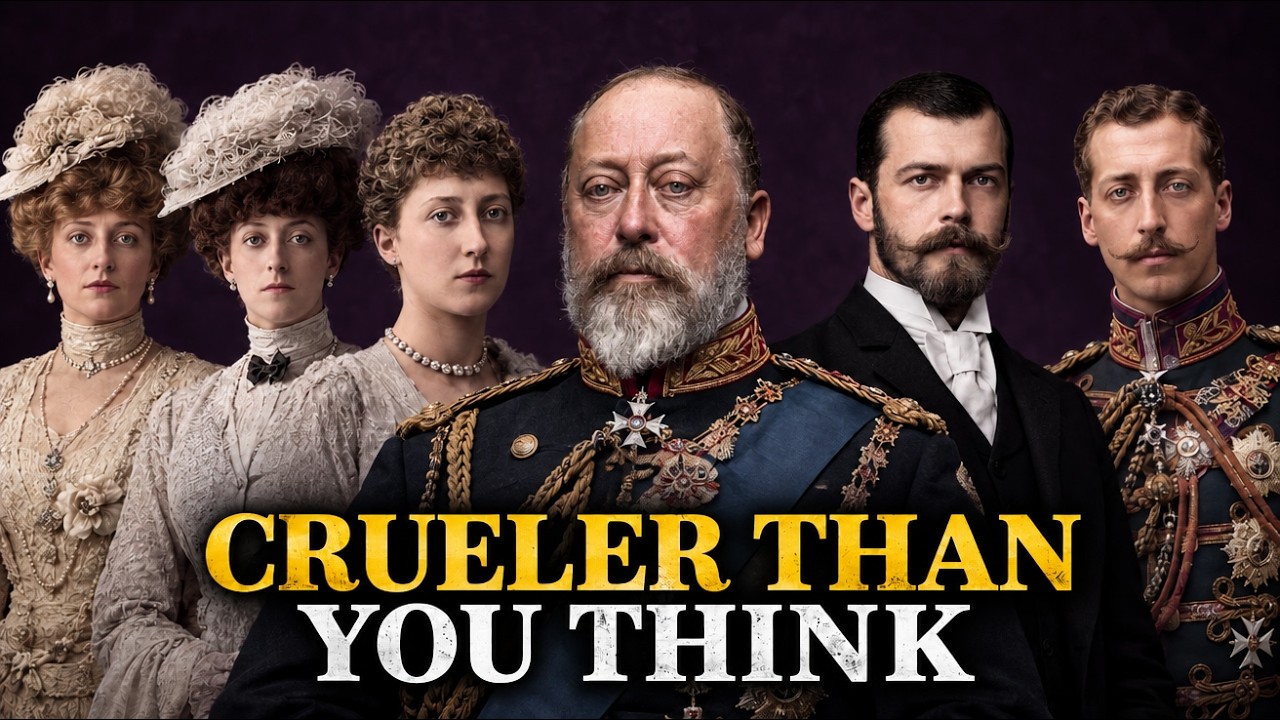
This is the detail people find hardest to sit with, because it is not tidy grief. It is a mother refusing for the rest of her life to accept a fact.
Remember James Kenneth Stephen, the Cambridge tutor. He had suffered a head injury years earlier, and his mental health had collapsed. He was in an asylum in Northampton when the news of Eddie’s death reached him. He refused all food from that day and died on 3 February 1892, 20 days after his former pupil.
Doctors recorded it. What it meant, nobody can say with certainty. And that uncertainty is precisely what later fed the conspiracy writers. What’s documented is simply this. One man heard that Eddie was dead and stopped eating.
And then there is what happened to the brother. George had been a naval officer, a serious one, with a career and a ship, and the reasonable expectation of never being king. Within days, he inherited his brother’s place in the succession. Within 18 months, he inherited his brother’s fiancée.
He and Mary married on 6th July 1893, and it worked, genuinely worked for 42 years. But the man that Eddie’s death created went on to do considerable damage to his own sons.
Because Eddie was not the first child this family buried. He was the second. And the first one is almost never mentioned. Not in the official portraits, not in the family groupings, not in most books.
He lived for 24 hours. His name was Alexander John Charles Albert. He was born at Sandringham on 6th April 1871, the sixth and last child. He was premature like Eddie had been. He died the following day.
What happened next is the part that stays with you. His father, the Prince of Wales, 30 years old, at that point the least popular man in the country, did not hand the child to anyone. He placed the body in the coffin himself. He arranged white flowers around it with his own hands.
Then he and two servants walked the small coffin to the churchyard at Sandringham, where the boy was buried in a private service. Alexandra was upstairs. She was too ill to attend, and she did not see her son buried.
The press, which loathed the Prince of Wales that year over his appearance in a divorce case, treated the funeral as theater. It probably wasn’t. Whatever else Bertie was, and he was a great many things, this was the one child he buried with his own hands.
Alexandra never let go of the boy, either. She referred to him in letters for decades afterwards. And the small stone marking his grave is still there in the churchyard at Sandringham, a few hundred yards from the house where her other son’s bedroom stayed locked.
Two sons gone, and a mother who responded by holding on to what remained with a grip nobody in that household was able to loosen. She had three daughters. One of them would be handed a foreign crown. One would vanish from public life. And one would never be permitted to leave her mother’s side. Not at 20, not at 40, not at 60.
Their names were Louise, Victoria, and Maud. They were born within 26 months of each other, 1867, 1868, 1869. And for most of their childhood, the court referred to them as one thing, not three. The whispering Wales girls. That was the nickname. And it wasn’t kind.
They spoke quietly. They giggled. They finished each other’s sentences. And they were, by the standards of their own class, spectacularly undereducated. This was not an accident.
Their mother had opinions about what daughters were for, and the opinions were simple. They were for staying. Alexandra kept them close, dressed them alike well into adulthood, and encouraged a nursery atmosphere that outlasted the nursery by about 30 years.
Even their father, who was not a demanding parent, complained that the girls were being brought up to be shy. You don’t have to take anyone’s word for how strange this looked at the time. Queen Victoria took it up directly. She complained in writing about the children’s upbringing, about how little the girls were taught, about how rarely they were made to behave like people who would one day have public roles.
When the Queen Empress of India thinks your parenting is too lax, that is not a modern judgment imposed backwards. That is the family itself saying it out loud.
And then there was the deafness. Alexandra had inherited otosclerosis, a hardening of the small bones of the ear. After a serious illness in 1867, rheumatic fever that left her with a permanent limp, her hearing deteriorated steadily. By middle age, she could barely follow a conversation in a crowded room.
At a dinner table full of her husband’s fast, worldly, joking friends, she was effectively alone. Her daughters could be understood. Her daughters stayed because her husband did not.
Bertie’s affairs were not a secret. Lily Langtry, Daisy Warwick, Alice Keppel. A social life that ran on other people’s houses and other men’s wives. Alexandra tolerated it publicly, and by most accounts genuinely liked some of the women involved. But the practical effect on three daughters was a household with one permanently present parent whose world was shrinking and who required company.
Two of the three got out. This is the story of the one who didn’t.
Princess Victoria, Toria, was born on the 6th of July 1868. The middle daughter, and the one everyone agreed was the cleverest and the sharpest tongued. She was the family’s mimic. She read. She had a quick, dry sense of humor that shows up in the letters of people who met her.
Of the three sisters, she was the one with the most obvious appetite for a life. She was given the least of one.
Suitors came. They did not get far. Lord Rosebery’s name comes up most often. A future prime minister, a widower, wealthy, close to the family. Accounts differ wildly on whether anything approaching a proposal ever existed, and there is no reliable documentation of one.
What is not in dispute is the pattern. Whenever a possible match appeared, it dissolved. Alexandra’s objection was never that the man was unsuitable. It was that Toria was needed.
So she became something the modern world doesn’t really have a word for. Unpaid companion. Permanent daughter. She traveled where her mother traveled, Denmark most years, cruises on the royal yacht, Copenhagen, Sandringham, London. She answered the correspondence. She managed the household details. She was functionally staff, and she held that position for the whole of her adult life without wages, without a house of her own, and without the option of resigning.
Her health collapsed repeatedly. She had surgery, long periods as an invalid, and stretches where she simply disappeared from public view into a sick room. The illnesses were real and documented. What no doctor could write down was the other thing that people who knew her described: a woman going quietly sour.
Bitter is the word that turns up again and again in memoirs. Sharp about her mother, sharper about her sisters who had husbands.
There was one relationship she did have, and it was the most important one in her life. Her brother. George and Toria had been close since the nursery, and after he became king in 1910, that closeness turned into a fixed daily ritual. They telephoned each other every single morning. Not occasionally. Every morning, for a quarter of a century, the king of Great Britain stopped what he was doing to talk to his unmarried sister.
There’s a story about those calls that gets repeated in almost every book about this family. One morning, Toria picked up and opened with something insulting and affectionate. The version usually printed has her calling him a fool before the operator had finished connecting, and the operator heard it. It’s a good story. Its sourcing is thin, and its wording changes from book to book. So treat it as family legend rather than record.
But the calls themselves are real. And what happened to him when they stopped is one of the strangest things in this whole story.
Alexandra died in November 1925. Toria was 57 years old. For the first time since the 1880s, nobody required her to be anywhere. She moved into a house at Coppins in Buckinghamshire, and by every account she loved it. Gardening, her own routine, her own table, her own front door.
It took her 57 years to get a life, and she had 10 years to live it.

Her elder sister had done the opposite. Louise got married at 22, got out of the house, and then did something nobody expected from a princess of that generation. She used her freedom to disappear.
Princess Louise, born February 1867, was the eldest daughter and the shiest of the three. In 1889, she married Alexander Duff, Earl Fife, a Scottish landowner, enormously rich, a friend of her father’s, and 18 years older than she was.
He was also not royal, which mattered. British princesses were expected to marry foreign princes. Marrying a British subject, even a wealthy earl, was close to unheard of. Queen Victoria approved anyway, and two days after the wedding, she made him Duke of Fife. Later, she went further, granting the couple’s daughters the rank of princess, an unusual piece of legal engineering designed to stop the grandchildren of a sovereign’s heir from sliding into the ordinary aristocracy.
On paper, it looks like a family closing ranks around a beloved daughter. In practice, Louise used the marriage to leave public life almost entirely.
She had two daughters, Alexandra and Maud, and she raised them mostly at Mar Lodge in Aberdeenshire and at the family’s houses in England, away from London, away from photographers, away from the court. She undertook almost no public engagements. She gave no interviews because princesses did not. But she also gave no speeches, opened almost nothing, and sat for remarkably few portraits.
She was a Princess Royal who behaved like a private countrywoman. Her father, once he became king in 1901, gave her the title of Princess Royal in 1905, the highest honorific a British monarch can give a daughter, held for life. She accepted it and carried on avoiding everything that came with it.
For 22 years, the marriage was quiet and by all accounts happy. Then in December 1911, the entire family nearly drowned.
They were sailing to Egypt for the winter aboard the P&O liner Delhi. On the night of the 12th of December, in fog and heavy weather, the ship ran aground off Cape Spartel near Tangier on the Moroccan coast. Warships from the British and French navies came to take the passengers off. The sea was too rough for a clean transfer. The lifeboats capsized in the surf.
So the Duke of Fife, his wife, and their two teenage daughters went into the water and were carried ashore through the breakers. Picture that properly. The king’s sister, a Princess Royal of Great Britain, soaked and half-drowned on a Moroccan beach in December, being pulled out of the sea by sailors. Two French seamen died in the rescue operation.
The family got to Tangier alive. That was the good part.
Her husband never recovered. He had been ill before the wreck, and the exposure finished what was already underway. They continued to Egypt as planned because he insisted. He developed pleurisy and died at Aswan on the 29th of January 1912, seven weeks after the shipwreck.
Louise was 44, widowed in a hotel on the Nile, 2,000 miles from home, with her daughters. She had 19 years left, and she spent them getting quieter.
The dukedom passed by special remainder to her elder daughter, Alexandra, who became Duchess of Fife in her own right, one of a handful of British peeresses ever to inherit like that. Louise handed the public part of the family over and stepped back.
Her daughters did not stay invisible. Alexandra married Prince Arthur of Connaught, a grandson of Queen Victoria, and served as a working nurse, an actual trained nurse on wards through the First World War and beyond, under the name Nurse Marjorie. The younger Maud married the Earl of Southesk and slipped out of royal life almost completely.
Two sisters, two directions in the next generation down. The pattern repeats in this family with unsettling regularity.
Louise died in London on the 4th of January 1931, aged 63, after an operation. She was buried in Scotland on the estates her marriage had given her. There are people who have studied this family for decades who struggled to name a single public act she performed in more than 40 years as a princess. That is not a hole in the record. That was the point.
Put those two lives side by side, and something uncomfortable appears. Toria never married and was kept in the house. Louise married and left, and the result, in terms of what either woman actually got to do with her time on Earth, was almost identical. Both ended up invisible. One had it imposed on her. The other seems to have chosen it. Neither escaped the thing their mother built.
Which leaves the youngest. Maud was born in November 1869, the baby of the family, and on paper she was the least likely of the three to end up anywhere interesting. She was called Harry by her family, after a naval officer they thought she resembled in temperament.
She rode. She cycled enthusiastically at a time when that was considered faintly scandalous for a princess. She was the tomboy. She wanted to marry a cousin, Prince Francis of Teck, the brother of the same Mary of Teck who had been engaged to Eddie and then married George. Francis was a gambler with debts and no interest in Maud whatsoever. He ignored her.
So in 1896, she married another first cousin instead, Prince Carl of Denmark, a naval officer, the second son of a second son, with no throne anywhere in his future.
Her mother predictably tried to keep her close. Maud was given Appleton House on the Sandringham estate as a wedding present, and for the first several years of the marriage she spent as much time in Norfolk as in Denmark, which did not go unnoticed in Copenhagen.
She was homesick. She was reportedly miserable in the Danish winters. She was a young wife married to a serving naval officer who was frequently at sea, in a country whose language she never fully mastered, with no particular role and no particular prospects.
That was Maud at 35. Nine years married, one small son, a borrowed life in a borrowed country, and no reason on earth to expect anything else.
Then a nation she had never set foot in voted on whether to make her husband its king, and he very nearly said no. What she did about that decided the rest of her life and the line that still sits on the Norwegian throne today.
None of it was planned. Norway had been tied to Sweden since 1814, sharing a king it had not chosen. In the summer of 1905, the Norwegian Parliament declared the union dissolved. That left a country with a functioning government, a constitution, and no monarch.
The Norwegians went looking for a king, and the man at the top of their list was Maud’s husband. Partly because he was Danish, partly because he was a serving naval officer of no great grandeur, and mostly because he was married to the daughter of the king of Great Britain.
Carl said no. Or rather, he said not yet. He refused to take a throne handed to him by politicians and insisted the Norwegian people be asked directly. There was a real republican movement in Norway at the time, and he had no intention of arriving as anyone’s compromise.
So Norway held a plebiscite in November 1905. Roughly 79% voted for a monarchy. Only then did he accept. He took the old Norse name Haakon VII. Their two-year-old son Alexander was renamed Olaf.
And on November 25th, 1905, the family sailed into Christiania Harbor, the city we now call Oslo, in freezing weather, to be met by a country that had just invented a monarchy for them. Maud was 35. Six years earlier, she had been an unhappy naval wife who could not get warm in Copenhagen. Now she was a queen.
Here is the question that follows Maud for the rest of her life. Was that an escape, or was it an exile with better furniture?
Because she never stopped going home. Appleton House, her wedding present on the Sandringham estate, stayed hers. She returned to Norfolk for weeks and often months every single year for more than 30 years. And she kept doing it after she was crowned.
She had her clothes made in London. She imported English food and English gardeners. She wrote to her brother constantly. Norwegian courtiers noticed that their queen’s household ran on English time, and Norwegian newspapers occasionally noticed how long she was away. She learned the language well enough to manage, no better.
And yet she did the work. Hospitals, charities, the Red Cross, a genuine interest in Norwegian folk dress and Norwegian winter sport. And she was photographed on skis.

She was shy in public and awkward at ceremonies, which the Norwegians read as coldness for years. They were wrong, but it took a long time to correct. Privately, she was funny and blunt, and she and Haakon appear, by every surviving account, to have genuinely liked each other. That mattered. This was a marriage arranged between cousins that turned into a working partnership for 42 years.
They had one child, and only one. Olaf grew up Norwegian in a way his mother never could. Schooled there, in the Norwegian army, an Olympic gold medalist in sailing at Amsterdam in 1928. He married a Swedish princess, Märtha. And in 1940, when German forces invaded, he and his father refused to abdicate under occupation and left for Britain, where the Norwegian king spent five years broadcasting resistance from London.
Maud did not live to see any of that. In the autumn of 1938, she traveled to London as usual and checked into a nursing home in Bentinck Street under the name Mrs. Brown. She had abdominal surgery. Her husband crossed the North Sea to be with her. She seemed to be recovering.
Then her heart failed, and she died on the 20th of November, 1938, three days before her 69th birthday. She was the only Norwegian queen to die abroad.
Her body was taken back to Norway aboard a British warship, HMS Royal Oak. Norwegians lined the harbor. The shy foreign queen they had never quite warmed to was buried in the royal mausoleum at Akershus Fortress. And her son, and her grandson, and her great-grandson have sat on that throne ever since.
Of Edward VII’s six children, the one nobody expected anything from is the one whose descendants still reign.
Which leaves the brother. The one who got everything. The fiancée, the throne, the long marriage, the country. And who spent his whole life being a substitute for a dead man.
George loved the Navy. That is not sentiment. It’s the record. He had served 15 years, commanded his own ship, and by 1892, he was a professional officer with a professional future. Eddie’s death ended it in a fortnight.
He was created Duke of York, given a household, and told to learn constitutional law with a tutor. A man who had been navigating warships was put back in a schoolroom at 26.
Then the marriage. He and Mary of Teck had been thrown together by grief and by Queen Victoria’s determination not to waste a suitable bride. It should have been a disaster. Instead, it became the steadiest thing in either of their lives.
They were both reserved to the point of awkwardness, and they wrote to each other with an affection neither could say aloud. He never took a mistress. After his father, that alone was remarkable.
And here is where two true things have to sit beside each other. Because flattening this man into either a hero or a monster gets the family wrong.
George V was a conscientious king, devoted to his wife, loyal to his sisters, and by the standards of his class, an absolute disaster as a father. He shouted. He mocked. He enforced punctuality and stamp collecting and silence at meals.
The line most often attributed to him is that his father had been frightened of his mother, he had been frightened of his father, and he was damned well going to see to it that his children were frightened of him. There is no reliable source for it. Historians have been trying to trace it for decades and cannot. But it stuck because it matched what everyone who watched that household actually saw.
What is documented is the result. His eldest son, another Edward, grew up terrified of him and became the king who abdicated in 1936 to marry Wallis Simpson, 11 months after his father’s death. His second son, Bertie, developed a stammer under that regime and then had to take the throne his brother threw away. His fifth son, John, had epilepsy and was raised apart from the family at Sandringham, where he died at 13.
Look at that sequence, and the pattern in this family becomes hard to ignore. A boy is removed from view because he is difficult or ill. A mother holds on too tightly. A son inherits a role built for someone else. George had lived through every one of those things as a child and then reproduced them almost exactly one generation down.
His sisters went first. Louise died in January 1931. That left Toria. For another four years, the morning telephone calls continued as they had since 1910. The king in his study, listening to his sister complain about the garden and the family and the weather.
Victoria died at Coppins on the 3rd of December 1935, aged 67. She had been free of her mother for 10 years. She had never had a husband, a child, a household of her own before that, or a job.
The news reached her brother that morning. He cancelled the state opening of Parliament, a ceremony no one cancels, and the King of Great Britain did not appear in public. He wrote in his diary that she was the sister he had loved most, and that nothing could ever replace her.
Those who were around him that winter said he seemed to lose interest in going on. He had already been in poor health for years, since a serious illness in 1928. He died at Sandringham on the 20th of January 1936, seven weeks after the telephone stopped ringing.
There is a detail about that night that only came out in 1986, when his physician’s private notes were published. Lord Dawson recorded that he administered morphine and cocaine to hasten the end. Partly to spare the king, and partly, he wrote, so that the death could be announced in the morning papers rather than the evening ones. His family did not know. Nobody outside that room knew for 50 years.
Six children. Put them side by side, and the arithmetic is brutal.
One died at a day old and was carried to the churchyard by his father. One died at 28 with his wedding presents already delivered. One was never permitted to marry and got 10 years of her own life at the very end. One married, left public view entirely, and was nearly drowned off Morocco before being widowed on the Nile.
And two got crowns. Not because they were the strongest or the cleverest, but because a brother died of pneumonia in 1892, and a parliament in Norway went shopping for a monarch in 1905. Neither of them asked for it. Both of them, in their own way, spent the rest of their lives homesick for a version of Sandringham that had stopped existing.
And the lines they left behind are almost comically unequal, too. Alexander John left nothing. Eddie left nothing. Toria left nothing. Louise’s dukedom passed to her daughter and still exists. The present Duke of Fife is her direct descendant. George’s line produced two kings, a queen, and a constitutional crisis. Maud’s single son produced the Norwegian royal house that sits on that throne today.
Two of the six had children who mattered to history. The other four were remembered mainly by each other, and then not at all.
What decided these six lives was not politics, and it was barely their father. Edward VII was an absent, genial, unfaithful man who was warmer to his children than his own mother had been to him and who left the daily shaping of them almost entirely to his wife.
The variable was Alexandra. Her deafness, her grief, her refusal to let go. It made her adored. It also made her daughters’ lives very small.
Which brings us back to that locked bedroom at Sandringham. We started there because of the clothes laid out and the flag over the bed, and because it looks at first like the strangest thing in this story. It isn’t. It’s the most honest thing in it.
Alexandra kept that room exactly as it was for 33 years, until her own death in 1925, and she showed it to visitors. Now you know who slept in it. You know that his fiancée married the brother down the corridor, that the brother took the throne meant for him, and that the brother’s own sons inherited the damage.
You know that the same woman who preserved that room also kept a daughter beside her until that daughter was 57. The shrine and the captivity were the same instinct pointed in two directions.
A few hundred yards from that house on the same estate, there is a small grave for a baby who lived one day. The stone is very small. And about a mile in the other direction stands Appleton House.
It is not a palace. It’s a modest brick country house with a sloping lawn, the sort of place a prosperous farmer might own. Maud kept it for 42 years. She was a queen. She had a palace in Oslo and a royal lodge in the mountains. And she came back to this house in Norfolk every year of her adult life, because it was the only address that was ever really hers.
After she died in 1938, it stood empty. The furniture stayed. Her husband, the king of Norway, never came back to it.
It’s still there today on the Sandringham estate, unoccupied. A small English house belonging to a Norwegian queen, kept ready for a woman who had been going home her whole life and finally stopped.