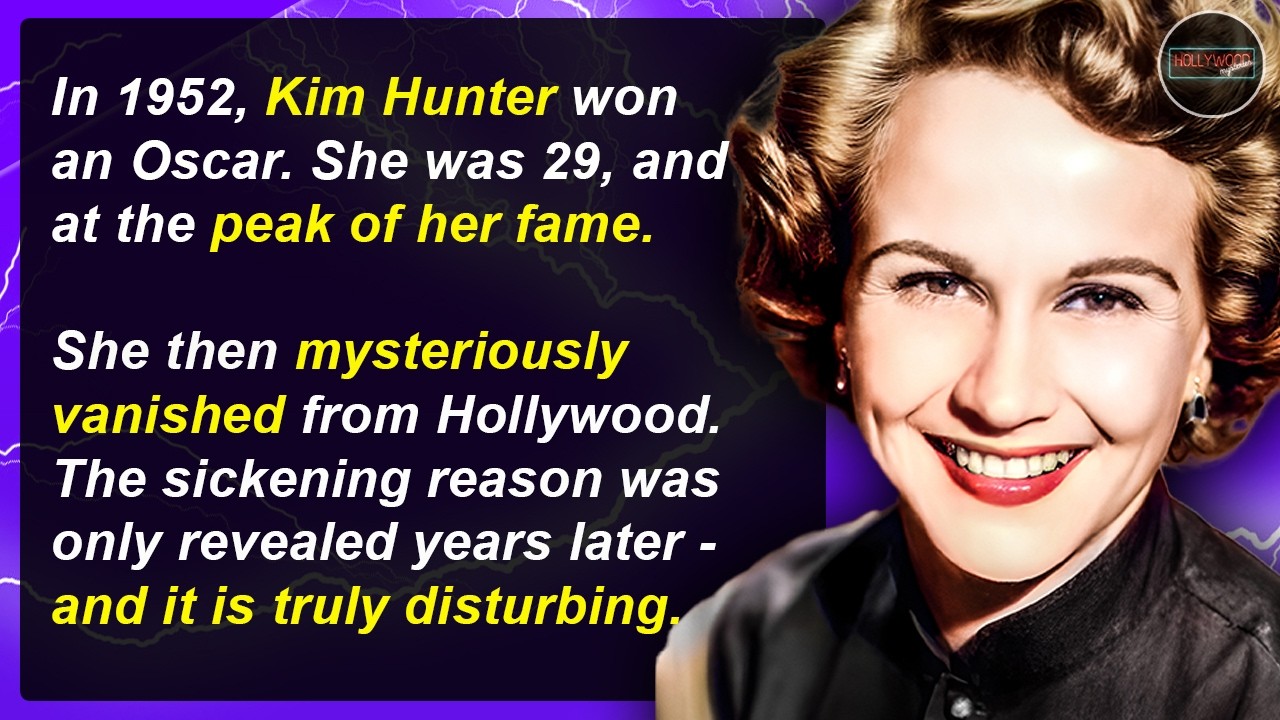
In the spring of 1952, a 29-year-old actress with a Broadway pedigree and a recent Academy Award stood at what should have been the summit of Hollywood. Kim Hunter had just won Best Supporting Actress for A Streetcar Named Desire, opposite Marlon Brando, with a husband and a baby on the way. Within months, the offers stopped. The telephone in her apartment fell almost silent, and she was eventually approached by a stranger who offered to clear her name for a cash fee of $200.
She refused. Born Janet Cole in Detroit in 1922, Hunter was the only child of a concert pianist mother and an engineer father who died when she was very young. The family moved to Miami Beach, where she made her professional debut at 17 in a play called Penny Wise. She spent the early 1940s working the regional circuit, learning her craft through summer stock and small parts before landing a role in a Pasadena Playhouse production of Arsenic and Old Lace.
The performance caught the attention of David O. Selznick, who renamed her. She contributed “Kim” for its directness, and “Hunter” was reportedly suggested by a secretary. As Kim Hunter, she made her screen debut in 1943 in the Val Lewton horror film The Seventh Victim.
The same year, she appeared in Tender Comrade, a wartime home-front picture with Ginger Rogers that would later be cited against her. In 1946, the British filmmaking team of Michael Powell and Emeric Pressburger cast her in A Matter of Life and Death. Her performance as a radio operator who falls in love with a dying pilot over a transatlantic frequency established her internationally. But the decisive door opened in 1947, when Elia Kazan cast her as Stella Kowalski in the original Broadway production of Tennessee Williams’s A Streetcar Named Desire.
The production ran 855 performances. Stanley was played by Marlon Brando, whose theatrical improvisation and raw physicality made him a sensation. Hunter, at 25, played Stella as the still center of the production. Kazan later wrote, “The minute I saw her, I was attracted to her.
” Hunter herself recalled not knowing at the time what a milestone the production would become. When Kazan adapted the play for the screen in 1951, Vivien Leigh replaced Jessica Tandy as Blanche, but Hunter, Brando, and Karl Malden reprised their stage roles. The film was a sensation, and at the Academy Awards on March 20, 1952, Leigh won Best Actress, Malden won Best Supporting Actor, and Hunter won Best Supporting Actress. Brando, nominated for Best Actor, lost to Humphrey Bogart for The African Queen.
The work did not follow. Hunter appeared in Deadline USA opposite Bogart in 1952 and a few other films, then the offers stopped without explanation. The cause was Red Channels, a 1950 booklet published by American Business Consultants that listed 151 entertainment figures it claimed were communist sympathizers. Hunter was included on two grounds: she had sponsored a 1949 symposium organized by the World Peace Council, and she had appeared in Tender Comrade.
The World Peace Council was publicly an advocate for nuclear disarmament and sovereignty, but it was later revealed to be funded by Soviet intelligence. Hunter said she was unaware of its true aims, and even Albert Einstein reportedly expressed regret after lending his name to the organization. In the repressive atmosphere of the Red Scare, ignorance was not accepted as a defense. Red Channels had no legal authority, but advertising agencies, network executives, and studios treated it as a hiring guide.
To be listed was to become “non-clearable. ” Hunter spent months in confusion before she understood what had happened. There was no accusation she could answer, no hearing she could request. There was simply an enormous quietness on the telephone.
The blacklist operated through a coalition of government committees, the FBI, sponsors, and private clearance organizations. It also attracted opportunists. Sometime after 1953, a man whose name Hunter would later struggle to remember offered to produce a dossier clearing her name for a fee of $200. She refused.
“I would not pay the $200,” she later told a court. “My life is absolutely an open book. ”
The cost of that refusal was years. In the late 1950s, her work came almost entirely from theater and live television.
She returned to Broadway repeatedly in plays including Darkness at Noon and The Children’s Hour, and appeared in Rod Serling’s Requiem for a Heavyweight on Playhouse 90 in 1956, which received the first Peabody Award ever given for television writing. The work kept her solvent but did not return her name to casting lists. The reckoning came in a New York courtroom in 1962. Radio personality John Henry Faulk had sued AWARE Inc.
, the private anti-communist clearinghouse that had replaced Red Channels as the industry’s preferred policing body. Faulk had been blacklisted and lost his livelihood, and with the help of lawyer Louis Nizer and financial backing from Edward R. Murrow, he chose to fight. Hunter testified about her experience: the discovery that she had been listed, the offers of paid clearance, and the pressure she had faced.
She stated plainly that she was neither a member of AWARE nor in sympathy with its methods. Asked about her work, she said, “I worked quite frequently after that and to the present date. ” Faulk won, and the jury awarded him three and a half million dollars, the largest libel verdict in American history at the time. AWARE collapsed.
Vincent Hartnett, the man behind it, was financially destroyed. The blacklist as a functioning machine did not survive the trial, though the careers that had been destroyed were not restored in any meaningful sense. Hunter’s testimony helped clear the names of several actors. She returned to film in 1964 with a small role in Lilith, opposite Warren Beatty and Jean Seberg.
But the role that restarted her movie career came from an unexpected direction. In 1967, producer Arthur P. Jacobs was casting an adaptation of Pierre Boulle’s novel Planet of the Apes. The project had been rejected by every major studio for years until a makeup test reel convinced 20th Century Fox it could work.
Jacobs needed an actress to play Dr. Zira, a chimpanzee psychologist whose curiosity about a captured human astronaut anchors the film’s emotional life. He went to Kim Hunter. She said yes.
The conditions were brutal. The makeup took three to four hours to apply each morning and could not be removed for meals. The latex restricted facial movement so severely that actors had to push their performances through their eyes and voices. Temperatures on the California desert locations climbed regularly into the high 90s.
“It was pretty claustrophobic,” Hunter said. “The only thing of me that came through was my eyeballs. ”
The film was released in 1968 and became one of the year’s biggest hits. She returned to the role in two sequels, and her largest performance came in Escape from the Planet of the Apes in 1971, which ended with one of the bleakest sequences in studio cinema.
The irony was not lost on her: the actress who had helped revolutionize American acting was now known to a generation as a chimpanzee scientist. The following decades were full. She moved between Broadway, regional theater, television guest spots, and miniseries. She published an autobiographical cookbook in 1975 called Loose in the Kitchen.
She joined the daytime soap The Edge of Night and earned a Daytime Emmy nomination in 1980. She made character appearances in Midnight in the Garden of Good and Evil in 1997 and A Price Above Rubies in 1998. Her marriage to writer and producer Robert Emmett, whom she married in 1951, lasted 49 years until his death in 2000. They lived in Greenwich Village, and friends described the household as comfortable rather than glamorous.
Kim Hunter died of a heart attack on September 11, 2002, at her New York apartment. She was 79. The date, one year to the day after the attacks on the World Trade Center, was a minor dark irony she might have acknowledged with a raised eyebrow. Her obituaries were unusually unanimous in tone, mixing admiration with a kind of belated apology.
Charlton Heston, asked for a remembrance, called her “a fine actress and a wonderful person. ”
Stella Kowalski and Dr. Zira remain the roles by which she is best remembered. Both are, in different ways, about a woman with intelligence and tenderness, refusing to be hectored, trying to live truthfully inside the wrong species of cage.
Kim Hunter reached the top of her profession before she was 30, was stripped of the rewards within months, refused to buy them back at the going rate, and then spent the next 40 years demonstrating what great acting actually looked like.