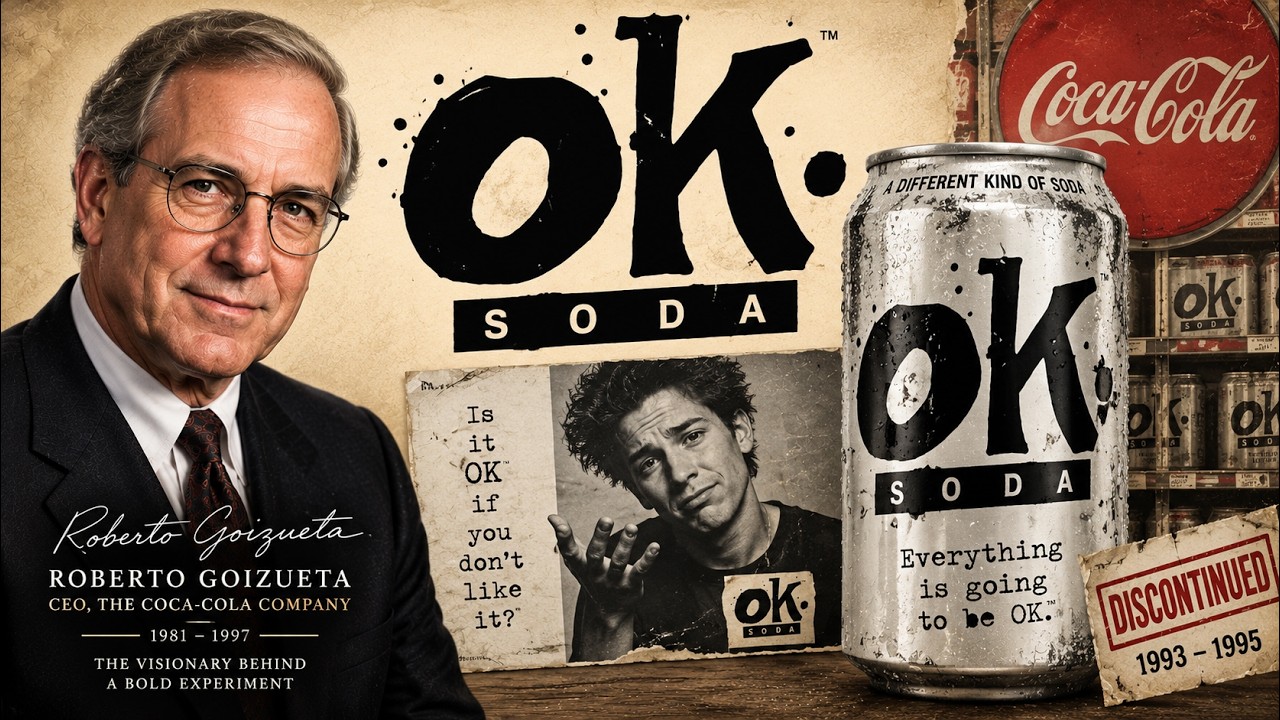
On a spring afternoon in 1994, Coca-Cola gathered journalists and analysts at the Four Seasons restaurant in New York to unveil a new product aimed at the most skeptical generation in America. Sergio Zyman, the company’s newly appointed chief marketing officer, leaned into the microphone and delivered a slogan that seemed to reject everything corporate advertising stood for: “Things are going to be okay. Not great, not extraordinary. Just okay.
”
The drink was called OK Soda. Its cans were gray. Its advertising made no promises of happiness or refreshment. One of its illustrated mascots bore the facial features of Charles Manson.
And within 14 months, nearly the entire product had vanished from store shelves. The story of OK Soda is not simply a tale of a failed beverage. It is a case study in what happens when one of the world’s largest corporations tries to market authenticity to a generation that has built its identity around detecting it. Zyman was born in Mexico City in 1945.
He studied at Harvard University and other executive programs, though he collected few formal degrees. What he possessed was an instinct for what consumers wanted before they knew they wanted it. Early in his career, he held management positions in Japan, Brazil, and Guatemala before joining PepsiCo, where he became president of its operations at age 30. In 1979, he moved to Atlanta to join Coca-Cola.
Within three years, he helped launch Diet Coke, which became the fourth best-selling soda in the United States. The success earned him a reputation as a marketing visionary. But in 1985, he oversaw one of the most famous corporate blunders in history: the introduction of New Coke. Blind taste tests had shown that a new formula consistently beat both the original Coca-Cola and Pepsi.
The data was overwhelming. But the company had miscalculated something that no taste test could measure: emotional attachment. When Coca-Cola discontinued its original formula on April 23, 1985, the backlash was immediate. Thousands of angry calls flooded phone lines.
Letters poured in by the tens of thousands. In some cities, consumers poured New Coke into gutters. Seventy-seven days later, the original formula returned as Coca-Cola Classic. Zyman left the company in 1988 and built a successful consulting firm.
But his chapter with Coca-Cola was not finished. In 1993, chairman Roberto Goizueta invited him back to Atlanta. Zyman became the company’s first-ever chief marketing officer, a position created specifically for him. Within months of his return, he began studying a problem that troubled Coca-Cola’s strategists.
Among Americans aged 12 to 25, soda consumption was softening. The generation that would come to be known as Gen X was buying fewer colas and drifting toward alternatives like Snapple and Gatorade. More troubling, market research revealed a linguistic finding that seemed almost too simple to be meaningful: across multiple languages, the word “OK” was the second most recognized word on Earth, ranking just behind “Coke” and ahead of “hello” and “stop. ” It carried the same emotional weight everywhere: not good, not bad, just acceptable.
Zyman saw an opportunity. What this generation wanted, he believed, was not the muscular optimism of a Pepsi commercial or the warm nostalgia of a Coca-Cola holiday ad. They wanted something that met them where they actually were: tired, ironic, aware that they were being marketed to, and deeply skeptical of anyone who pretended otherwise. The drink would be called OK Soda.
Its slogan: “Things are going to be okay. ” The concept had an elegant internal logic. If Gen X distrusted advertising, build advertising that admitted it was advertising. If they distrusted corporate sincerity, replace sincerity with transparency.
If they were too smart to be sold something, tell them they were smart and sell it to them anyway. The creative work was handed to Weiden & Kennedy, the Portland-based advertising firm. Working with creative director Charlotte Moore, conceptual artist Peter Wegner, and designer Todd Waterbury, the team assembled a roster of artists from the world of alternative comics: Daniel Clowes, creator of Eightball and Ghost World; Charles Burns, whose work in Black Hole defined the underground aesthetic; and illustrators David Cowles and Caleff Brown. Clowes later recalled that he took the job with complete skepticism.
The pay was good, better than his last five comics combined. But he told The Believer magazine in 2014 that he knew from the first conversation what the campaign could not accomplish. “I knew full well that what they were trying to do was not possible,” he said. “You cannot market to cynical hipsters by being cynical and hipsterish.
” He took the commission anyway. Then he did something that would become the most remembered detail of the entire OK Soda story. He drew the brand’s mascot, a flat, expressionless figure meant to embody studied indifference, with the eyes and nose of Charles Manson. The reference was not subtle.
Clowes had signed extensive non-disclosure paperwork before beginning the project, but none of it, he noted, contained the clause: “Don’t put a mass murderer on the can. ”
Coca-Cola approved the design. The cans went to print. In the spring of 1994, OK Soda launched in eight test markets across the United States: Boston, Seattle, Austin, Denver, Providence, Minneapolis, Pittsburgh, and Columbus.
The cities were chosen not for size but for their demographic profile: high concentrations of college students, young professionals, and the culturally restless 18-to-25-year-olds that Zyman’s research had identified as the target. The product itself presented the first problem. The flavor, described by Coca-Cola as citrusy and spicy, was experienced by many drinkers as simply strange. Independent tasters reached for different comparisons, some describing it as a graveyard of mixed soda dispenser flavors.
There was nothing technically wrong with it. There was also nothing particularly right. The flavor was deliberately subdued, designed not to be loved immediately but to reward repeated exposure. Whether that was a product strategy or a rationalization of a formula that never quite landed remains unclear.
The packaging, however, was genuinely radical. Where the formula underwhelmed, the can design was unlike anything a major beverage company had ever attempted at scale. The gray, two-tone artwork looked nothing like a commercial product and everything like the cover of an underground literary magazine. Four distinct designs were released, each illustrated by a different artist.
The marketing campaign leaned into every counterintuitive instinct the creative team had. There were no celebrity endorsements, no athletes, no musicians. The tagline was a question: “What’s the point of OK? ” The manifesto, printed directly on the cans, read like a parody of corporate mission statements.
Sample entries included: “OK Soda emphatically rejects anything that is not OK, and fully supports anything that is,” and “The better you understand something, the more OK it turns out to be. ”
The cans also featured a unique code that consumers could enter at one of two toll-free numbers: 1-800-I-Feel-OK and 1-800-4-OK-Soda. Callers were invited to leave voicemail messages, with the disclosure that their comments might be used in future advertising. Some of those messages, including highly critical ones, were actually aired in radio spots.
A brand broadcasting its own criticism as a marketing tool was unprecedented in 1994. The campaign generated significant media coverage. Time magazine ran a feature. The Wall Street Journal covered the Four Seasons press luncheon.
Marketing trade publications treated OK Soda as a potential industry watershed. In the coffee shops and record stores of Seattle and Boston, the gray cans appeared alongside cassette tapes and zines. The aesthetic fit was real. The cultural alignment on the surface was almost perfect.
The problem was underneath the surface. The people who were supposed to be reached by OK Soda — the ones who bought Ghost World comics, who knew Daniel Clowes by name, who recognized the visual grammar of alternative culture — also knew the moment they picked up the can exactly what they were holding. Not a voice from their world, but a very large corporation’s approximation of a voice from their world. A simulation built by the same company that made the red cans, distributed by the same trucks.
Clowes had seen it coming. He had put Charles Manson’s face on a can as a private joke about the impossibility of the entire enterprise. By the summer of 1994, OK Soda had the cans, the hotline, the manifesto, the underground artists, and $10 million in marketing support. What it did not have was customers.
In some test market locations, weekly sell-through rates were running at a fraction of projections. Individual stores reported cases sitting untouched on shelves for weeks. Consumers found the product interesting, worth discussing, even worth buying once. But they did not buy it a second time, and a beverage business runs entirely on repeat customers.
There was also a deeper problem that no amount of creative reinvention could address. The Gen X audience that OK Soda was pursuing did not particularly want to be saved by a soda company. Their disillusionment was not a market gap waiting to be filled. It was a worldview, and a worldview, unlike a thirst, is not resolved by a product.
By September 1994, the internal numbers had moved from concerning to decisive. Cumulative sales across the eight test markets were tracking at a fraction of the threshold Coca-Cola required to justify national expansion. In late 1994, the company attempted one modest adjustment, a reformulation that pulled back on the spice elements that had generated the most negative feedback. The change was not announced publicly, which was consistent with the brand’s anti-marketing ethos, but it also meant that consumers who had tried the original and disliked it had no particular reason to try again.
The adjusted formula did not move the sales numbers. The end came in stages. In early 1995, Coca-Cola quietly began winding down production runs. Distribution to the eight test markets was not replenished at the same rate.
In the spring of 1995, the company made the decision official: OK Soda would not receive national distribution. The product was discontinued. No press release explained the decision. No spokesman offered a postmortem.
The brand that had built its identity around refusing corporate euphemism ended without a statement. Approximately 1 million cases had sold across 14 months in eight cities. Coca-Cola moved roughly 30 billion cases every year. OK Soda never came back.
There was no acquisition, no brand revival, no craft beverage startup purchasing the trademark and relaunching it with better ingredients. The name sits in Coca-Cola’s portfolio, technically owned, practically dormant. What survived instead was a small cult following. Vintage OK Soda cans, particularly the Daniel Clowes and Charles Burns designs, trade on collector markets with consistent regularity.
A single unopened can sells for between $40 and $150, depending on the design. Full sets of all four original designs have sold for over $300. Original promotional materials appear occasionally in estate sales and vintage markets, typically in the Pacific Northwest cities where the test markets ran. Clowes went on to become one of the most critically acclaimed graphic novelists in American literary history.
Ghost World, the comic series he was working on during the OK Soda period, was adapted into a film in 2001 that received an Academy Award nomination. His subsequent books were reviewed in The New York Times and taught in university literature programs. Zyman went on to write a book in 2002 titled The End of Marketing as We Know It, in which he argued that traditional advertising was finished and that the future belonged to brands willing to have honest conversations with their consumers. He was right about all of it.
Viewed from a distance of 30 years, OK Soda means this: Coca-Cola correctly understood that a new generation of consumers had developed immunity to traditional persuasion. The insight was real. The execution was real. The budget was real.
The artists were real. What was not real was the brand itself. OK Soda was a corporate product wearing the clothes of a counterculture artifact, and the generation it was designed to reach had spent their entire conscious lives learning to distinguish between the clothes and the body inside them. They looked at the gray can, read the manifesto, appreciated the craft, and set it back on the shelf.
In the three decades since, the advertising industry has largely solved the problem that OK Soda could not. Brands now build authentic communities through social media, limited releases, and genuine collaborations with independent creators. The entire influencer economy is built on the premise that authenticity can be structured, managed, and monetized. Social media gave corporations a way to perform authenticity at a granular, personal level that a toll-free hotline and a gray can could not approximate.
OK Soda was not wrong. It was early.