The check hit me in the face before I even understood what was happening. Theren threw it the way you toss a coin to a stranger on a street corner, without looking, without any sense that I was a person at all. I was lying on the marble floor of our Scottsdale estate, propped against the leg of a console table that cost more than most cars, and everything on my left side felt like it had been put through a press. Each breath came shallow and wet, a grinding sensation under my ribs that told me something in there was badly, permanently wrong.
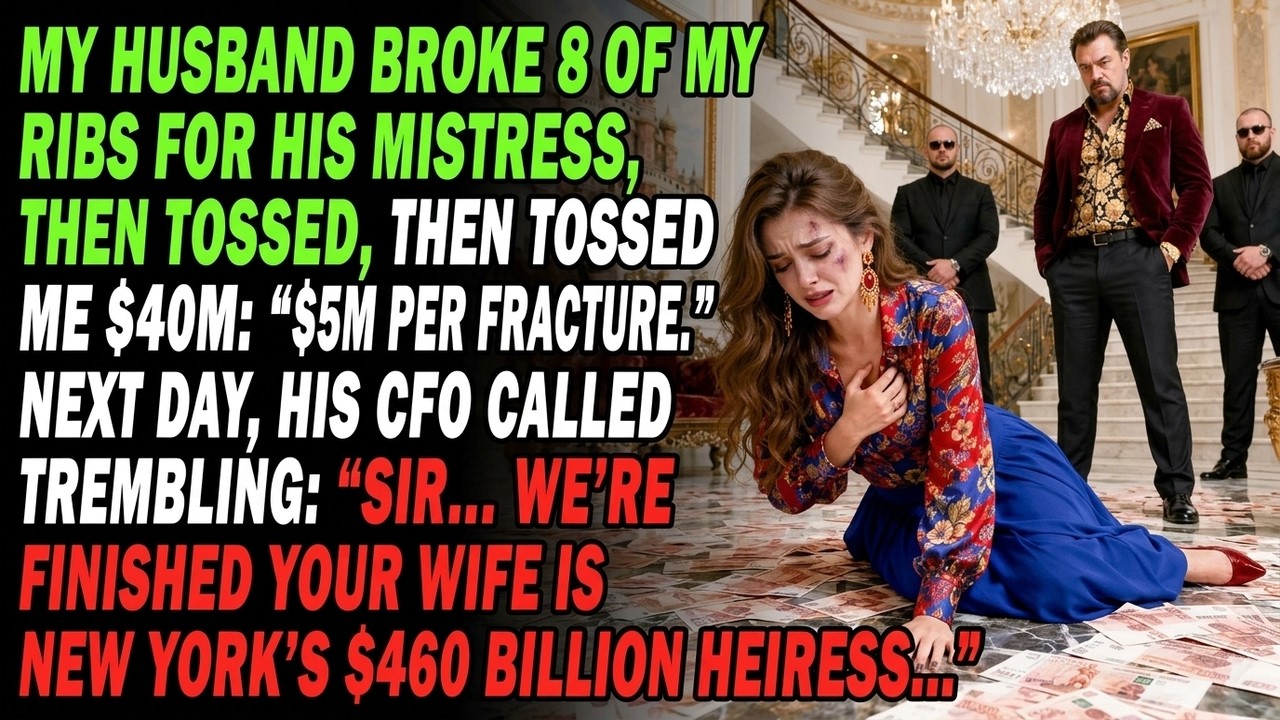
The check fluttered down and landed on my chest. I didn’t look at it. I was watching Theren straighten his cuff links while his head of security stood over me like a problem already solved. Five million per fracture, Theren said, his voice flat, like he was dictating a memo.
Count yourself lucky. Eight breaks, forty million. That’s more than you were worth when you walked in the door. Viven stood behind him.
She wasn’t crying anymore. She had stopped the moment the bodyguards moved toward me, which told me everything I needed to know about those tears. They had been manufactured with surgical precision. She was at the base of the staircase in a silk wrap dress, watching me through half-lowered lashes, wearing the faintest smile.
The kind of smile you wear when you already know how the story ends. Three minutes earlier, she had thrown herself backward down the last four steps of that staircase and landed in a heap at my feet, screaming that I had pushed her. I hadn’t touched her. I had been standing six feet away.
But Theren never checked the footage when it came to Viven. Her tears were the only evidence he needed. In the two years I had been his wife, I had learned that lesson slowly, painfully, the way you learn about a gas leak. Not until it was already too late to leave.
Get her out, he said to the man standing over me. Put her on the street. If she goes to a hospital, remind her of the NDA she signed. They carried me out through the service entrance.
Not the front door. The service entrance, like I was a broken appliance being hauled to the curb. They set me down in the driveway and walked back inside without looking back. I lay there for a long time.
The Arizona night air was dry, smelled like heated concrete and jasmine from the garden beds. I could see the lights of the house through the hedge, heard music faintly. They had put on music. They were already celebrating.
I thought about the past four years. The two years of marriage, and the two before that, when I had fallen in love with a man I believed was simply driven, ambitious, misunderstood. I thought about the morning three years ago when I had sat across from my father in the study of the Whitmore family’s main house in Manhattan and told him I would not be taking the chairmanship of Whitmore Capital. That I was staying in Arizona.
That I was choosing this life. My father had gone very quiet. He hadn’t argued. He had only said, sweetheart, a man who loves you does not need you to shrink.
I should have listened. I got myself upright. I don’t know how. I found out later I had fractured six ribs on my left side and two on my right, one of them dangerously close to puncturing a lung.
At the time, I only knew that breathing felt like swallowing broken glass, and that I needed to move before I couldn’t anymore. I flagged down a car on the road outside the gates. A retired school teacher named Bernice, driving home from her book club, pulled over without hesitation and drove me forty minutes to a private urgent care facility I had researched and quietly memorized years ago, when I first understood that someday I might need it. The ER physician on duty was a young woman named Dr.
Aches. She looked at my X-rays and put both hands flat on the desk. Eight fractures, she said. Three of them displaced.
You need surgery. You need it tonight. Stabilize me, I said. And give me something for the pain.
I can’t in good conscience. I met her eyes. I will sign whatever you need me to sign. I just need to be stable enough to make one phone call.
She looked at me for a long moment. Then she nodded. The anesthetic hadn’t fully kicked in when I reached into the inner pocket of my jacket. The jacket they had left me in because it was cheap compared to anything Theren had bought me.
I pulled out a phone that had been off for nearly four years and pressed the power button. The screen came on slowly, like something waking from a long sleep. I dialed the only contact saved in it. It rang twice.
Miss Whitmore. The voice on the other end was steady, calm, carrying the particular quality of someone who has been waiting. Not anxiously, but with absolute patience for a very long time. I’m glad you called.
Edmund, I said. My voice was steadier than I expected. I’m done. A sound on the other end.
Not quite relief. Something deeper than that. Something I couldn’t fully name. Where are you?
I told him. Twenty minutes, he said. The Whitmore jet is already fueled at Scottsdale Air Park. It has been for the past four years, just in case.
A pause. Your father never stopped hoping. I closed my eyes. I tore the check in half while they were setting my ribs.
Tore it again and again until it was confetti, then left it in the trash bin next to the examination table like the garbage it was. Forty million dollars. That was what Theren Aldridge, founder and CEO of Aldridge Development Group, darling of the Arizona real estate market, Man of the Year three times over in the Phoenix Business Journal, thought my dignity was worth. He had no idea I was the sole heir to Whitmore Capital.
No idea the Whitmore family held controlling interests in four of the eight institutions that held his construction financing. No idea that when he married me, he had been standing inside a cathedral without knowing it, and that the cathedral belonged to me. By the time I landed in Manhattan, it was four in the morning. Edmund met me on the tarmac with a car, a coat, and the kind of quiet efficiency that had made him the Whitmore family’s chief of operations for thirty years.
He took one look at the way I was holding myself, careful, shallow breaths, one arm braced against my side, and said nothing. He simply opened the car door. My father was waiting in the library of the Whitmore townhouse on the Upper East Side. He was in his robe because he had been woken the moment Edmund answered my call, and he had not gone back to sleep.
He stood when I came through the door and looked at me. Really looked, the way a father looks. The expression that crossed his face in that moment is something I will carry for the rest of my life. He crossed the room and held me as gently as if I were made of glass.
My girl, he said. And nothing else. He didn’t ask what happened. He could see it.
The bruising darkening along my jaw and temple, the careful way I moved, the flinch when the silk of his robe pressed against my left side. I stood in his arms and for exactly forty-three seconds, I let myself feel all of it. The humiliation. The fear.
The grief of four years given to a man who had never seen me. The rage, quiet and cold and structural, like the foundation of a building. Then I stepped back. Father, I said.
I want to start with the financing on Aldridge’s Tempe Corridor project. What’s the exposure? He looked at me for a moment. Then the corner of his mouth moved.
Not quite a smile, but something that understood me completely. Two point four billion in construction loans, he said. Whitmore Capital holds primary position on all of it. Haul it, I said.
In the morning, I didn’t sleep. I sat in the library while a Whitmore family physician set two of my worst ribs and wrapped me in a chest brace, and I worked. Edmund brought coffee and files. My father sat across from me, and we worked together until the sun came up over the East River and the city outside the windows turned from charcoal to gold.
The news hit Theren’s phone at 9:14 in the morning, Arizona time. I know the exact time because Edmund had someone watching. Theren was at breakfast with Viven when his CFO called. I’m told he went very still.
I’m told Viven asked him what was wrong and he didn’t answer her. Just stood up from the table and walked into his office and closed the door. The CFO call was followed by calls from three banks, a federal regulatory body, and his lead attorney. By noon, Aldridge Development Group stock had dropped forty-one percent.
By three, the Phoenix Business Journal had published a story about the loan recall, and a separate piece, fed to them anonymously through channels that could not be traced, about a federal audit quietly opened into Aldridge Development’s accounting practices going back six years. The kind of audit that only gets opened when someone very powerful decides it’s time. Theren flew to New York that evening. He brought Viven, which told me he still thought this was about a personal dispute that could be smoothed over with charm and an apology.
He booked a suite at a Midtown hotel and had his assistant reach out to our family’s office, requesting an urgent meeting with the Whitmore Capital decision-making team. Edmund replied that Miss Whitmore’s schedule did not permit a meeting at this time. Not Mr. Whitmore.
Miss Whitmore. I’m told the assistant had to read that email three times. I was in the private dining room of a members-only establishment on the fifty-third floor above Rockefeller Center when they arrived. The restaurant did not accept walk-ins.
It did not accept reservations made less than six weeks in advance unless you held a founding membership, of which there were twelve in existence. One of them was Whitmore Capital’s. I was wearing black. A cashmere turtleneck and tailored trousers, my hair back, no jewelry except the single piece I always wore, a thin platinum bracelet my grandmother had left me.
I was eating a bowl of soup and reading a briefing document when Edmund came quietly to my elbow. They’re downstairs, he said. He convinced the maître d’ to send up a card. I glanced at the card.
Theren’s name embossed, with a handwritten note. Please. Five minutes. I can explain.
I set the card face down on the table. Send someone to let them up, I said. I want him to see where I am. Viven saw me first.
She came through the entrance in a coat that cost more than most mortgages, her hair perfect, and stopped dead when she recognized me across the room. I watched her recalibrate, watched her take in the deference of the staff around me, the quiet authority of the table I was seated at, the way the room arranged itself in my direction without any of it being obvious. She grabbed Theren’s arm. He looked over.
I watched the color drain from his face in real time. Not shame. Confusion first, then the particular terror of a man who has just understood that the ground beneath him is not what he thought it was. He crossed the room.
Viven followed, and I noticed she had already let go of his arm, had already begun, in the small animal way of people like her, to calculate her own exit. Aine. His voice was stripped of its usual confidence. He stopped at the edge of the table, and I didn’t invite him to sit.
I don’t understand. What is this? What are you doing? I picked up my cup of tea.
I’m having lunch, I said. The banks. The audit. Viven.
If this is about what happened, I can—
You can what? I asked. I kept my voice pleasant, like I was asking what he wanted from a coffee shop. His jaw worked.
I’ll make it right. Whatever number you want. I’ll sign whatever. Theren.
I set the cup down. The sound of porcelain on the table was very precise in the quiet room. Do you know what Whitmore Capital’s asset base is? He blinked.
Four hundred and sixty billion, I said. We manage positions across eleven sectors, nine countries, and forty-three institutional clients. Last quarter, we returned nineteen percent. I tilted my head.
You thought forty million was a meaningful number to me. The silence that followed had weight to it. Viven, standing just behind his right shoulder, made a small sound and took a half step back. You hid this.
Theren’s voice was strange. Not angry yet. Still trying to process. You hid all of this.
The whole time we were—
Yes, I said. I did. Because I thought if I came to you as myself, as who I actually am, I would never know whether you loved me or what I represented. I looked at him steadily.
I found out anyway. Just not in the way I hoped. He looked at me for a long moment. Something moved across his face that might, under other circumstances, have been almost human.
Then Viven stepped forward. This is insane, she said. Her voice had gone hard and bright, the sweetness stripped off entirely. This is abuse of market power.
This is targeted financial harassment. My attorney will—
Vien. I turned to look at her. I didn’t raise my voice.
I didn’t need to. You threw yourself down a staircase to have my ribs broken. Whatever your attorney builds, I have already built the counter. I reached into the folio beside me and placed two documents on the table.
That is a sworn affidavit from the estate’s head of security, who reviewed footage from the internal system your people missed when they wiped the main servers. And that is a recording of a conversation between you and your friend Petra, made eleven days ago, in which you discuss in considerable detail the plan you executed that evening. The blood left Viven’s face. My team has been documenting your conduct for fourteen months, I said.
I stacked the documents neatly and slid them back into the folio. I wasn’t going to use any of it. I had decided to simply leave quietly. But then your foot connected with my left side, and I changed my mind.
I stood. I moved carefully, because the chest brace was still on under the cashmere and the pain had not gone anywhere. But I stood straight. Edmund, I said.
He appeared at my elbow instantly. Have the legal team file the civil suit this afternoon, I said. Both defendants. And call the Phoenix DA’s office.
They’ve been waiting. Yes, Miss Whitmore. I looked at Theren one last time. He was standing at the edge of my table with his hands at his sides and nothing left on his face.
The man who had thrown me out through a service entrance the night before. The man who had tossed a check at a bleeding woman on the floor and called it generosity. He was standing in the middle of a restaurant he could not afford to enter, looking at a version of me he had never been permitted to see, and understanding all at once everything he had thrown away. I did not feel satisfaction exactly.
It was something colder and more final than that. I’d tell you to take the forty million back, I said. But you don’t have it anymore. I walked out.
The days that followed moved with a speed that even I found bracing. On Thursday, the Arizona Attorney General’s office announced a fraud investigation into Aldridge Development’s land acquisition practices. A series of transactions that had been quietly flagged for us by an analyst at Whitmore Capital two years ago, which I had sat on, waiting, because I had still believed at that point that I was choosing love over leverage. The investigation covered six years of deals and implicated not just Theren but four members of his senior team.
On Friday, three of Aldridge’s remaining construction partners announced they were pulling out of the Tempe Corridor project. By Saturday morning, it had collapsed entirely. Viven was arrested on Sunday. The recording was admissible.
The security affidavit was damning. Her attorney, the same one she had threatened me with two days earlier, quietly withdrew from representation by Monday afternoon. I was not in Phoenix for any of it. I was in Manhattan, in the Whitmore Capital offices, getting reacquainted with a world that had been running without me for four years, and that, despite everything, had held my place.
My father sat across from me in the board meeting and said nothing when I walked in. Only watched as I took my seat at the head of the table, and the twenty-three people assembled there straightened almost imperceptibly. The way people straighten when something they’ve been waiting for finally arrives. The trial was scheduled for eight months out.
In the interim, Aldridge Development was placed in receivership, and the receivership was administered through a series of legal arrangements that were entirely above board and that Theren’s remaining attorneys could not touch. An entity that ultimately reported to Whitmore Capital, which meant in practical terms that I controlled what happened to it. I did not dismantle it. I had been prepared to, but Edmund counseled patience, and Edmund was usually right.
Instead, I repurposed it. The assets were reorganized. The workforce, three hundred and forty people who had nothing to do with what Theren had done, was retained. The Tempe Corridor project was restructured and relaunched under a new name with a new leadership team.
And its first major subcontracting contract went to a construction company owned by a woman who had spent eleven years trying to break into the Phoenix market and had been locked out every time, because Theren had considered her competition. I learned that from the business journal. It ran a small piece about her contract. She was photographed outside her office, smiling, and the caption said she was surprised and grateful and had no idea who had flagged her firm to the new project team.
Edmund told me about it over dinner and watched my face. You’re allowed to feel good about that, he said. I looked out the window at the park below. The lights of the city spread out in every direction, indifferent and magnificent.
I know, I said. Viven received four years. The judge, in sentencing, noted the premeditated nature of the deception and the severity of the injuries resulting from it. Her attorney argued for leniency on the grounds that she had been acting under emotional duress.
The judge was not moved. Theren’s trial took eleven days. On the sixth day, his defense team entered a plea agreement. He received seven years on the fraud charges, and a separate civil judgment that stripped him of the last of his personal assets.
There were not many left by then. I was not in the courtroom for the verdict. I was in a conference room in Midtown, in a meeting about a Whitmore Capital initiative I had proposed the week I returned. A fund capitalized entirely from the recovered Aldridge assets, designed to provide legal and financial support for women leaving abusive marriages who lack the resources to fight back.
Not charity. Structure. Lawyers, financial advisers, a team of people who understood that the reason so many women stayed was not because they wanted to, but because the math made leaving impossible. We named it the Chrysalis Fund.
Within three months of its launch, we had assisted sixty-one women in seven states. By the end of the first year, that number was four hundred and twelve. I spoke about it once at a small event in Manhattan. Not a gala.
A working dinner. Thirty people. No press. A woman in her fifties sat across from me at the table and asked what had made me start it.
I thought about the marble floor. The check landing on my chest. Lying in a driveway in Scottsdale, looking up at a sky full of stars, trying to remember how to breathe. Someone once told me, I said, that a man who loves you does not need you to shrink.
I picked up my glass. I’m trying to make it a little easier for women to believe that, before they’ve already paid the price for finding out otherwise. The woman nodded. She didn’t say anything else.
Neither did I. There are things I do not let myself return to often. The night in the urgent care facility. The sound of my own ribs.
The check. The service entrance. But there is one moment I return to. Sometimes, when the city is quiet and the work is done and I am sitting alone by the window with a cup of coffee going cold.
It is the moment I pressed the power button on that old phone. The moment between silence and connection, that thin suspended instant before the call went through, when I was still the woman on the floor and not yet anything else. I keep it close. Not as a reminder of how far the distance is between who they decided I was and who I actually am.
But of the fact that I made that entire journey in less than forty-eight hours.