One of the most notorious figures to emerge from the Second World War was a man whose voice became synonymous with betrayal. Known to millions as “Lord Haw-Haw,” he broadcast Nazi propaganda directly into British homes. His goal was simple: to undermine British morale and push the public to abandon the war effort. The man behind the voice was William Joyce, and his story would end in one of the most controversial and gruesome executions in British history.
Joyce was born in the United States, a fact that would later become central to his trial. His father was Irish, and his mother came from an Anglo-Irish family. The family eventually returned to Ireland, where a young Joyce reportedly worked as a courier for enemies of the Irish Republican Army. At one point, he was even targeted for assassination on his way to school.
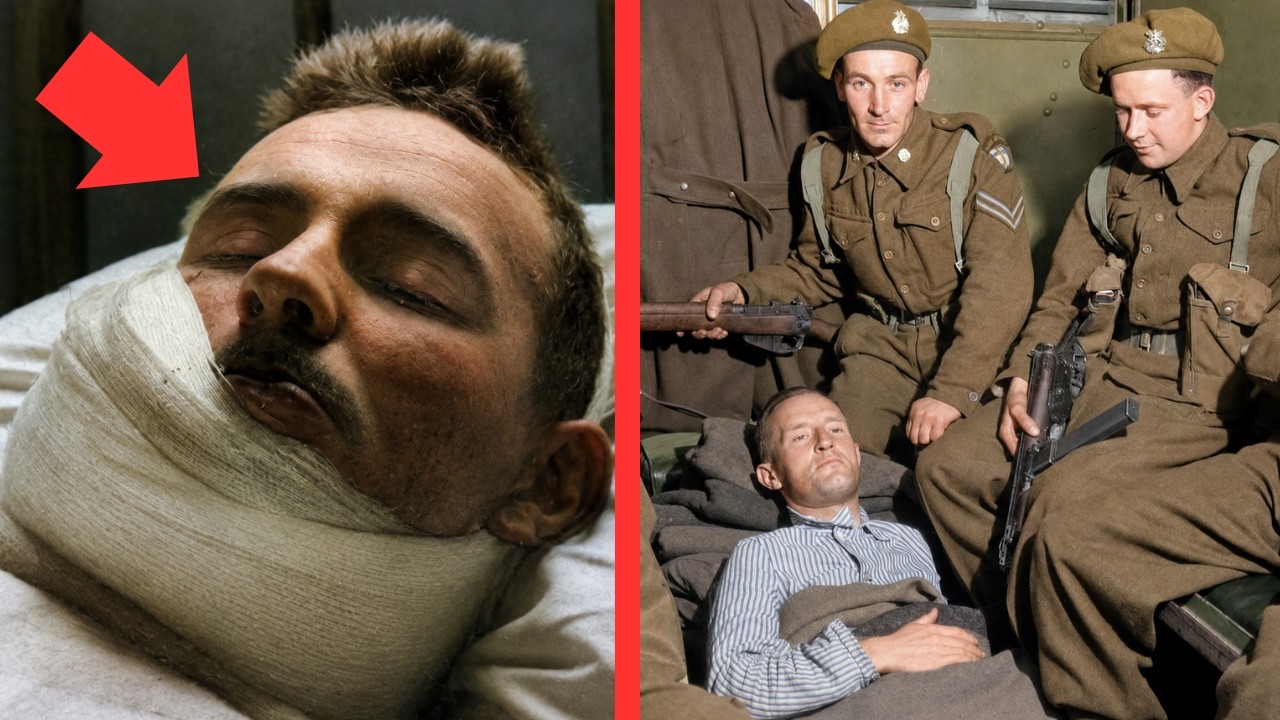
He later moved to England, where he became deeply involved in right-wing politics. In 1932, he joined the British Union of Fascists under Sir Oswald Mosley. By then, Joyce was already a hardened political fighter. He bore a large scar on his face from an attack by communists. Within the BUF, he found his true political home.
One witness to his speeches described him as “thin, pale, and intense,” adding that within minutes of his speaking, the room felt electrified. He was a powerful agitator and became the movement’s director of propaganda. He was also a physical fighter, unafraid to bloody his hands against political enemies. His rhetoric mirrored the Nazis in Germany, targeting the same groups they would later persecute.
Eventually, Joyce was expelled from the BUF. He then set his sights on Nazi Germany, seeking purpose and inspiration in the Third Reich. Just before the outbreak of the war, he and his wife Margaret fled Britain for Germany. In 1940, Joyce became a naturalized German citizen, a detail that would become extremely important later.
He found work in the Reich Ministry of Propaganda and was initially hired as a news announcer for the German radio’s English service. He soon became the most famous British broadcaster in Germany. His program, “Germany Calling,” was beamed directly to Britain and listened to by millions. In these broadcasts, he mocked the British war effort and aimed to demoralize the population, urging them to turn against their government.
It was during this time that he earned the nickname “Lord Haw-Haw.” While the broadcasts were meant to shake British resolve, many listeners simply laughed them off. Beyond radio, Joyce wrote propaganda material distributed among prisoners of war. He even attempted to recruit British POWs into a Waffen-SS unit known as the British Free Corps. Hitler awarded him a War Merit Cross, though the two never met.
Joyce made his final broadcast on April 30, 1945, the same day Hitler died. Berlin was collapsing under Soviet bombardment, and Joyce was reportedly drunk. He fled the city, knowing that urban areas were too dangerous for capture. He made his way to Flensburg, near the German-Danish border, which had become the last capital of the Third Reich.

But the British were hunting him. They knew exactly who “Lord Haw-Haw” was. Intelligence officers tracked him to a village near the border. During his arrest, Joyce was shot when he reached into his pocket to retrieve his passport. The soldiers mistakenly believed he was pulling out a weapon.
He was taken to Britain and tried for high treason. Three charges were brought against him. He pleaded not guilty. His defense argued that he was never a British citizen and therefore could not be a traitor. They claimed he had never sworn allegiance to the Crown, so he could not be guilty of betraying it. Despite these arguments, he was convicted and sentenced to death.
Joyce was sent to Wandsworth Prison to await execution. His appeals were rejected, and he showed no remorse. He reportedly said, “Let the swastika be raised from the dust.” He believed he was being executed simply because he had been on the losing side of the war. In his final written words, he warned the British people against Soviet imperialism and expressed pride in dying for his ideals.
On January 3, 1946, at the age of 39, Joyce was led from his cell to the execution chamber. The hangman was Albert Pierrepoint, a master of the “long drop” method. This technique was designed to break the condemned person’s neck cleanly. Pierrepoint had measured Joyce beforehand to calculate the exact drop distance needed.

Joyce’s arms were bound behind his back, and his legs were tied together. A white hood was placed over his head, and the noose was adjusted around his neck. Pierrepoint then pulled the lever, and Joyce fell through the trapdoor. But the execution did not go as planned.
The force of the fall caused the old scar on Joyce’s face to burst open. Blood poured onto the floor of the execution chamber. When his body was lowered, his face, clothing, and the rope were covered in blood. The scene was so gruesome that it made the doctor’s task of confirming death much more difficult. His body was placed in a coffin while blood was still flowing from the wound.
The brutality of the execution added to an already fierce debate. Many argued that Joyce was wrongly executed. His possession of a British passport was illegal, but his defense claimed it did not grant him the Crown’s protection. They argued that once he became a German citizen, any British nationality was void. Therefore, he could not be guilty of treason.
Some argued that he was technically an American citizen by birth and a German citizen by naturalization. Whether he was ever truly British remains a point of contention. The historian A.J.P. Taylor later noted that, technically, Joyce was hanged for making a false statement on a passport application, an offense usually punished with a small fine.
After his execution, Joyce’s body was buried in an unmarked grave within the walls of Wandsworth Prison. It was not handed over to his family. In 1976, 30 years after his death, his daughter requested the release of his remains. His body was exhumed and returned to Ireland, where it was reburied in a cemetery in Galway.
The case of William Joyce remains controversial to this day. Many believe he was unjustly executed. What is certain is that his death was far bloodier and more brutal than intended. The scar on his face, a mark from his political past, tore open in his final moments, leaving a chaotic scene in the execution chamber. He remains one of the most infamous figures of the Second World War, a man whose name is forever linked with treason.