The story that most people remember about Coco Chanel and the Duke of Westminster is framed as one of her greatest victories. The richest man in Britain wanted her, but she was too free to become his duchess. The legend is neat, flattering, and almost entirely unsupported by the evidence.
There was no documented marriage proposal. There was no famous rejection. Instead, there was a woman who belonged to no one, arranging nearly a decade of her life around a married duke who was never going to choose her. She fished in his rivers. She decorated a house for him in the Scottish Highlands. She waited. And when it was over, he married a woman half his age and left her with the smallest word in the language to describe what they had been.
This is the story of what that cost her.
Chapter One: The Woman Who Belonged to No One
Before the duke, there was an orphanage and a girl who learned early that the only person who would never leave her was herself. Gabrielle Chanel was born in 1883 into profound French poverty. As a child, she was placed in an orphanage run by nuns in Aubazine, central France, raised behind high stone walls.
It was a strict and austere world that asked nothing of the child but obedience. Most people who came out of such a childhood spent the rest of their lives seeking care. Chanel did the opposite. She spent the rest of her life making sure she would never depend on anyone again.
She had no money, no name, and no protector. What she had was taste, audacity, and a refusal to be pitied. She started with hats. She simplified them and sold them to women who could afford the best. From hats, she moved to clothing. She stripped away the stiffness and the corsets. She gave women clothes they could breathe, move, and work in.
By the early 1920s, she was no longer a shop girl who had done well. She was a force. Her perfume, which carried her name and a number, reached the world in 1921 and made her rich in a way fashion alone never could have. She built a house that owed nothing to a husband or a financial backer. She turned her name into wealth, and her wealth into freedom.
There was one wound beneath all of it. The man who came later would be measured against it, whether Chanel wanted that or not. His name was Arthur Capel, an Englishman and businessman. His friends called him Boy. He believed in her from the start and gave her the money that allowed her to stand on her own feet. In December 1919, he was killed in a car accident.
She never fully recovered from the shock. The only person she had ever allowed into the depths of her heart was gone in an instant, and no amount of wealth could bring him back. So the woman a duke would meet a few years later was not a girl waiting to have her heart stolen. She had already buried the only man she ever loved without reservation.
Chapter Two: A Meeting Arranged in Monte Carlo
In late 1923, a mutual friend introduced her to a man who owned more of London than anyone alive. The friend was Vera Bate, a well-connected society woman. The place was the Hotel de Paris in Monte Carlo on the winter Riviera, where Europe’s wealthy gathered when the north turned cold. One detailed account places the meeting on Christmas Day.
The man was Hugh Grosvenor, the second Duke of Westminster. Everyone who knew him called him Bendor, a name that had stuck since childhood. He was 44. Chanel was 40. From almost the first moment, the two took comfort in each other’s company.
To understand him, one must understand a level of wealth that had almost nothing to do with work. Bendor was the first duke of England, the highest rank of nobility directly below the royal family. His fortune came from land, specifically from the accident of his family owning much of the most expensive land in London, including most of Mayfair and Belgravia.
He had served the Crown as a soldier in the Boer War and again in the First World War. He was married at the time he met Chanel, in his second marriage to a woman named Violet Nelson. He would not be free of it for years. That single fact was the crux of everything, though it seemed unimportant at first.
Chanel was not entering this blindly. In the years after Capel’s death, she had been involved with another exceptional man, Grand Duke Dmitri Pavlovich, a member of the exiled Russian imperial family. When she later tried to explain, in her dry and unemotional way, why she had chosen the Duke of Westminster, she did not speak of love. She said she chose the man who could best protect her.
That phrase is the key to everything that followed. She came to him fully aware, a woman who had already lost the great love of her life and decided that what she wanted now was safety, comfort, and a shield from the world. She believed she could take his protection and keep her independence. The story of the next six years is a slow test of that belief.
Chapter Three: An Emerald Hidden Among Vegetables
He courted her in a way only a man with no financial ceiling could, with gifts that stopped being gifts and became something like weather. In winter, when nothing grew, he sent her fruit from the heated greenhouses of his great country house. Strawberries, peaches, and nectarines transported across the sea out of season. He sent fresh salmon from his rivers in Scotland. He sent gardenias and orchids. He sent paintings and jewels.
The most famous story of his courtship has been told so often it has become familiar. He sent her a basket of vegetables, an ordinary basket of ordinary vegetables, and buried among them, without a word of explanation, a huge uncut emerald. That was the character of the entire relationship. Wealth presented as if it were nothing, hidden in something simple.
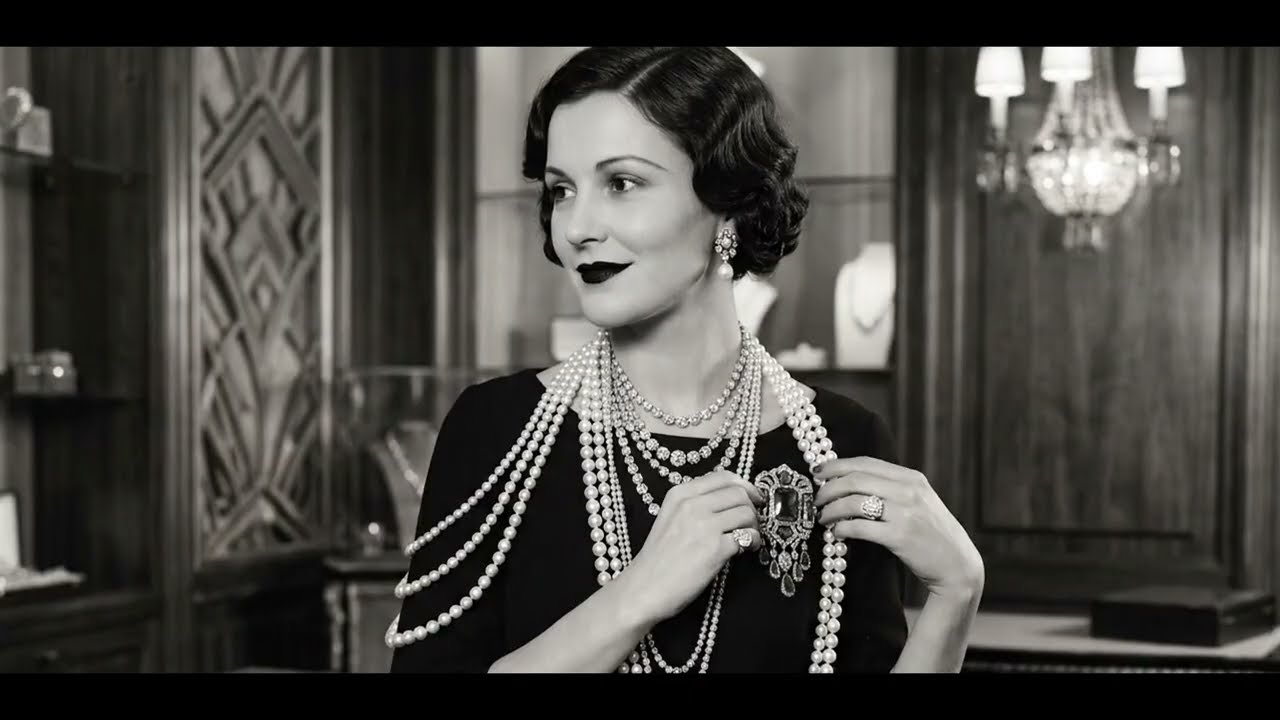
Pearls became her own signature. She was said to receive a new necklace of pearls every birthday, and many more on other occasions. She wore them wrapped and layered in a way the world came to copy. She took the most luxurious gifts a man could give and made them look effortless. She turned his wealth into her style.
Imagine the life surrounding these gifts. He owned two large yachts, a four-masted sailing ship called the Flying Cloud and a converted warship called the Cutty Sark. The relationship moved through a floating world of decks, cabins, and open sea. There were long cruises across the Mediterranean. There was wild boar hunting at his estate in Mimizan in the Landes. There was constant movement of the rich between beautiful places.
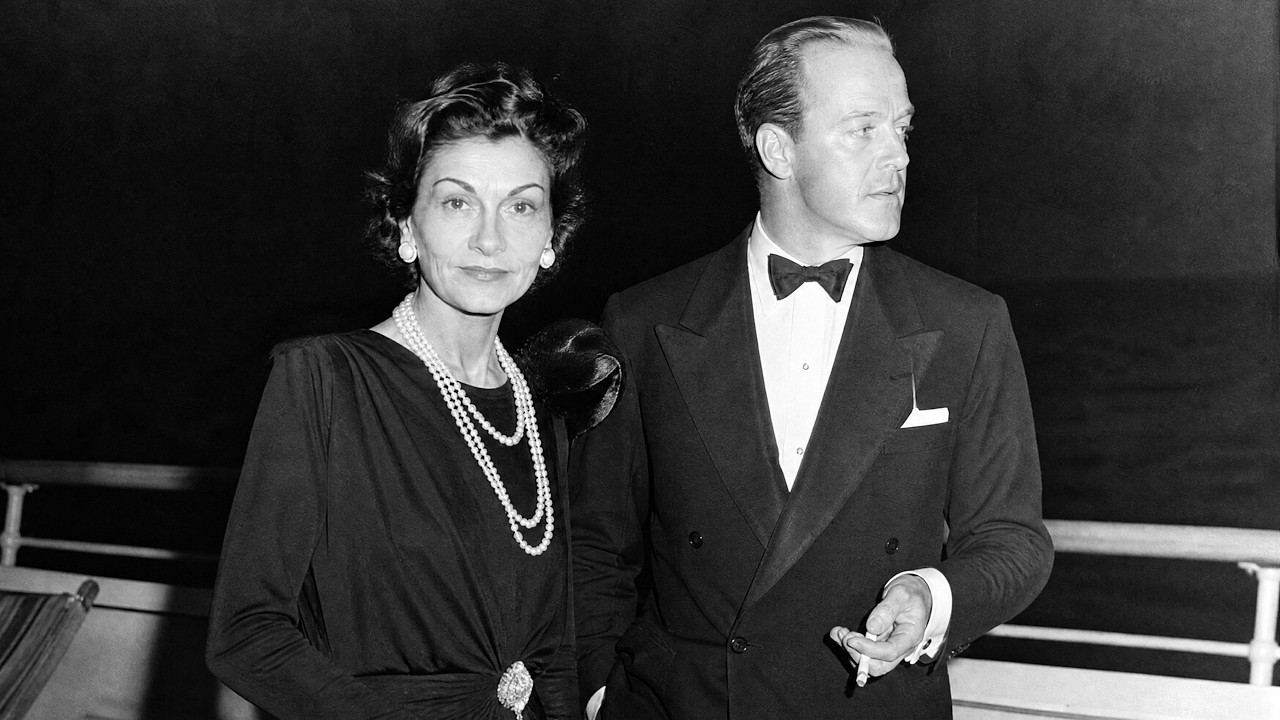
Chanel, who had grown up with nothing behind convent walls, now stepped off a private yacht onto a private beach, wearing her own designs, adored by the richest man in the country. From the outside, it looked like the height of a woman’s luck. In those early years, it almost was.
Chapter Four: Measuring the Size of the Man She Was Facing
The size of the world he owned is the only honest way to measure what she was silently giving up. Bendor’s wealth was not a large version of an ordinary fortune. It was something of a completely different kind. His family held the freehold to much of Mayfair and Belgravia, the most expensive land in London, and part of Pimlico as well. The inherited estates covered more than 130,000 acres.
His main country house in Cheshire was said to have 54 bedrooms and sat amid 11,000 acres of gardens, parkland, and stables. Its walls were hung with paintings by Goya, Rubens, Raphael, Rembrandt, Frans Hals, and Velázquez. He owned two ocean-going yachts, one a four-masted sailing ship about 282 feet long with a crew of 40 men. The other was a converted warship said to carry a crew of around 180. He owned 17 Rolls-Royces. He ran a private train to move him between his country house and London so he never had to share his carriage with a stranger.
A man who lives at this level of wealth learns a particular lesson without being taught. He learns that the world is something that can be bought, arranged, and controlled. Rooms are prepared before he arrives. Fruit is available out of season. Rivers are stocked with fish. Nothing he wants is out of reach, because Bendor’s range had no limits.
That was the psychological nature that would eventually break the relationship. A man for whom everything was always available met a woman who was not for sale. For a long time, he seemed to believe, as men of his kind do, that this made her merely a more valuable prize. That in the end she would be his as well, in the way he owned everything else.
Consider what that meant for Chanel. She had spent her life trying to climb out of a bottom no one was supposed to escape, and built her own fortune so she would never have to stand before a rich man with her hand out. Now she had chosen for protection the richest man of all. A man who saw the entire visible world as a collection of things he already owned. It was the safest choice she could make. It was also the most dangerous, because such a man does not easily distinguish between a woman he loves and a woman he owns.
There was a deeper hunger beneath that wealth. All of Bendor’s land, all his palaces and titles, were attached to a single condition. They needed an heir. Not a daughter, by the law of that world. A legitimate son to carry the ducal title and hold the estates together for future generations. Here was the richest man in Britain, in the only area that mattered to him, poor. He had married and married, and he had no living son.
He could buy anything on earth except the one thing his entire inheritance was built to claim. That need would lie quietly in the background during the golden years, during the cruises and the pearls and the southern winters, and then emerge, cold and absolute, to end everything.
Chapter Five: A House in the Highlands Painted in Her Own Colors
In the far north of Scotland, she did something she had done for no other man. She designed a house with her own taste and called it beautiful. In 1926, the duke bought an estate called Rosehall in Sutherland, a comfortable house overlooking good fishing water in a wooded valley. It was not a palace. It was a simple, elegant country house of the kind a rich man keeps for himself and his friends when they come north to fish for salmon and stalk deer.
To that ordinary house in the Highlands, Chanel brought the most extraordinary thing in the entire relationship, because she decorated its rooms herself according to her own taste. The result was the only known interior design she ever created anywhere in Britain. Where the county expected dark wood, tartan fabrics, and stuffed stag heads, Chanel gave the rooms Parisian colors. She used beige and cream, the quiet neutral shades she had made fashionable in her clothing. Upstairs, she decorated the bedrooms with French hand-printed wallpaper, delicate and pale, brought from France to a valley that had never seen anything like it.
She became attached to the place. She learned to fish, and not as a display. Her fishing records still survive. Her first salmon was caught on May 27, 1925, a fish of 9 pounds. Her largest was caught the same year, a 17-pound salmon on September 20, with another of similar size the very next day. The most famous woman in the world stood in a Highland river up to her knees in the rain, catching fish after fish. By all accounts, she adored it.
Winston Churchill, the duke’s closest friend, was a guest at these estates, and his letters are the best surviving witness. In a letter to his wife in January 1927, he described Chanel as a capable and very agreeable woman, and the strongest personality Bendor had ever encountered. That spring, he wrote that he was staying in a very comfortable house in a Highland glen and that Coco had caught three fish the previous day. In October of that year, he recorded from a lodge on the duke’s water that Coco was there instead of Violet, fishing from morning to night, and had caught 50 salmon in two months.
Read that last line again, and the sadness behind the perfect picture becomes clear. Coco was there instead of Violet. Chanel was not the wife. She was the woman who took the wife’s place, in the wife’s house, on the wife’s husband’s river. Everyone in that circle was fully aware of the arrangement. She had made a home for a man who already had a wife, painted its walls in her own colors, and yet she would never be his in the eyes of the law or the world.
Chapter Six: Sharing a Man Who Belonged to No One
In the early years, she was the mistress of another woman’s husband. And even after that, she was never the only woman in his life. When the relationship began, Bendor was married to Violet Nelson. He remained married to her until 1926, deep into his relationship with Chanel. So in the early years, the woman occupying the wife’s place at Rosehall was simply a mistress, however luxurious the gifts.
When the duke finally divorced and became free, it did not make much difference, because Bendor did not become faithful simply by becoming single. He was, by all accounts, a natural philanderer. Other women passed through his life throughout their relationship, and Chanel knew it.
For most women of that world in that era, the infidelities of a wealthy lover were something to be endured in silence, as the price of protection and jewels. The mistress maintains her position by staying quiet. But Chanel was not like other women, and here the real cost of the relationship begins to show. She was not subservient to anyone. She had built a fortune that answered to no man. She had spent her whole life making sure she would never be at anyone’s mercy, and now she found herself waiting for a man who took his pleasures where he wished, arranging her days around his moods and movements.
The clearest picture of this growing tension comes, like so many details of this story, from aboard one of his yachts. During an argument, said to be about another woman, Chanel is said to have taken a precious emerald he had given her and thrown it into the sea. Whether the details are accurate matters less than the truth they carry. She would not accept being one possession among many. She would not accept being bought for silence. She would rather send a fortune to the bottom of the ocean than accept the terms on which it was offered.
For Bendor, the emerald was replaceable, just another jewel from a supply that never ended. For Chanel, the emerald was the embodiment of the entire insult, proof that he thought he could pay for the right to treat her as he treated the rest of his world. Throwing it away was the only language that money could not answer.
But the line drawn in an argument is not an ending. The relationship continued because she loved his protective shadow even as she hated sharing him. And because he wanted her even while he wanted others. What ended it in the end was not a quarrel and not another woman. It was something colder and more final, a need embedded in the very stones of everything Bendor owned.
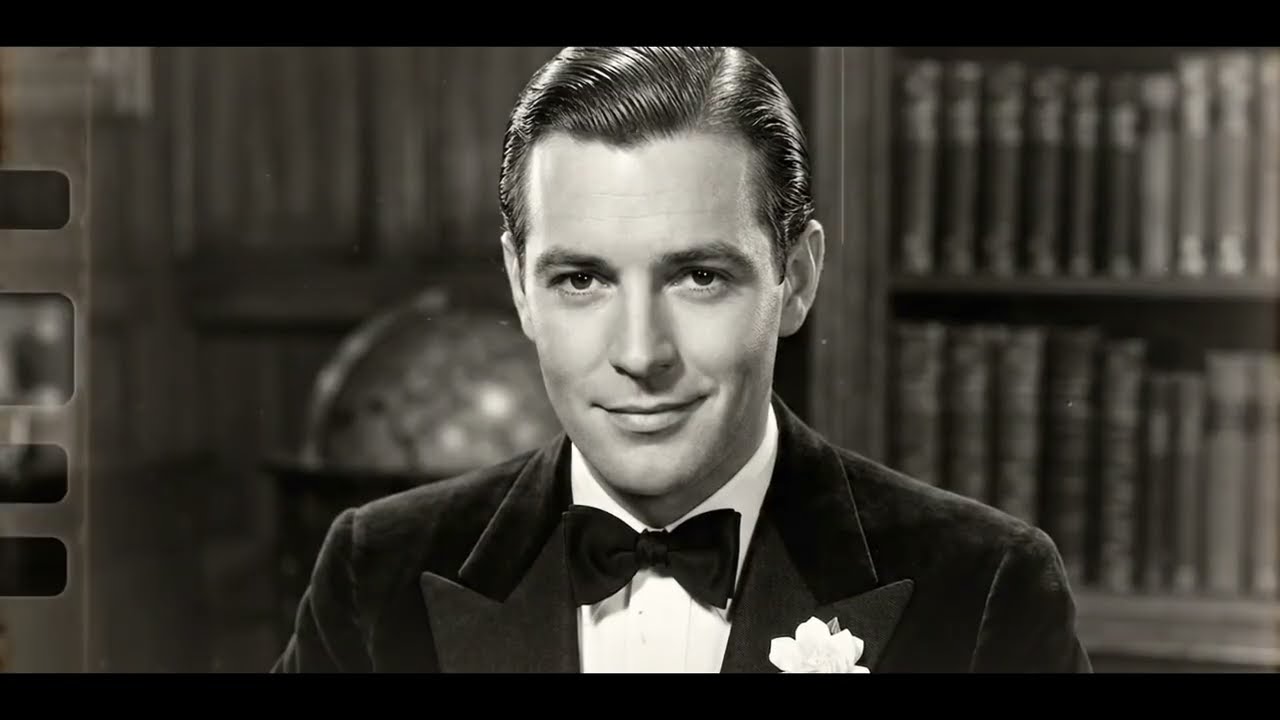
Chapter Seven: The One Gift She Could Not Give Him
Everything he wanted, his money could buy, except a living son. That was the one thing she could not sell him. Go back to the hunger beneath the wealth. Every acre Bendor owned, every house and title, was held on one unspoken condition, that a legitimate son would come to carry the inheritance after him. That was the oldest requirement of his world, rooted deeper than any passion.
He had lost a son once, years before, a small boy who died in childhood, and the wound, and the need it left behind, never healed. Over a lifetime of marriages, he had produced daughters and grief, and no living heir. By the final years of the relationship, Chanel was a woman in her forties, past the easy years of childbearing, while the future of an entire dukedom depended on a child she was likely unable to have.
Reports suggest she tried. The most confident woman in Europe, who had built her entire identity on needing no one, reportedly went so far as to seek surgery and other attempts in the hope of having a child for him. Accounts are careful to note this is hearsay and should remain so. But if it is true, it is the most painful truth in the entire story. Here was a woman whose genius was her independence, quietly subjecting her body to the requirements of a man’s inheritance, trying to become the one thing the situation demanded of her, and failing because time had already closed the door.
The woman who freed a generation of others from what their bodies were supposed to be for was subjecting her own body to a duke’s need for an heir. That failure was the real engine of the ending. The relationship did not fail because Chanel refused to be owned by Bendor. It ended, in large part, because she could not give him the son that being owned by Bendor was supposed to produce. The freedom the legend celebrates was not, at the decisive moment, a choice she fully made. It was, at least in part, a door that closed on her.
For Bendor, the calculation was cold and simple. A mistress, however beloved, who could not bear him an heir, was a pleasure. She was not a solution. He could keep Chanel and remain without an heir. Or he could seek a younger wife who might give him one. The tenderness of the years had its weight and its value. But the dukedom had more. In the end, for a man like Bendor, blood always had more weight.
Chapter Eight: The Rejection That Never Happened
The most famous thing she ever said about the Duke of Westminster is a phrase she swore she never uttered. Nearly everyone who knows the story knows the line. It has been quoted in books and printed on a thousand websites, repeated as the perfect summary of Chanel’s magnificent independence. The legend says that when she was asked why she would not marry the Duke of Westminster and become a duchess, she allegedly replied that there had been many Duchesses of Westminster, but there was only one Chanel.
It is a magnificent line. It is witty and proud, and exactly the kind of thing the world wishes she had said. There is a very good reason to believe she never said it at all. In her old age, Chanel denied it herself. She said she never uttered the phrase and reportedly described it as too vulgar to have come from her.
The biographer Justine Picardie, who examined the story carefully, attributes the remark not to Chanel but to a British diplomat in Paris, Sir Charles Mendl. According to that account, when Mendl heard she would not marry the duke and asked her why, he was met with a simple answer that there were already plenty of dukes. It was Mendl, gallantly, who added the famous line about there being only one Chanel. The best line in her legend was said to her as a compliment by a man, then passed down through generations as if it had come from her own mouth.
Beneath the false quote lies a harsher and more important truth. There is no documented evidence that the duke ever formally proposed to Chanel at all. The great rejection the world remembers, the moment when the free woman refused the crown, may never have happened, because there is no proof the offer she supposedly refused was ever made. Once the fabricated line is removed, the famous act of independence behind it dissolves as well. She had not refused a crown in a blaze of pride. More likely, she simply had not been chosen. The pride was attached to her later by other people to make the wound look like a casual wave of the hand.
That is why the correction matters more than the legend. The legend flatters everyone. It flatters Chanel by making her loss look like a decision she made. It flatters the duke by making him a suitor who was refused, rather than a man who kept her with him and then moved on. The truth beneath it is grayer and much sadder. A woman gave years of her life to a man, hoping perhaps, in her reserved way, that it would become something permanent. It did not. And to soften the blow, the world gave her a witty line she never spoke and called the whole thing a victory.
Put the two versions side by side, because the distance between them is the real subject here. In the first, Coco Chanel stands at the height of her glory and says no to the richest man in Britain. In the second, Coco Chanel waits and hopes, and even tries by some accounts to have his child, and is then passed over for a younger woman, with history quietly rewriting her disappointment as triumph. The first is the story on the quote sites. The second is the one supported by the evidence.
Chapter Nine: A Wedding That Belonged to Someone Else
There was no closing of doors and no grand farewell, just an announcement in February 1930 that he would marry a younger woman. That was the ending in reality. Not a dramatic scene, not a refusal, not an immortal line, but a wedding. And the wedding was not hers.
In February 1930, the Duke of Westminster married a young woman named Loelia Ponsonby, nearly half his age, a woman who might give him the son Chanel could not. With that quiet ceremony, the six-year relationship simply ended. The most extravagant love affair in Europe did not end with a broken engagement or tearful goodbye. It ended in the pages announcing another woman’s marriage.
There is a special cruelty in an ending that lacks all drama. A great quarrel would at least have given the relationship the dignity of importance to the end. A great refusal would have made her the one who decided to leave. Instead, the years of pearls and cruises and Highland rivers ended with an administrative fact, a new duchess in place, the position filled.
Chanel was not left at the altar. She was left on the other side of someone else’s altar, watching the man she had lived within for six years walk toward a marriage arranged partly because of the very lack that had ended their relationship. He needed a son. She could not give him one. He found a younger woman who might. The logic was clear and as merciless as a ledger entry.
What was left for Chanel? Consider the word she was said to have used herself years later when recalling the period with the writer Paul Morand. She said she gave Westminster ten years of her life. Ten years, by her own accounting, longer even than the usual measure of such relationships. A full third of her prime professional years. And she said that at the end of those ten years, the two remained friends.
Friends. After the emeralds and the rivers and the house she had designed with her own touch, after the attempts and the waiting and the sharing, the word that remained in her hand was the smallest and coldest in the language. Not wife. Not love. Friends. The gap between what she gave and what she got is the entire tragedy in a single word. She gave a decade, a measure of hope, and a portion of the fierce independence that formed her entire identity. What she received in return was polite friendship and a clever line she never spoke.
That woman who belonged to no one arranged her life for ten full years around a man who never intended to make her his. When the calculations of his inheritance forced a decisive choice, he chose a stranger over the most remarkable woman of her age, because the stranger was younger and possibly fertile. There is no gentler way to phrase that calculation, because there was not a grain of gentleness in it.
She did not break down in public. That was not her way. She had survived the orphanage and the death of Boy Capel. She would survive this too, with her fortune intact and her name, if anything, stronger than before. But surviving something does not mean being unaffected by it. Somewhere behind the composure, there was a woman who learned again, this time at the hands of the richest man in Britain, that allowing herself to belong to someone was the surest path to abandonment.
Chapter Ten: The Heir Who Never Came
He married twice more, chasing the son he needed, and died without one. Follow the duke’s path to its end first, because there is bitter justice in it. He ended his relationship with Chanel for an heir, and the heir never came. His marriage to Loelia Ponsonby, undertaken under that need, produced no son and ended in divorce in 1947. That same year, he married for the fourth time, to a woman named Anne Sullivan, who remained his wife until his death.
Four marriages in total. Across that long and married life, Bendor never got the one thing he wanted above all else, the legitimate son to carry his name. The sacrifice he made by ending his relationship with Chanel, the decision to replace a beloved woman with a fertile one, failed by his own accounting again and again until the very end of his days.
When the second Duke of Westminster died at one of his Scottish homes in 1953 at the age of 74, the tax assessed on his estate was £18 million. It was such an enormous sum that its settlement was said to have taken until August 1964, more than 11 years after his death. With no living son, his dukedom and his great inherited estate did not pass to any of his descendants at all. They passed sideways, to a cousin who became the third duke. The vast machine of wealth continued, the very thing the relationship had been sacrificed to protect, passing to a man who was not his son, because the son he had traded Chanel for was never born.
Something else must be said about the duke, and honesty requires it, though it belongs to a later and darker chapter of his life. In the years that followed, Bendor moved toward the ugliest politics of his era. In the late 1930s, he made public statements that were hostile to Jewish people and sympathetic to Germany to such a degree that figures in his own government began to consider him, as war approached, a danger to the country. It is a stain on the man, recorded here plainly rather than hidden. It is not the subject of this story, which is about a love affair in the 1920s, but a full account of Bendor’s character cannot omit it.
Compared with Chanel, the duke’s end looks like the life of a man who won every argument except the one that mattered. He kept his wealth. He kept his freedom to marry whom he chose. But he gave up the most extraordinary woman he ever knew for a lineage that did not continue. In the end, that lineage died with him anyway. He spent his life certain that anything could be arranged, bought, or forced. And in the end, the one thing he had traded everything for slipped through his fingers like water.
People remember him now, more than any deed, more than all his lands and yachts, as the man who had Coco Chanel and let her go.
Chapter Eleven: The House She Kept and the House She Left
Two houses remain from this story, and the difference between them tells everything. Go north first, back to Rosehall, the house in the Sutherland valley that Chanel decorated with her own taste. After the relationship ended, the reason for that house faded. The rooms painted in Parisian colors for a man who did not marry her were used for a time, then neglected, then simply abandoned. Rosehall stood empty for more than 60 years. It is derelict now. Its roofs are collapsing, its floors unsafe. An elegant house rotting quietly in its wooded valley.
And yet, remarkably, traces of Chanel’s touch still cling to its walls. The beige colors remain in places. The French hand-printed wallpaper she brought from France is still there, peeling but present, decades after the death of the woman who chose it. The only interior design Coco Chanel ever executed in Britain is now an uninhabited ruin.
Now go south to the warm coast, to a villa called La Pausa in Roquebrune-Cap-Martin on the French Riviera. This is the other house, and it is the opposite image of the first. The popular story, repeated even in the duke’s own biography, is that Bendor gave Chanel the land in 1927. Property records tell a different story. Chanel bought the land herself for 1.8 million French francs in February 1929, built the villa with the help of an architect named Robert Streitz, and completed it in 1930 at a cost of around 6 million francs. The truth of who bought the land is disputed and should remain so. But one thing is certain. La Pausa was hers.
Look at what she made of this house, for it is the exact opposite of Rosehall in every important way. She did not build La Pausa for a man. She built it for herself. And she built it inspired by her own past. She modeled it on the orphanage at the Aubazine convent where she grew up, the very place that taught her not to need anyone. She placed in it a decoration of five windows, a private reference to the perfume that made her free. She kept the house for about 24 years. She cared for it, lived in it, and loved it. She only sold it in 1953, the same year the duke died, as if the matter had quietly completed itself.
Put the two houses side by side, and the entire story unfolds. Rosehall is the house she made for a man, and it was closed, abandoned, and left to the weather. Something beautiful that ended up belonging to someone who did not choose her. La Pausa is the house she made for herself, kept, and cared for over a quarter of a century. The house she gave to belonging became ruin. The house she dedicated to independence became treasure. This is not poetic rhetoric. It is a matter of brick, plaster, and public record. Two real buildings stand today in exactly the condition that relationship predicted for them.
Her later life had its long shadows, and honesty requires them to be mentioned in a single sentence here, as we did for the duke. During the war that followed, Chanel spent the German occupation of Paris with a German officer, and researchers working in French and German archives have since established that she was for a time a registered agent, a fact far outside this 1920s love story that casts a shadow over the woman without erasing her. That subject belongs to another film. It is mentioned here only so that nothing remains hidden.
So return to the question the entire story asks. What did this relationship, which the world remembers as her victory, cost her? It cost her most of a decade, a portion of the independence she had sacrificed so much to build, and the quiet knowledge she carried forever that even she could give herself and be left. But it did not cost her the most important thing, the self she built behind the convent walls, the self La Pausa was designed to honor. She came out of the duke’s crowded life still, in the end, owning herself. She belonged to no one. That was the essence of her genius and the essence of her suffering.
Chapter Twelve: What It Cost the Woman Who Belonged to No One
The world decided she won because winning was the only story worthy of a woman like her. It is easy to see why the legend took root. Coco Chanel was the woman who freed other women, who removed the corset, built an empire under her own name, and submitted to no husband. A story in which she waited for a man for years and was then quietly passed over does not fit that character at all. So the world reached for the other story, the story of triumph, gave her a crown to refuse and a witty line to refuse it with, and classified the entire relationship among her victories.
It was kinder. It was tidier. And it was, in nearly every detail, untrue.
Look at what the evidence actually holds, one final time. There was no recorded proposal. There was no famous rejection. There was a woman who chose a duke for protection because her true love was already dead, a woman who gave that duke the best ten years of her life, painted his house, fished in his rivers, and is said to have tried even to bear his child, and who was finally set aside for a younger wife who might do what she could not. She had not refused a crown. She had waited and hoped, and then she was left. That is the harsh truth the legend was built to cover.
But be careful with the word tragic, because Chanel would not have thanked anyone for pity, and she did not need it. She was not destroyed. She lost neither her fortune nor her fame nor her genius. She came out of that relationship with her empire intact and her name greater than before. Winston Churchill, who watched the whole thing closely, described her as a very capable and agreeable woman, and the strongest personality Bendor had ever encountered. He was right.
The tragedy here is not a woman shattered. It is quieter and stranger than that. The tragedy is that even she, the strongest personality in the room, the woman whose genius was built on independence, could waste years of her one life on a man who was never going to choose her. Remember where her heart truly was, because that puts the duke in his proper place. He was never the great love of her life. That was Arthur Capel, the man killed in a car accident in 1919. The only person she ever loved without defense. What she found with the Duke of Westminster was never that. It was shelter, grandeur, salmon rivers, and ropes of pearls, and in the end, a polite goodbye.
The real tragedy of her emotional life happened years before she met him. Her relationship with Westminster was only a long and glittering proof that lightning does not strike twice, and that a fortune the size of London could not buy what Boy Capel had given her for free.
So return at last to where the story began, to the smallest word in the language, and to the woman it was given to. The richest man in Britain courted her with emeralds hidden in vegetables and a house painted in her own colors in a Highland glen. He could give her everything in the world, and he did so generously, and still it was not enough, because the one thing she wanted from him, to choose her and hold onto her, was the one price he would not pay. She gave him a decade. He answered with a single word, cold and measured, and the world has called it a victory ever since.