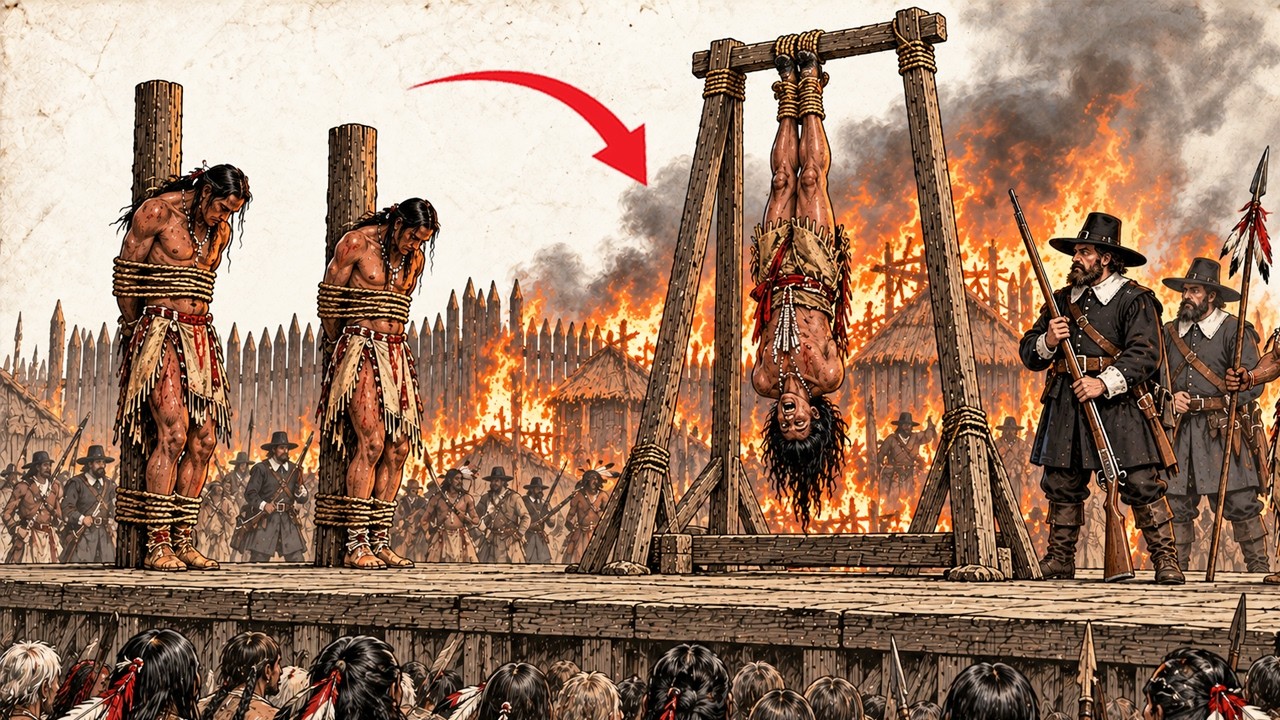
Just before dawn on May 26, 1637, several hundred people slept inside a palisaded village on a rise above the Mystic River in southeastern Connecticut. The village was made of closely packed wigwams, bent pole frames covered with layered reed mats. Inside were men, women, children, grandmothers, infants. Outside, in the darkness, roughly 77 English soldiers and between 200 and 300 Mohegan and Narragansett warriors had finished moving into position.
No one inside knew they were there. The English force was commanded by Captain John Mason, a 33-year-old veteran of the Dutch wars. Beside him was John Underhill, 36, another Netherlands-trained professional and the most technically experienced English officer in New England. Both men believed they knew what had started this.
English traders had been killed, John Stone in 1634 and John Oldham in 1636. English demands for surrender had been refused. The colonies blamed the Pequots, and the Connecticut General Court had voted for war on May 1. The Pequots were not a small or weak people.
Under their principal sachem, Sassacus, they had been a dominant power on the coast for a generation, a confederation of villages that farmed corn, fished the sound, and traded with the Dutch and the Narragansett. Sassacus knew the English wanted something, but he did not know what shape it would take. In August 1636, Massachusetts had tried to force a settlement with an expedition led by John Endicott. It failed and made things worse.
By the spring of 1637, English parties could not move safely along the Connecticut River. On May 10, Mason sailed from Hartford with 77 Connecticut men. At Saybrook Fort, he met Lion Gardiner, the 45-year-old military engineer commanding the garrison. Gardiner thought the force was too small.
He was right. Mason sailed anyway. Underhill joined him with roughly 20 more men from Massachusetts. Of the four Englishmen whose accounts would shape the historical memory, Mason, Underhill, Gardiner, and Bradford, only two were actually inside the palisade when it burned.
Gardiner wrote from second-hand reports at Saybrook. Bradford wrote from Plymouth. The story that later generations were told about Mystic was mostly written by men who were not there. The force sailed east along Long Island Sound and landed on the Narragansett coast, well east of Pequot territory.
There Mason met Miantonomo, the Narragansett sachem, who committed a large force of warriors. Uncas, the Mohegan sachem, had already broken with the Pequots over a political dispute older than the English presence, and he brought warriors who knew every path and stream. Together, the Native allies formed the operational core of the campaign. Without them, Mason’s small force could not have found the fort, let alone surrounded it.
The entire force turned west and marched overland for two days in punishing heat. Men carried matchlocks, powder horns, swords, pikes, biscuit, and dried meat. Underhill would later write about soldiers so exhausted they could barely stand. The march was a deception.
The Pequots were watching the sea. The attack was coming from the land, from the east, from the direction of their enemies. Mason had not been ordered to attack Mystic. The Connecticut General Court had sent him against Weinshauks, Sassacus’ main settlement, where the Pequot fighting men were gathered.
Mason chose instead to strike Mystic, which held the families. He knew Weinshauks held the warriors. He knew Mystic held the women, children, and elderly. He chose the softer target.
On the evening of May 25, the force stopped within a few miles of Mystic. The men slept on their arms. There were no fires, no voices above a whisper. The plan was to split into two companies, one under Mason and one under Underhill, and surround the palisade from opposite sides.
The Mohegan and Narragansett would form an outer ring and catch anyone who broke through. Somewhere in the darkness, a Native ally told the English commanders that most of the Pequot warriors were not inside the fort. They were with Sassacus at Weinshauks. The men who would meet the English at Mystic were the ones left to protect the village.
Mason did not change the plan. He was told in advance that the people inside those walls were overwhelmingly those who did not usually fight, and the plan did not change. That detail never appeared in Mason’s own account, published nearly a century later. It survived only around the edges of Underhill’s narrative and in Pequot oral tradition.
Mason’s company moved up to one side of the palisade, Underhill’s to the other. The last fifty yards were the most dangerous. A dog barked inside the fort. A voice called out in Pequot, Owenox, Owenox, Englishmen, Englishmen.
The village knew. Mason gave the order. The English rushed both entrances. A Pequot warrior drew his bow.
The first arrow struck an English soldier in the chest and deflected off his buff coat. Behind him came a volley of matchlock fire, the sound of fifty muskets at close range in a confined space, a sound no one inside had ever heard. The Pequot defenders fought back from inside the wigwams, from behind sleeping platforms, from the narrow lanes between structures. The English won the entry, but they did not win the village.
A village of mostly non-warriors held its own against trained European soldiers. That resistance is why what happened next happened. Two English soldiers were killed outright, the only two who would die inside the palisade. A sergeant was wounded.
Mason could not form his men into a line. They were fighting one on one, two on one, in doorways and between structures. He realized that if his men kept fighting this way, they would lose more of them, perhaps many more. Mason was inside a wigwam he had just cleared.
He looked around. He saw the reed mats on the walls, the sleeping platforms, a fire still burning low in the hearth from the night before. He bent down and picked up a burning stick. He straightened, walked three paces to the nearest wigwam wall, and pushed the burning end against the reed mat.
Underhill, watching from the other side of the fort, later wrote it down in a single sentence. Captain Mason, entering into the wigwams, brought out a firebrand, putting it into the mats with which the wigwams were set on fire. There was no agonized deliberation in the sentence. One man, one burning stick, one wall.
The mat caught immediately. Dry spring reed, oiled by wood smoke, lit the way paper does. The flame ran up the wall in less than ten seconds. It jumped to the frame, then to the next wigwam three feet away.
Within a minute, two rows of structures were burning. Within three minutes, half the fort was burning. Within five, there was no part of the Mystic Palisade that was not on fire. Mason gave the order to fall back.
The English retreated through the gates. Underhill’s company did the same. Once outside, they reformed on either side of the wall. Beyond them, in a wider ring, stood the Mohegan and Narragansett warriors.
Anyone who ran out of the burning palisade ran into them. Inside, the fire did what Mason knew it would do. Pequot defenders had to choose between burning inside and being shot or cut down trying to come out. Many came out, bows in hand, fighting.
They were shot at point-blank range as they emerged. Behind them came women. Behind the women, children. Behind the children, the elderly, moving slower.
William Bradford, hundreds of miles away in Plymouth, would receive the reports and write the sentence that history has mostly chosen not to read aloud. Those that escaped the fire were slain with the sword. Some hewed to pieces, others run through with their rapiers, so as they were quickly dispatched. And very few escaped.
He closed his description with what he intended as a moment of providential awe. It was a fearful sight to see them thus frying in the fire, and the streams of blood quenching the same. He meant it as evidence of God’s judgment. Some Pequot families did not come out.
The reed mats were now burning on the sleeping platforms. The pole frames were collapsing. The baskets of stored corn were catching. The smoke was black and thick.
The sound inside Mystic came in waves, a rush of noise as a wigwam collapsed, then a silence, then another rush. The silences were worse than the noise. Archaeology has recovered what the English accounts omitted. Metal and bone fragments at the Mystic site show evidence of close-quarters combat inside the burning palisade.
People inside the fort were still fighting after the fire began. They were not simply dying passively. They were resisting until the structure collapsed on them. The fire burned at its peak for perhaps twenty minutes.
When it subsided, the palisade was a ring of smoldering posts around a flattened village. Of the 77 Englishmen who entered the fort, two were dead and approximately twenty-six were wounded. Casualties of the Mohegan and Narragansett allies were unrecorded in the English accounts, itself a form of erasure. Of the inhabitants of Mystic Fort, no one will ever know the exact number.
Underhill, who was there, said six to eight hundred with about fourteen survivors. Mason, who was there, said six to seven hundred killed. Bradford, who was not there, said four hundred. Gardiner, who was not there, said three hundred with many prisoners taken.
The men who did this could not tell you, within four hundred people, how many human beings died. That is what happens when the people inside the walls were never counted as individuals in the first place. Mason gave the order to withdraw. The column had to reach the ships several hours’ march to the west.
The Pequot fighting men from Weinshauks had seen the smoke. They were coming. The English column reassembled, wounded men supported by comrades, a small number of captives seized by the Native allies. They began to move west.
Within an hour, the first Pequot warriors reached the column. The English accounts record only the tactical fact: the column was under constant attack from the moment it left Mystic until it reached the sea. Modern archaeology has reconstructed the withdrawal in detail. Four and a half miles, ten hours of running combat.
Some estimates suggest more Pequot casualties during the retreat than inside the fort itself. By late afternoon, the column could see the sound. By evening, they were at the ships. By late summer, the surviving Pequot leadership knew the war was unrecoverable.
English and allied forces burned villages and destroyed food stores. Sassacus fled west with a group of followers and sought refuge among the Mohawk. They took him in. Then they killed him.
Then they sent his head and hands to the English at Hartford as a diplomatic gift, a demonstration that the Mohawk would not make war on Englishmen over a Pequot sachem. In September 1638, at the Treaty of Hartford, the English, the Mohegan, and the Narragansett formalized what the war had already achieved. The surviving Pequots, perhaps a thousand people, were divided among the victors. Some became captives of the Mohegan, some of the Narragansett, some property of English households.
And the treaty did something stranger and more total than that. It legally abolished the Pequot name. Survivors were forbidden to call themselves Pequots. They were forbidden to return to the Pequot country.
The word itself was removed from the political map by colonial decree. Mason, writing in 1736 for the General Court of Connecticut, described the burning of the fort as a providential victory. The framing of the massacre as providence became the official memory. By the nineteenth century, a statue of Mason stood in Mystic on the ground where the fort had burned, sword raised, inscription praising the victory.
It stood for more than a hundred years before anyone successfully argued that it should not. It was removed in 1996 after decades of pressure from the Mashantucket Pequot and others. The Pequot Nation was not destroyed. The name was legally abolished in 1638, the people dispersed, the political structure dismantled, and the Pequots survived anyway.
The Mashantucket Pequot Tribal Nation and the Eastern Pequot Tribal Nation exist today in Connecticut on land where their ancestors have lived continuously for centuries. Miantonomo, the Narragansett sachem whose warriors made the Mystic attack possible, was dead within six years, captured and killed by English order in 1643. Uncas lived longer, died in old age, honored by the English who had used him. His descendants continue.
So do the Narragansett. So do the Pequot. All of the native nations that fought at Mystic on both sides of the palisade are still, four centuries later, on their land.