In 1934, three years after Karin Göring’s death, her husband Hermann Göring ordered her body exhumed from a Swedish cemetery and transported to Germany, where he would build her a grand mausoleum that became an unlikely sanctuary for the Third Reich’s most powerful men. Yet the man who spent years protecting her memory would later abandon her remains to the Soviet army, setting off a chain of events that scattered her bones, hid them in a forest, and left historians with a mystery that remains unsolved today. Karin was born in Sweden in 1888 into aristocratic privilege. Her father was a Swedish baron, her mother of Anglo-Irish descent.
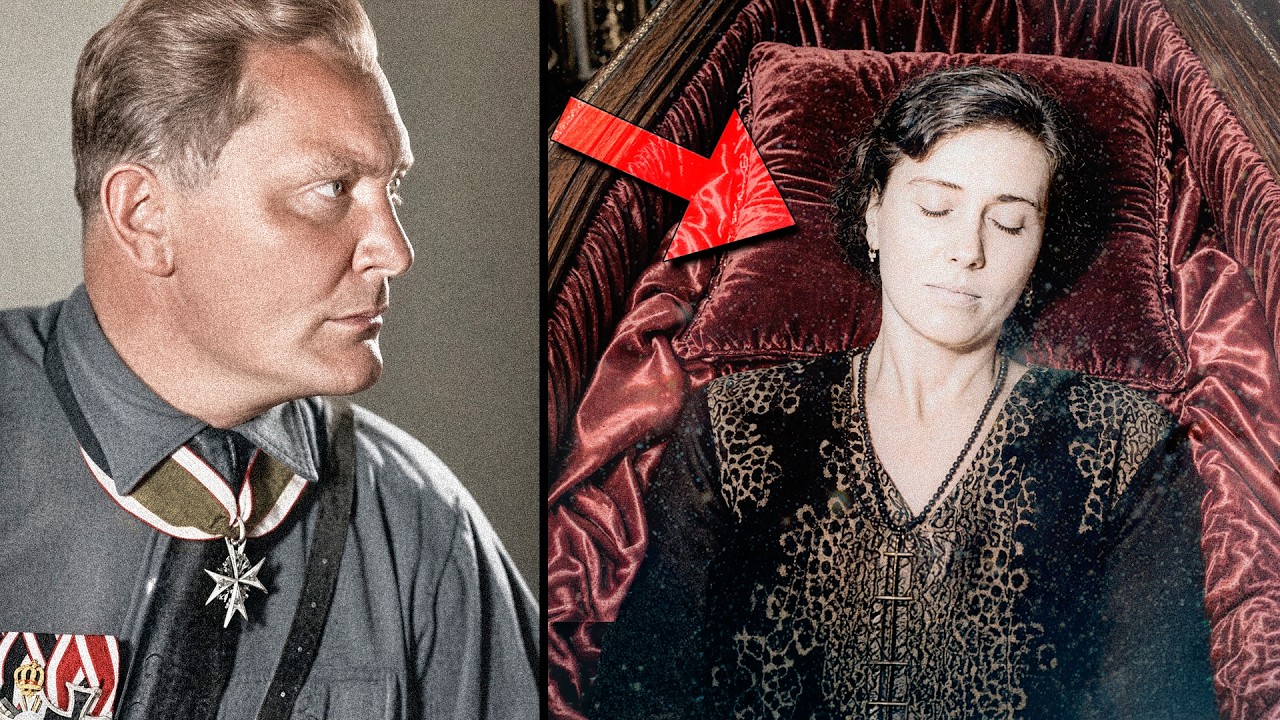
Raised in a world of status and refinement, she seemed destined for a conventional life. In 1910, she married Nils von Kantzow, a Swedish army officer, and the couple had a son. For years, she lived the exact life expected of her. But something was missing.
Everything changed in 1920. That year, she met Hermann Göring. At the time, Hermann was not yet the infamous Nazi leader history remembers. He was a decorated German fighter pilot from the First World War, a celebrated hero with a magnetic personality and a reputation for courage in combat.
Still, he was also unsettled, searching for purpose after the war’s end, far from the prestige he would later gain. The two fell in love quickly and intensely. Their romance seemed pulled from a screenplay: letters, secret meetings, decisions made on impulse. Karin left her marriage, her stable life, her young son, and her social standing to be with him.
In 1923, they officially married. Soon after, Göring began gravitating toward an obscure politician barely known outside Germany: Adolf Hitler. He joined the Nazi movement in its early years, when the party was small, marginal, and practically irrelevant across Europe. Göring saw something different in it: opportunity, ambition, a path back to prominence.
Karin, rather than steering him away, actively encouraged his involvement. In November 1923, when Göring was seriously wounded at Hitler’s side during the failed Beer Hall Putsch in Munich, it was Karin who nursed him back to health, risking her own safety to keep him hidden from authorities. From that point, Göring’s political rise accelerated dangerously fast. Karin was part of those early years, close to Hitler and the Nazi leadership.
Many contemporary accounts described her as a vital emotional and social support for Göring during this period. She was not a passive wife watching from the sidelines; she was actively involved in building what would become one of the most feared regimes in history. Yet here lies the tragic irony: Karin died just before Göring reached the heights of power she had helped him build. She would never see the final outcome of what they had started.
Over the years, her health declined. She suffered from heart problems and epilepsy, conditions with far more limited treatments then than today. Her episodes grew more frequent and more intense, each relapse leaving her weaker. In October 1931, while visiting Sweden, her body gave out.
She suffered a cardiac arrest and died at just 42 years old. She was buried in Lovön cemetery in Sweden, a simple, discreet funeral with no indication of what her name would later represent. Göring was devastated. Biographers describe this as one of the rare moments when the hard, ambitious political figure showed genuine human grief.
Her older sister even wrote a biography of her that became a bestseller in Germany, selling hundreds of thousands of copies, evidence of how deeply the loss reverberated far beyond Göring’s personal circle. For Göring, mourning was never simple. He refused to accept that Swedish cemetery as her final resting place. Three years after her death, in 1934, he ordered her body exhumed.
There is a curious detail behind this decision. After the Nazis took power in January 1933, Göring returned to Sweden for a niece’s wedding and used the trip to visit Karin’s grave. The moment was heavy with symbolism. The man who now held one of the most powerful positions in Germany returned to the place where he had left the woman he claimed to love above all else.
He laid a wreath shaped like a swastika on her grave, a gesture blending personal mourning with political statement. The image spread through the Swedish press. In a country watching Nazi Germany with growing suspicion, the reaction was immediate. Swedes opposed to the regime removed the wreath from her grave.
Göring was enraged. For him, it was not just a political insult but a direct offense to the woman he had lost. From that moment, he was determined to take her body out of Sweden and bring it to Germany, where he believed no one could disrespect her memory again. In June 1934, her coffin was exhumed, wrapped in a swastika banner, and transported to Germany.
Göring’s power within the Nazi regime was already enormous, and he used that power and fortune to bring Karin back to him. The day after the coffin’s arrival, she was reburied on German soil in a place Göring immediately transformed into a shrine to her memory. Hitler himself attended the reburial, a near-state ceremony for a woman who had never formally held public office. It is here that the story grows strange.
The place was named Karinhall. Göring built a vast, luxurious estate surrounded by forest, named for his dead wife. Located in the Schorfheide forest, about two hours from Berlin, it sat in an isolated region between lakes and dense woodland. The first structure was a relatively simple wooden hunting lodge, but as Göring’s power grew, so did the estate.
It expanded into an enormous property with grand halls, art collections, and grounds covering dozens of hectares. It was more than a house. It was a public declaration of mourning and a symbol of the power and wealth he had accumulated within the Nazi regime. Over the years, Karinhall became the site of important Nazi leadership meetings and the destination for many of the artworks Göring looted from territories occupied by Germany during the war.
Within the estate, near the shores of one of its lakes, Göring built an underground mausoleum dedicated exclusively to Karin. Historical records and photographs show a grand, almost theatrical tomb. It was not an ordinary grave but a space designed to eternally preserve her memory. According to accounts, Göring visited almost daily whenever he was at the estate, over nearly eleven years.
Oddly, even after he remarried in 1935 to actress Emmy Sonnemann, he kept Karin’s grave right there, near where he lived with his new wife. Emmy reportedly never publicly objected. But the man who built that place to preserve her memory forever would soon have to abandon it, and with it, Karin’s body itself. By the final stage of the Second World War, Germany was collapsing.
Soviet troops advanced into German territory. Karinhall, located directly in the path of the Red Army, became an inevitably vulnerable target. But it was not the war that destroyed Karinhall; it was Göring himself. On April 20, 1945, with Soviet artillery already audible in the distance, Göring fled to Berlin.
Before leaving, he gave explicit orders to the guards responsible for the estate: dynamite everything, the main house, the halls, all the buildings, so nothing would fall intact into Soviet hands. The order was carried out. The main house was destroyed. Yet curiously, Karin’s mausoleum was not dynamited.
It remained standing, practically intact, amid the rubble. It was only completely demolished over a decade later, under the communist government of East Germany, around 1956. Here lies the most unsettling detail. Göring had spent years obsessed with preserving his wife’s memory, spending fortunes and political capital to bring her body near him.
Yet in this final moment, he took no steps to protect her remains. He knew the Soviets were coming. He knew what typically happened to Nazi elite properties when the Red Army passed through. Still, he left the tomb behind with no attempt to rescue or hide the remains.
Soon after, Red Army troops arrived and looted the mausoleum, turning everything over in search of riches, jewelry, anything of value hidden inside. In the process, Karin’s skeleton was scattered across the floor of the tomb. It was in that moment, amid the final collapse of the Nazi regime, that Karin Göring’s body disappeared. About five years after the war ended, a Swedish pastor working at the Lutheran church in Berlin decided to risk everything to go to the ruins of Karinhall.
According to an account told by a minister who served at the Swedish church in postwar Berlin, the story was even stranger than it seemed. This version claims Karin’s body had already been removed from its coffin before the mausoleum was looted and reburied in the forest by a forestry worker. Soviet soldiers found that new hiding spot, disturbed the body, and left it there. The forestry worker then buried her body a third time in yet another location.
Only after that did the Swedish pastor manage to locate the remains, place them in a sack, and secretly cross into the western part of Berlin. Unable to reveal the truth about whose body he carried, he registered the cremation under a false name in February 1951 at a Berlin crematorium. With the urn in his luggage, he traveled by train to Sweden, where the remains were finally reburied near her family. For decades, that was the accepted version.
Karin had finally found lasting rest in 1951. But that was not the complete story. In 1991, someone found something that should not have existed. Decades passed.
The region where Karinhall once stood became known among people who explore historical ruins, enthusiasts, and even World War II relic hunters. In 1991, one such group made a startling discovery in the middle of the forest: a zinc coffin, practically hidden, buried with no visible identification. Inside it were human remains. The immediate question was obvious.
If Karin’s remains had already been recovered and brought to Sweden in 1950, whose remains were in that hidden coffin more than forty years later? The discovery drew attention. Investigators analyzed the remains, trying to reconstruct where the coffin came from and why it lay there, unidentified, in a region so associated with Karinhall. Forensic examinations, including DNA analysis, produced a result that contradicted the version everyone had accepted.
The remains found in the 1991 coffin matched Karin Göring. Not all of her remains had been recovered in 1950. Part of her body had remained hidden, forgotten for more than four decades. From this point, the story lacks a clear answer.
Several possibilities exist. The first: the Swedish pastor in 1950 simply failed to recover all the remains scattered by the mausoleum’s destruction. That makes sense; it was a scene of ruin, bones spread over a wide area without order. The second: part of the remains stayed hidden in the region by chance, perhaps covered by debris, earth, or vegetation, away from the eyes of those who collected them.
A third, more uncomfortable hypothesis: the coffin may have been moved later by someone at some point between the destruction of Karinhall and the 1991 discovery. That raises questions about who did it and why. To this day, no definitive answer exists about exactly when, how, or why that coffin stayed hidden in the forest for so long. Historical records from that period are fragmented.
Many documents were lost with the war’s end. Much of what is known comes from later accounts, not from evidence documented at the moment of the events. Karin herself died in 1931, long before Göring’s peak power within the Nazi regime, before the war, before the destruction and collapse of everything he built. She never saw her husband become one of Nazi Germany’s most powerful and feared figures.
She never saw Karinhall rise in her honor or transform into a site for Nazi leadership meetings and a repository for looted European art. She never saw the war her own support had helped enable. She never knew her body would be exhumed, transferred, desecrated, scattered, and partly lost for decades. Perhaps that is the most disturbing part.
Karin had absolutely no control over any of it. She lived, loved, and died of natural causes at a time when the Göring name had not yet carried the historical weight it would later bear. Yet her remains continued to be affected by events she never witnessed: the war, the regime’s fall, the looting of the mausoleum built in her honor, the forest hiding place, the discovery decades later. All of it happened after her death, and all of it reached her mortal remains one by one over more than sixty years.
Karin Göring died nearly a century ago, but she never truly rested. Her body was buried, exhumed, transferred, desecrated, and decades later, part of it was found hidden in a forest inside an unmarked coffin. And to this day, no one can explain with absolute certainty how those remains ended up there.