James Longstreet was one of the finest battlefield commanders of the Civil War, on either side. Robert E. Lee called him his old warhorse, the officer he trusted most when the pressure became unbearable. Longstreet’s men were ferociously loyal to him, and his tactical instincts were so far ahead of their time that military historians would later recognize him as a man who understood modern warfare before it existed.
He fought at First Bull Run, Antietam, Fredericksburg, and Chickamauga. At Fredericksburg, he held a defensive position so efficiently that Union soldiers were cut down in rows and his line never moved. At Gettysburg, he begged Lee not to make the charge that would become the most catastrophic mistake of the war.
When the Confederacy collapsed and Lee surrendered at Appomattox, Longstreet went home to Georgia and came to a conclusion that would destroy his reputation, endanger his life, and make him the most hated man in the post-war South. He concluded that the Confederacy was wrong. Not just tactically, but wrong at the root, wrong in its purpose, wrong in what it was fighting to preserve.
He said it in newspapers. He said it to former colleagues who stared at him like he had gone insane. He joined the Republican Party, the party of Abraham Lincoln, at a moment when that act alone was enough to get a Southern man killed. He took a federal appointment in New Orleans and enforced Reconstruction policy with Black police officers and Black militia under his command.
When a white supremacist mob of more than 3,000 armed men marched on the city in 1874 to overthrow the legitimate state government, Longstreet rode out personally to stop them. They shot him, captured him, and paraded him through the streets. Still, he did not change his position.
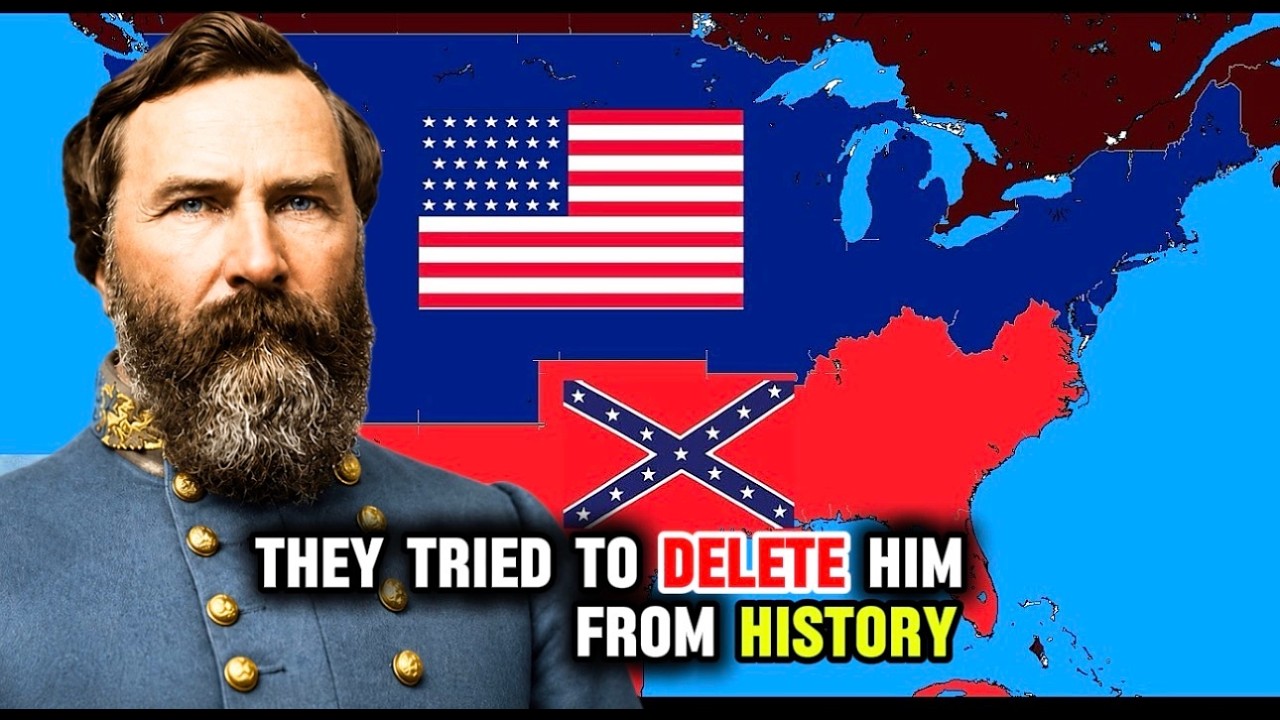
The post-war South responded by systematically dismantling him. Former Confederate generals who had relied on his brilliance suddenly remembered him as slow, insubordinate, and incompetent. They rewrote Gettysburg, the battle Lee lost because Longstreet advised against it, and handed Longstreet the blame. They built monuments to every Confederate officer they could name and made sure his name was never on the list.
They constructed an alternate version of the war, scrubbed of inconvenient facts, and planted it in textbooks, memoirs, and courthouse squares across the South. It was called the Lost Cause, and James Longstreet was its first casualty.
Longstreet was born in 1821 in South Carolina and raised partly in Georgia. His father died when he was 13. He secured an appointment to West Point through an uncle’s political connections and arrived in 1838 as an unremarkable student. He graduated near the bottom of his class.
What West Point gave him was not grades but a way of seeing, a cold, unsentimental ability to look at a battlefield and understand what was actually happening versus what everyone assumed was happening. That gap between assumption and reality would define his military life.
He served in the Mexican-American War, where he was wounded carrying the flag during the assault at Churubusco. He built a reputation as someone who stayed calm when everything around him was disintegrating. He was not flashy. He simply assessed situations clearly and acted on what he saw.
When the Civil War fractured the country in 1861, Longstreet made the choice that nearly every officer with Southern roots made. He resigned his U.S. Army commission and went with his state. Whether he believed deeply in the Confederate cause is a question historians still debate. What is clear is that he believed in the men under his command.
From the earliest engagements, he distinguished himself as a general who prioritized his soldiers’ lives without sacrificing tactical effectiveness. He understood earlier than almost anyone on either side that the rifle had fundamentally changed warfare. The old Napoleonic tactics of massed frontal assaults were no longer heroic. They were suicidal.
Longstreet advocated constantly for defensive positioning, for using terrain, for making the enemy come to you and absorb the casualties. Lee listened to him, mostly. When Lee did not listen, the results were catastrophic.
Fredericksburg in December 1862 was Longstreet at his most masterful. He positioned his corps along Marye’s Heights, constructed a defensive line of almost mathematical precision, and waited. The Union Army under Ambrose Burnside attacked across open ground in wave after wave and was destroyed. Union casualties exceeded 12,000. Confederate casualties were minimal.
Gettysburg was the opposite of Fredericksburg, and Longstreet knew it from the moment he arrived on the field. July 1863. The Army of Northern Virginia was deep in Union territory. The battle began accidentally, with a cavalry skirmish that escalated beyond anyone’s intention. Lee found himself drawn into an engagement he had not planned on ground he had not chosen.
Longstreet saw immediately that the ground was wrong. The Union Army held the high ground at Cemetery Ridge, Little Round Top, and Culp’s Hill. He went to Lee on the evening of July 1st and proposed something audacious. He said, “Don’t fight here. Move the entire army south between the Union forces and Washington, find defensible ground and force Meade to attack us.”
Lee refused. On July 3rd, Lee ordered the assault that history calls Pickett’s Charge. Nearly 15,000 Confederate soldiers marched across three-quarters of a mile of open ground toward fortified Union positions. Longstreet was ordered to give the signal for the charge to begin. He could not speak.
He wrote about this moment later with a raw honesty almost unprecedented among Civil War memoirs. He said he knew with absolute certainty that the attack would fail, that the men marching out there were going to die. He gave the order with a nod because his voice had left him. More than 6,000 Confederate soldiers were casualties in under an hour. The Army of Northern Virginia never recovered.
After the war, the architects of the Lost Cause mythology needed someone to blame for Gettysburg. They could not blame Lee. Lee had already been canonized. So they chose Longstreet. They claimed he was slow on July 2nd, that his reluctance was insubordination, that his failure to attack earlier cost the Confederacy the battle and possibly the war.
The historical record does not support this. The timing of Longstreet’s movements on July 2nd has been examined exhaustively, and the delays were largely beyond his control. But the Lost Cause was not interested in the historical record. It was interested in a story, and the story required a villain.
Longstreet was available because by the time the story was being written, he had already made himself the most despised man in the South by doing something his former comrades found genuinely incomprehensible. He had moved forward.
In 1867, Longstreet published a letter in the New Orleans Times that landed like a grenade in the former Confederacy. He argued that the South had lost, that the terms of Reconstruction were the legitimate consequences of that loss, and that Southern whites needed to accept the new political reality, including the participation of Black citizens in civic life.
The reaction was volcanic. Former colleagues wrote open letters calling him a traitor. Confederate veteran organizations expelled him. Newspapers across the South savaged him with a fury that reads even now as almost personal. Jubal Early, who would become the primary architect of the Lost Cause mythology and Longstreet’s most relentless enemy, began a decades-long campaign to destroy Longstreet’s military reputation.
Longstreet did not retract anything. He deepened his commitments. He moved to New Orleans, accepted a position as Surveyor of Customs, and cultivated a genuine friendship with Ulysses Grant, now president of the United States. While other former Confederate officers maintained a dignified, resentful distance from federal authority, Longstreet embraced it.
Then came September 14th, 1874. The White League, a paramilitary white supremacist organization with more than 3,000 armed members, staged a coup attempt in New Orleans. They were trying to overthrow the legitimate Reconstruction government of Louisiana and roll back Black civil rights. Longstreet commanded the Metropolitan Police and the state militia, a force that included a significant number of Black officers and soldiers, and he rode out to meet them.
He was outnumbered badly. The battle, called the Battle of Liberty Place by its Confederate sympathizers, lasted less than an hour. Longstreet’s forces were routed. He was shot in the thigh, captured, and briefly held prisoner by the very people who had once celebrated him as a hero.
The federal government eventually restored order. President Grant sent troops. The coup was reversed, at least temporarily. But a monument to the men who tried to violently overthrow a democratically elected government went up anyway. For over a century, in the middle of one of America’s most diverse cities, there stood a monument to the men who shot James Longstreet in the street for trying to stop them. The monument was not removed until 2017.
Longstreet continued in Republican politics. He served as U.S. Minister to the Ottoman Empire under President Garfield. He was Commissioner of Railroads under McKinley. He wrote his memoirs, a book called From Manassas to Appomattox, published in 1896, in which he defended his military record, his Reconstruction politics, and his friendship with Grant with equal conviction and essentially no apology.
The book was met in the South with contempt. In the North, it was received with awkward respect. He married again late in life to a woman 34 years his junior named Helen Dorch. She would outlive him by 60 years and spend much of that time, well into the 1960s, advocating publicly for his historical rehabilitation.
Longstreet died in 1904. He was 82 years old. The obituaries were, in many parts of the South, essentially hostile. Men who had served under him struggled to separate their personal loyalty from the political fury his post-war choices had generated.
The rehabilitation came slowly. Serious historians began pushing back against the Lost Cause mythology in the mid-20th century. Shelby Foote treated Longstreet with genuine respect in his massive Civil War narrative. More recent military historians have gone further, arguing not just that Longstreet was a great general, but that he was right at Gettysburg.
In 1998, 94 years after his death, Longstreet finally got a statue. It was erected at Gettysburg, on the ground where he had tried to stop Lee from making the worst decision of the war. The statue shows him on horseback, slightly apart from the main Confederate monuments, as if, even in bronze, he is still positioned at an angle to his own side.
What James Longstreet’s story actually is, underneath the military history, underneath the Reconstruction politics, underneath a century of deliberate erasure, is a story about what it costs to change your mind publicly in a culture where the people around you have staked everything on not changing theirs.
The post-war South needed its story. It needed the Lost Cause because the alternative, honestly reckoning with what the war had been fought for, was more than a culture in collective trauma could absorb. The Lost Cause gave them noble defeat instead of unjust war. It gave them gallant soldiers instead of enslaved human beings. It gave them a story they could live inside.
Longstreet refused to live inside it. Not because he was a saint. He had fought for the Confederacy willingly. His post-war positions on race were progressive by the standards of his time and place, but they would fall far short by any modern measure. He was a man of his era in ways that should not be sanitized.
But he did something that cost him everything and changed nothing immediately and mattered enormously in the long run. He told the truth as he understood it, loudly, repeatedly, at personal cost, when every social pressure and every instinct of self-preservation pointed toward silence or revision. He kept saying the thing that needed to be said.
That the Confederacy was wrong. That the war was lost and deserved to be lost. That the men who died for it deserved to be mourned, but not to be used as props in a mythology that kept their descendants from building something better.
There is a version of American history that remembers Longstreet as a traitor. The men who built that version of history also built monuments to a slave-holding rebellion and called that heritage. There is another version, harder to find, longer in coming, that remembers him as something rarer. A man who was on the wrong side of a war, knew it, said so, and spent the rest of his life trying to do something useful with the knowledge.
In a country still working out what to do with its own history, still arguing about which monuments to keep and which stories to tell, that story is not finished. James Longstreet is still controversial. He is still debated. He is still, in some corners, still hated. Which probably means he was on to something.