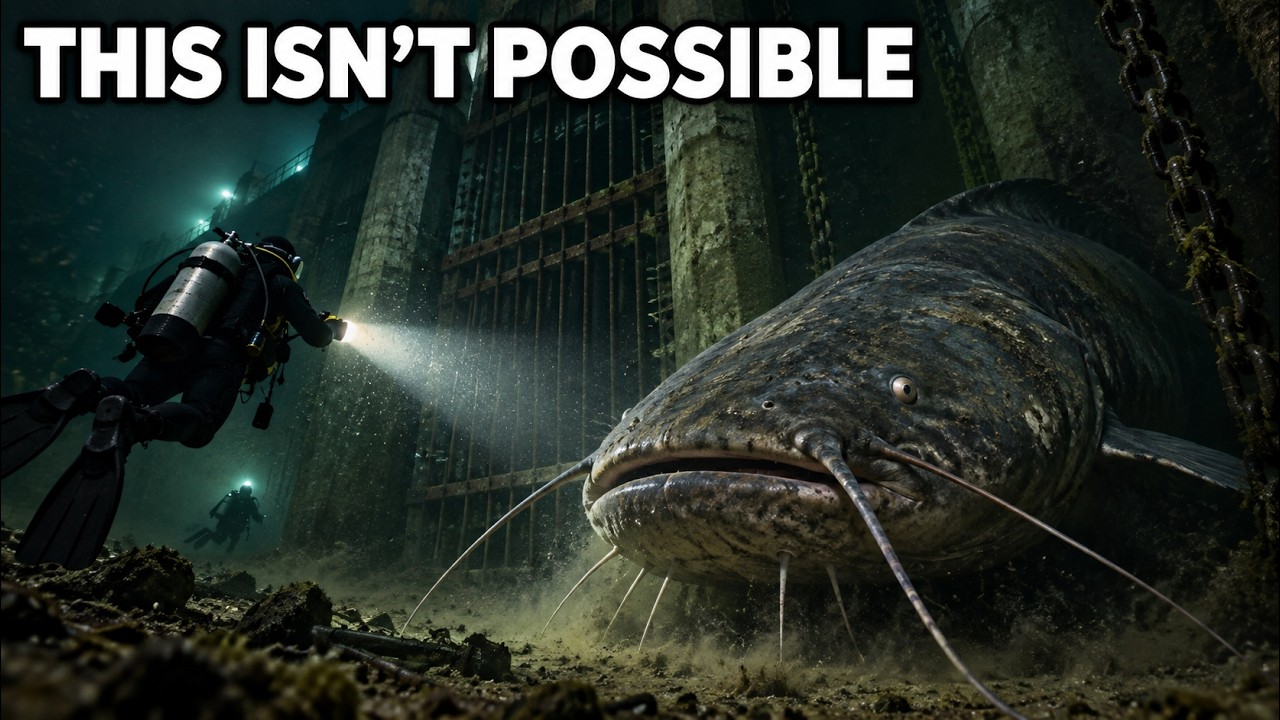
Commercial divers working in the tailwaters below the Mississippi River’s lock and dam system do not talk about what they find there the way most people talk about rivers. They describe it the way people describe something that changed their lives, something they were not prepared for, even after years of working in frigid, fast-moving water where visibility is so poor it would stop most people’s hearts. Over the past decade, these divers have described catfish below the major Mississippi River dams that do not resemble catfish anywhere else in the river system. When biologists finally began listening, they found something stranger than the divers’ stories.
Tailwaters are not a river in any usual sense of the word. They are a phenomenon so difficult to compare to everyday life that people who work in them sound like they are describing another world when they try to explain them to someone who has never been there. When water passes through hydroelectric turbines or over dam spillways, it undergoes physical transformations that continue for miles downstream. The most important of these is supersaturation of dissolved oxygen.
Water pushed under enormous pressure and then released carries vast amounts of atmospheric air, dissolving oxygen into the water column at concentrations that can reach 200 percent or more of natural saturation levels. This might sound beneficial to fish, but in extreme cases, the opposite is true. Gas bubble disease in fish is the aquatic equivalent of decompression sickness in divers, caused specifically by this supersaturation. At moderate levels, however, elevated oxygen content below dams creates nutritional and metabolic conditions that do not exist elsewhere in the river.
Temperature dynamics in dam tailwaters are also unusual. Dams draw water from specific depths in their reservoirs, and water released through turbines can be much colder in summer or warmer in winter than the receiving river would be naturally. On the low-head lock and dam structures of the upper Mississippi River, this thermal modification creates a thermal refuge environment that concentrates fish and invertebrates in ways the unmodified river never did. The shape of the current below a dam is the most surprising feature for anyone who assumes river current flows directly downstream.
Below a large dam, water does not simply flow downstream. It surges and reverses, forming hydraulic structures called eddies, circular currents in which surface water moves against the current while deeper water moves downstream. They are stable enough to map and dynamic enough to kill a swimmer in seconds. Boils erupt from the bottom where upwellings push water suddenly to the surface.
Lateral eddies the size of football fields rotate in patterns that change with dam release rates. This is not water behaving like a river. It is water behaving like the inside of a washing machine designed by someone who has never seen a washing machine. For fish that live permanently in this environment, these conditions represent both extraordinary opportunity and tremendous stress.
Food supplies are massive, physical demands are punishing, and the animals that thrive in tailwaters differ behaviorally and physiologically from those in the ordinary river upstream. Commercial diving in major river systems is not a profession that appears in many career guidance materials, and the people who do it do not speak at length about it with those who do not understand its nature. Their work takes them to underwater structures at lock and dam complexes to remove debris. Massive amounts of debris accumulate in the navigation channel below a major dam during floods, and this debris must be cleared from gates, intake structures, and navigation markers by workers operating under conditions that eliminate almost every other option.
Their tasks include structural inspection of dam faces and lock walls and maintenance of navigation aids in the channel below the dam. What distinguishes divers’ observations from any other form of aquatic biological data is direct, close contact with living organisms. A fish that flees a sonar pulse, stays beyond the resolution of any imaging system used in murky water, and avoids an electrofishing boat by diving to the bottom and holding still may show no reaction at all when it touches a diver’s hand in water where visibility is zero. Divers perceive fish through contact, pressure changes in the water column, sound, and the displacement effects of large moving objects nearby.
They build a sensory and acoustic picture of their environment that instruments cannot simulate. Zero visibility is not a metaphor in Mississippi River water; it is a physical reality. Visibility in sediment-laden water below a major Mississippi dam is usually measured in inches, not feet. Divers work by feel, referencing structural surfaces, navigating by touch and by the sensory image created by water pressure and movement around them.
In this environment, large fish cannot be seen. They are encountered. Their passing is felt. Their movement is heard.
Their proximity is registered in ways experienced divers describe with a precision and consistency that is difficult to attribute to imagination. A culture of underreporting among commercial divers is real and deserves explicit mention. These are professionals working in regulated environments, often under government contracts, where liability considerations make extraordinary claims professionally risky. What divers say publicly is a carefully edited version of what they discuss among themselves.
The specific moment when divers began systematically comparing their observations about tailwater catfish did not come from any formal research process but from informal conversations at industry gatherings, moments when one diver described an encounter and another said, without hesitation, that they had experienced the same thing at a different site. Those conversations eventually reached biologists. To their credit, the biologists listened. United States record holders for blue catfish and flathead catfish are not modest documents.
The world record for a hooked blue catfish is 143 pounds, caught in Kerr Lake on the Virginia-North Carolina border in 2011. Flathead catfish records range from 90 to 100 pounds in several states. These are fish that, by any ordinary standard, represent extraordinary encounters, fish that anglers pursue throughout their entire careers with realistic expectations of never touching one. Divers working below Mississippi River dams describe encounters with catfish they believe vastly exceed these records.
Their descriptions include fish they estimate, and these are estimates made by experienced people in zero-visibility conditions based on physical contact and displacement, at lengths approaching or exceeding 6 feet, with weights they describe in terms that place them above the current record class. The specific word that recurs most frequently across independent accounts from different divers at different sites is “massive. ” Not big, not impressive. “Massive,” in a tone that suggests the speaker is still processing what they touched.
Individual diver size estimates made in zero-visibility conditions cannot be considered scientific measurement. It is important to acknowledge this clearly. A diver whose arm brushes the side of a large fish in murky water and estimates its length based on that contact is not producing data comparable to a weighed and measured specimen. Estimates could be wrong in either direction.
Yet the direction of surprise expressed by these divers, surprise upward rather than downward, is notable. When many independent observers, with no communication and no incentive to agree, produce convergent descriptions of the same phenomenon, the probability that they are all equally wrong in the same direction diminishes significantly. Divers who have never met, working at different dam sites across the upper and lower Mississippi River system, have produced descriptions of encounters with exceptional animals that cluster around similar size ranges and behavioral characteristics. Recreational anglers working in major Mississippi tailwaters have documented catches that, while not reaching the extreme sizes divers describe, demonstrate the extraordinary productivity of these environments in producing large catfish.
Blue catfish over 23 kilograms are reported regularly at specific tailwater sites, something rare elsewhere. Fish in the 80 to 90 pound range are caught frequently enough to be documented multiple times per year at specific dam outfalls. These catches represent the visible surface of a population, while the lower layers, fish that are too large, too deep, or too net-avoidant, represent what divers describe. Traditional fisheries biology, based on population models derived from trawl surveys, electrofishing data, and conventional angling surveys, does not produce predictions that accommodate apex predator populations of the sizes that tailwater reports indicate.
The models say the food web should not support them. The fish have not absorbed these models. Blue catfish and flathead catfish, in their normal river behavior, are not animals that invite close observation. They are bottom specialists associated with deep holes, submerged timber, and cut banks.
They are nocturnal at peak activity and equipped with sensory systems, particularly the lateral line and barbels, that allow them to detect and avoid disturbances at considerable distance. A catfish in a natural river environment, if it detected a diver, would disappear before the diver knew it was there. What divers describe in dam tailwaters is different. Not all catfish in these environments necessarily behave uniformly, and behavioral differences emerge most clearly at specific hydraulic features associated with the dam structure itself.
But at those locations, divers describe animals whose relationship to their presence differs markedly from what the same divers encounter with catfish elsewhere. The most commonly reported anomalous behavior is holding. Divers working on dam structure faces, turbine discharge sides, and the lower edges of navigation lock walls describe catfish that do not simply occur near these structures. They position themselves within specific hydraulic features in ways that suggest active, purposeful use of current rather than passive residence in calmer water beside the flow.
A catfish holding in the boundary layer of a turbine discharge, where current structure creates a zone of relative calm directly beneath maximum velocity, is doing something that requires continuous position adjustment and muscular activation. It is working with the current the way a fly, suspended on the surface by surface tension, works with the surface. These are not fish that ended up where they are. These are fish that chose to be there.
Reduced flight response is the observed behavior divers find most difficult to explain and describe accurately. Large catfish in tailwater environments at specific locations allow divers to make contact, not intentional contact, but inadvertent contact that occurs when a diver moving by touch along a structural surface encounters a fish that is not where the diver expected it to be. Without the sudden, disorienting burst that characterizes most diver encounters with large fish, the fish moves away, but slowly. It repositions rather than flees.
Divers who have encountered large catfish in river environments away from dams describe those encounters as brief and violent, a collision with something extremely powerful that disappears before they can register what it was. Tailwater encounters at dam structures are described differently, as encounters with something that has decided you are not a threat. This distinction is behaviorally significant. Feeding behavior observed at turbine discharge points may be the most ecologically significant of the reported behaviors.
Divers describe catfish positioned at the edge of turbine discharge currents, picking off prey, fish, invertebrates, and organic material, that has passed through the turbines and emerged stunned, dead, or disoriented. This is not passive foraging in any conventional sense. It is active interception of a predictable food delivery system. Divers describe animals that clearly know the rhythm of the turbine cycle and position themselves accordingly.
This level of behavioral sophistication, timing feeding to an artificial feature of the environment that has existed for decades, is an adaptation not covered by theoretical descriptions of catfish behavior. It is biology no one predicted, and science is only beginning to document it. Biologists who began systematic study of catfish populations in the tailwaters of the upper and lower Mississippi River system during the first two decades of the millennium started from a null hypothesis: dams create barriers to fish movement that slightly affect population structure but have no major impact. Fish above a dam and fish below belong to the same species and face different conditions but draw from the same gene pool through whatever passage exists, producing animals that differ slightly in distribution and abundance but not fundamentally in biology.
Otolith aging studies were the first indication that this null hypothesis would face difficulty. Otoliths are small calcium carbonate structures in the inner ear of fish that function like tree rings, recording annual increments that allow age determination with reasonable accuracy. When researchers began examining the ages of catfish from tailwater populations below Mississippi River dams and comparing their ages and growth profiles to fish of the same species collected from the reservoir upstream or the river downstream, the differences were striking. Tailwater catfish grew faster, much faster, not within normal variation margins but at rates that in some age classes reached two to three times the growth rates observed in reference populations elsewhere in the river system.
A 5-year-old blue catfish from a Mississippi River dam tailwater, for example, was comparable in size to a 7-year-old blue catfish from the river above the dam. The food subsidy hypothesis, that tailwater environments provide exceptional caloric abundance that drives exceptional growth, was the clearest explanation. Data supported this hypothesis more strongly than expected. Condition factor data was equally striking.
Condition factor is a standard fisheries metric relating fish weight to the cube of its length, expressing how well-fed and physically robust an animal is compared to what would be expected from its length alone. Multiple studies showed that tailwater catfish possess significantly above-average condition indicators for the species, heavier for their length, with greater energy stores and better physiological reserves than fish of comparable age anywhere else in the ecosystem. Stomach content analysis provided the clearest picture of what lay behind these differences. Tailwater catfish consume things that catfish in unimpounded river sections rarely find in quantity.
They feed on shad and other forage fish that are stunned or killed passing through turbines, invertebrates concentrated by current below dams, and organic material processed by the dam and delivered in quantities the unmodified river does not provide at a single site. Stomach content data directly supported the turbine-passage subsidy hypothesis: dams act as unintentional fish processors, delivering stunned prey directly to waiting predators downstream, in a manner that surprised the researchers who studied this data. The dam, without intending to, has become the most efficient fish delivery system in the river. Downstream catfish have learned to depend on it for their feeding needs.
Physiological adaptations observed in organisms with long-term residence in tailwaters go beyond growth rate differences. Differences in gill morphology, possibly reflecting adaptation to oxygen supersaturation, have been documented in some populations. Muscle development patterns have been described that differ from river catfish in ways consistent with living in high-flow environments. The question remaining unanswered by current research is whether these differences represent phenotypic plasticity or group-level selection.
The answer to this question is critical. When a dam is built across a river, water exiting the other side carries energy that has no outlet except the riverbed. The kinetic energy of released water scours the bed immediately downstream, removing material and carrying it away, creating a depression in the riverbed that grows over years and decades until it reaches a depth where energy dissipation is sufficient to stop the scouring process. These depressions are known as scour holes, and below major Mississippi River dams they reach depths unmatched anywhere else in the river system.
Scour holes below some major lock and dam structures on the upper Mississippi and its principal tributaries have been documented at depths approaching 60 feet or more below the natural riverbed level. In a river whose main channel may not exceed 15 to 20 feet deep under normal conditions, a 60-foot scour hole is not a natural river feature. It is a different environment connected to it. Temperature, pressure, current structure, bottom composition, light penetration, and dissolved oxygen dynamics all differ in scour hole depths from the surrounding river, and they differ in ways that create conditions found nowhere else in the river system.
Divers working in scour holes below Mississippi dams describe this phenomenon with remarkable specificity, suggesting they are describing a real and distinct experience rather than exaggerated accounts of ordinary deep-water diving. Current structure in scour hole depths is counterintuitive. High-velocity surface flows characterizing the main discharge zone give way to slower, more complex currents at depth, with upwelling and downwelling patterns capable of moving a diver horizontally without warning. Temperature at scour hole depth can differ by several degrees from surface water temperature.
In extreme cases, the pressure difference between the surface and scour hole depths approaches what recreational divers face at significant ocean depths. For catfish, divers working in scour hole depths describe catfish in sizes falling within the upper range of diver accounts from shallower tailwaters, but with an addition. At the deepest accessible points in scour holes, they describe animals they have been unable to identify precisely because they have not fully encountered them. They feel something enormous passing nearby, registered in the water column above them, without being able to fully confront it in a way that permits even a rough size estimate.
These accounts are necessarily the least documented in the entire body of diver testimony. They are also the accounts that experienced divers repeat very quietly and with evident seriousness. According to theoretical models of catfish physiology, temperature and oxygen dynamics at scour hole depths should limit extensive large catfish habitation. Large fish require abundant food, and food availability at depth is supposed to limit biomass.
The scour hole interpretation suggests either the models are wrong about food availability at depth, possibly explained by turbine-discharge food supply that sinks in the water column, or the models are wrong about physiological requirements of catfish, or both. The question of whether tailwater catfish populations below Mississippi River dams are becoming genetically distinct from the river populations from which they are separated was not on any researcher’s agenda when tailwater population studies began. It emerged as a consequence of other findings, specifically the combination of population isolation created by the dams themselves and evidence of physiological differences between tailwater and river populations. Dams are not absolute barriers to fish movement for all species.
Adult blue catfish and flathead catfish can pass through lock chambers during navigation operations, and some fish passage structures exist at certain facilities. But fish movement through locks is intermittent, irregular, and quantitatively limited compared to free movement through an unimpounded river. Practically, tailwater catfish populations below major dams have been at least partially isolated from populations above them since dam construction, a period of 60 to 90 years for most Mississippi River facilities. Sixty to 90 years is a long time in catfish generations.
Blue catfish mature at 3 to 5 years and can live 30 years or more, producing overlapping generations that, under conditions of partial isolation and strong directional selection, can accumulate genetic differences faster than isolation without selection. The tailwater environment provides unusually strong, consistent selection pressure. Animals that excel at exploiting turbine-derived food, survive in high-velocity hydraulic zones, and tolerate oxygen supersaturation will systematically outperform others. Preliminary genetic studies on tailwater catfish populations have revealed early indications of differentiation among these populations.
Allele frequencies differ between tailwater populations and upstream fish populations at a small number of genetic loci, not enough to classify them as a distinct ecotype, but enough to indicate that random mating was not the correct model. The gene flow problem, how much these fish move between tailwater and upstream populations and whether this movement is sufficient to prevent differentiation, remains incompletely understood given the logistical difficulties of sampling needed to classify it accurately. Confirming that tailwater catfish below Mississippi River dams represent a genetically distinct ecotype would mean that engineering decisions made between 1930 and 1970, when most Mississippi River navigation dams were built, inadvertently initiated a process of speciation. Not completed speciation, as populations are not reproductively isolated in the absolute sense required for true species divergence, and the elapsed time is short by evolutionary standards.
But it is a differentiation process representing one of the most significant unintended consequences of large-scale river engineering in history. Commercial fishing on the Mississippi River before the navigation lock and dam system was built was not a marginal activity. It was an industry operating on a large scale, producing catches documented in state and federal records and discussed in agricultural and commercial reports of the early twentieth century. The people running this industry knew where large catfish were and why they were there.
Historical commercial fishing records reveal fragmented but suggestive information about catfish populations before dam construction. Accounts of enormous catfish, consistently described in commercial records as massive in terms suggesting they were larger than ordinary size, cluster around specific geographic features of the pre-dam river: deep holes, major tributary confluences, and the downstream side of natural obstacles that created hydraulic features similar to what dams now produce artificially. The river had its deep holes and hydraulic complexities before dam construction. Large fish knew where they were.
The dam construction zone itself produced some of the most striking documentation of enormous catfish in the historical record. Dredging and blasting accompanying dam foundation work disturbed deep-water habitats and displaced animals that had resided there for years or decades. Construction workers and fishermen operating in affected areas immediately following construction reported catches and encounters that entered the folklore of river communities as examples of what the deep river had contained. Some of these accounts describe animals that, if their sizes were accurate, would have rewritten record books.
Most were never scientifically documented. These stories were passed among people whose testimony was of no interest to the institutions managing the river at the time. The folk knowledge accumulated by river communities over generations about deep holes below dams, accumulated through decades of fishing, net-setting, and direct experience, represented genuinely sophisticated ecological understanding. River people knew that holes below certain dams produced fish with different behavior.
They knew that fishing those holes required different methods than fishing the open river. They knew, practically if not scientifically, that the animals there were unusual. This knowledge was not recorded in the form fisheries scientists look for. It lived in community memory, and as the communities that held it aged and dispersed, it faded.
The divers working in dam tailwaters today are, in a sense, encountering the same phenomenon that river people knew a century ago and could not explain. That knowledge was lost in the gap between the commercial fishing era and the scientific study era. What divers are doing through their informal comparisons of encounters at different dam sites is helping reconstruct this phenomenon. Scientists now taking this seriously have an opportunity to document what the last generation with direct knowledge of these environments described, before it is too late.
The catfish below Mississippi River dams are fascinating in themselves. They are enormous fish in unusual numbers, behaving in ways that exceed current scientific description of their species, in an environment created by dams that did not exist before dam construction. This is a story worth telling on its own. But it points to questions beyond the biology of a single species.
Tailwater catfish are apex predators in the food web of these waters. The condition and size of apex predator populations are among the most sensitive indicators of food web health available to aquatic ecologists. If apex predators are fat, abundant, and fast-growing, the energy base supporting them is large. Tailwater catfish data indicates food webs of exceptional productivity in a narrow strip of river immediately below major dams.
This productivity is almost entirely attributable to the dams themselves: the food subsidy from turbine processing, thermal modification, oxygen dynamics, and hydraulic concentration of prey. In other words, dams have inadvertently created some of the most productive large-predator habitats in the entire Mississippi River system. This complicates the dam removal debate in ways rarely discussed. The dam removal movement on American rivers, driven by legitimate concerns about fish passage, sediment transport, and river habitat connectivity, has developed a narrative that dam removal is directly beneficial to river ecosystems.
For many rivers and many species, evidence supports this. What the tailwater catfish story adds is a reminder that some ecological value in the current system is value created by the dams. Removing the dams means losing that value along with the costs. Tailwater-adapted populations have no habitat to return to if dams are removed.
Scour holes fill in. Food subsidies disappear. The broader question raised by the tailwater catfish story is about the limits of institutional knowledge in complex systems. Divers knew something biologists did not because they had direct contact with the environment in ways tools and surveys did not provide.
This is not an unfamiliar situation in ecology. People who spend the most time in an environment, directly, often notice things formal scientific programs miss. Listening to these people is not a substitute for systematic scientific study. It is a precondition for knowing what to study.
The tailwater catfish story suggests we have missed significant parts of the picture in one of the most studied river systems in North America because we did not ask the right people what they had seen. Sixty to 90 years ago, engineers built dams across the Mississippi River system for reasons unrelated to catfish: navigation, flood control, hydroelectric power. In the water immediately below those dams, something happened that no one planned and no one was watching. An environment unprecedented in the natural history of the river emerged.
Deeper, faster, colder, richer in food than anything the river had produced before modification. And the catfish were there, as they had always been, in the deep waters of the Mississippi River system, waiting to exploit whatever the river offered. What they did over six or seven decades of this advantage is what divers began observing and biologists are now documenting: animals larger than those recorded in record books, in better condition than models predict, behaving in ways textbooks do not describe, and possibly genetically differentiating in ways that make them something new. Something the river made with the tools we unintentionally gave it.
We engineered the Mississippi River on a scale and duration that changed its environment in ways we are still discovering. The catfish in the dark water below the dams are one of the results. A strange, enormous, behaviorally sophisticated, possibly genetically distinct result, produced by the river without anyone asking it to. What lies in its depths that we have not yet begun to search for?
The divers, those who go into the water, already have opinions. Biologists are now learning how to ask.