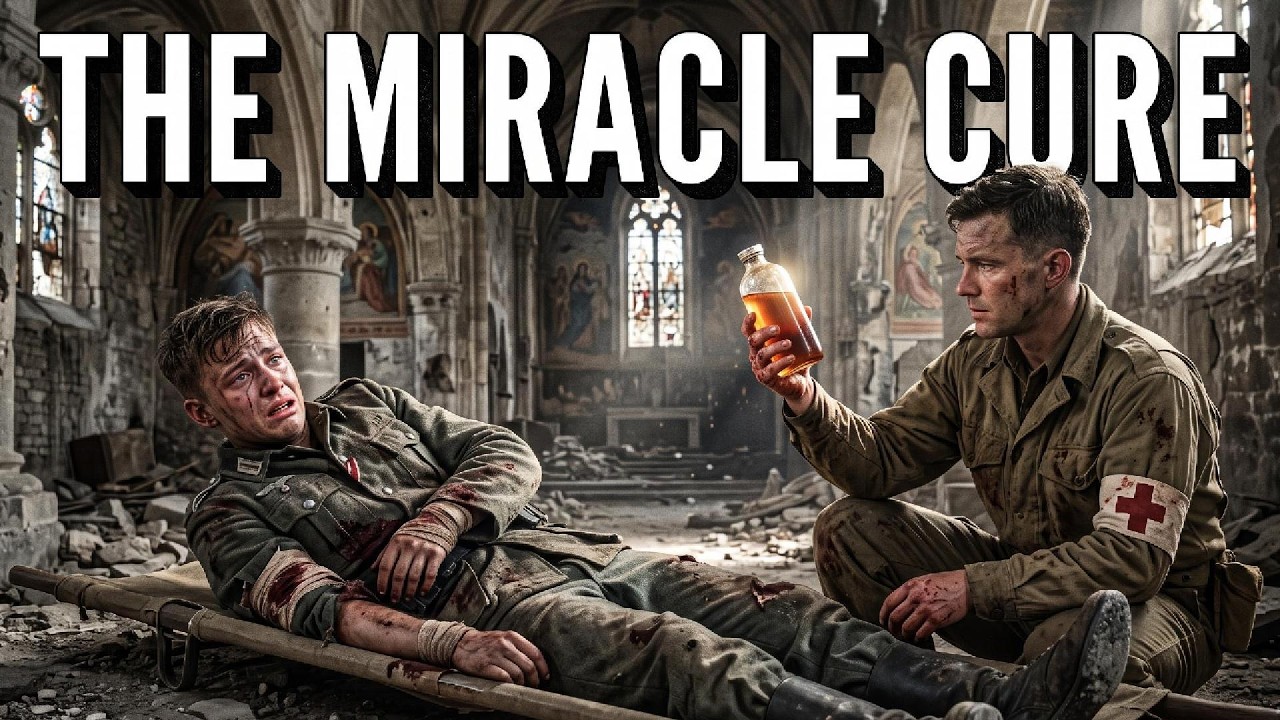
The shattered stone walls of a bombed-out church in the Hurtgen Forest echoed not with hymns, but with the wet, metallic gasp of a dying boy. On a blood-soaked stretcher, a nineteen-year-old German infantryman, his leg shredded by shrapnel, stared at the vaulted ceiling with the hollow eyes of a man who had already accepted his fate. He had been told for three days that the Americans were merciless gangsters, that they executed prisoners and left the wounded to rot in the mud. His own commanders had left him behind with a paper bandage, a discarded resource in the brutal triage of a collapsing Reich. He begged in broken English to see a doctor, fully expecting to be dragged into an alley and shot. Instead, an American surgeon, his apron slick with the blood of other men, walked over. He did not ask for the boy’s rank. He did not ask for intelligence. He simply looked at the wound, barked an order to a nurse, and grabbed a pair of shears. Within seconds, the shredded uniform was cut away, a needle slipped into the boy’s arm, and a glass bottle of warm, golden human blood plasma was hoisted above his head. The surgeon then pulled out a small glass vial of a strange, cloudy liquid the German had never seen before: penicillin. As the pain melted away and the warm plasma surged into his freezing veins, the German soldier began to weep, not from agony, but from the absolute, world-shattering shock of mercy. His own empire had left him to die in the dirt. His enemy was spending a small fortune to save his life. This scene, repeated thousands of times across the Western Front in the winter of 1944 and 1945, represents one of the most profound psychological weapons ever deployed by the United States military. It was not a bomb or a bullet that broke the German soldier’s will; it was a glass bottle of plasma and a shot of penicillin. To understand the devastation this caused among captured German troops, one must examine the deeply opposing medical philosophies of the Axis and the Allies, philosophies that were as stark as the difference between darkness and light. By the winter of 1944, the German Medical Corps was suffering from the same logistical starvation as the rest of the Wehrmacht. But it was also poisoned by the dark, underlying ideology of the state. The German system operated on a ruthless interpretation of survival of the fittest, a Darwinian nightmare where medical care was heavily prioritized for the slightly wounded—men who could be patched up and shoved right back into the meat grinder. If a soldier was catastrophically wounded, administering precious morphine or anesthesia to him was seen as a waste of materials on a lost cause. A bullet in the gut was a guaranteed, agonizing death sentence, and the German command accepted that as the cost of war. Across the lines, the United States viewed military medicine through a radically different lens. To the Americans, saving a life was not just a moral imperative; it was the ultimate flex of logistical supremacy. The US military believed that if you drafted a young man from Kansas, you owed him the greatest medical care the industrial world could produce. They didn’t just build tanks; they mass-produced miracles. The Americans pushed highly trained surgeons directly to the front lines, standardized the mass collection, freezing, and shipping of blood plasma across the Atlantic Ocean, and weaponized the greatest medical breakthrough of the 20th century: penicillin. While German soldiers were dying by the thousands from simple mud-borne infections, their limbs amputated with wood saws and no anesthesia, American GIs were being injected with a miracle drug that stopped gangrene in its tracks. For years, the German Ministry of Propaganda had painted the United States as a chaotic, soulless, capitalist machine. They assured their soldiers that an army of factory workers could never possess the deep, spiritual brotherhood of the German military. They assumed American medics would be cowards under fire and American doctors would be overwhelmed by the carnage of modern war. They failed to realize that the United States had completely revolutionized battlefield survival. When these two realities collided in the brutal winter of 1944 and 1945, the friction was absolute. German front-line units were disintegrating, their supply lines severed. A German soldier wounded in the snow knew he was already dead. They watched their comrades die screaming in the mud because there was no morphine left. But when German soldiers were captured or overran American positions, they stumbled into a completely alien world of medical abundance. They saw American medics running directly into machine gun fire to drag wounded men to safety. They saw fleets of heated ambulances waiting behind the lines. For a starving, freezing German soldier suffering from infected wounds, capturing an American medical kit was like finding treasure. The syrettes of pure morphine and the sterile bandages were worth more than gold. Inside the ruined church, the American surgeon works with terrifying speed. He is tying off arteries and packing the German boy’s shattered leg with sulfa powder. There are wounded American GIs in the room, some moaning in pain. The German boy, his mind clouded by morphine, looks at the American soldiers. He expects them to demand that the doctor stop treating the enemy. He expects them to drag him off the table. Instead, an American infantryman with a bandaged head sitting on a nearby pew simply lights a Lucky Strike cigarette, walks over, and places it between the German boy’s lips. The psychological collapse is instantaneous. The German boy realizes that everything he has been taught about his own racial superiority and the cruelty of the Americans is a lie. He is looking at a glass bottle of blood plasma, plasma that was donated by an anonymous civilian in New York, shipped across a submarine-infested ocean, driven across a contested beachhead, and delivered to a ruined church in Germany, all so a frontline surgeon could pump it into the veins of an enemy soldier. The sheer industrial and moral weight of that act crushed him more effectively than any artillery barrage. Following the war, Allied medical logs revealed a staggering truth: the survival rate of German prisoners treated in American field hospitals was astonishingly high. When German soldiers wrote letters home from POW camps, they didn’t write about the superiority of the Sherman tank or the fear of the B-17 bomber. They wrote about the doctors. They wrote about how they were given the exact same medicine, the exact same food, and the exact same surgical care as the American troops. The German military had built an ideology that celebrated suffering, sacrifice, and a callous disregard for human life. But the American Medical Corps shattered that ideology completely. The United States proved that true power doesn’t come from how ruthlessly you can abandon your wounded. True power comes from an industrial society so massively abundant and a culture so deeply confident that it can literally afford to heal the men trying to kill it. The Third Reich was defeated by steel and fire, but the German mind was broken by a glass bottle of plasma and a shot of penicillin. In that ruined church, as the morphine took hold and the cigarette smoke curled toward the shattered rafters, the nineteen-year-old German boy understood the truth. He was not a superman. He was a child who had been lied to. And the men he had been taught to hate were the only ones who treated him like a human being. The war would end in a few months, but the memory of that American doctor, working frantically to save an enemy’s leg while his own men watched, would never fade. It was the ultimate victory of humanity over ideology, and it was won one shattered soldier at a time. The scene in that church was not an isolated act of charity; it was a calculated, systematic policy that defined the American war effort. Every bottle of plasma, every dose of penicillin, every trained surgeon pushed to the front lines was a deliberate investment in a philosophy that valued human life above all else. The Germans, with their cold, utilitarian calculus, could not comprehend this. They saw the American abundance as weakness, as decadence. They were wrong. The American system was a weapon of mass persuasion, a demonstration of power so overwhelming that it left no room for doubt. When a German soldier surrendered, he was not just giving up his rifle; he was surrendering his entire worldview. He was walking into a world where his life mattered, and that was a concept more terrifying to the Reich than any tank division. This psychological warfare did not require propaganda leaflets or radio broadcasts. It was waged silently, in the mud and the blood of the front lines, one wounded man at a time. The German high command never understood it. They continued to believe that their soldiers would fight harder out of fear of the enemy and fear of their own officers. But fear is a brittle weapon. It shatters under pressure. What the Americans offered was hope, and hope is unbreakable. The German boy in the church, weeping on the stretcher, was not weeping for his lost leg or his lost cause. He was weeping because he had been shown a glimpse of a world that did not have to be a hellscape of suffering and sacrifice. He was weeping because he had been saved by the very people he was told would kill him. And in that moment, the American ideal proved itself to be the most powerful force on the battlefield.