
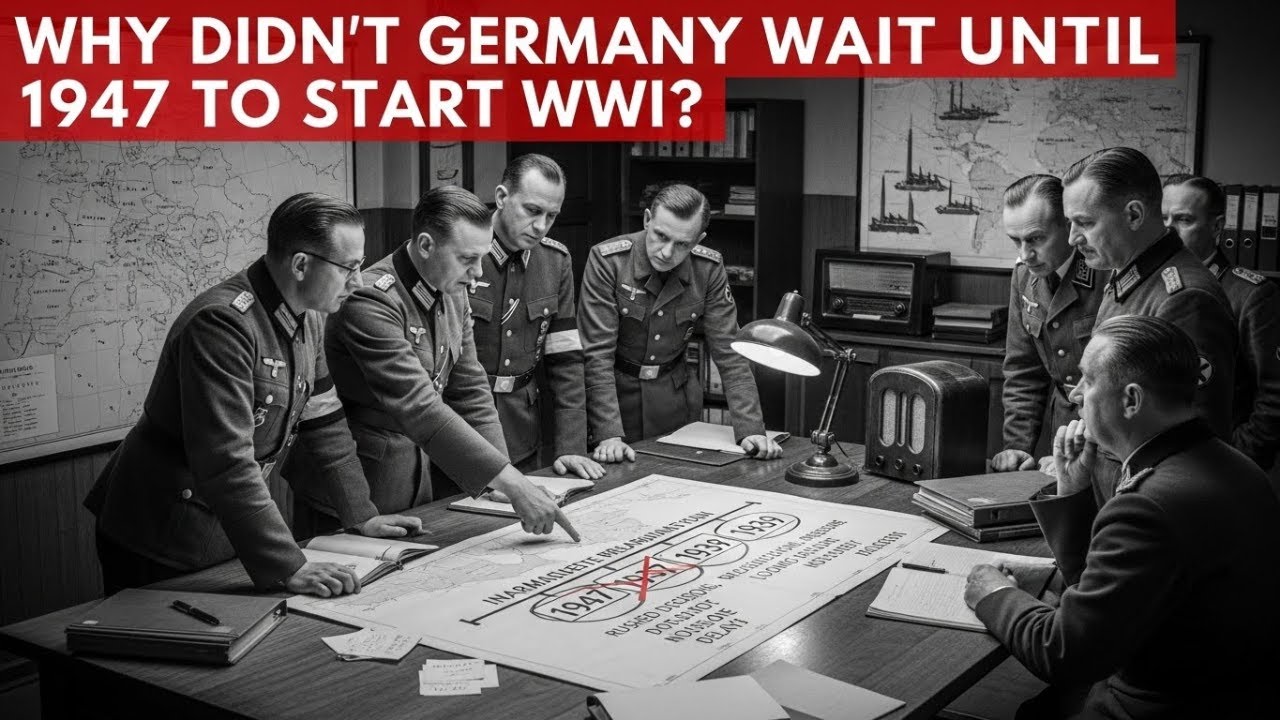
The violent gamble that plunged the world into its deadliest conflict was not the result of a meticulously timed master plan, but a frantic leap into the abyss driven by desperation. For years, the prevailing narrative suggested a calculated schedule, yet the reality was a nation on the brink of internal collapse, a leader staring down the barrel of his own mortality, and an economy running on fumes. The decision to unleash war in 1939 was not taken in a vacuum of confidence, but rather in a cold, calculating panic that waiting any longer would mean the end of the Reich’s ambitions.
The pressure valve was set to burst by an economy that had been surgically attached to a treadmill of debt and military procurement. The vast rearmament programs of the 1930s had transformed Germany’s industrial landscape, but they had also hollowed out its financial core. By 1939, the nation was effectively bankrupt, with the government resorting to printing money to sustain the war machine it had built.
 This was not a position of strength; it was the fever pitch of a patient with a dangerously high temperature, with the state’s financial system stretched so thin that any prolonged delay could snap it entirely.
This internal economic fragility created an unbearable pressure to externalize the crisis. The factories were producing weapons at an unsustainable pace, but the resources to feed both the industry and the future military machine, namely iron ore, oil, and food, were critically absent. Hitler viewed the war not merely as a strategic conquest but as a necessary economic theft—the act of looting another nation’s wealth to pay for the previous years of deficit spending.
Every month of inaction promised not just more debt but the real possibility of domestic upheaval, as the living standards of the German people began to suffer for the sake of the guns.
The economic flaw was severe, but the physics of relative military power were even more unforgiving, creating a geopolitical clock that ticked against the Third Reich. While Germany had outpaced its rivals in the immediate rearmament phase, the mathematics of industrial capacity were working against them. Britain, having finally shaken off its interwar lethargy, had initiated a massive rearmament program that, by the late 1930s, was beginning to hit its stride.
France’s Maginot Line was a fortress, but the capacity to build tanks and aircraft was escalating. More critically, the Soviet Union under Stalin was on a trajectory toward outright industrial domination.
Hitler’s military intelligence looked at the raw data with dread, perceiving a “sleeping giant” in the East that was not sleeping, but training and building at staggering speed. Stalin’s army was bloated and decapitated by the purges of the late 1930s, appearing weak, but the potential for an armor and industrial output eclipsing Germany was colossal. By 1947, in the planners’ models, Soviet tank divisions would have quadrupled, their Air Corps modernized, and their logistical networks complete.
The window where the Wehrmacht was quantitatively and qualitatively superior to all potential rivals was rapidly narrowing, a condition that made waiting for a “perfect” military build-up a fool’s errand.
This strategic race was not helped by subjective, personal fears that gripped the uppermost echelons of the German state. Historians have long debated the physical health of Adolf Hitler, but by the summer of 1939, he was a man clearly feeling the weight of his own mortality. Suffering from tremors, chronic gastritis, and the potential early stages of Parkinson’s disease, Hitler was witnessing the steady deterioration of his own instrument.
The grand vision of a thousand-year Reich, and the need to accomplish it in his lifetime, became a biological imperative. He would go to war now, with his mental faculties intact, rather than risk waiting a decade and being physically and mentally unable to lead.
 But ultimately, it was the perception of a perfect aligning of political stars that tipped the scales in the fall of 1939. Hitler’s confidence was born from the empirical evidence of appeasement policy. The Munich Agreement had handed him the Sudetenland, and by March 1939, the rump of Czechoslovakia, without him firing a single shot.
This passive acceptance emboldened the belief that Britain and France would perform the political calculus to avoid another world war, this time over Poland. He placed internal faith in the complacency of the Western powers, who seemed fundamentally terrified of repeating the horror of 1914.
The geopolitical tableau appeared just as optimal for Germany. The Ribbentrop-Molotov pact, a stunning diplomatic armistice signed with the arch-communist enemy, the Soviet Union, neutralized the threat of a two-front war on the eastern border. The pact, with its secret protocols for slicing Poland and the Baltic states, allowed Hitler to invade Poland without the immediate smoke of a new 1914-style encirclement.
In his mind, he had bought off the Eastern threat, secured a trade route for grain and oil at least for the initial year of the war, and the Western powers would prove too weak to intervene on behalf of a distant nation using their terror of modernization.
The actual, real reason why the timeline couldn’t be extended to 1947 was the abandonment or dissolution of the territory design. The entire geopolitical strategy we are to absorb the “Lebensraum” concept, was designed not to just border expansion but the ethnic cleansing and re-planning of eastern Europe. This project was expensive, and disruptive, but more importantly, it had a clear schedule.
In 1939, Poland was the gateway. The the country and its corridor presented them not only a vital territory, but the primary start-up zone for these mass settlements.
If Germany delayed the Poland campaign, they were effectively delaying the entire “eastward” colonial project. Time would allow Poland to more thoroughly fortify these areas, to modernize their poorly equipped army, and to integrate more strongly with the Western alliance structures. The German Paul’s calculations did not demand that the perfect, up-to-issue system of pig-pay.
The 1940 offensive in the West was planned for, but in 1939, the immediate objective was the collapse of the Polish state because waiting for a potential better motor encryption in the West would risk the initial piece of the domino falling for a reason of “the swamp”.
 Military leaders often speak of “acceptable losses” and “opportunity costs”, but Hitler’s relational view of time was radical. He refused to wait for the battleship Z-Plan or the somewhat advanced long-range bomber fleets to complete, because in his mind, by the time those systems came online in the mid-1940s, the opponent’s numerical advantage would be insurmountable. The German war doctrine was built around the “Blitzkrieg,” or lightning warfare, a concept that relied on tactical velocity rather than logistical longevity.
It was designed for a confrontation to occur now, using the element of surprise and rapid movement. If you wait for the cavalry to finish becoming a fully armored division, the tank is obsolete.
There would also be a profound moral corrosion within Germany if a state of “war-readiness” was sustained indefinitely. The national spirit could not maintain its level of aggressive militarism without release valves of actual victory. The nation had been fed a constant diet of propaganda about its “living space” and the fact of an existential threat.
To wake up in 1947 with the military still on alert but the borders unchallenged, would be an admission that the leadership was bluffing. It would create fragility, internal fractions, and the strengthening of the military commander who began to think of peace rather than preemptive war will be an obvious threat to Hitler’s vision and the cohesion of the party.
One also has to consider the hazardous of dependency on a coalition. Germany’s success was heavily influenced on the support of its allies, Italy, Japan, and the was intake from the Soviet Union in 1939. These were not friendships based on trust but on self-interest tied to timing.
Mussolini, even in 1939, was defensive that the war would go on, and he was vastly unprepared. To wait for two years would to wait for Italy to be a bit more prepared, yes, but it also would have been a Italy whose self-interest in the conflict had quieted down with the economic compensation that the Reich would have to outbid, draining them further. Japan, preoccupied with the Soviet borders, might have secured a complete peace with the Russians.
The window of violence that aligned with another nations to keep the USSR unstable was a precarious one.
The very static fact is that Germany’s “plan” was not to win a war of attrition. They fully expected to be able to achieve strategically limited, catastrophic campaign drops in 1939-1940 that were over before the US could fatally sway the concept, and before the CIA could expand its industrial capacity. Delaying until seeing the US entry into the ring, even as a potential, was considered.
 But if 1947 arrived, the Lend-Lease infrastructure would be in place, and the strategic bombing of the US industrial production would be a bleak prospect. There was no incentive to allow the industrial banks of the United States to fully align with the UK and USSR.
The decade of military buildup had already stretched the country’s physical boundaries. But the psychological impetus was that of a dream on the verge of default. Hitler’s he had encompassed “1000-year Reich” but at its base, the core was about a single lifespan.
The drive for this, now, was intellectual matching of a classic notion of historical “Kairos”—the perfect moment. He believed the Nazis had the chance to “stick it” to the historical wave of democracy and socialism. That if they hesitated, the Nazi party would be relegated to a footnote of also-rans, a historical anomaly of a party that was outfoxed by the rest of the world’s leaders.
In the end, it was not germany that initiates wait until 1947 because the possibility of a “good 1947” was a delusion. The entire program of the vast “Blitz” plan rested on the underlying principle of the “irregularity” that the enemy will not have time to mobilize their own resources. If Germany waited eight years, it would lose Netflix and the massive identity of the “surprise” they sustained.
The healthier, well-fed, and better-lead Polish army in 1947 would be a defensive nightmare; the fissure in the Wehrmacht’s experience with the chaotic Russian offensives would be crushing; and the guaranteed entry of the military powerhouse of the US would be a calculated check-mate.
So, the decision was not a strategy based on adrenaline, but a cold, rational view of when to die. The the world will usually view 1939 as the start, but for the Nazi high command, it was a self-rescue, to attempt a miracle in a building that they knew if they waited too long would collapse empty. They not choose to strike; the volatile climate.
An American alone. Economic my other tells us that often a nation goes to war not when it is beloved or weak, but when it knows its own collapse is inevitable without external acquisition. The German invasion of Poland was the start of a catastrophe, but for Berlin, it started as a last-ditch survival of their own flawed economic and political system action, they were the initiators but also the prisoners of their own impossible clocks.