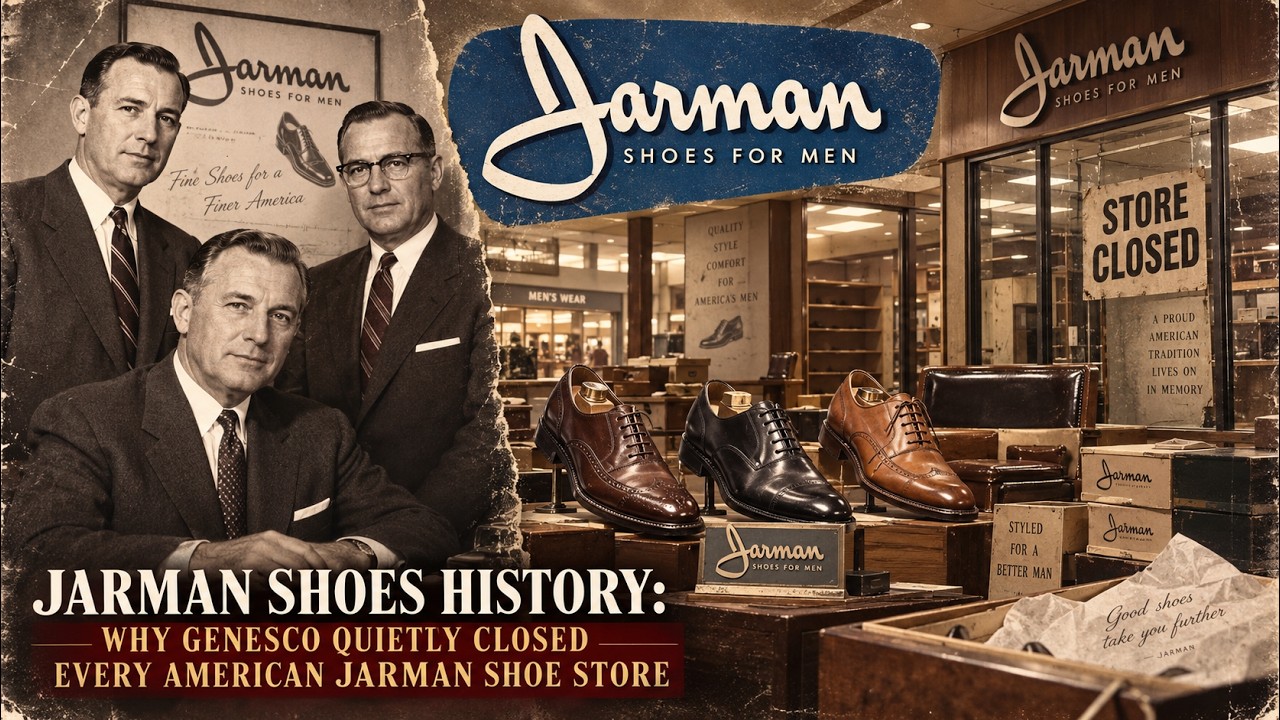
The silence was the first tell. No press release, no liquidation sale, no farewell to the customers who had bought their church shoes, their work oxfords, and their first job-interview dress shoes from the same counter for nearly three decades. Just a sign change.
By the spring of 2004, the “Jarman” name was being torn down in malls across the American South and replaced with the company’s other concept: Underground Station. Same carpet, same cashier, same shoe stock. Only the identity was missing.
 The brand that had outfitted generations since the Coolidge administration was gone, not with a bang, but a corporate flip.
The decision to execute this silent transformation is rendered even more puzzling when examined against the financial health of the parent company, Genesco Inc. In 2004, Genesco was not a struggling entity. It was profitable, expanding, and aggressively opening stores under a different banner, one aimed at the sneaker-obsessed teenage demographic: Journeys.
The conglomerate was not retreating from the business of malls; it was doubling down on its investment. It simply decided, according to results from the period, that the Jarman name had culturally “outlived its usefulness” in their corporate plan, despite that name still being capable of generating millions in sales.
To understand how the company reached that point of disposal requires moving back to the muddy banks of the Cumberland River in Nashville, 1924, where the seeds of the empire were quietly planted by a traveling salesman. James Franklin Jarman and his partners had spent years on the road, hauling sample cases full of other mens’ products. They knew the retail territory, but lacked the factory and the brand name.
It was an inauspicious start: they built a factory near the river for shipping convenience, but the famed resilience of Tennessee waters flooded them out in the first year, forcing a high-ground retreat before the company had even celebrated its first birthday.
The market gap he identified was basic economics. In the 1920s, a working man earning twenty-five dollars a week faced a brutal choice: a high-quality pair of dress shoes for ten dollars—a week’s wage—or a shoddy, cardboard-soled version that fell apart in a season. So Jarman decided to anchor his new company not on customization, but on a single, fixed price point.
When the company launched under the name Jarman(now with the brothers), later renamed General Shoe, it introduced the “Friendly Five”—a real leather shoe priced at exactly five dollars, a figure that seemed impossible while maintaining quality. This was the sweet spot: halving the cost of a good shoe, cutting the margin small enough to push out the “cardboard” imports.
The company’s real rocket fuel, however, came with the ascension of Maxey Jarman in 1933. Having dropped out of MIT to avoid engineering, he took over the factory floor at ten dollars a week, and by 29, he was President. Maxey changed the name to General, but its horizons expanded further.
General Shoe began sponsoring a national radio program called Friendly Five Footnotes, featuring a tap-dancing Fred and an orchestra. The writing on the rack was clear: this shoe wasn’t that it was the sensible choice for the American working family, providing “quality surpassing the cheap play stores at a price-ground.”
The product itself sold because it was built to be repaired, not replaced, pleasing the budget of the Southern man looking at a huge purchase. The mass adopted vertical integration. Because the retailers refused to carry the shoes, Max decided to just buy the retailers.
 By 1930, in Louisville, they opened store #1. General Shoe began building a network that gave it unprecedented control over how its inventory moved. They didn’t rely on the chain, they didn’t care.
Then the new issuing happened that made them a legend: War. During WWII, the factory turned out 5 million pairs for the troops. The most famous pair came on September 2, 1945, standing on the deck of the USS Missouri as the Japanese surrender was being signed.
Millions of men read the papers behind MacArthur. His boots? Built by General Shoe.
A Nashville factory had dressed the boots that changed history.
But the war weather built the company’s infrastructure yet established the habits that would eventually lead to its demise: logistics and a model built on “manly” utilitarian clothing. By 1959, General Shoe had become Genesco, an acronym for “General Shoe Company,” designed to sound less leather-bound and more conglomerate-like. In 1962, they crossed the top.
The company grew to 80 factories, 51 shoe brands, and operated over 1500 retail storefronts. They even bought Johnston & Murphy, a premium New England shoe. By 1968, the year it broke $1 billion in sales—the first apparel company in America to do so—Genesco was the largest shoe empire the world had ever seen.
The fall began, actually, not with a fashion shift but a lacking of financial discipline. Maxey retired in 1969, leaving a sprawling, Frankenstein conglomerate of perfume stores, retail stores, and jewelry—acquisitions that had nothing to do with shoes. When the 1970s oil crisis hit, sports apparel was the crying.
In 1977, the company reported catastrophic losses of $11 a share. New CEO John Hanigan was hired to clean up the mess. His mandate: break effect.
He divested 50 of the 80 companies. He sold off Bravo. He sold off the perfume.
 It saved the company, but ignored the shoe’s industry. For a decade, while they dismantled, the tide went out on the “dress shoe.”
A disaster struck. In 1986, control of the company then felt the same internal shift. It decided to hedge its bets.
Target the 13-to-22 year old. That year, in the Rivergate Mall, was opened its first “Journies” signature store: a skateboarder, a hip-hop sneaker retailer that sold to the youth market. Genesco called it a “lifestyle” bet.
But by implementing Jarman and creating Journeys in the same mall, the company effectively began eating its own child. The fathers quietly kept shopping the base the stores had established. The sons were in Journeys.
And a boy who enters a sneaker store at 14 is not likely to walk into the clerk at the “same location” for an Oxford at age 18.
The boom years of the 1990s could not mask the death blow. In 2002, Genesco’s CEO Ben Harris candidly acknowledged the truth. The returned-mail.
Dress shoe sales had been thrown into decline by a national shift: to business casual in the office. More men were in Dockers jeans, fewer in the barely. As a result, they couldn’t justify keeping old American factories.
In 2002, the company made the final cut. They shut the Johnston isnt & Murphy plant in Nashville, ending the “dress” entirely made in the USA. The company’s CEO oversaw the closing.
The years of domestic product construction were over.
 Two years later, spring 2004. New hal pen—Other. They looked at the dismissed Jarman, with its loyal two-decades-honest trade, but they saw the entire chain’s spirit as “dead” because the “dress up” generation had aged.
Rather than sell it, they did the “no-mess” thing: they flipped it. Same carpet, same cash register, same clerk. The tag said Underground Station now (a low-end chain they perceived as more contemporary).
They essentially closed everything, but the roll-out: Since they did not have to “close” the malls, they did not win the clearance sales going available to the old echelon.
They kept the name. It acts as a trademark—they license it. But independent retail locations are extinct, and sales for a generic “Jarman” format slip.
What killed Jarman was not failure. It had never failed. It was the victim of the corporation’s final inversion.
The company—Genesco—had moved from “manufacturers to merchandisers”. To escape the rigor of male foot, they sold to the ” teenage lifestyle scenario.” The old customers—the fathers—gave them $5 in cash, but the new way was that a “streetwear om ” and corporate valuation estimated the 13-22 year old trol or $100+ a pair of sneakers.
Once Genesco realized the mass division’s customer was older, stepping into that footwear, they decided the better method of growth was to “kill your darlings.”
The DNA of this era’s final punch is the Jarman name. In 2025, a first-year garment american can’t achieve a by product. A pair of the “Frending” of the new aligns with the vendors have annihilated the loafer.
And the building base in 2024, altered due to BNA’s expansion? Parkland. The site of the factory that produced the of the.
The very concrete that boots supervised surrender, is about to be a parking lot. Not because the shoe was bad, but because the American man switched his identity communication system to a sneaker, and the parent company took a scalpel to the part of its structure that had become too slow.
End of era. stripped. gonzoes victory.