Reinhard Heydrich died on 4 June 1942 in Prague, the highest-ranking Nazi official to be assassinated during the war. But the shadow he cast outlived him. His widow Lina and their four children remained bound to one of the Third Reich’s most feared figures long after Germany’s collapse in May 1945. When the regime fell, they lost their estate, their protection, and their place in Hitler’s world.
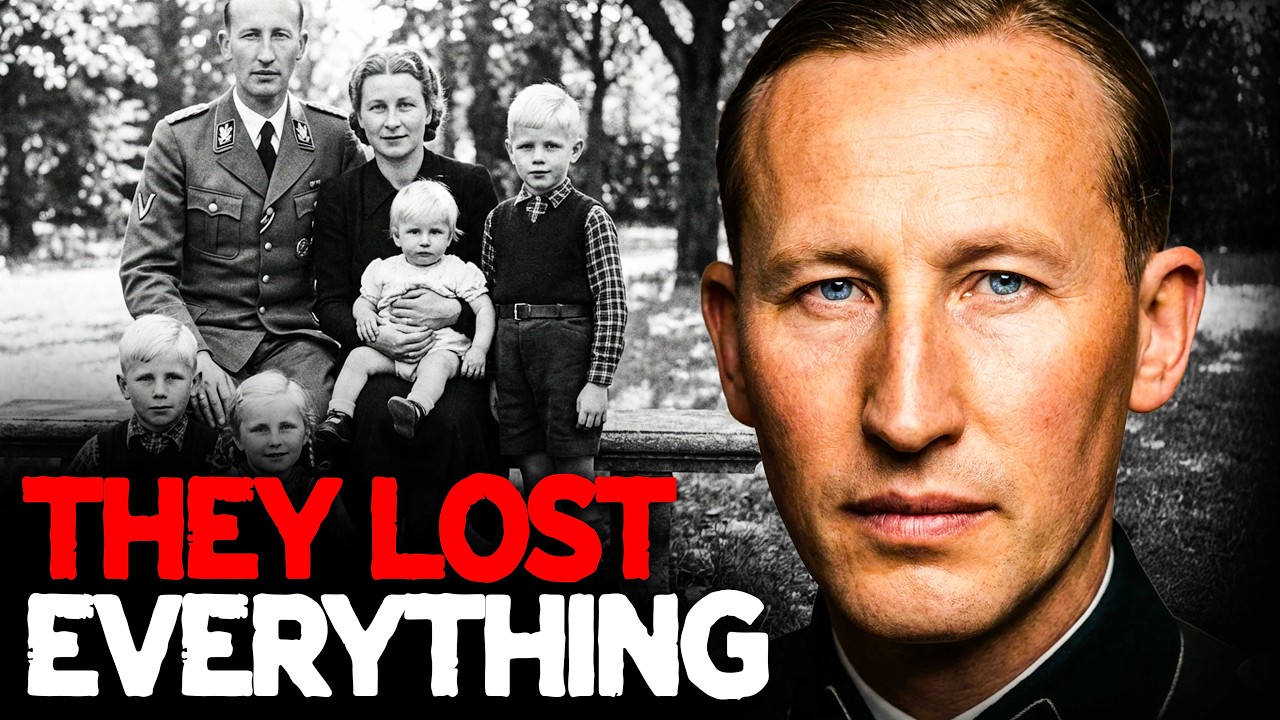
What followed were years of interrogations, denazification hearings, legal battles, and a life lived under a name many wished to forget. For Lina Heydrich, the war was only beginning. She first met Reinhard Heydrich on 6 December 1930 at a rowing club ball in Kiel. She was nineteen, the daughter of a minor German aristocrat who worked as a village schoolteacher on the Baltic island of Fehmarn.
Lina was already a convinced National Socialist, having joined the party in 1929, well before Hitler’s rise to power. Her brother Hans had introduced her to the movement, and a rally addressed by Hitler had swept her into its enthusiasm. When she met the tall, blond naval lieutenant at that ball, she saw a man who matched both her ideology and her ambitions. The connection proved decisive in ways neither could have predicted.
In early 1931, Heydrich faced a naval inquiry after becoming engaged to Lina while still committed to another woman. In April 1931, he was dismissed from the Navy for conduct unbecoming an officer and gentleman. Devastated and drifting at twenty-seven, he saw no clear path forward. Lina saw opportunity.
She persuaded him to pursue a career in the newly formed SS, and her political connections opened the door. When SS chief Heinrich Himmler cancelled an appointment at the last minute, Lina ignored the message, packed Reinhard’s suitcase, and sent him to Munich anyway. An intermediary brought him before Himmler, who asked Heydrich to sketch out his ideas for an SS intelligence service. Impressed, Himmler hired him on the spot as chief of what would become the SD.
Heydrich entered the SS in July 1931, and his ascent through the Nazi hierarchy began. The couple married in December of that year. Over the next decade, Heydrich built an apparatus of surveillance and terror as head of the Reich Security Main Office, the RSHA, formed by combining the SD, the Gestapo, and the criminal police. Hitler called him “the man with the iron heart.
” He was the founding head of the Einsatzgruppen, the mobile killing units that murdered more than two million people by mass shooting and gassing in occupied territories. On 20 January 1942, he chaired the Wannsee Conference, at which fifteen senior officials coordinated what they called the final solution to the Jewish question, the systematic murder of eleven million European Jews. Within the family, Lina remained the public face of the household. Reinhard was often away, and the long absences almost ended the marriage, but the couple reconciled.
Four children were born: Klaus in 1933, Heider in 1934, Silke in 1939, and Marte in July 1942, six weeks after her father’s death. In September 1941, Heydrich received his final major appointment as acting Reich protector of Bohemia and Moravia, the Nazi designation for occupied Czechoslovakia. The family moved into the lower castle at Panenské Břežany, an estate confiscated from a Jewish sugar magnate who had fled to Switzerland. Heydrich ruled through terror and calculation.
He proclaimed martial law upon arrival and executed 142 people within five days. By February 1942, he estimated that between four and five thousand people had been arrested and between four and five hundred executed, while those not killed were sent to concentration camps. Yet he also increased food rations for industrial workers and granted paid holidays, calculating that crushing open resistance while meeting basic needs would raise productivity. At the estate, Lina hosted events for SS families.
According to postwar testimony, approximately thirty Jewish forced laborers worked there, and Lina physically abused them. One witness recalled that she watched them through binoculars from her balcony and ordered brutal punishments, and that when the Heydrich children saw the prisoners, they spat on them. Later, during denazification proceedings, Lina told the tribunal, “I never felt empathy for the Jews, and that was in line with the German folk. ”
The Czechoslovak government-in-exile in London, together with the British Special Operations Executive, had been planning Heydrich’s assassination almost from the moment he arrived in Prague.
The operation was codenamed Anthropoid. Out of two thousand exiled Czechoslovak soldiers based in Britain, two were selected: Warrant Officer Jozef Gabčík, a Slovak, and Staff Sergeant Jan Kubiš, a Czech. They trained at SOE facilities in Scotland and England. On the night of 25 December 1941, a Halifax bomber dropped them near Prague, though navigation errors scattered the paratroopers from their intended landing zones.
They made contact with Czech resistance networks and spent months building a detailed picture of Heydrich’s movements. Local resistance leaders, fearing catastrophic reprisals, begged the government-in-exile to cancel the attack, but Edvard Beneš personally insisted it proceed. On the morning of 27 May 1942, around 10:30, Heydrich began his daily commute from Panenské Břežany to Prague Castle, driven by SS Oberscharführer Johannes Klein in an open-topped Mercedes. He had spurned normal security precautions.
Gabčík and Kubiš waited at a tram stop near Bulovka Hospital at a tight curve where the car would have to slow. As the Mercedes rounded the corner, Gabčík stepped into the road and raised his Sten submachine gun. It jammed. Instead of ordering the driver to accelerate away, Heydrich made a fatal error.
He stood up, drew his pistol, and ordered Klein to halt. As the car braked, Kubiš threw a modified anti-tank grenade. It detonated against the rear wheel, sending shrapnel into Heydrich’s body, along with horsehair from the car’s upholstery. Heydrich leapt out with his pistol, tried to chase Gabčík, then doubled over in pain and collapsed.
He was evacuated to Bulovka Hospital, where surgeons removed his damaged spleen. For several days he appeared to recover, then sepsis set in. On 4 June 1942, he died of his wounds at the age of thirty-eight. The impact on Lina and the children was immediate.
Hitler sent condolences and confirmed the family’s right to remain at the estate. Himmler delivered the address at a lavish state funeral in Berlin on 9 June. But even as the family mourned, reprisals descended on Czechoslovakia. Hitler initially ordered the execution of ten thousand randomly selected Czechs, but an adviser convinced him such indiscriminate killing would cripple the vital Czech arms industry.
Instead came more targeted, though still massive, retaliation. More than thirteen thousand people were arrested. The villages of Lidice and Ležáky were destroyed on false intelligence linking them to the assassins. On 10 June, all male inhabitants of Lidice aged fourteen and above, an estimated 340 men, were shot.
The women and most of the children were deported to concentration camps, and the village was burned to the ground. The assassins were eventually betrayed. On 18 June 1942, German troops surrounded the Orthodox Church of St. Cyril and Methodius in Prague, where seven resistance fighters, including Gabčík and Kubiš, had taken refuge.
A gun battle lasting several hours followed. Kubiš died from wounds sustained in the fight. The remaining four, including Gabčík, held out in the crypt as German soldiers tried to flush them out with gunfire and flooding. When they ran out of ammunition, they took their own lives rather than be captured.
The mass murder operation in the occupied territories that followed was codenamed Operation Reinhard in Heydrich’s honor. In the extermination camps of Bełżec, Sobibór, and Treblinka, approximately 1. 7 million Jews were murdered between 1942 and 1943. The genocide Heydrich had coordinated continued without him.
Tragedy struck the family again on 24 October 1943. Klaus, the eldest son, now ten, rode out through the open gates of the estate onto the road and was struck by a small truck. He died later that afternoon. Lina described the loss for the rest of her life as the most devastating blow she had ever suffered.
The final months of the war brought rapid upheaval. By April 1945, Soviet forces were approaching Prague, and Lina fled west toward Bavaria with her three surviving children, joining thousands of Germans streaming away from the Red Army. At war’s end, she entrusted her two eldest surviving children, Heider and Silke, to near strangers, who returned them safely to Fehmarn. Lina herself took the youngest, Marte, and reached Fehmarn in a makeshift caravan by the end of 1945.
They settled temporarily in Bavaria, in circumstances far removed from their former status. They survived on small stipends, extended family support, and temporary housing arranged by local authorities. Denazification shaped Lina’s postwar existence. From 1946 onward, she faced a series of hearings in Bavaria.
Investigators noted that she had joined the Nazi party in 1929, well before Hitler’s rise to power, and emphasized her close involvement in elite SS social circles. She rejected this interpretation, portraying herself as a politically passive wife who knew nothing of her husband’s crimes. By 1949 she was classified as a follower, the second-lowest category, and ordered to pay 75 Deutschmarks in three installments. The fine was almost laughably light given her husband’s central role in the Holocaust.
Czechoslovakia, however, convicted her in absentia. A Czech court found her guilty of mistreating Jewish forced laborers at the estate, feeding them table scraps, and ordering household staff to beat them with whips and clubs. She was sentenced to life imprisonment but evaded it by remaining in West Germany, which did not extradite her. Unable to claim her husband’s estate and lacking any formal occupation, Lina sought recognition as the widow of a German officer, which would entitle her to a pension.
Her case hinged on a technical question: whether Reinhard Heydrich, despite his SS rank, still counted as a member of the military at the time of death. In 1954, a Munich court ruled that he did, granting Lina a widow’s pension. The decision sparked public criticism, but through further cases in 1956 and 1959, she secured a substantial pension because her husband was technically a German police general killed in action. By the early 1950s, Lina had completed denazification and was legally free to work and receive state support.
The family settled permanently on Fehmarn, where she opened a guesthouse called Pension Imbrüglia, which became both her livelihood and a hub for her social circle. She later converted Reinhard’s former summer house on the island into a restaurant, run with her second husband until it burned down in February 1969. She continued operating a boarding house. Throughout her life she maintained ties with families connected to the SS elite and often presented herself as a victim of the postwar climate.
In interviews, she emphasized the hardships she faced while downplaying the consequences of the regime her husband had served. In 1965, Lina remarried, wedding Finnish poet and painter Manno Manninen, primarily to change her surname. The union lasted until his death in 1969. In 1976 she published her memoir, Life with a War Criminal, a provocative title for a book that historians immediately criticized as a selective account that shifted blame away from her husband, questioned established evidence, and emphasized his private qualities as a father and musician rather than his role in organizing genocide.
Public interest in her resurfaced in the 1970s and 1980s when journalists traveled to Fehmarn to interview her. Observers noted that she defended Heydrich firmly and showed no willingness to reinterpret the past. Each of the children followed a different path under the weight of their surname. Klaus died in 1943.
Heider, born in 1934, became an engineer and spent decades avoiding public attention. In 2009 he gave a rare interview, adopting a defensive stance toward his father. In 2011 he offered to support the restoration of the former family estate, which drew strong reactions in the Czech Republic. Silke, born in 1939, kept her postwar life largely undocumented.
Marte, born six weeks after her father’s death and who never knew him, lives on Fehmarn under the surname Bayer and runs a small clothing shop. She once noted that people cannot imagine what it is like to have such a father, and that his name follows her day and night. There was, however, one striking moral contrast within the family. Reinhard’s younger brother Heinz, a fervent SS officer, was given a packet of his brother’s personal files before the state funeral in 1942.
He sat up all night burning the documents, and afterward his wife remembered that he seemed like stone. From the files, Heinz likely understood for the first time the full enormity of the final solution that his brother had coordinated. The revelation transformed him. Thereafter he used his position as editor of a soldiers’ newspaper to forge identity documents for Jewish families, helping them escape Nazi-occupied Europe.
In November 1944, an economic commission investigated his editorial staff. Heinz believed he had been discovered and shot himself to protect his family, though the attorney investigating was only looking into paper shortages. Heinz’s son Peter later wrote books confronting the family legacy and publicly stated that he found it unfortunate that Reinhard’s children never distanced themselves from their father. Lina Heydrich died on 14 August 1985 at the age of seventy-four, and is buried on Fehmarn.
Her death closed a chapter that spanned the rise of the Third Reich, its collapse, and four decades of postwar Germany. The pension she received, the lenient denazification verdict, and her unrepentant memoir all raised difficult questions about how West Germany handled the families of perpetrators after 1945. Her story is not just about one man’s crimes, but about what comes after: the long aftermath of atrocity, the slow erosion of denial, and the weight history places on those who did not choose it but cannot escape it.