In May 1945, a wounded man lay dying in a hospital bed at Gusen, one of the subcamps of Mauthausen. The people standing over him were not doctors. They were former prisoners of the camp he had commanded for six years. The man was Franz Ziereis, commandant of Mauthausen, and through the night he talked without stopping, aware that he was not going to survive until morning and had nothing left to protect.
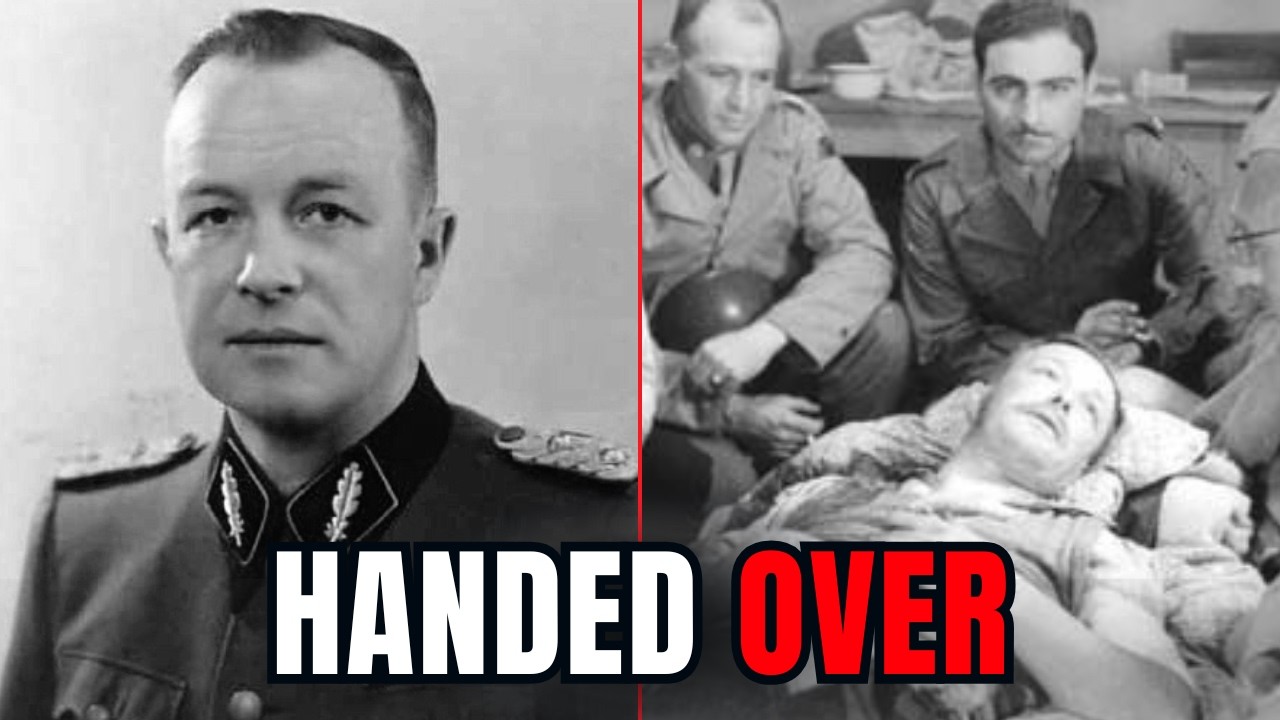
Nearby sat Colonel Richard Seibel, the American officer whose 11th Armored Division now controlled the camp. He watched the interrogation unfold and chose not to intervene. What he did afterward, and more importantly what he refused to do, would complicate the entire story of what was said that night. Mauthausen had been one of the most brutal camps in the Nazi system.
It was built around a granite quarry in the Austrian hills, and its cruelty was built on exhaustion rather than industrial mass gassing, at least at first. The SS classified it internally as the harshest camp in the entire system, reserved for prisoners considered the most dangerous and the most disposable. The centerpiece of that cruelty was a staircase of 186 stone steps carved into the quarry wall. Prisoners hauled blocks of granite strapped to their backs, climbing again and again until their legs gave out.
Survivors called it the stairs of death. Guards reportedly bet on how long a man could last before collapsing. Some prisoners, driven past endurance, threw themselves off the quarry edge rather than climb one more time. Ziereis was not a distant administrator.
He walked the quarry grounds personally and was documented as having taken part in executions himself. Under his command, tens of thousands of people died at Mauthausen, shot, gassed, starved, or worked into the ground on that staircase. He was born in 1905. He worked as a department store apprentice and messenger boy as a teenager, studied commerce in the evenings, then spent more than a decade as a German army soldier, rising to sergeant before his discharge in 1936.
That same year he joined the SS. Within a year he commanded a Totenkopf unit, the death’s head formations that staffed the concentration camp system. By February 1939, at just 33, he was appointed commandant of Mauthausen, a position he held for the rest of the camp’s existence. In the spring of 1945, with the war collapsing, Ziereis ran.
On May 3 he slipped away from the camp with his wife and three children and headed for a hunting lodge in the mountains near Spittal an der Drau. He stayed hidden for almost three weeks, waiting for chaos to settle into something he could vanish into. It almost worked. It did not work because of who came looking for him.
In the final weeks of May, an American patrol tracked him down. Walking with the soldiers were former prisoners of Mauthausen, men who knew the commandant’s face and had been waiting a long time for this moment. The official account says Ziereis was shot while attempting to escape. That phrase appears again and again across the collapse of the Third Reich, and it can mean exactly what it says, or it can mean something considerably less official happened.
Whatever happened, Ziereis did not die on the spot. He was carried to a hospital at Gusen. For six to eight hours through the night, as he lay dying, Ziereis was interrogated. Not by a military prosecutor, not with a court stenographer.
He was questioned by Hans Maršálek, a former Mauthausen prisoner who had survived the camp Ziereis commanded, alongside Colonel Seibel, a Polish survivor, and a doctor who had also once been a prisoner there. Ziereis talked. According to Maršálek, he confessed freely, knowing he would not survive the night. The account that emerged described the systematic killing of Jewish prisoners, executions carried out on his own orders, a mobile gas van alongside the fixed gas chamber, forced death marches in the final weeks, a brothel operated inside the camp using female prisoners, the tattooing and marking system used to track inmates, and among the darkest claims attributed to him, the use of human skin taken from murdered prisoners to bind books and make leather goods for SS officers.
That last claim requires caution. It is attributed directly to a dying man in a documented interrogation, but similar allegations at other camps were later found to be exaggerated or impossible to verify with physical evidence. Most of the rest of what he described, however, lines up closely with what investigators and survivors independently confirmed about how Mauthausen operated. Ziereis died on the evening of May 24, 1945.
Maršálek’s account was handed to Colonel Seibel and later cited in war crimes proceedings. Then comes the detail most retellings skip past. Colonel Seibel, the American officer physically in the room who watched the entire interrogation from start to finish, later refused to sign the written confession Maršálek produced. Ten months later, from memory, Maršálek reconstructed what he recalled Ziereis saying.
That reconstructed document, not a signed contemporaneous transcript taken in the room, is what circulated as the confession. Seibel would not put his name to it. He also declined to testify about it at Nuremberg. There is even a competing account from others who claimed to be present that night, insisting Ziereis never regained full consciousness and never gave any coherent statement at all.
In March 1946, the United States opened the main Mauthausen trial at Dachau. Sixty-one defendants, camp officials and guards, stood before an American military tribunal. Fifty-eight were sentenced to death. Woven into the case against several of those men was testimony traced back to what Ziereis reportedly said in that hospital bed.
That included identification of Dr. Eduard Krebsbach, one of the camp’s physicians, as the man responsible for operating the gas chamber, and the naming of Viktor Wąsik as the person who handled and distributed the Zyklon B used inside it. Krebsbach’s fate closes the loop. Prisoners at Mauthausen had nicknamed him Dr.
Spritzbach, roughly Dr. Injection, because he killed sick and disabled prisoners with lethal injections directly to the heart and oversaw construction of a gas chamber built into the basement of the camp hospital, a facility under his own medical authority that murdered hundreds of people. He was sentenced to death at the same 1946 Dachau tribunal. On May 28, 1947, almost exactly two years to the week after Ziereis died, Krebsbach was hanged at Landsberg prison.
In any functioning legal system, nearly everything about that hospital room would disqualify what came out of it as evidence. The interrogators were direct victims of the man they were questioning. The subject was dying in pain. There was no defense counsel, no judge, no due process.
And the one American officer in the room made the deliberate choice not to attach his name to any of it. Yet the substance of what was said still traveled forward and shaped verdicts. The Americans who tracked Ziereis down through three weeks of Alpine terrain did something that mattered. They found a man who believed he might vanish into post-war chaos the way so many others did, with a new name and forged papers.
They made sure he never got that chance. The unresolved testimony, born out of unsupervised vengeance, extracted from a dying man by his own victims in a room with no judge and no rules, still helped convict other men in a real trial a year later. Historians still disagree about where the weight of that evidence sits. A piece of evidence nobody in an American uniform would formally vouch for still shaped real verdicts and real executions.
Whatever Ziereis’s silence was protecting, the words that came out of that room reached across a year and into a courtroom and helped send other men to the gallows.