On the evening of February 10, 1983, Ken Eto sat in a parked car on Chicago’s northwest side while two men he had known for years pressed a pistol to the back of his head and fired three times. The shooters were certain the job was done. It was not. Their rounds had been handloaded and packed too lightly, and the bullets only grazed his skull.
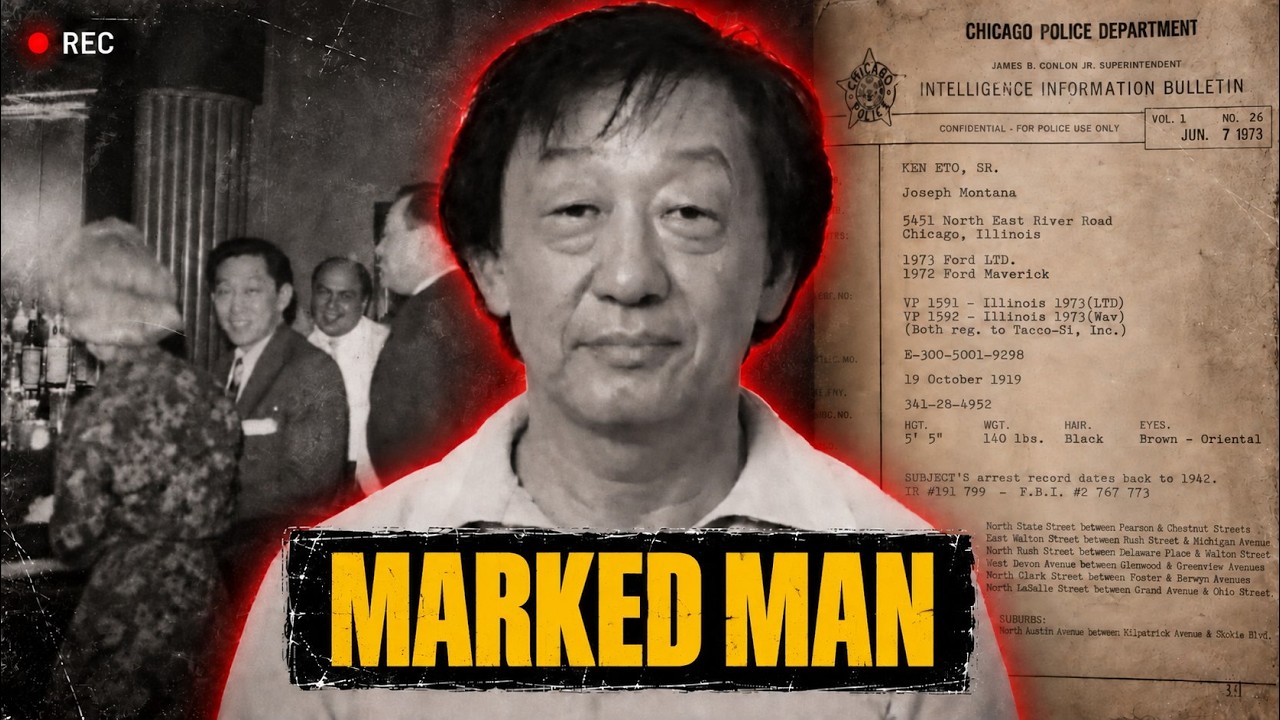
What Eto did next was what the Chicago Outfit should have feared all along. The file on Ken Eto opens far from that parked car. He was born in Stockton, California, in 1919, the son of a Christian preacher. For the first twenty years of his life, nothing pointed toward organized crime.
Then war came. In 1942, the federal government sent his family to the Minidoka War Relocation Center in Idaho, one more Japanese American household swept behind barbed wire on the strength of ancestry and nothing else. The same government that locked him up in 1942 would be the one he handed the Outfit to in 1983, and neither side of that bargain was comfortable. Inside the camp, Eto learned to run card games, and he was good at it.
A preacher’s son who might have led an ordinary life instead learned that a game with fixed odds pays the house every single time. He carried that lesson out of the war and straight to a city ready to pay for it. He arrived in Chicago in 1947. By 1949, he had taken over a numbers racket called bolita for the Outfit, a Latin American–style lottery run through the city’s Puerto Rican, Black, and Chinese neighborhoods.
A player picked a number, paid a few coins, and waited on a drawing. The house kept the gap between what came in and what went out. Run once, it was pocket change. Run across an entire side of the city every day for years, it became a fortune skimmed a nickel at a time.
The FBI later estimated the game cleared around $50,000 a day, most of it drawn from working people in neighborhoods that the rest of the city preferred not to think about. That work made Eto valuable. The Outfit never had a steadier earner in that lane. He never fired a shot or ran a street corner.
He turned a nickel-and-dime lottery into a machine that paid the organization every single day. Gambling was the quiet engine beneath everything the Chicago Outfit ran. The organization lived on steady, boring daily cash from street lotteries, sports books, and juice loans far more than on headlines. A capo could order a killing and make the papers for a week, but a man like Eto brought in money that never stopped, week after week, decade after decade.
That money paid the lawyers, the bondsmen, and the officers who kept the rest of the business running. Eto was an outsider by every measure the Outfit usually cared about: not Italian, not from the old neighborhood, a Japanese American who had come up through a wartime camp. He held his seat anyway because the money he generated was impossible to argue with. The organization misjudged that seat for years, treating its quietest earner as its safest man.
The plain truth was that a man who knew exactly where all the money went became the most dangerous person alive the day his loyalty slipped. By the early 1980s, Eto’s operation was doing as much as $200,000 a week in total business, and he was paying roughly $3,000 a week to corrupt Chicago police officers to keep it turning. That second number mattered because it bought a standing weekly payroll. Eto was the man signing for it.
He worked under two North Side bosses across those decades: first Joseph DeVaro, the crew boss called Little Caesar, then Vincent Solano, who ran the North Side while serving as president of a laborers union local, a legitimate title stretched over an illegitimate business. Somewhere in those years, Eto became the highest-ranking Asian American figure the Chicago Outfit ever had, an anomaly in an organization built on blood and neighborhood. A man who ran the money for that long knew the money: which officers, which envelopes, which backrooms, which names sat above his own and how they got there. So long as Eto stayed loyal, that knowledge was an asset.
The moment anyone doubted him, the same knowledge became the single most dangerous thing in Chicago. In February 1983, the fault line opened. Eto pleaded guilty to a federal gambling charge and faced sentencing. To a capo like Solano, a conviction worked as a countdown.
A man staring down prison was a man who might trade what he knew for a lighter sentence, and what Eto knew could bury a generation of the North Side crew, the cops included. Solano decided Eto had to go. One detail showed how seriously the crew took the threat: this was a full execution planned in advance, with a two-man team assigned and their own ammunition prepared by hand. You only prepared your own rounds like that when you meant to kill a man and leave nothing behind.
Eto seems to have known it was coming. Before the dinner he had been invited to that night, he took a bath and put on his best suit. He told his wife, Mary Lou, to collect the family’s pawn slips within the week, and he showed her where the life insurance policy was kept. Those were the acts of a man settling his affairs.
On the 10th of February, he drove to a quiet spot near the Montclair Theater with the two men sent to kill him, John Gatuso and Jasper Campis, faces he had known for years. When the car was parked, Gatuso pulled a . 22 and fired three times into the back of Eto’s head. The bullets did not go through.
The hit team, trying to leave nothing a lab could trace, had handloaded its own cartridges with too little powder. The rounds carried just enough force to split the scalp and skid off bone. The Outfit’s caution, the exact precaution meant to keep the shooters clean, is what kept Eto breathing. They were so careful about not getting caught that they forgot the only part of the job that mattered: making sure the man was dead before they walked away.
Eto did the one smart thing left to him. He slumped over and played dead until the gunmen walked off satisfied. Then, bleeding from three head wounds, he pushed out of the car and crawled into a drugstore on Grand Avenue, where he reached the pharmacist, Morris Robinson, and managed five words: “I’ve been shot. Call me an ambulance.
”
That moment ended the Chicago Outfit’s grip on Eto for the next seventeen years. While he lay in a hospital bed under a false name, a decision formed that his bosses had never planned for. Surviving your own execution changes the arithmetic of loyalty. For thirty years Eto had kept the code, absorbed the losses, paid the cops, and asked no questions.
The men he served answered that by putting three rounds in his skull and leaving him in a parked car. When the FBI arrived at his bedside with an offer, the calculation was no longer hard. His loyalty was finished in that hospital room. Eto set one condition, strange for a man in his position.
He would talk, but only to a single agent: Elaine Smith of the Chicago Organized Crime Squad. Smith got the call about the shooting while on a ski trip in Colorado. When she returned, she became the one person a lifelong racketeer was willing to trust inside a system that had spent his whole life trying to jail him. She later said she was struck by his quiet charisma and odd gentleness, and that she made him a project.
For years she crossed the country at his side while he testified, and she eventually wrote a book about their working relationship. Eto’s defection landed as hard as it did because the Chicago Outfit built its reputation on the idea that its people did not talk. Eto was no soldier or hanger-on but a boss-level earner with decades inside. When a man at that level walked into the FBI and started naming names, it told every other member that the code was never a law, just a story the outfit told itself.
What Eto handed them grew into one of the widest crackdowns on the Chicago Outfit in decades, an FBI effort called Operation Sunup. He could lay out the structure, the payoffs, and the people who took them from memory in an order a prosecutor could use. Over roughly seventeen years, his information helped convict fifteen Outfit members and associates. Cooperation on that scale was years of grinding work.
Eto sat through debrief after debrief, matching names to payments and payments to dates, knowing the Outfit had already shown what it did to a man it decided was a liability. He lived the rest of it looking over his shoulder, because a marked man does not stop being marked just because the first attempt missed. What held the arrangement together was the one agent he chose to trust and the fact that she kept showing up. The convictions did not come all at once.
Eto testified around the country, case after case, while defense teams worked to tear apart the credibility of a man who admitted to running an illegal lottery. He was not a clean witness, and he never pretended to be. What made him work on the stand was that he had been in the rooms and handled the cash. Juries convicted because the details held up under cross-examination.
The fifteen names stacked up slowly across those seventeen years. The hardest part of the case was who some of the defendants turned out to be. Once the man who signed for the $3,000 weekly police payroll started talking, the officers on the take became codefendants. One of the two men who shot him, John Gatuso, carried a badge himself as a Cook County sheriff’s deputy, holding a place in the crew and a place in law enforcement at the same time.
Eto eventually gave the whole account to the President’s Commission on Organized Crime, testifying with a hood pulled over his face, the highest-ranking Outfit figure ever to sit on the government’s side of the table. The men who failed were arrested for the shooting and released on bond, Gatuso and Campis each posting ten percent of a $500,000 bail. For five months they lived free while waiting on trial. The FBI kept them under surveillance the entire time, right up until the watch was lifted exactly one day before the two men failed to come home.
On July 14, 1983, both bodies turned up wrapped in plastic in the trunk of Campis’s silver-blue Volvo, left on a road near Naperville. The county coroner ruled multiple stab wounds. Frank Coconate, a Chicago mob watcher, put the logic into four words still quoted by the coverage: “You mess up, you die. ” An FBI spokesman said there was absolutely no question the hit was done by the crime syndicate.
To this day, the double murder sits officially unsolved. The file never closes on the one name at the top. Vincent Solano, the capo who allegedly ordered it all, was never charged for the attempted hit on Eto. He was not charged when Eto survived, not charged when Eto testified for seventeen years, and not charged when fifteen other men went to prison on Eto’s word.
Solano died of natural causes at his home in Lyle, Illinois, on November 16, 1992, a free man who kept the president’s chair at his union local to the end. The government got its convictions and its crooked cops, but the man whose single order started the whole thing was never made to answer for a day of it. Witness protection turned Ken Eto into Joe Tanaka, a name built to erase the old one for good. He moved more than once and ended up in the South.
He kept in touch with Elaine Smith long after the last trial, one of the few threads still connecting Joe Tanaka to the man he used to be. The Outfit never found him. For all its reach into police departments and courtrooms, the organization that ran half of Chicago’s rackets could not locate one aging gambler living quietly under a made-up name. By the time Joe Tanaka died on January 23, 2004, at eighty-four, almost no one around him knew the life he had outrun.
His obituary described him simply as a restaurant owner. The highest-ranking Asian American the Chicago Outfit ever produced, the witness whose word put fifteen of its men in prison, went into the ground under a name the mob never learned, having outlived the boss who ordered his death by more than a decade. Back in that parked car, two men put a pistol to the back of Ken Eto’s head and walked away certain the job was finished. They had misjudged both the job and the man.
The rounds they loaded too light did not just fail to kill him. They handed the federal government the best witness it would ever have against the Chicago Outfit.