On the afternoon of July 14, 1882, searchers found the body of John Peters Ringo under a scrub oak tree in Arizona’s West Turquoise Mountain country. He had a bullet wound in his right temple, his horse was gone, and a strip torn from his undershirt had been wrapped around his right foot, for reasons no one has ever satisfactorily explained. He was thirty-two years old. The coroner ruled it a suicide.
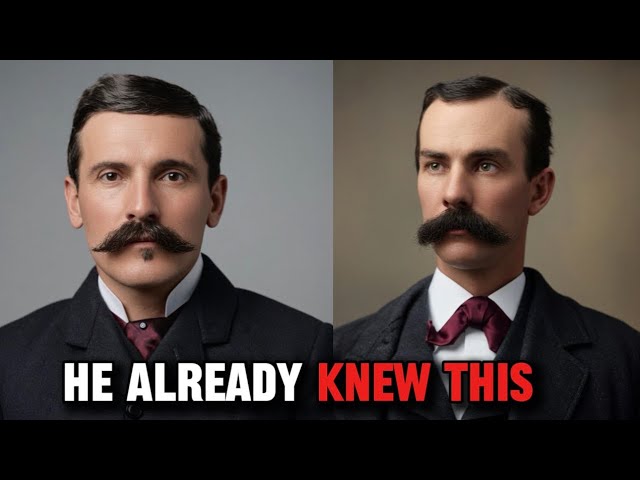
But the cartridge casing found near the body did not match the caliber of Ringo’s own revolver, and several frontier lawmen noted that a man who shot himself in the head would not likely have died with the weapon still cocked. The death was never definitively solved. And near the top of the short list of men who had both the motive and the ability to end him stood the name of a Georgia-born dentist who was already dying of tuberculosis and had long since concluded that a bullet was unlikely to be worse than the disease that was already killing him: John Henry Holliday, known to the frontier as Doc. The relationship between Doc Holliday and Johnny Ringo is one of the most compelling pairings the American frontier produced, not because it was violent, though it was, but because of what the two men represented side by side.
They were not simple outlaws born of poverty or ignorance. Both had been educated, given every reasonable starting point mid-nineteenth-century America could offer a young man, and yet each had arrived by a different route at the same destination, a territory where the law was a suggestion, a gun was an argument, and tomorrow was not something to bank on. Ringo understood Holliday in a way almost no one else in the West did, because Ringo was looking at a version of himself, a version that had chosen different loyalties and arrived at a different kind of doom. John Henry Holliday was born in Griffin, Georgia, in August 1851, into a family the Antebellum South considered respectable.
His father was a pharmacist and a veteran; his mother, a woman of some education, died of tuberculosis when John was fifteen, a death that would haunt him in the most literal biological sense. He studied Latin, and in 1870 enrolled in the Pennsylvania College of Dental Surgery in Philadelphia. He graduated in 1872, twenty years old, with a legitimate professional degree and every reasonable expectation of a settled life. Then came the diagnosis, tuberculosis, the same disease that had taken his mother.
In the medical understanding of the 1870s, the dry air of the Western territories was the most effective available treatment, not a cure, but a possible prolongation. Holliday moved west. He opened dental practices in Dallas, Dodge City, and other frontier towns, where the profession of extracting teeth increasingly competed with the profession of extracting money from men who played cards. The dental work declined.
The gambling advanced. The tuberculosis progressed regardless. The diagnosis shaped his psychology, and his observable behavior tells a coherent story. A man told in his early twenties that he is dying by a slow and unpleasant disease can rail against it, deny it, accept it quietly, or decide that if the outcome is already determined, the manner of getting there is the only variable left.
Holliday appears to have chosen something in the vicinity of the last option. He drank heavily, which accelerated the disease. He gambled compulsively. He picked fights with men who were armed, which seemed unwise except that for a man already dying, the risk calculation looked different than it did for others.
A bullet was in some respects a faster exit than what he already had waiting. By every reliable account, he was genuinely dangerous with a gun, not in the theatrical manner of frontier mythology, but in the practical way of a man who had decided that speed and accuracy were worth developing because they were likely to be necessary. He was not large. He was frequently ill.
He often arrived at confrontations weakened by coughing. It mattered little, because what he brought was something most opponents lacked: a mind accustomed to operating precisely under pressure, and a relationship with his own mortality that removed the fear most men carried into a gunfight. John Peters Ringo arrived at a similar place through a different map. He was born in Indiana in 1850, moved with his family to California, and carried with him an education that stood out sharply against the background of frontier outlawry.
Contemporary accounts describe him as a man who read widely, who could hold a conversation in Latin when the mood struck him, and who presented himself with a bearing considerably more refined than the company he kept. How such a man ended up riding with the Cochise County Cowboys, the loose outlaw confederacy that formed the primary organized criminal presence in Southern Arizona in the early 1880s, is answered by his biography. Violence, flight, reinvention, and then more violence had become his pattern. By the time Ringo arrived in Tombstone’s orbit, he had a reputation that preceded him and a drinking problem that had moved well past the social into the structural.
Men who knew him left accounts consistent in a specific detail: Ringo was intelligent enough to be aware of what he had become, and that awareness appeared to make him worse rather than better. There is a particular kind of self-destruction that runs on clarity rather than confusion, a man who can see exactly where he is headed and proceeds anyway because stopping requires an energy or reason that is no longer there. Ringo appears to have been that kind of man. In the existing historical record, the direct encounters between Ringo and Holliday are sparse and contested.
The famous street confrontation described in later accounts may be embellished, entirely fabricated, or an accurate account surviving in distorted form. What is historically established is that the two men moved in the same physical geography during the same years, that they were aligned with opposing factions in the conflict that became known as the Cochise County War, and that their mutual regard appears to have been genuine, expressed through a kind of careful armed respect that acknowledged the other as someone not to be taken lightly. That conflict was not fundamentally a story about good men and bad men, though that is how it tends to be told. It was a story about competing economic and political interests in a territory where the institutions that normally mediate such conflicts were absent, corrupt, or contested.
The Earp faction, which Holliday attached himself to through his friendship with Wyatt, represented one set of interests. The Cowboys, which included Ringo among their more notable members, represented another. The violence that erupted between them, the gunfight near the OK Corral in October 1881, and the killings that followed through the winter and spring of 1882, was the product of those interests colliding in a place where collisions were settled with guns rather than lawyers. Holliday’s role at the OK Corral has been analyzed from every available angle for over a century.
What happened in about thirty seconds of gunfire on the afternoon of October 26, 1881, is still disputed in its specifics: where everyone stood, who fired first, whether some of the Cowboys were attempting to surrender. What is not disputed is that Holliday was there, sick enough that morning that witnesses later said they were surprised he could stand, and that he performed under that pressure with exactly the controlled efficiency his reputation suggested he would. Three members of the Cowboy faction were dead when the smoke cleared. Ike Clanton, who had been loudest about what was going to happen to the Earps, fled without firing a shot.
Several members of the Earp-Holliday party were wounded. Ringo was not present that day, but the killing did not stop there. Through the winter of 1881 to 1882, both men were drawn further into the conflict. Morgan Earp was murdered at a billiard table in March 1882.
Virgil Earp, already crippled from an earlier assassination attempt, was no longer an effective force. Wyatt, with Holliday and a small group of others, launched what became known as the Vendetta Ride, a deliberate, systematic search for the men responsible for Morgan’s death. The ride ended with several suspected conspirators dead and the Earp party leaving Arizona territory under circumstances that made return inadvisable. Ringo, who had not been among the men Wyatt killed, remained.
He did not remain long. Four months after the Vendetta Ride ended, Ringo was found under that scrub oak with a bullet in his head and no explanation that satisfied anyone. The suicide ruling was the path of least resistance for an Arizona inquest that had neither the means nor the particular motivation to investigate more aggressively. Holliday in subsequent years is reported to have made statements suggesting he knew more about Ringo’s death than a man who was not there would know.
Those statements are not documented in any form that would satisfy a court, and they may have been the product of a man who understood the value of a reputation. Or they may have been the truth. What matters about Ringo’s death is not the mechanism but the trajectory. He was thirty-two years old, found alone in rough country with no apparent purpose for being there.
The strip of undershirt around his foot suggests disorientation or injury or something else nobody has ever explained. He had been drinking heavily in the days before his death, heavily enough that those who encountered him in his final week described a man not fully tracking the world around him. The man who quoted Latin in frontier saloons and whose intelligence contemporaries noted as unusual for his circumstances arrived by whatever route at a solitary end with no witness, no explanation, and a wound the available evidence did not cleanly assign to his own hand. Holliday died five years later in a bed in Glenwood Springs, Colorado.
The tuberculosis finally completed what it had been working on since his twenties. He died in the morning, looked at his bare feet, and said, according to the account that has come down through those who were with him, that this was funny. What was funny, those present understood, was that he had always expected to die in a gunfight. He had spent fifteen years constructing a life around the premise that a bullet was coming for him before the disease could finish its work.
The disease finished its work. He was thirty-six years old. The comparison between these two men reveals something about the frontier that conventional mythology obscures. The West of popular imagination is populated by a fairly limited cast: the lawman, the outlaw, the farmer, the gambler, the hired gun.
Holliday and Ringo represent a category that does not fit cleanly into any of those: the educated man who ended up on the frontier not because he was pushed there by poverty or ignorance, but because something in his life had removed the conventional reasons to pursue the conventional path. For Holliday, it was the tuberculosis. For Ringo, the evidence suggests it was something less clinical and more psychological, a decision or a drift away from the life his education had prepared him for, toward something that offered intensity at the cost of duration. Both men were brilliant in the specific ways the frontier rewarded: fast, calm under pressure, capable of reading a room, understanding exactly where the danger was positioned.
Both were destroyed by the specific ways the frontier punished: the drinking, the violence, the absence of the ordinary social structures that give most lives their shape and their reason for continuing. The difference between them was not intelligence or capability. It was attachment. Holliday had Wyatt Earp, a friendship so unlikely and so durable that historians have spent decades trying to explain it.
That friendship gave Holliday something to be loyal to outside himself, and loyalty is one of the things that keeps a man going when the internal reasons have run thin. Ringo had the Cowboys, which was not the same thing. The Cowboys were a loose affiliation of men with overlapping criminal interests, not a community in any meaningful sense. There was no one in the organization whose regard for Ringo ran deep enough to constitute a reason.
When the conflict broke down and the factions scattered, Ringo was left with what he had been left with for most of his adult life: himself, his intelligence, his drinking, and the growing awareness that the distance between where he was and where he might have been was not going to close. Ringo warned us about Doc Holliday the way a rough draft warns you about the finished version. Both men were writing the same story, educated, capable, doomed, the frontier burning off whatever future they might have had in more ordinary circumstances. But Holliday wrote his version with a loyalty that gave it shape, a friendship that gave it direction, and a particular sardonic wit that made it, against all reasonable expectation, something worth remembering.
Ringo wrote his version alone, without the attachment that might have changed the ending, and arrived at an oak tree in the Arizona heat with no one to say anything funny at the close. The frontier produced violent men in quantity, used them, and discarded them with an efficiency that mythology tends to romanticize away. What it rarely produced was the combination both Holliday and Ringo represented: the violent man capable of understanding with full clarity exactly who he was and what he was doing. Most men who lived by the gun either never had the intellectual equipment to fully reckon with their situation, or had it and found ways not to look directly at it.
Holliday looked directly at it and kept his sense of humor. Ringo looked at the same thing and kept drinking. One of them died alone under a tree with an unexplainable strip of cloth wrapped around his foot in the dust. The other died in a bed, glanced down at his feet, and found something worth laughing at.
The difference between those two endings is not as large as it looks, but it was everything.