The Mississippi River doesn’t negotiate. It simply moves, carrying millions of cubic feet of water past the bluffs of Mississippi, indifferent to the armies massing on its banks and the dead men who would soon float down its current.
For the first two years of the Civil War, that river was not a boundary. It was a wound. Whoever controlled the final Confederate stretch between Memphis and the Gulf held the structural spine of the American continent: its commerce, its agricultural output, its ability to move armies and ammunition from one half of itself to the other.
In the spring of 1863, one city stood between the Union and that control. Vicksburg, Mississippi. A city of 8,000 souls perched on a 200-foot limestone bluff, its artillery batteries stacked in tiers against the hill, its guns trained on every vessel that dared pass below.
Jefferson Davis called Vicksburg the nail that held the two halves of the Confederacy together. Abraham Lincoln called it the key. Both men were right, and both understood that whoever lost this argument would lose something they could never recover.
By May of 1863, Ulysses Grant had been trying to take that city for six months. He had tried flooding the bayous north of the city to float gunboats through interior waterways. He had tried cutting a canal across a river bend. He had pushed four separate expeditions through the Yazoo Delta, watching each one dissolve under impossible terrain and Confederate resistance.
His critics in Washington were multiplying. Newspaper editors were printing his professional obituary. There were whispers about his drinking, his judgment, his fitness to command. A senator from Ohio, backed by two of Grant’s own subordinates, lobbied Lincoln directly to have him removed.
Lincoln refused. He had looked at the list of his available generals, and Grant was the one who kept moving. “I can’t spare this man,” Lincoln reportedly said. “He fights.”
What Grant was preparing in the late winter of 1863 was unlike anything the war had yet seen in the Western theater. It violated every conventional principle of military logistics that serious officers had spent their careers studying.
It required his army to sever its own supply line, move deep into hostile territory with nothing but what it could carry or steal, and fight its way through the heart of Mississippi before the Confederates could concentrate enough force to stop it.
When he shared the outline with Sherman, his most trusted subordinate, Sherman drafted a memorandum urging him in the strongest possible terms to stop. Grant read it, filed it, and gave the order to move.
The river crossing that made everything else possible happened on the night of April 16th, 1863. Admiral David Porter ran his fleet of gunboats and supply transports south past Vicksburg’s batteries under cover of darkness, hugging the Louisiana shore.
The Confederates anticipated exactly this and were prepared. They lit enormous bonfires on the western bank to illuminate the river, and the batteries opened up at close range. Grant watched from the deck of a vessel nearby. His wife Julia was with him, along with their children. By some accounts, the children mistook the artillery flashes for fireworks.
For two and a half hours, the Mississippi above Vicksburg turned into something between a naval battle and a spectacle. The concussion of the guns shook the riverbanks. Shells hissed into the water. The burning hulks of two Union transports drifted south like slow lanterns.
When Porter’s fleet emerged below the city, 12 of 13 vessels were intact. Grant had his crossing.
He marched his army south through Louisiana on roads that turned to mud and then recovered. He crossed the Mississippi at Bruinsburg on April 30th in the largest American amphibious operation before the Second World War.
He stepped onto Mississippi soil with no supply line behind him and no serious intention of establishing one. His plan was to move fast enough to deny the Confederates the ability to concentrate, live off the surrounding country, defeat Pemberton’s forces in the field before they could retreat to Vicksburg’s fortifications, and take the city from the rear.
The army he was launching into the Mississippi interior carried three days of rations in its haversacks. It would not be resupplied for the next 17 days.
The man waiting on the other side of that equation was Lieutenant General John C. Pemberton. The irony of his situation was the kind the Civil War manufactured with consistent cruelty. He was born in Philadelphia.
He had attended West Point, served in the Mexican War, and built a career in the peacetime army alongside men who were now attacking him. He married a Virginia woman, and when the war began, he chose the Confederacy. It was a decision that cost him his family’s respect in the north and never fully purchased its equivalent in the south.
His soldiers doubted him because of where he was born. His superiors in Richmond doubted him because he was methodical in a war that demanded instinct. The Confederacy had given him an impossible position to defend, and then provided him with a command structure designed to make defending it harder.
His nominal theater commander was General Joseph Johnston, who arrived in Mississippi in mid-May and surveyed the situation with the air of a man who had already decided the case was closed. Johnston told Pemberton to abandon Vicksburg and save the army.
Jefferson Davis, whose plantation sat nine miles south of the city, told Pemberton to hold it at all costs. Between these two irreconcilable orders, Pemberton attempted to satisfy them both simultaneously, which left him unable to execute either with conviction.
Meanwhile, Grant was already moving inland. He struck Confederate forces at Port Gibson on May 1st, 40 miles south of Vicksburg.
The terrain there was not what the soldiers had expected. This was not the open farmland of the upper Mississippi Valley. The ground south of Vicksburg was a chaos of loess ridges, cut apart by ravines so deep and so densely vegetated that they became impassable except along their floors.
Visibility dropped to 20 yards in places. Regiments lost contact with each other in the undergrowth and found themselves firing at the sound of voices. Grant’s army was larger than the Confederate force defending Port Gibson, and it ground through the terrain on that advantage alone.
By nightfall, the road north was open and the Confederate right flank on the Vicksburg approaches had been turned.
The army pressed north and east. At Raymond, on May 12th, a Confederate brigade under Brigadier General John Gregg attacked Grant’s lead division in a hollow below the town. Gregg had badly underestimated what he was facing and committed his men before he understood the numbers.
The resulting collision in the creek bottoms and ravines around Raymond was close and furious. Gregg’s men eventually broke and fell back north, but not before inflicting casualties that told Grant something he already suspected. The Confederate soldiers in Mississippi, whatever their officers’ difficulties, intended to fight.
Raymond placed Grant within striking distance of Jackson, the state capital and the principal rail hub supplying Confederate forces in the state. He turned his army east.
On May 14th, in a cold rain that turned the roads to paste, Sherman and McPherson struck Jackson from two converging directions. Johnston, who was inside the city with a small force, assessed the arithmetic and evacuated north.
Grant’s men spent the rest of that rainy day destroying the infrastructure of the Confederate supply system. They tore up railroad track, burned warehouses full of military stores, and wrecked the telegraph lines that connected Mississippi to the Confederate command structure in the east.
Then Grant turned his army west again. The road to Vicksburg ran through the ridge country of central Mississippi, and somewhere along that road Pemberton was trying to stop him.
The collision came three days later at a place called Champion Hill, and it was the campaign’s fulcrum. Pemberton had positioned his army across the ridge system east of Vicksburg, roughly 22,000 men on ground that should have been defensible.
The terrain favored him. The ridges were steep, the roads between them were few, and a determined defense should have been able to hold Grant long enough for Johnston to organize something coherent. What Pemberton lacked was not ground. What he lacked was a clear understanding of Grant’s intentions.
The battle on May 16th lasted nine hours. Grant attacked with everything he had, pushing his core forward in a rolling pressure that forced Pemberton to commit reserves faster than he could move them.
The critical moment came in the early afternoon when a Union division under Alvin Hovey broke through the Confederate center on Champion Hill’s crest. For a time, the entire Confederate Army was in danger of being cut in half.
Pemberton scraped together a counterattack that briefly retook the hill, but by late afternoon the weight of Grant’s numbers had made the position untenable. The Confederate retreat collapsed into something close to a route in places.
Pemberton lost nearly 4,000 men and the momentum that defensive terrain had given him. He was now falling back toward Vicksburg with Grant pressing close.
The final confrontation before the city happened the next morning at a bridge over the Big Black River. The Confederate rearguard dug in behind a line of rifle pits and a shallow bayou.
What happened next was one of those moments when the difference between a demoralized army and a defeated one becomes visible in real time. A Union brigade under Michael Lawler, a 300-pound Illinois farmer who had been a soldier in two previous wars, saw a gap in the Confederate position and charged before anyone had given him formal authorization to do so.
The Confederate line dissolved in 18 minutes. Union soldiers were across the rifle pits before the defending troops had finished deciding what to do. Pemberton burned the bridge behind his survivors and fell back to Vicksburg.
Grant had Union engineers building a new crossing by the following morning.
On May 18th, the first Union soldiers climbed the ridgelines east of Vicksburg and looked at what they had been marching toward for 18 days. The Confederate works that greeted them were not improvised.
Nine miles of fortifications encircled the city’s landward approaches. A connected system of forts, redoubts, lunettes, and rifle pits with artillery positioned to cover every ravine and hollow that an attacker might use.
The engineers who designed them understood the ground. The soldiers who built them understood what was coming. In any set piece assault on prepared field works, the arithmetic overwhelmingly favored the defenders.
Grant ordered an assault anyway on May 19th. He was half convinced that Pemberton’s men were too broken by the last two weeks to mount serious resistance. He was wrong about that.
The assault was repulsed with rapid efficiency, and Grant lost close to a thousand men proving something he should perhaps have known from Champion Hill. Pemberton’s soldiers might be starving and demoralized, but they could still load a rifle and aim it.
Three days later, on May 22nd, Grant ordered a full-scale coordinated assault along the entire Confederate line. He had his reasons. He had received a communication from General Henry Halleck in Washington suggesting that a portion of his army might need to be redirected to support operations in Louisiana.
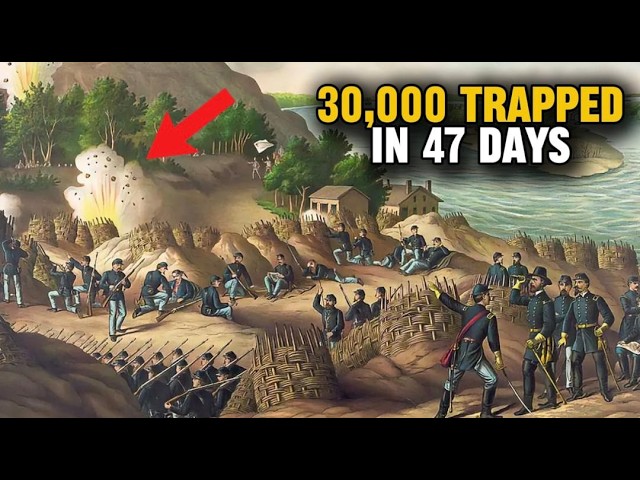
He also believed that a simultaneous attack across nine miles of front would eventually find a soft spot. The assault lasted most of the day.
Individual acts of extraordinary courage produced nothing strategically useful. At the railroad redoubt, men from the 13th Corps reached the exterior slope of the Confederate works and held a corner of the fortification for over two hours.
At the second Texas lunette, a regiment of Iowa volunteers planted their regimental colors in the ditch wall. The men who had planted them were shot, and more men came up to plant them again, and those men were shot too.
The flags remained there through the afternoon as a kind of monument to something that was either extraordinary courage or extraordinary waste, and probably was both. Grant’s casualties on May 22nd exceeded 3,000.
He did not take the city. He settled in instead.
The decision carried a certain grim clarity. Grant’s army was already well supplied after the Navy had opened a line through Grand Gulf. He moved his base to the Yazoo River north of Vicksburg, which gave him a shorter, more reliable supply corridor.
He drew his siege lines, Union entrenchments that mirrored the Confederate works at distances ranging from a few hundred to a few thousand yards, and he waited.
The logic was simple and irresistible. He had 70,000 men, a supply line, and time. Pemberton had 30,000, none of those things, and a clock that was running against him with every meal his soldiers ate.
The siege engineering was not simple work. Union engineers directed the digging of approach trenches in the pattern that centuries of European siege warfare had refined. Parallel trenches running toward the Confederate works, connected by zigzag sap trenches that approached at oblique angles to prevent Confederate guns from firing directly down their length.
Soldiers who had never heard the word gabion learned to fill them with dirt. Men who had grown up on farms learned to push sap rollers, great cylinders of woven wickerwork, ahead of the digging parties to absorb Confederate fire.
The work went on by day and by night, by shifts, in heat that reached the 90s and did not relent. Every morning the Confederate fortifications were a few yards closer than they had been the evening before.
The Confederates pushed back. They dug counter approaches. They mounted night raids on Union work parties. They placed artillery to enfilade the Union approaches and dragged it to new positions when the Union engineers found ways to neutralize its angles.
The low-level violence of the siege produced a daily attrition that accumulated on both sides without changing anything fundamental. Snipers. Mortar rounds dropping into trenches. The occasional sharp skirmish.
In some places the lines were close enough that men could hear each other talking across the parapets. In those places, informal truces developed. Confederate and Union soldiers agreed on intervals during which no one shot at anyone, during which tobacco and newspapers changed hands across ground that was otherwise strictly lethal.
Then the agreed interval ended and they resumed trying to kill each other.
Inside the city, the civilian population had been adapting to siege conditions since before Grant arrived. The Union naval bombardment had been intermittent since March, and by late May a significant portion of Vicksburg’s residents had abandoned their homes for shelters cut into the hillsides.
A network of cave dwellings ranged from simple holes in the earth to elaborate warrens with multiple rooms, carpeted floors, and oil lamps mounted on clay ledges. Women kept house in them. Children played outside them while shells fell in the streets 50 yards away.
A woman named Emma Balfour, whose husband was a physician, recorded in her diary through the siege with a composure that either reflects genuine adaptation or a writer’s discipline she could not abandon even under pressure.
She noted the specific sounds of artillery. Union mortar rounds had a different trajectory and a different voice than the rifled artillery from the gunboats. She noted the social arrangements of cave society, which families had combined households in the larger excavations.
She wrote about the food with increasing frequency as the weeks passed. The gap between the early diary entries and the later ones in terms of what she found worth noting tells the story of the siege more honestly than any official report.
Food became the defining reality. Pemberton had entered Vicksburg with approximately a month’s worth of rations at full allocation, and he had immediately placed the army on reduced rations to extend the timeline.
By mid-June, a Confederate soldier at Vicksburg received roughly four ounces of bacon and a quarter pound of cornbread per day. Then less.
Mule meat entered the diet without ceremony. Rats, genuine city rats, were sold at market stalls at prices that made it clear they were not considered food for the desperate, but food for anyone who could afford them.
Pea bread, made from ground cowpeas, appeared in army rations as a cornmeal substitute and was eaten reluctantly at first and then without comment because the alternative was nothing.
By late June, Confederate surgeons operating in canvas hospitals noted that their patients’ wounds were not healing. The bodies they were working on had consumed their reserves.
The soldiers in the works were losing weight visibly week by week. Men who had entered the siege as healthy young adults came out of it looking like something the countryside had used up.
They could still load and fire from fixed positions propped against the earthwork walls if they needed support. What they could not do by early July was anything that required sustained movement.
The option of breaking out of the encirclement, which had been theoretically available earlier in the siege, had been consumed by the same biological clock that was consuming everything else.
Joseph Johnston’s army of relief gathering northeast of Vicksburg had reached approximately 30,000 men by late July. The theoretical plan, Johnston striking Grant from the rear while Pemberton sorted from the city, had the shape of military sense and none of its substance.
Grant had been reinforced throughout June and now had enough men to maintain the siege and hold a blocking force against Johnston simultaneously. Sherman commanded that blocking force and he had positioned it well.
Johnston looked at Sherman’s position and made the decision that defined him as a general and a man. He would not advance.
His communications to Pemberton during this period were models of strategic evasion. He suggested the possibility of a breakout, hedged the suggestion with conditions, withdrew the conditions when Pemberton pressed for clarity, and finally sent a message asking Pemberton to decide for himself whether a sortie was practicable.
The army that was supposed to save Vicksburg spent July at a careful distance from it, waiting for circumstances that Johnston’s own caution was preventing from developing.
Johnston would defend his decisions for the rest of his life in memoirs and in correspondence. The defense was always technically coherent and always missed the point. 30,000 Confederate soldiers were dying of hunger nine miles west of him, and he had an army, and he did not move it.
The surrender came in stages, like most inevitable things do.
On July 1st, Pemberton called his division and brigade commanders together and asked them directly, could the army break out? The men who answered him had been living in those trenches.
They told him that their soldiers were too weak to sustain a march under fire. They could hold their positions for a time. The earthworks were still intact. The artillery ammunition was mostly present. But they could not make the kind of mobile night attack that a breakout required.
Pemberton heard this from man after man around the room. He thanked them and dismissed them.
On July 3rd, the same afternoon that the survivors of Pickett’s division were walking back across the fields at Gettysburg, Pemberton sent a note through the lines requesting terms.
Grant’s initial reply was what anyone who knew him expected: unconditional and immediate surrender. Then he sat with it for a few hours and revised his position.
The practical problem was logistical. He had roughly 30,000 Confederate prisoners to process, and the Union infrastructure in Mississippi could not move 30,000 men in any reasonable timeline. Men would sit in improvised compounds and die of disease while the administration caught up.
Grant offered parole instead. The Confederate soldiers would be released on their word of honor not to fight until formally exchanged for Union prisoners. He had opposed parole throughout the war on the grounds that Confederate soldiers violated it. He offered it anyway.
The decision was more calculated than it appeared. Paroled soldiers walking home through the South were evidence of what had happened. They moved through towns and farms, thin and empty-handed, and the people who saw them drew their own conclusions that no newspaper could revise.
The symbolic weight of 30,000 men walking away from Vicksburg under parole was precisely the weight that Grant intended.
At 10:00 in the morning on July 4th, 1863, the white flags went up along the Confederate works. Grant rode into Vicksburg on a chestnut horse.
The Confederate soldiers came out of their fortifications and stacked their arms in long rows along the roads. The Union men who had spent 47 days in the opposing trenches watched them emerge in silence.
Not a triumphant silence by the accounts that survived, but something more considered than that. These were men who had held nine miles of earthwork for a month and a half against a superior force while slowly starving. Union soldiers passed food across before the formal ceremonies were complete.
The date was not accidental. Grant had shaped the final negotiations at least partly to produce a surrender on the 4th of July, and the symbolism reverberated immediately.
News arrived in Washington on July 7th, the same day Lincoln was still processing the dimensions of Gettysburg. The combination of those two victories produced a political and psychological impact that no single event could have generated alone.