On November 10, 1985, a hunter walking through the woods near Bear Brook State Park in Allenstown, New Hampshire, found a 55-gallon industrial drum lying among the trees. Inside were the bodies of a woman and a young girl, wrapped in plastic and bound with industrial electrical wire, reduced to skeletons. Police distributed composite sketches across New England. No one recognized them.
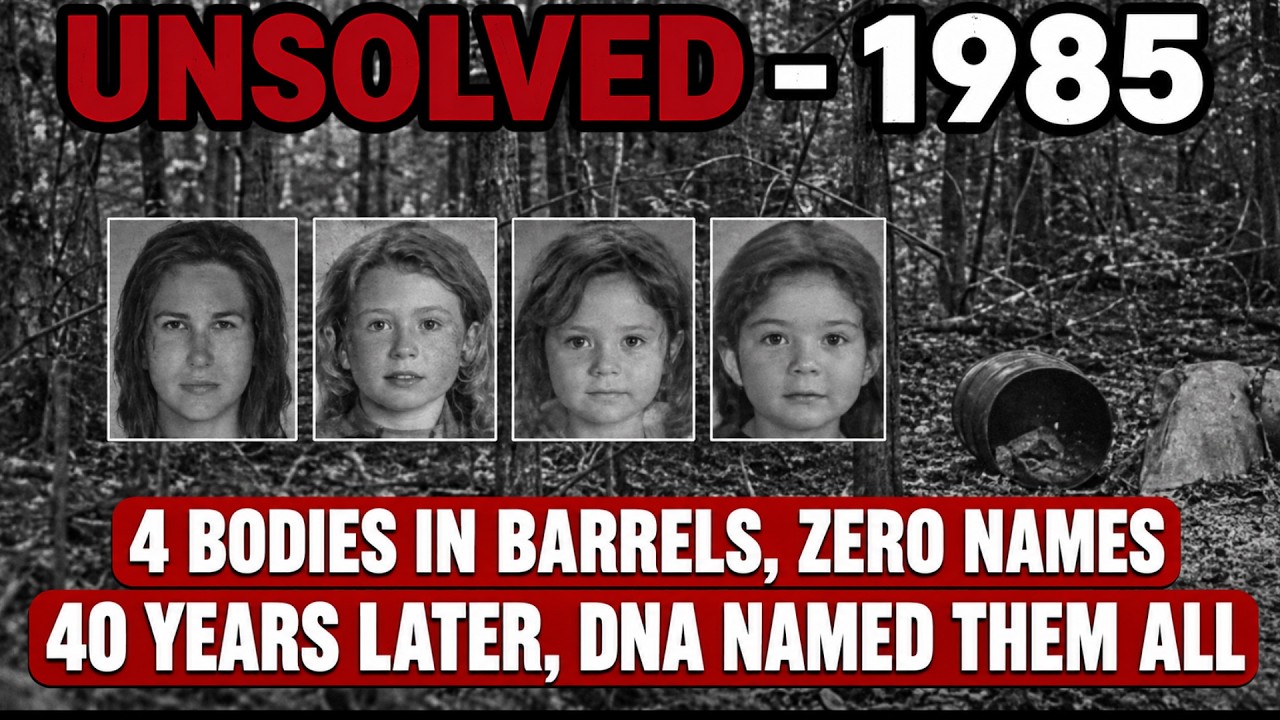
No missing persons reports matched. They were buried in a town cemetery under a marker that read simply: Unknown. Fifteen years later, in 2000, a second drum was found less than 100 meters from the first, containing the bodies of two more young girls, disposed of in the same manner. Four victims.
No names. No suspects. In any other state, this would have triggered a national uproar, but this was before the age of DNA identification, and these four people had not only been killed—they had been stripped of their identities entirely. Their killer was still alive, changing names, and killing others.
No one knew. It would take four decades, forensic technology that did not yet exist, a librarian searching family forums at midnight, a genealogist who built a tree of 25,000 people, and a volunteer organization to restore the names of the four skeletons in the New Hampshire woods. Inside the first drum, investigators found a woman in her early twenties and a girl estimated between five and eleven years old. Both had been killed by blunt force trauma to the head—beaten to death with a heavy object.
The electrical wire came from Carol Cable, a manufacturing facility that once operated in New England. It was one of the few physical leads, and for years, one of the only ones. The bodies had been inside the drum for years, possibly since the late 1970s or early 1980s. No one in Allenstown or any neighboring town had reported a young woman and small child missing during that period.
The case remained frozen until the second drum was discovered in May 2000. The two new victims were toddlers, estimated between one and four years old, killed the same way. Investigators concluded both drums had likely been placed at the same time by the same person. The discovery transformed the case from a mystery into a nightmare—not two victims, but four.
Not one murder, but the pattern of a serial killer. The FBI joined the investigation. DNA was collected and entered into CODIS. Facial reconstructions were updated with newer technology.
America’s Most Wanted aired a segment. No matches. The families of the victims did not know their relatives were dead, so they never submitted reference samples. It was a vicious cycle—to identify the victims, investigators needed family DNA, but to find the family, they first needed to know who the victims were.
While the four unidentified bodies lay in the Allenstown cemetery, the answer was close. In the late 1970s, a man calling himself Bob Evans appeared in Manchester, New Hampshire, the state’s largest city, less than twenty miles from Bear Brook State Park. He was hired as a master electrician at Waumbec Mills, a large textile factory. He was skilled, reliable, and seemed like an ordinary industrial worker.
But Bob Evans was not his real name. Between February and October 1980, Evans was arrested three times—for writing a bad check, stealing electrical service, and illegally diverting electricity—always under the name Robert T. Evans. Manchester police never once checked his identity, never compared fingerprints, never ran a criminal background check.
This was the late 1970s and early 1980s, before digital federal databases and automated identification systems. A man could enter a new city, assume a new name, and start over without anyone asking questions. That man was Terry Peder Rasmussen. Born December 23, 1943, in Denver, Colorado, he grew up in Phoenix, Arizona, dropped out of high school, and enlisted in the Navy at seventeen.
The Navy trained him as an electrician—a skill he used for legitimate work and for his crimes. He served six years, received an honorable discharge in 1967, married in Hawaii in 1968, and had four children with his wife. From the outside, he seemed a normal veteran, a skilled technician, a father. Inside, the story was different.
In 1973 he was arrested in Arizona. In June 1975 he was arrested again for violent assault. That same year, his wife left him, taking the children. In late 1974 or early 1975, Terry Rasmussen disappeared from the lives of everyone who knew him.
No farewell, no new address, no phone call. He simply stopped existing under that name. From that moment, he lived under different names in different cities, building false lives and leaving when things became uncomfortable or dangerous. Bob Evans in New Hampshire, Curtis Mayo Kimball in California, Gordon Jensen elsewhere, Jerry Mockerman when police stopped him in San Luis Obispo, Lawrence William Vanner when he needed a cleaner identity.
Investigators later called him the Chameleon Killer. A criminologist later noted that what set Rasmussen apart was that he targeted people with whom he had emotional relationships. Most serial killers target strangers. Rasmussen targeted girlfriends—women who trusted him enough to live with him, and to bring their children into his home.
He did not stalk victims on the street. He cooked them dinner. Marlyse Elizabeth Honeychurch was born in California, was twenty-four years old, and used several names, including Marlyse McWaters. She had two daughters by different fathers: six-year-old Marie Elizabeth Vaughn and one-year-old Sarah Lynn McWaters.
They were last seen in November 1978. No one filed a missing persons report for years. The family assumed Marlyse had moved away and started a new life elsewhere, perhaps with a new man. Around the same period, Rasmussen met a woman named Pepper Reed, born in 1952 in Houston, Texas.
In 1976, in Orange County, California, she gave birth to a daughter. The birth certificate listed the father as Terry Rasmussen. The child was named Reya Rasmussen. After that, Pepper Reed vanished—no address, no tax records, no driver’s license, no bank accounts.
Authorities later came to believe Rasmussen killed her, though her body was never found. Reya, his biological daughter, ended up inside the second drum in Bear Brook State Park. She was two to four years old when she died—killed by her own father, the same way as the others. Investigators later described this as the most brutal aspect of the case: a father killed his daughter and stuffed her in a barrel with three strangers, then continued his life as if nothing had happened.
Rasmussen did not stop. After the Bear Brook murders, he began a new relationship in Manchester with 23-year-old Denise Beaudin. She had a six-month-old baby. On Thanksgiving 1981, Denise, her infant daughter, and Bob Evans all disappeared from Manchester.
Denise’s family did not file a missing persons report, believing she had left for financial reasons or to start over. Authorities believe Rasmussen killed Denise somewhere in California after they left New Hampshire. Her body was never found. But he did not kill her daughter.
He kept the baby, named her Lisa, and pretended to be her father for years. In June 1986, he abandoned the girl—then about five years old—at a recreational vehicle park in California and fled. She was found alone and placed in foster care, adopted by a new family, growing up not knowing who her mother was. Rasmussen was arrested in March 1989 for child abandonment and served one year.
He violated his parole the day after release and disappeared for eight years. In 2002, under the name Lawrence William Vanner, he was living in Richmond, California, with a Korean-American woman named Eunsoon Jun. In June 2002, she vanished. In November, police found her body in the garage—killed by a heavy blow to the forehead, dismembered, and buried under hundreds of pounds of cat litter.
Rasmussen pleaded guilty to second-degree murder and was sentenced to fifteen years to life. In 2003, DNA testing revealed a stunning fact: Rasmussen was not Lisa’s biological father. The child he had kept for years had been abducted. He refused to answer questions.
He sat in his cell and remained silent. On December 28, 2010, Terry Peder Rasmussen died in a California state prison of lung cancer. He was sixty-seven. He died under the name Curtis Kimball in prison records, not his real name.
At the time of his death, no investigator knew this man was connected to the four bodies in the Bear Brook drums. He took all the answers with him to the grave. Six years after his death, and thirty-one years after the first barrel was found, the answers began to come from an unexpected place. In July 2016, the San Bernardino County Sheriff’s Office in California called New Hampshire authorities.
While tracing the dead inmate’s false identities, they discovered he had once lived in New Hampshire as Bob Evans and was connected to unsolved cases there. That call was the turning point three decades of investigation had failed to achieve. The second piece came from a field most law enforcement agencies had not even heard of in 2016: genetic genealogy. Traditional DNA testing relies on comparison—a sample is checked against criminal databases like CODIS.
If there is no match, the investigation stalls. The Bear Brook victims’ DNA sat in CODIS for years without hits because their families, the people who could provide reference samples, did not know their relatives were dead. Genetic genealogy takes a different path. Instead of direct comparison, it uploads a victim’s or suspect’s DNA to public genealogy databases like GEDmatch, where millions of ordinary people have voluntarily submitted their DNA for ancestry research.
Algorithms search for matching segments indicating shared ancestors. From those matches, a genealogist builds a family tree backward, starting from distant relatives and narrowing down to identify the person. The woman at the center of this breakthrough was Barbara Rae-Venter, a retired patent attorney turned genetic genealogist. She was not a law enforcement officer or a traditional forensic scientist—an ordinary citizen with expertise in a field most people did not know existed.
In 2016, she began working on the Bear Brook case. Her first task was identifying Lisa, the child Rasmussen had abducted and abandoned. Rae-Venter uploaded Lisa’s DNA to GEDmatch, built a family tree, and identified Lisa as the daughter of Denise Beaudin. After thirty years, the little girl left in a California mobile home park finally knew who her mother was.
Rae-Venter’s second task was more difficult: identifying the real name of the man known as Bob Evans. She took his DNA from the California prison system, uploaded it to GEDmatch, and began building a reverse family tree for the killer himself. It took thousands of hours. In 2017, she finally stripped away more than six false identities.
The man the world knew as Bob Evans was Terry Peder Rasmussen. The same year, another DNA result shocked investigators: Terry Rasmussen was the biological father of the toddler found in the second drum in 2000. He had killed his own daughter. The four victims were exhumed from the cemetery for additional DNA testing.
In January 2017, New Hampshire police held a press conference. For the first time in thirty-two years, the public learned that the Bear Brook killer was Terry Peder Rasmussen—and that he had died in prison seven years earlier. It was the first time in criminal history that genetic genealogy had been used to solve a cold case. But the most important question remained unanswered: the four victims in the drums still had no names.
In October 2018, New Hampshire Public Radio launched the podcast Bear Brook, a six-episode series produced by reporter Jason Moon. It explained genetic genealogy to millions of listeners and inspired ordinary people to join the investigation. Among them was Rebecca Heath, a librarian in Connecticut who had found a family forum post in 2017 from a woman searching for a half-sister named Sarah McWaters. The details matched what she knew about Bear Brook—a young woman and two daughters who disappeared in the late 1970s.
When Heath heard the podcast, she contacted the family directly, gathered information, and brought the thread to law enforcement. On June 6, 2019, the New Hampshire Attorney General’s office held a press conference and announced the names the world had waited thirty-four years to hear: Marlyse Elizabeth Honeychurch, Marie Elizabeth Vaughn, and Sarah Lynn McWaters. The fourth victim, the toddler identified only as the middle child, still had no name. In early 2024, the New Hampshire Cold Case Unit partnered with the DNA Doe Project, a nonprofit specializing in genetic genealogy to identify unidentified remains.
The team built an enormous family tree of about 25,000 people. After eighteen months of searching, they found a substantial DNA match that led them to a couple born in the 1870s. Tracing down generations, they found an obituary from 2005 for a great-granddaughter who left behind a daughter named Pepper Reed. There were no records of Reed after the 1970s.
Then, within thirty minutes of identifying Pepper Reed as the mother, they found a birth certificate for a child named Reya Rasmussen, born 1976 in Orange County, California. Father: Terry Rasmussen. Mother: Pepper Reed. On September 5, 2025, the identity was officially confirmed.
The middle child had a name: Reya Rasmussen, daughter of Terry Rasmussen and Pepper Reed, about three years old when her father killed her. Investigators believe Pepper Reed was also a victim of Rasmussen, but there is no physical evidence. Her family released a brief statement: “Pepper was deeply loved and her memory is present every day. Although we never had the opportunity to meet Reya, she is also precious in our hearts.
Our family asks for privacy as we navigate our grief. ” Rasmussen was never tried for the Bear Brook murders. He died in prison in 2010, seven years before DNA linked him to the four bodies, nine years before three victims were identified, and fifteen years before the last victim received her name. He was convicted of only one murder out of at least six he is suspected of committing.
The justice in the Bear Brook case did not come in the form of handcuffs or a prison sentence. It came in the form of names. Forty years the four victims existed only as the Allenstown Four—four unidentified skeletons in a small-town cemetery. Their killer not only took their lives; he erased their existence.
Restoring their names was the precise reversal of what he had done. The criminal legacy of Bear Brook extends far beyond New Hampshire. In 2017, when Barbara Rae-Venter identified Rasmussen through genetic genealogy, it was the first successful use of the technique to solve a cold case. A year later, she used the same method to identify the Golden State Killer, Joseph James DeAngelo, a case that brought genetic genealogy into the international spotlight.
The technique has since been applied to hundreds of other cold cases. A retired woman sitting before a computer screen, building family trees from fragments of DNA, launched a revolution in forensic science no one expected. And it all began with Bear Brook. The case was not solved by police or scientists alone.
It was solved through the combination of cutting-edge technology and ordinary people who refused to give up: a retired genetic genealogist, a librarian searching forums at midnight, a social worker knocking on doors, a reporter who spent months investigating, and a volunteer organization that built a 25,000-person family tree over eighteen months. Rasmussen’s pattern was unusual and horrifying: most serial killers target strangers, but Rasmussen did the opposite. He targeted vulnerable women, won their trust, became part of their lives, then killed them when he decided to leave. Each time, he changed his name, changed states, changed lives, and began the cycle again.
Often, he killed or kidnapped their children too. There are gaps in his timeline investigators still cannot fill, especially from 1974 to 1978, and two women remain missing: Pepper Reed and Denise Beaudin. The case is not closed. It may never be completely closed.
On November 10, 1985, a hunter walking through the woods near Bear Brook State Park found a drum containing two unidentified bodies. Forty years later, four names have been restored to four people whose lives and identities were stolen. They are no longer the “Allenstown Four. ” They have names.
They have families who searched for them. They have a story—and that story, after four decades of silence, has finally been told.