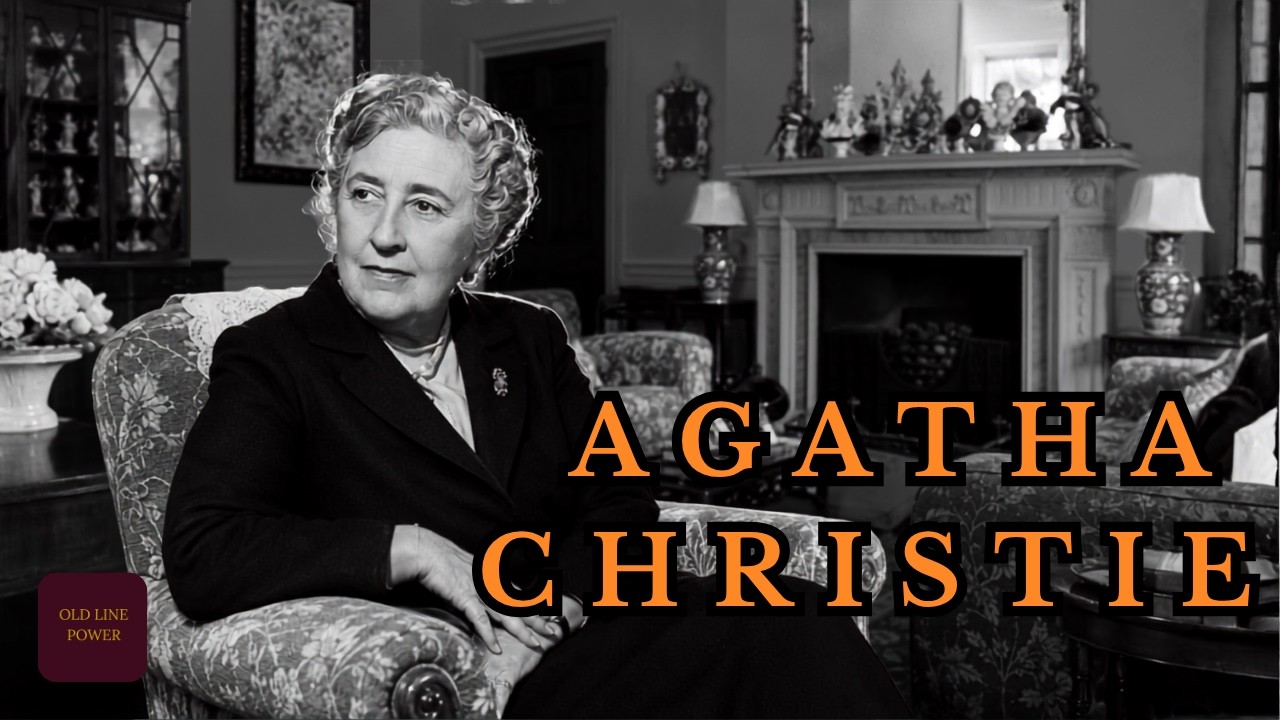
Agatha Christie was among the best-selling writers in human history, yet when she died in 1976, the estate filed with the principal probate registry in London listed her entire personal fortune at £16,683. Time magazine had estimated her lifetime earnings at roughly $20 million. The gap between those two numbers has rarely been examined seriously. Agatha Mary Clarissa Miller was born in 1890 in Torquay, Devon, into a family that appeared financially secure.
Her American father, Frederick Miller, lived as a gentleman on inherited wealth structured through trusts managed in New York. Those trusts were poorly handled, and over two decades the family fortune eroded through mismanagement, financial crisis, and what one account described as plain chicanery. Frederick Miller died in November 1901 of pneumonia and chronic kidney disease. His youngest daughter was 11 years old, and she later said her childhood ended that month.
The household changed immediately. Her mother and sister were left with a large house they could no longer comfortably afford, and Agatha was brought out into society in Cairo because a London season cost more than the family had. Her first marriage, to Colonel Archibald Christie, began during World War I. They married on Christmas Eve 1914 while he was on leave and did not actually live together until the war ended.
She worked long hours as a volunteer nurse and later as a dispenser in a Red Cross hospital, earning £16 a year. By 1926, Christie had become famous with the publication of The Murder of Roger Ackroyd. That same year, her mother died, and her husband asked for a divorce after falling in love with a woman named Nancy Neele. On December 3, 1926, after an argument, Christie kissed her sleeping daughter and drove away from their home in Sunningdale.
The next morning, her car was found abandoned at a place called Newlands Corner in Surrey. Her disappearance triggered an enormous public search, but the deputy chief constable of Surrey later wrote to the Home Office that much of what appeared in the newspapers was without foundation. The accounts of thousands of volunteers, aircraft, divers, and officers drawn from other counties were, in his words, exaggerated. The police officers were largely drawn quietly from districts where they would not be missed.
Christie was found eleven days later at the Swan Hydropathic Hotel in Harrogate, Yorkshire, where she had checked in under the name Mrs. Teresa Neele, using the surname of the woman her husband intended to marry. She dined publicly, played billiards, danced the Charleston, and read newspapers carrying photographs of her own face. Hotel staff eventually recognized her.
Two doctors examined her and recorded what was described as a genuine and unquestionable loss of memory. She never explained the episode publicly, and she omitted it entirely from her autobiography. The divorce was granted in 1928, and Archibald Christie married Nancy Neele the following week. Agatha kept custody of their daughter Rosalind and retained the surname Christie because it was, by then, an asset.
She never remarried Archibald, but she did marry again. In 1930, after lending her London house to the archaeologist Leonard Woolley and his wife, she was invited to visit their excavation in Iraq. Woolley’s young assistant, Max Mallowan, showed her around, and the two married within months. She was 39 and he was 26.
The marriage lasted until her death. Her second husband gave her a second working life. She spent three or four months of every year on excavation sites in Iraq and Syria, photographing finds, cataloging objects, and reassembling broken pottery. She also paid for a great deal of the expeditions out of her royalties.
Over her career, Christie bought and sold a remarkable number of properties. At one point in the 1930s, she owned eight houses at the same time and called the period her plutocratic period. She bought a house in Sheffield Terrace in Kensington and remodeled it into the scale of her childhood home. She bought Winterbrook House in Wallingford, which she shared with Mallowan.
In 1938, she sold Ashfield, the house where she had been born and where her mother and father had died. She had held onto it through the lean years when selling would have been sensible, and sold it once she no longer needed the money. The proceeds paid for Greenway, a Georgian house above the River Dart in Devon. In the 1960s, she was told Ashfield had been demolished for new housing, and those who recounted the moment said she wept helplessly.
During World War II, she worked in a hospital dispensary at University College Hospital in London. In 1941, she wrote two novels intended as the final cases for her most famous detectives, Hercule Poirot and Miss Marple, sealed them, and placed them in a bank vault. She then signed the copyright of one over to her daughter and the other to her husband as deeds of gift while she was alive. In 1952, she made her most famous financial decision.
She gave her grandson Matthew Prichard, then nine years old, a play she had adapted from a radio piece. The play was The Mousetrap, and she signed the royalties over to the boy before it opened a single night. It opened at the Ambassador’s Theatre in London in November 1952 and has been running continuously ever since. By the time she died, it had taken close to $3 million, and it remains the longest-running production in theater history.
In 1955, she incorporated a private company, Agatha Christie Limited, and transferred her copyrights into it. Around 1959, she signed Greenway, the house she had sold her childhood home to buy, over to her daughter, seventeen years before her death. In 1968, at the age of 78, she sold a controlling stake in Agatha Christie Limited to Booker, the food and sugar conglomerate, keeping 36 percent for herself. Her rationale for these moves was grounded in the British tax system.
The top rate of income tax was 90 percent, and she wrote that additional royalties would mostly go to the state. She described her own position sourly as being a wage slave. That statement, made by the best-selling novelist alive, is among the most revealing things she ever said about money, and almost nobody quotes it. In 1973, she finished her last novel.
In 1974, she had a heart attack and a fall and could no longer write. Her daughter opened the vault, and the final Poirot novel, written during the war and stored for more than three decades, was published in 1975. On August 6 of that year, the New York Times ran an obituary for Hercule Poirot on its front page, the only time a newspaper of record has done that for a fictional character. Agatha Christie died at Winterbrook on January 12, 1976, of natural causes, at age 85.
She is buried in the churchyard at Cholsey in a plot she chose with her husband ten years earlier. The wreaths included one from the cast of The Mousetrap, the play she had given away. When her estate was settled, it was worth £16,683. There was nothing for her heirs to fight over because there was almost nothing left in her own name.
The money had been moved on a timetable she set herself, decades before anyone needed it to be. Her father had let other people hold his fortune and watched it evaporate. She held her own fortune and then handed it over on days she had chosen, through instruments she commissioned and paid for. As a child, she had watched what happens to a family when the money sits somewhere else, held by people you have never met.
She spent the rest of her life making sure it would not happen to her family. The money was not lost. It was deliberately transferred, piece by piece, into structures that would survive her in the hands of people she had chosen.