On June 22, 1941, German forces crossed the Soviet border and launched Operation Barbarossa, the largest invasion in European history. As armored columns advanced eastward, cities fell one after another, and millions of Red Army soldiers were captured. Nazi propaganda framed the invasion as a crusade against Bolshevism, and among those who welcomed it was a former general of the fading Russian Empire.
In his seventies, Pyotr Krasnov declared his support for Adolf Hitler and called on the Cossacks to fight alongside Nazi Germany. Through speeches and radio broadcasts, he portrayed the Soviet government as a rule of "Bolshevik Jews" and presented the advancing German army as liberators. Thousands answered his call, and many were eventually sent to the Balkans, where Cossack units became associated with reprisals, looting, and violence against civilians.
Four years later, as the Third Reich collapsed, Krasnov surrendered to British forces in Austria, believing that decades of exile would save him from Soviet justice. Instead, he was handed over to the Soviet Union, where his collaboration with Nazi Germany ultimately cost him his life.
Pyotr Nikolayevich Krasnov was born on September 22, 1869, in St. Petersburg, then part of the Russian Empire. He grew up in a military family of Don Cossacks, the largest Cossack formation in the empire, where service to the tsar was considered both a duty and a tradition. His father, Nikolai Krasnov, was a lieutenant general in the Imperial Russian Army, while his grandfather, Ivan Krasnov, was a general and writer.
Krasnov graduated from the Pavlovsk Military School in 1888 and joined the elite Ataman Regiment of the Imperial Guard. Alongside his military career, he also established himself as a war correspondent and author. He covered the Boxer Rebellion in China and the Russo-Japanese War of 1904–1905, traveling through Manchuria, China, and Japan. His articles, which reflected both admiration for Japanese courage and criticism of their military leadership, attracted the attention of Tsar Nicholas II and were later published as a book with support from the War Ministry.
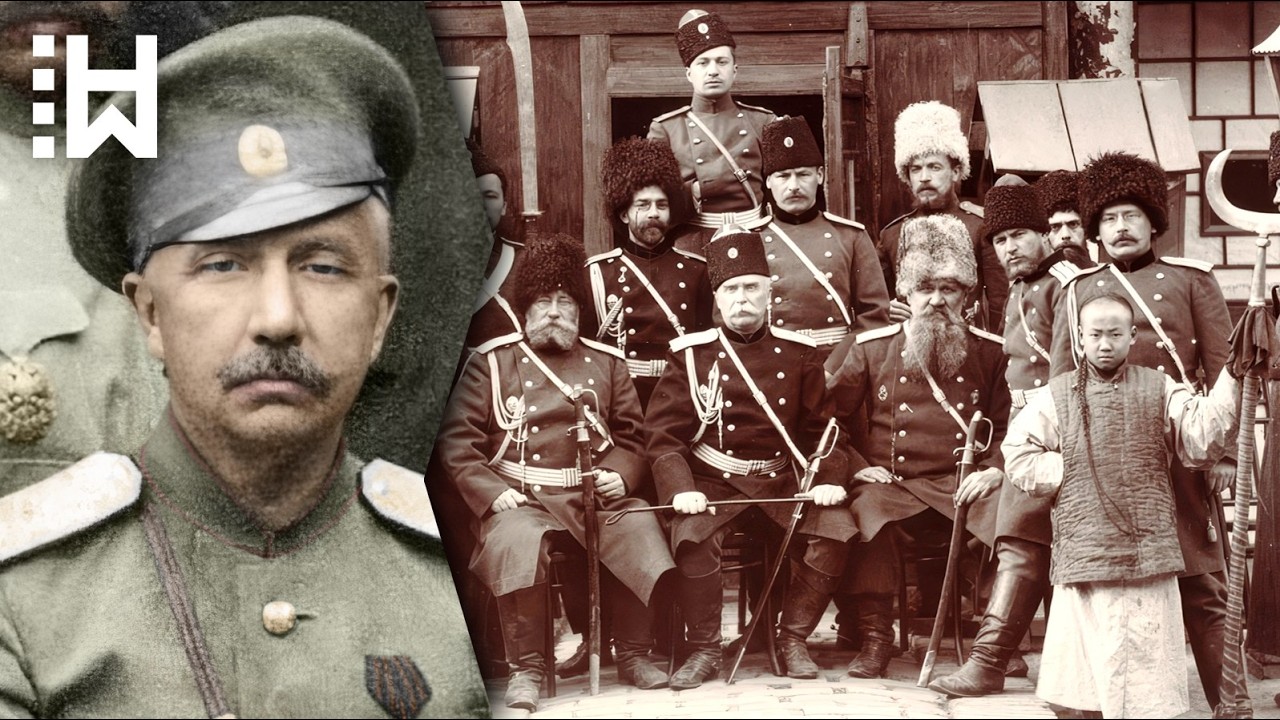
During World War I, Krasnov commanded Cossack cavalry with distinction. The collapse of the Russian state in 1917 moved him from the battlefield into the political arena. When the Bolsheviks seized power in Petrograd during the October Revolution, the deposed head of the Provisional Government, Alexander Kerensky, turned to Krasnov to retake the capital. A small column of Cossacks advanced toward Petrograd, but the attempt, known as the Kerensky–Krasnov uprising, collapsed within days, and Krasnov was captured by the communists.
Leon Trotsky, a key figure in the Bolshevik Revolution, released Krasnov only after he gave his word not to take up arms against the new government—a promise he broke almost immediately. Krasnov made his way to the Don region in southern Russia, the traditional homeland of the Don Cossacks, where an assembly in the city of Novocherkassk elected him Ataman in May 1918, making him the political and military leader of the Don Cossack Host.
His authority was shaped by the broader catastrophe unfolding around him. With the Imperial German Army occupying southern parts of the former Russian Empire, particularly Ukraine, after the Treaty of Brest-Litovsk, Krasnov looked to Germany for weapons and recognition. He wrote to Kaiser Wilhelm II, declaring that the Cossacks were friends of the Reich and requesting its protection. This choice provided him with arms but cost him standing within the broader anti-Bolshevik movement in Russia.
His alliance with Germany complicated his relationship with the Allied-backed White commander Anton Denikin and earned him lasting distrust within the White movement, which was officially committed to the Allied cause against Bolshevism. With German money and rifles, Krasnov’s Don Army grew to around 40,000 men by mid-1918. He cleared the Don region of Bolsheviks and advanced toward Tsaritsyn, now Volgograd on the Volga River, hoping to open the road to Moscow, but the attack was repelled.
Krasnov’s rule in the Don was also marked by the violence of the Russian Civil War. Under his leadership, the White Terror swept through the region, targeting suspected Bolshevik supporters. Historians estimate that between 25,000 and 40,000 people were killed.

When Germany was defeated in November 1918, foreign support for Krasnov faded and his position weakened. The Allies, who had assigned the Don region to British influence, armed only Denikin’s Volunteer Army. In January 1919, under pressure, Krasnov recognized Denikin’s authority over the White movement. A month later, after losing the confidence of the Cossacks in a leadership contest, Krasnov resigned and left Russia for good.
He settled first in Germany and then, from 1923, in France, joining the large wave of White Russian émigrés spread across war-torn Europe. In exile, the writer overtook the soldier. Over two decades, he produced around 40 books, including historical novels, war stories, and memoirs, becoming one of the most widely read émigré authors, with his works translated into many languages.
Some considered his trilogy "From the Double-Headed Eagle to the Red Flag" deeply anti-Semitic. It treated "The Protocols of the Elders of Zion"—the most infamous and widely circulated anti-Semitic publication of the modern era—as an authentic document and accused world Jewry of inventing communism. His anti-Semitism was not confined to his fiction. During the Bern Trial in the Swiss capital in the mid-1930s, which centered on the forged Protocols, Krasnov secretly affirmed his belief in the authenticity of the anti-Semitic forgery.
His political views hardened over the years into an unrelenting hatred of Bolshevism and contempt for the liberal West. As the 1930s progressed, he gravitated toward the German far right, seeing in the rise of Adolf Hitler and the Nazi Party the instrument that might finally destroy the Soviet state. In 1937, after several White Russian émigré leaders were assassinated in Paris by the Soviet secret police, the NKVD, Krasnov moved to Berlin, where he believed he would be safer, and declared his support for the Third Reich.
World War II began on September 1, 1939, when Nazi Germany invaded Poland. Less than two years later, when Germany invaded the Soviet Union in June 1941, Krasnov, already over seventy, committed to the cause without reservation. Upon hearing of the launch of Operation Barbarossa, he issued a statement supporting the crusade against "Bolshevik Jewry," declaring: "I would like to tell all Cossacks that this is not a war against Russia, but against communists, Jews, and their accomplices who trade in Russian blood. May God help the German sword and Hitler. May they complete their mission, just as the Russians and Emperor Alexander I did for Prussia in 1813."

Krasnov contacted Joseph Goebbels, the German propaganda minister, and requested permission to speak on Berlin Radio in Russian to deliver pro-Nazi speeches. His request was approved. From late June 1941 onward, Krasnov became a regular speaker on Berlin Radio’s Russian-language service, delivering anti-Semitic addresses that portrayed the Soviet government as the rule of Bolshevik Jews and the advancing German forces inside the Soviet Union as liberators.
In January 1943, Alfred Rosenberg, the Nazi minister for the occupied Eastern territories, appointed Krasnov to lead the Central Cossack Office. Rosenberg believed that only a Cossack of high standing could motivate recruitment where German officials had failed. Despite his age and reliance on a cane, Krasnov remained widely respected as a former Ataman and famous novelist, chosen for the prestige and authority his name carried. As a symbolic figure and recruitment official, he urged Cossacks to view the conflict not as a war against Russia but as a struggle against communists and Jews, echoing the ideology of the Nazi regime.
In September 1943, soldiers of the newly formed 1st Cossack Cavalry Division learned that their unit would not be sent, as expected, to fight on the Eastern Front but to the Balkans to combat communist partisans. At the request of the division commander, Major General Helmuth von Pannwitz, Krasnov traveled to address the division. He tried to soothe the wounded feelings of the Cossacks, who did not want to go to the Balkans, by assuring them that fighting partisans was part of the same struggle against the international communist conspiracy as the Eastern Front. He promised that if they performed well in the Balkans, they would eventually go to the Eastern Front.
The division quickly gained a reputation in the Balkans for undisciplined and cruel behavior, not only toward partisans but also toward civilian populations, prompting even pro-Nazi Croatian authorities to complain to the Germans, and ultimately to Adolf Hitler himself. Alongside rape, murder, looting, and the burning of towns suspected of harboring partisans and their supporters, the division used telegraph poles along railway lines for mass hangings as warnings to partisans and others.
At the end of World War II in May 1945, Krasnov’s Cossack forces surrendered to British troops in the Drava Valley near the city of Linz in Austria. British officers gave assurances that émigrés among them—men who had left Russia decades earlier and never held Soviet citizenship—would not be handed over to the Soviet Union. Those assurances were not honored. Under the repatriation agreement approved by the Allies at the Yalta Conference, the Cossacks were handed over to the Soviet Union.
The officers were separated from their men through deception, summoned to what they believed was a conference and then arrested. The camps were then forcibly cleared amid scenes of resistance, despair, and suicide, in what became known as the betrayal of the Cossacks. Krasnov was handed over to the Soviets at the end of May 1945.
Pyotr Krasnov was charged with collaboration with Nazi Germany during World War II and with his role in the White Terror during the Russian Civil War. He was tried in Moscow before the military collegium of the Supreme Court of the Soviet Union, alongside other Cossack and White Army leaders, as well as SS commander Helmuth von Pannwitz, who had led Cossack units in German service.
When Pyotr Krasnov was executed on January 17, 1947, he was 77 years old. His legacy remains contested. Russian courts have refused to rehabilitate him, rejecting attempts to portray him as a victim of Bolshevism rather than a collaborator with Nazi Germany. Yet he is still honored in parts of the Cossack and émigré world as an anti-Soviet martyr.