In the summer of 1989, a sentence that was almost certainly never uttered sent Leona Helmsley to federal prison. “We only own the little people,” read the line that appeared in the New York Post, spread to every newspaper in America, and finally landed in the closing arguments of a federal tax trial. It did more damage to her than the sixty-one million dollars her husband’s companies were accused of misappropriating. The remark entered the record through a former housekeeper, Elizabeth Baum, who testified under oath that Mrs.
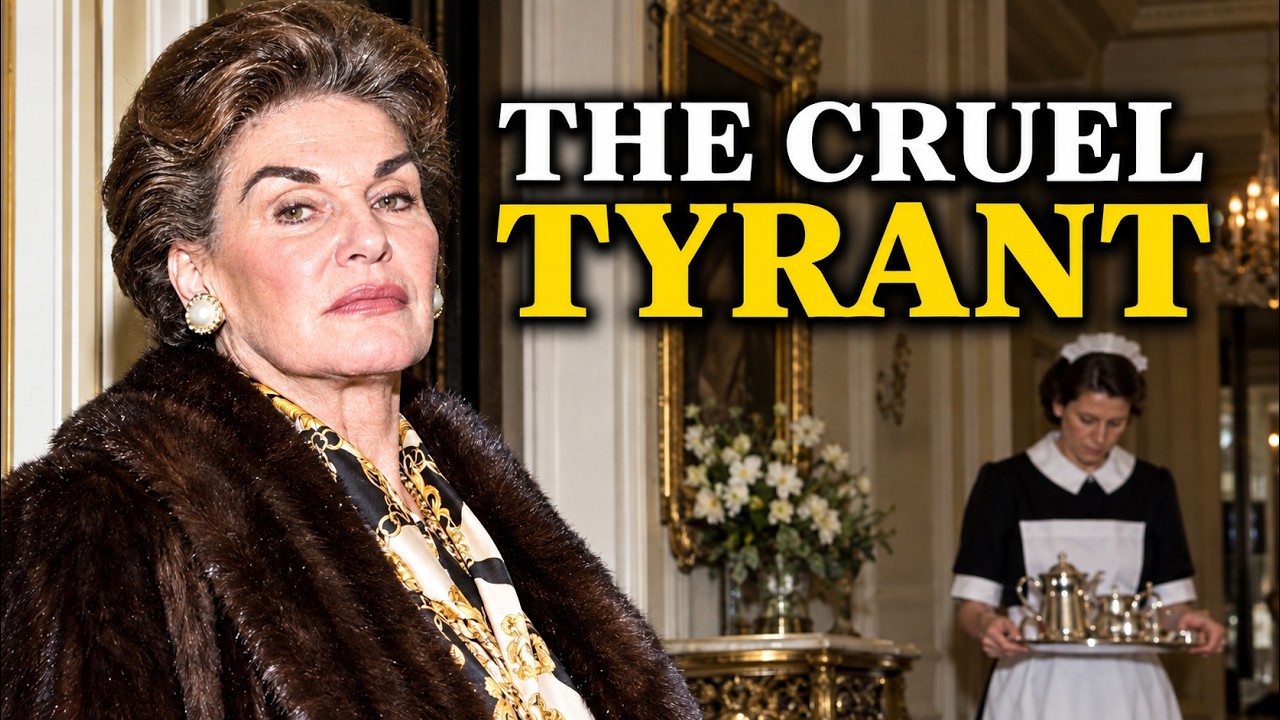
Helmsley had told her, in substance, that they did not pay taxes, only the little people paid taxes. Leona denied it flatly for the rest of her life, and her defense attorney denied it. Yet it stuck because, by that point, the prosecution had already put a dozen former employees on the witness stand, and every one of them had described the same woman. The government’s case was about tax fraud, but the evidence that convicted her was about how she treated her staff.
A Manhattan hotel empire, a Connecticut mansion, a private household, and a turnover rate at the top that people in the New York hotel industry still talk about. She fired a chief financial officer over a hotel bill. She fired the general manager of the Palace, and she fired people for looking at her wrong, for wearing the wrong shoes, for simply existing in a hallway at the wrong moment. She did it in front of other staff deliberately, as a management technique.
Yet the version of Leona Helmsley as simply a monster is incomplete. She began as a receptionist. Her father was a Polish immigrant hat maker in Brooklyn. She had no money, no completed education, two failed marriages, and a child before she was thirty.
By 1970, before she ever met Harry Helmsley, she had built herself into the highest-earning woman in American real estate. Everything she feared losing, she had actually earned. She was born Lena Mindy Rosenthal in July 1920 in Marbletown, New York, and the family moved to Brooklyn. Her mother and father raised four children in the working immigrant Brooklyn of the 1920s, where the margin between managing and not managing was measured in weeks.
She dropped out of Abraham Lincoln High School and then spent roughly twenty years methodically editing herself. Lena became Leona, and Rosenthal became Roberts. A first marriage to a lawyer produced her only child, Jay, in 1940, and ended in divorce. A second marriage, to a garment executive, ended in divorce, then an extraordinary remarriage, then divorce again.
By her mid-thirties, she was a divorced single mother with no degree and no capital, and she went to work. The standard telling treats her as a woman who married money. She did not. She made money first.
As a receptionist at a real estate firm, at the absolute bottom of the industry, she noticed that the men above her were mishandling something. In the 1950s and sixties, New York was full of rental buildings being converted into cooperatives, and the process required persuading existing tenants, one by one, to buy the apartment they were already living in. Most brokers found it tedious and low-status. It was also, if you were good at it, enormously lucrative, because a converted building generated a sale on every unit.
Leona became one of the best co-op converters in the city. By the late 1960s, she was running her own operation, and in 1970 she was made a senior vice president at Brown, Harris, Stevens, with reported earnings around half a million dollars a year. In 1970, for a woman in New York real estate, that made her without peer. The women who beat that industry in that generation did it by being unpleasant, not as a personality flaw but as a working method.
A woman who was agreeable in a room of male brokers in 1965 had her deals taken from her. The aggression was the tool that worked. It kept working, and she used it for another forty years after the circumstances that had required it were gone. Harry Brakmann Helmsley was born in 1909 and started at the bottom, as an office boy in a Manhattan real estate firm at seventeen, earning twelve dollars a week.
A quiet Quaker, extremely intelligent about numbers, he had built one of the largest real estate portfolios in the United States by the time Leona met him. His method was leverage and syndication, identifying undervalued buildings and acquiring them with very little of his own capital. His holdings at the peak included the Empire State Building, the Flatiron, the Helmsley Building on Park Avenue, and roughly a hundred properties across the country. They met professionally in the late 1960s.
In 1971 he divorced his wife of thirty-three years, and in 1972 he married Leona. What complicates the story is that, by every account from every side, including from people who loathed her, Harry and Leona genuinely adored each other. There was no arrangement, no prenuptial extraction, no dynastic calculation. He was sixty-three, she was fifty-two, and they had both come up from nothing in the same brutal industry.
He put her in charge of the hotel division and gave her enormous authority. She called him her prince, and on her birthday he took out full-page newspaper advertisements about her. Whatever was happening with the staff was coming from somewhere other than a loveless marriage. Harry made her president of Helmsley Hotels, and the flagship was the Helmsley Palace on Madison Avenue, a luxury hotel built around the nineteenth-century Villard Houses, preserved as the entrance while a fifty-one-story tower rose behind them.
It opened in 1980. Leona did something commercially brilliant with that hotel. She put herself in the advertising. Full-page magazine spreads with her photograph proclaimed her the personal guarantor of the guest experience, styled as the queen of the palace, the only palace in the world where the queen stands guard.
She became one of the most recognizable business faces in America at a time when almost no woman occupied that space. Occupancy was strong, and the Palace became one of the premier hotels in New York. The problem with that campaign was that she had publicly staked her own name, not the company’s, on perfection. From 1980 onward, every flaw in every hotel, a smudged glass, a slow elevator, a crooked tie, was not an operational issue.
It was a personal accusation against her, in a campaign she had written herself. So she went through those hotels constantly, personally, looking for it. Dozens of former employees, industry journalists, and the trial record give remarkably consistent accounts. She arrived without warning, went through a property room by room, ran her fingers along surfaces, checked under beds, examined the uniforms of staff standing in front of her.
If something was wrong, she said so immediately, in the corridor, in front of whoever was standing there. She fired people on the spot, frequently over something trivial. A general manager dismissed over an inspection finding, kitchen staff let go over a dish, front desk employees gone because of a single interaction she witnessed. And she screamed, audibly along corridors and into public areas, subjecting senior executives to it in front of their own subordinates.
Plenty of powerful people are difficult, and the hotel industry was full of tyrants. What made her different was that the humiliation was deliberately public and aimed downward with precision. Firing a general manager in front of the housekeeping staff demonstrated that there was no rank in that building high enough to be safe. It was a management system, a bad one, but a deliberate structure in which the only stable authority was her, and everyone else’s position was provisional at all times.
She had spent twenty years in an industry where a woman’s position was provisional at all times, where the deal you built could be taken from you. She had survived by becoming the one who could not be removed, and then built an organization that ran on exactly the principle that had nearly destroyed her, pointed the other way. The ugliest component was the money. Accounts consistently describe her as cheap in a way that struck people as personal, disputing bills, refusing to pay contractors, challenging invoices from small suppliers over small sums.
The combination of enormous visible wealth alongside a refusal to pay small people small amounts generated the kind of hatred that lasts decades and shows up in a courtroom. The Helmsleys owned a Greenwich, Connecticut estate called Dunellen Hall, twenty-six acres purchased in 1983 for a reported eleven million dollars. Renovations ran for years, involving dozens of contractors and reported extravagances including a barbecue pit over one hundred thousand dollars and a dance floor over the pool. The allegation that became the criminal case was that the Helmsley organization had those personal renovations invoiced to their business entities, treating personal spending as deductible business expenses, with improperly deducted personal expenses in the region of four million dollars within a broader case involving the misuse of company funds.
The government found out because the contractors talked. The case did not begin with an audit. It began with an unpaid contractor and the New York Post, which in the mid-1980s published accounts from tradesmen who said they had done work on Dunellen Hall and had been refused payment. Those stories generated more contractors, which generated documents, which drew the attention of New York State authorities, and then the office of the United States Attorney for the Southern District of New York, then run by Rudolph Giuliani.
She was indicted in 1988 along with Harry and two associates on federal charges including tax evasion and mail fraud. Harry was found mentally unfit to stand trial. He was seventy-nine and in genuine decline, and the finding removed him from the case entirely. Leona walked into that courtroom in the summer of 1989 alone.
The tax evidence was technical, invoices, billing routes, corporate entities, the kind of material decisive to a jury and useless to a newspaper. So the prosecution built its narrative out of people. Former employees, a housekeeper, staff from Dunellen Hall, hotel personnel, and business associates described the same woman, the screaming, the firings, the humiliation, the contested invoices, a household run on fear. Then Elizabeth Baum testified that Mrs.
Helmsley had said something to the effect that they did not pay taxes, that only the little people paid taxes. The line went around the world in about a day. It did not matter whether she said it, because a dozen people had already testified to a pattern of behavior that made the line entirely believable. The quote was not evidence.
It was a summary. The jury and the country had already heard in detail exactly how this woman regarded the people who worked for her. That is how a reputation actually kills someone, not the accusation, the plausibility. She was convicted in August 1989 on thirty-three counts, including tax evasion and mail fraud, and acquitted on the extortion charge.
The judge sentenced her to four years and a fine of over seven million dollars, along with substantial back taxes and penalties. After the appellate process, she went to federal prison in April 1992 at seventy-one years old. She served roughly eighteen months in custody, including at Danbury, Connecticut, home detention, and community service. During those eighteen months, Harry Helmsley was dying.
She was, by the accounts of that period, in genuine distress about being separated from him. She was also a compliant and largely unremarkable inmate. Harry died in January 1997 at eighty-seven. Leona, released and seventy-six years old, convicted felon and publicly reviled, was left alone holding one of the largest real estate fortunes in the United States.
Her son Jay had died of a heart attack in 1982 at forty-two, and she had then sued his estate, pursuing claims that forced her daughter-in-law out of a house. In 2003, she fired her long-time assistant, and she was the subject of a lawsuit from a former hotel manager who alleged he had been dismissed because he was gay. A jury awarded him damages reported at over ten million dollars. She died in August 2007 at Dunellen Hall at eighty-seven of heart failure, leaving an estate reported at four to five billion dollars, the bulk directed into a charitable trust.
The will was the most revealing document she ever signed. She left twelve million dollars in trust for her dog, a Maltese called Trouble, with provision that the dog be buried alongside her in the family mausoleum. A court later reduced the dog’s trust to two million dollars. She left three million dollars for the maintenance of the mausoleum, with a requirement that it be steam cleaned at least once a year.
She left substantial sums to two of her four grandchildren and disinherited the other two entirely, the will stating the reason in writing: for reasons which are known to them. Leona Helmsley spent forty years extracting perfect service from human beings by making their positions permanently unsafe. At the end of her life, she looked at the entire human population of her existence, hundreds of employees, two surviving generations of her own family, an industry she had dominated, and concluded that the only creature who had never let her down was a dog she had owned for nine years. In an organization built entirely on fear, the dog was the only being whose loyalty was not a performance under threat.
Two things about Leona Helmsley are true and almost never said in the same paragraph. The first is that her treatment was in one respect unfair. She went to federal prison for tax offenses that were close to routine in the New York real estate world of the 1980s. Personal expenses run through business entities was standard practice among people who were never charged.
She was prosecuted for what she did and destroyed for who she was, and she was the subject of coverage that was genuinely misogynistic, called the queen of mean while a male hotel owner who screamed at staff was described only as demanding. The second is that essentially every person who worked for her across four decades independently arrived at the same assessment, and when a federal prosecutor went looking for people willing to say so under oath, he had no difficulty at all finding them. Her estate went into the Leona M. and Harry B.
Helmsley Charitable Trust, which has since given away several billion dollars to medical research, into type 1 diabetes, Crohn’s disease, rural American health care, and hospital funding across the country. The woman who was destroyed for saying that only the little people pay taxes ended up funneling almost her entire fortune into public medical research that overwhelmingly benefits ordinary people. She had left instructions that a substantial portion go toward the care of dogs, which the trustees, with a court’s permission, largely declined to follow.
The woman who spent her life ensuring that nobody around her was ever secure died having correctly identified, in her final and most carefully drafted piece of paperwork, the only living thing in her world that had ever been loyal to her without being afraid.