Seven days after the assassination of her husband, a 34-year-old widow sat in a house in Hyannis Port and summoned a magazine writer. For four hours she told him exactly what the murdered president’s legacy should mean to the country. When he finished his notes, she took them and began crossing out words in her own handwriting, sharpening the phrases, line-editing the first draft of American memory. It was in that room that she handed him a specific word borrowed from a Broadway musical: Camelot.
That word does not appear anywhere in the historical record of John F. Kennedy’s lifetime. She invented it. To the public, it looked like a grieving wife seeking solace in a fairy tale, but the historical record reveals something else.
She was not improvising. She was executing a strategy she had been perfecting her entire life. Jacqueline Bouvier’s understanding of image began with a scandal. Her father, John “Black Jack” Bouvier, lost his marriage when a camera captured him with another woman.
At eleven years old, Jackie learned a brutal lesson: a photograph can destroy a family. But she also learned its inverse. A camera can save one. Following the loud, highly public divorce, her mother, Janet, remarried a Standard Oil heir named Hugh D.
Auchincloss. Jackie gained access to massive estates in Washington and Newport, but the arithmetic of her new life was made explicitly clear. She owned none of it. Her step-siblings would inherit.
She and her sister were merely guests with excellent bedrooms. Janet had been humiliated by a charming man with no money, and she was fiercely determined not to watch her daughters repeat the mistake. So Jackie developed a specific set of skills. She became observant to the point of being unsettling.
In 1951, she won Vogue’s prestigious Prix de Paris writing competition against more than a thousand other college women. The prize was six months working in Paris. She turned it down. The pressure at home was to remain in Washington and get on with the actual business of her life, which everyone in her class understood to be marriage.
She even had a brief engagement in 1952 to a New York stockbroker named John Husted. It lasted barely three months. Husted later noted that her mother’s assessment of his modest $17,000-a-year income was the fatal blow. Instead of Paris, Jackie took a $42.
50-a-week job at the Washington Times-Herald as the “inquiring camera girl. ” Her assignment was to stop strangers, take their photos, and craft the copy. Long before she was a first lady, she was learning how a carefully chosen caption dictates a narrative. She learned that the person choosing the questions controls the answers.
When she was seated near Congressman John F. Kennedy at a Georgetown dinner party, there was no thunderclap of romance. It was a slow, erratic courtship. He did not write love letters.
He sent postcards. His reputation as a womanizer was not a secret in Washington, but this was not a romance of blind love. It was a merger. Joseph P.
Kennedy had a son he intended to make president, but the Kennedys lacked refinement. They needed an answer to the accusation that they were just rich Irish upstarts buying their way into American politics. Jackie, fluent in French, highly educated, and socially unimpeachable, solved a political problem. She offered social invulnerability.
In return, she gained a family with real money, political relevance, and an escape from her stepfather’s house. The transaction was so coldly calculated that the Kennedy political machine actually delayed their engagement announcement in 1953. Why? Because the Saturday Evening Post was about to publish a profile on the Senate’s most eligible bachelor.
They waited for the magazine to finish selling the fantasy of a single man before announcing the reality. When the proposal finally reached her, Jackie was in London working for the Times-Herald to cover the coronation of Queen Elizabeth II. Her final act of professional journalism was reporting on another young woman being crowned in front of the world. Then she stopped being a byline and became a fiancée.
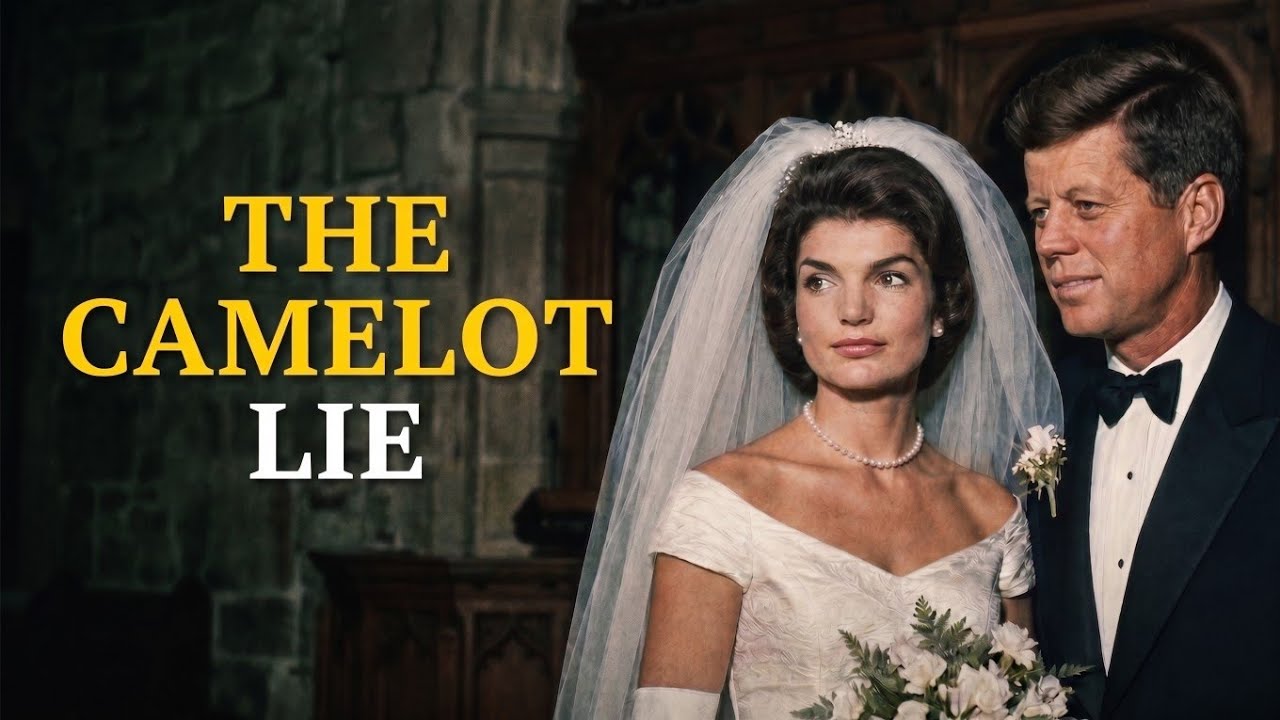
Their 1953 wedding set the template for the next ten years: a pristine public event masking a ruthless private reality. Behind the 1,100 perfect photographs, her own father was barred from the church. The Auchincloss family spent weeks ensuring that Black Jack Bouvier, found drinking in his hotel room, would be marginalized. Hugh Auchincloss walked her down the aisle instead.
Jackie smiled through the cameras, hiding the fact that her father wasn’t even in the building. The marriage she entered was overwhelming. The Kennedys did not just live near each other; they lived at each other. At the Hyannis Port compound, the sisters mocked her refinement, nicknaming her “the Deb.
” She fought back with wicked private impressions of them, but she was always outnumbered. Her unlikely ally was her father-in-law. Joe Kennedy controlled the family trusts. When a Kennedy needed a story killed or a house bought, it went through Joe.
He genuinely liked Jackie, backed her against his own daughters, and paid her bills when she overspent. She had married into a system where her financial security ran through her father-in-law, not her husband. The early years tested that security to its breaking point. During Kennedy’s near-fatal back surgery in 1954, Jackie functioned as a nurse and research assistant, quietly organizing notes for the Pulitzer-winning Profiles in Courage.
Yet when she suffered a devastating stillbirth in 1956, her husband, cruising the Mediterranean on a chartered yacht, did not immediately return. It was his brother, Robert Kennedy, who handled the hospital and arranged the burial. The fracture in the marriage was profound. When Jackie eventually returned to Washington, the Virginia house she had bought, complete with a freshly painted nursery, was quietly sold.
The buyer was Robert. She sold the nursery to the brother who had buried her child. She adapted. By the time they entered the White House, she was no longer a passive participant.
In 1962, 80 million Americans watched her televised tour of the White House. She had raised private money, hunted down Lincoln’s China, and pushed through legislation to make the collection permanent. She was constructing a living set for the presidency, proving that the woman who once photographed strangers for $42. 50 a week now completely controlled the frame.
But behind closed doors, Kennedy’s affairs were intersecting with the Chicago mob through a woman named Judith Campbell Exner, handing FBI Director J. Edgar Hoover permanent leverage over the Oval Office. How did Jackie handle the open secrets? With unsettling control.
When she required a press secretary, she hired Pamela Turner, a woman widely reported in Washington circles to be one of her husband’s mistresses. She placed the problem at a desk where she could see it every single day. By late 1963, she began leveraging her own undeniable star power, taking a highly publicized cruise on the yacht of Greek billionaire Aristotle Onassis. The administration was terrified.
But then the historical record pivots abruptly. In August 1963, they lost a premature son, Patrick. The tragedy shattered Kennedy’s usual detachment. Aides witnessed the president weeping openly.
Observers noted a genuine physical tenderness between the couple in public that had never existed before. The political alliance had finally become a true marriage. They had fifteen weeks left. When the shots rang out in Dallas, the bloodstained pink suit became instantly iconic.
Aides on Air Force One begged her to change. Lady Bird Johnson offered her fresh clothes. She refused. “Let them see what they’ve done.
” It was a conscious editorial decision. The girl who learned that cameras dictate history was now directing the most traumatic photographic record of the American century. After burying him, she ruthlessly policed his legacy. When historian William Manchester wrote the authorized account of the assassination in 1966, Jackie took him to court.
She threatened injunctions and offered a million dollars to kill the serialization. She successfully forced out details she deemed unacceptable, including the contents of her handbag, a description of the president in his underwear, and the fact that she was a smoker. She lost the public relations battle, but she won the text. In 1968, she married Onassis.
The contract, negotiated personally through her lawyers, gave her a fortune that no Kennedy trustee could control. She was thirty-nine years old and financially independent for the first time in her life. For her final two decades, the woman who held America’s most sought-after story worked as a New York book editor. For nineteen years, she sat in an office reading manuscripts, cutting other people’s sentences, and deciding which other people’s stories deserved to be told.
She never wrote a memoir. The famous pink suit now sits in the National Archives. Under a deed of gift from her daughter, it is legally sealed from public view until the year 2103. She wasn’t preserving Camelot for the rest of us.
She was its architect, its director, and its only true resident. And when she was finished, she locked the door behind her.