When a Spartan soldier returned home after a lost battle, the greatest danger he faced was not waiting in the enemy ranks. It was standing in his own doorway. In Sparta, survival itself could be treated as a crime, and the woman who enforced that judgment was his own mother. Ancient sources record that Spartan mothers were trained to place the state above their own children.
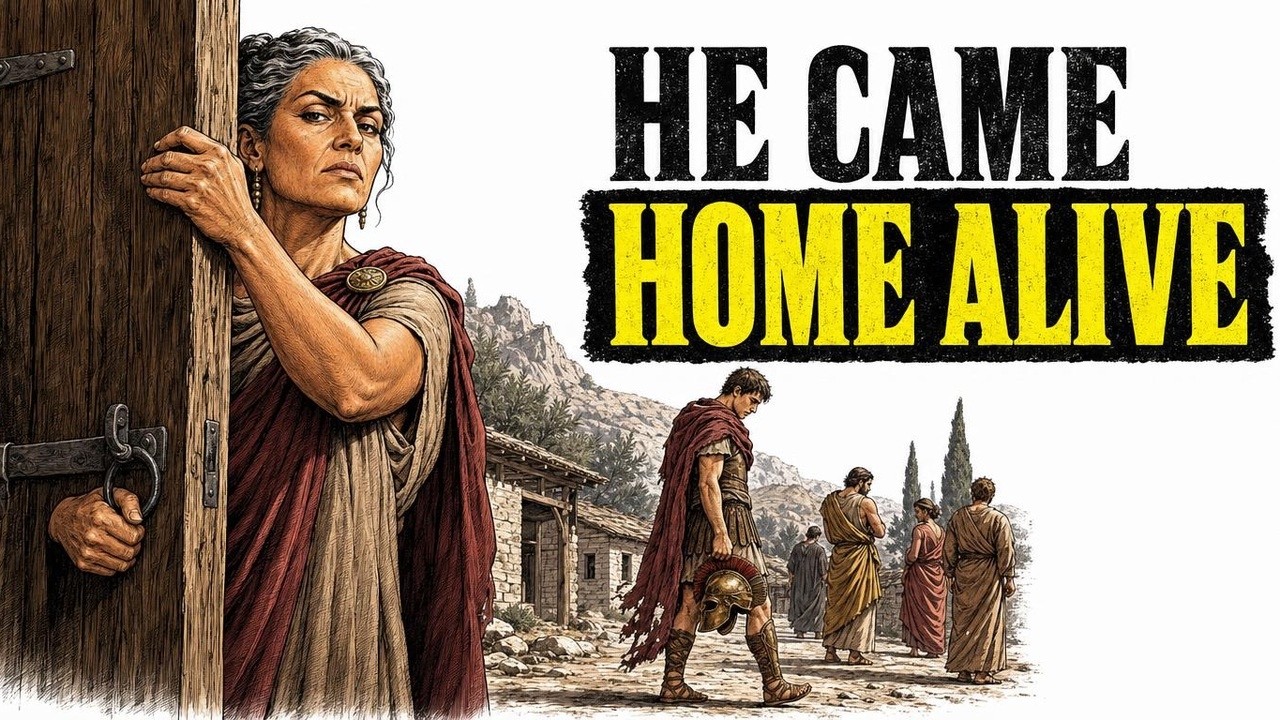
They raised sons for one purpose: to die well in battle. A soldier who came home alive when his comrades had fallen could be declared a “trembler,” a legal status that stripped him of citizenship, marriage rights, and honor. The same mothers who sent their sons to war were expected to condemn them if they returned without their shields. The historian Plutarch preserved the sayings of Spartan women, including the famous command given to sons before battle: “With your shield or on it.
” In practice, this was not poetry. It was a contract. A man who dropped his shield had broken the phalanx line and endangered every soldier beside him. His love, his name, and his place in the family all depended on his willingness to die.
A Spartan son left for war carrying the weight of his mother’s judgment. She was not merely a parent; she was an enforcer of state ideology. When a son disgraced himself, the city watched the mother’s reaction. If she refused to speak to him, barred her door, and mourned him as though he were dead, the entire city followed her lead.
The most extreme recorded example comes from Plutarch. A mother whose five sons went to war learned that four were dead and the fifth had survived by running. She walked out to meet him on the road and killed him with a roof tile. Asked why, she answered that she had borne her sons not to live or die, but so that Sparta would win.
An unworthy son, she said, was a disgrace she could not carry. Historians have treated this account with caution, but note that the Spartans repeated it proudly. It was the ideal they aimed at: a mother who would execute her own child rather than accept a coward in her family. Spartan women trained publicly in athletics, ran races, and wrestled in front of spectators.
Athenian observers mocked them, calling them “thigh flashers,” but the Spartans saw this physical conditioning as essential to producing strong soldiers. Girls ate controlled rations, avoided weaving, and built muscle so they could bear strong sons. Even marriage was arranged with breeding logic. Brides had their hair cropped and were dressed in men’s cloaks.
Husbands visited them only at night and returned to the barracks before dawn. When a husband passed his prime, he might be asked to lend his wife to a stronger man so the city could harvest better offspring. A newborn child had to pass an inspection before it was allowed to live. The father carried the infant before the elders of the tribe at a place called the Lesche.
If the child was judged weak or malformed, it was left to die in a ravine on Mount Taygetus known as the Apothetae. The mother learned only afterward whether her child had been permitted to breathe. The most famous case of a Spartan condemned for surviving is that of Aristodemus, one of the 300 Spartiates at Thermopylae in 480 BC. He and another soldier, Eurytus, were struck by an eye infection and ordered by Leonidas to recover in a rear village.
When the final stand came, Eurytus, though blind, ordered his helot to lead him back to the fighting and was killed. Aristodemus stayed behind and lived. He was the only one of the 300 to return to Sparta. Sparta showed him no mercy.
No citizen would speak to him or share fire with him. He was shunned completely until the battle of Plataea a year later, where he fought with reckless fury, broke from the phalanx, and was killed. Even in death, the judges refused to honor him, saying he had thrown his life away in a private madness rather than holding the line in his right mind. Another soldier, Pantites, missed Thermopylae because he had been sent as a messenger.
When he returned and found himself dishonored, he hanged himself. The daily life of a condemned trembler was engineered to be unbearable. He wore a cloak patched with contrasting colors. He shaved half his beard, leaving the other half to grow.
He could hold no office, speak in the assembly, or eat at the common mess. Any citizen could strike him, and he had no recourse. He was forced to give way even to boys younger than his own children. He was forbidden to marry, and the shame spread to his family, who could neither give nor receive brides.
His mother’s rejection was the first and heaviest blow. One mother, told that her son had fled, said openly: “It is falsely reported that you are alive and have fled. My true son died holding his shield. ” Another mother, seeing her son approach after a defeat, lifted her dress and told him the only place a coward belonged was back in the womb that had borne him.
After centuries of this brutal system, the collapse came at Leuctra in 371 BC. The Theban general Epaminondas stacked his left wing fifty men deep and angled his line so that a massive column struck the Spartan right where King Cleombrotus stood. The phalanx, long believed unbreakable, broke. Around 700 full Spartiates were on the field; about 400 died.
Nearly 300 survived by running. That same evening, the survivors returned to a city whose law defined them all as cowards. The law demanded they be stripped of citizenship, but the state could not afford to lose that many men at once. The city stood between destroying its army and betraying its own sacred code.
King Agesilaus, old and lame, offered a strange answer. He asked the city to let the laws sleep for one day, then resume their full force the next morning. The vote carried. The survivors were not punished.
For the first time in centuries, the state had chosen survival over honor, and everyone had witnessed it. News of the defeat reached Sparta during the Gymnopaedia festival while the chorus was singing. The ephors let the song finish before reading the names of the dead. The next morning, the families of the fallen walked the streets with pride.
The families of the survivors stayed indoors, hiding in shame. The defeat had exposed a fatal flaw. The mothers had raised men who could die superbly but could not adapt. A culture built on the glorious death had no answer for a survivable defeat.
The weaponized love that had held the system together turned out to be the crack that broke it. After Leuctra, Epaminondas marched into Laconia itself and stood on the far bank of the Eurotas, looking at the unwalled city. He then crossed into Messenia and freed the helots, the vast enslaved population whose labor had fed the Spartan machine for centuries. In 369 BC, he built the city of Messene with stone walls that still stand today as a monument against Sparta.
The economic foundation of the Spartan state was pulled out in a single season. Sparta never recovered. It shrank into a curiosity, a place travelers visited to see what a legend looked like after the terror had drained out of it. Under Rome, the old rituals continued as tourist spectacles.
The mothers went on teaching the old words, but the force behind them was gone. The record preserves the Spartan mother as a symbol of resolve. But the fuller story is darker. She was the most effective piece in a machine that ground its own people to powder, and she was also one of its victims.
Her love was weaponized so completely that it helped bleed a civilization white, one dead son at a time.