In 1920, with the American beer industry shut down by Prohibition, a grieving St. Louis brewery heir sold the rights to the Falstaff beer name for $25,000. That name, borrowed from a Shakespeare character, would go on to become the basis of the third-largest brewing company in the United States, a brand that outsold Budweiser in its own hometown before disappearing from shelves entirely by 2005. The story began in 1840, when 19-year-old German immigrant Adam Lemp arrived in St.
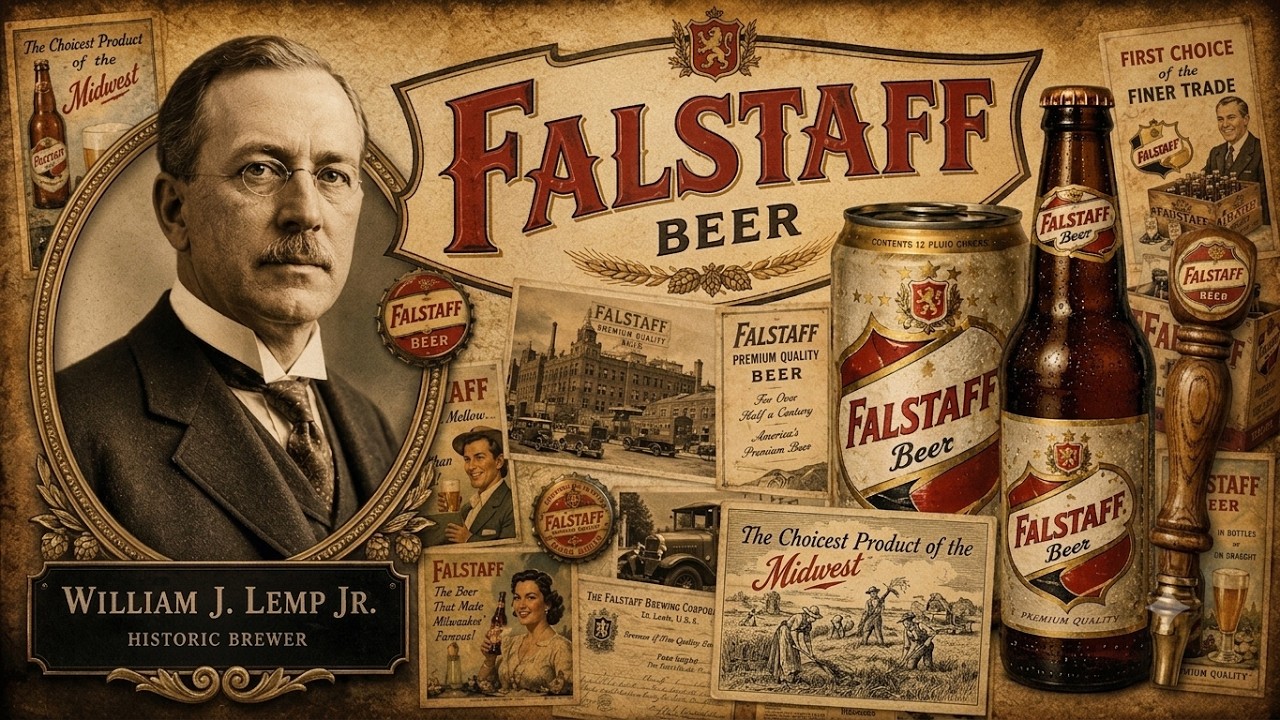
Louis with a brewing trade and a lager recipe. Using natural limestone caves along the river for year-round cool storage, Lemp opened the Western Brewery. The operation grew into a Midwestern empire under his descendants, and in 1903, William J. Lemp Jr.
named a flagship beer after Sir John Falstaff, the larger-than-life character from Shakespeare’s history plays. The dynasty cracked in a single year. Frederick Lemp, the son being groomed to take over, died of heart failure at age 33. When Prohibition shut down the legal beer industry in 1920, the Western Brewery closed.
Two years later, the physical complex was sold at public auction to the International Shoe Company. William Lemp Jr. , described in family accounts as a broken man, agreed to sell the Falstaff name itself to Joseph Griesedieck for $25,000. Later that same year, in the office where the deal had been signed, William Lemp Jr.
took his own life. Joseph Griesedieck, known as Papa Joe, was a St. Louis brewer who had already survived the early years of Prohibition by producing near-beer. His first attempt, a non-alcoholic drink called Hec, failed.
He then raised capital from backers and renamed his company the Falstaff Brewing Corporation. Rather than using the common shortcut of stopping fermentation early, Falstaff brewed full beer and then stripped the alcohol out with a specialized dealcoholizer. The process cost more and took longer, but it meant the company never lost the actual skill of brewing. When Prohibition ended in 1933, Falstaff had a federal permit ready and a workforce that had kept practicing its craft.
What followed was three decades of expansion by acquisition. Falstaff bought the Fred Krug Brewing Company in Omaha in 1936 and the National Brewing Company in New Orleans the same year. The strategy was to purchase the buildings, equipment, and distribution routes of regional breweries that had gone under during Prohibition and never reopened. By 1957, Falstaff had placed third nationally behind Anheuser-Busch and Schlitz, a position it held for years.
At its peak in the 1960s, the company brewed over seven million barrels in a single year. Falstaff built its audience in the American South largely through radio. KMOX out of St. Louis carried St.
Louis Cardinals broadcasts across a vast territory that had no major league team of its own. Broadcaster Harry Caray served as Falstaff’s pitchman, drinking the beer on air during games. Millions of listeners across Arkansas, Mississippi, Tennessee, and Louisiana came to associate the brand with the only major league baseball many of them had ever known. The brand’s cultural reach appeared in song lyrics by artists with no connection to St.
Louis, including Ray Wylie Hubbard and Sheryl Crow. On New Year’s Day 1953, a Falstaff can was found in the car where country singer Hank Williams was discovered dead, a detail noted by historians and biographers. Falstaff’s survival through two national crises helped build confidence. Of the roughly 20 breweries operating in St.
Louis before Prohibition, only a fraction reopened when it ended. Falstaff was one of the survivors. During World War II, the company adapted to grain rationing and manpower shortages, keeping production running rather than waiting out the war. In 1965, Falstaff acquired the Narragansett Brewing Company of Rhode Island.
The Rhode Island government challenged the deal as anticompetitive, and the case reached the United States Supreme Court. In 1973, the Court ruled in Falstaff’s favor. By then, however, the company had spent nearly a decade focused on litigation while Anheuser-Busch and Miller poured money into advertising and modern brewing capacity. The victory confirmed Falstaff had broken no law, but it came too late to preserve the company’s momentum.
In 1972, Falstaff purchased the Ballantine beer brands, a Northeast name with its own history. Ballantine’s business was already declining, and integrating it stretched Falstaff’s finances at a vulnerable moment. By 1974, the company sold its own San Francisco plant to raise cash. By early 1975, Falstaff was losing an estimated $3.
5 million a year and had slipped from third place in national rankings to between sixth and eleventh. That year, Paul Kalmanovitz, a corporate raider who had built a fortune buying distressed companies, took control. In exchange for $20 million in preferred stock and voting control, Kalmanovitz gained control of Falstaff on April 28, 1975. Within months, he dismissed dozens of corporate managers, moved headquarters from St.
Louis to San Francisco, halted plant maintenance, and cut quality control. The original St. Louis operations stopped production soon after, with the historic Gravois Avenue site fully shuttered by 1977. New Orleans closed in 1979.
Cranston, Rhode Island, and Galveston, Texas, closed in 1981. Omaha closed in 1987. By the late 1980s, Falstaff’s workforce had fallen from thousands across a dozen plants to under 500. In 1983, Kalmanovitz acquired Pabst Brewing Company outright, making Falstaff one name inside a portfolio that also included Pabst, Stroh’s, Pearl, and Olympia.
The company that had once been the third-largest independent brewer in America was no longer competing as itself. The last Falstaff brewery, in Fort Wayne, Indiana, closed in 1990. The plant had been bought in 1954 from the Berghoff Brewing Corporation, and it had run longer than any other Falstaff facility. There was no ceremony.
After that, the name became a license owned by Pabst, printed on cans brewed elsewhere by other companies. In 2004, Falstaff sold only 1,168 barrels nationwide. In May 2005, Pabst shipped the last cases and quietly discontinued the label. For the first time since 1920, no Falstaff beer was being brewed anywhere in the United States.
The trademark still exists. Pabst continues to own the rights to the Falstaff name, dormant in its portfolio. The physical traces remain as well. Falstaff’s old plant number ten still stands in the Benton Park neighborhood of St.
Louis, an empty brick building. The Brewery Collectibles Club of America maintains its headquarters in Fenton, Missouri, and Falstaff memorabilia is still traded by collectors. Descendants of the Griesedieck family have returned to brewing in St. Louis under the old GB shield.
The real story of Falstaff is not a failure of craft. The beer never lost the argument. The company survived Prohibition, survived a world war, and won at the Supreme Court. What it could not survive was an owner who was not interested in beer at all, only in extracting value from a company with decades of accumulated loyalty and undervalued assets.
That pattern, a proud regional brewery built by men who knew how to brew, sold to men who only knew how to buy, played out across dozens of American breweries in the second half of the twentieth century.