Roy William Cobb was born on March 4, 1922, in Harlan County, Kentucky. His father died when he was two, and his mother remarried a coal miner sixteen years her senior, with whom she had six more children. Cobb, who went by the name Ray, left school after the seventh grade. Around 1938, at the age of sixteen, he enlisted in the army using a false birth date of November 4, 1919.
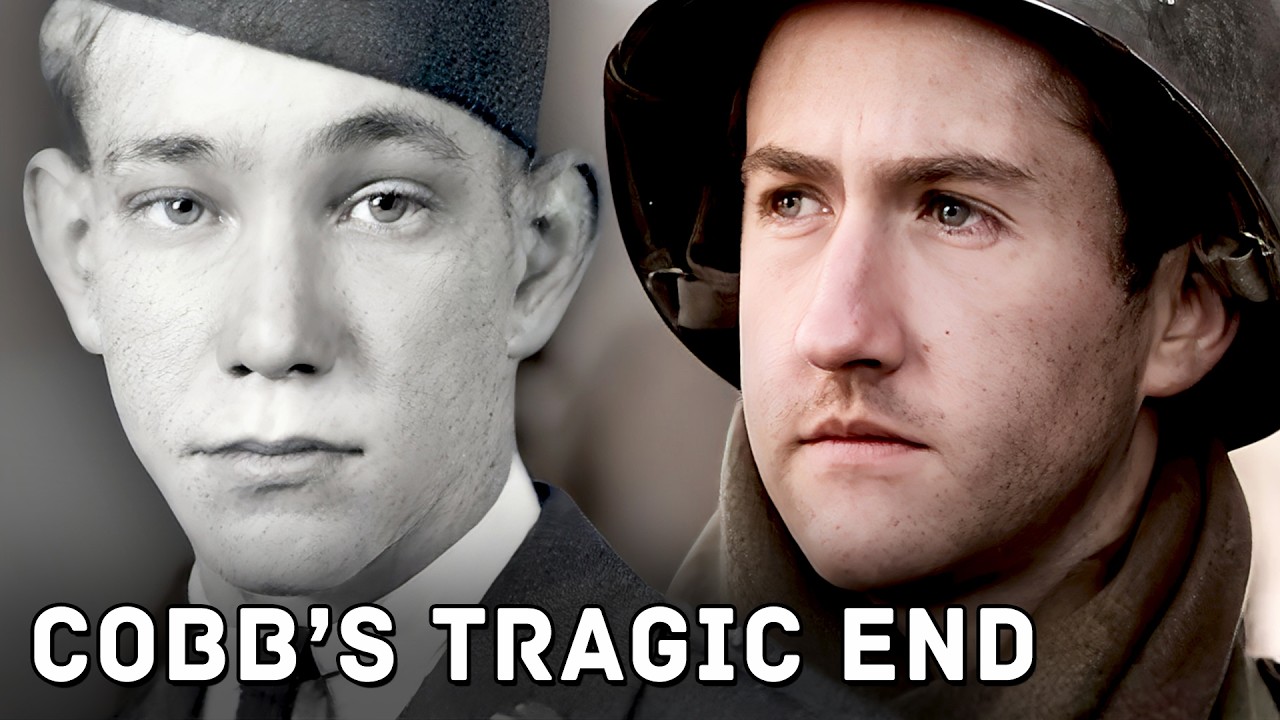
By January 1940, he was a private in Battery C, 68th Field Artillery Battalion at Fort Knox. The battalion was soon converted to armored, aligning with the creation of the 1st Armored Division. From June to August 1942, Cobb was hospitalized with tertian malaria near Belfast, Ireland. According to Stephen Ambrose, he then served with the 1st Armored Division during Operation Torch in North Africa in November 1942, which would make him the only member of Easy Company to have taken part in both a beach landing and an airborne assault.
Ambrose also claimed that the troop ship returning him to America was torpedoed, and that Cobb reached port on a destroyer. No record of such a torpedoing exists, though the incident may reflect the many lesser-publicized convoy losses of that period. After returning to the United States, Cobb volunteered for the paratroopers in 1943. In June of that year, he was with Company A of the 515th Parachute Infantry Regiment at Fort Benning, where he attended jump school.
By November, he had been promoted to private first class at Camp McCall, North Carolina. Shortly after, he joined Easy Company, 506th Parachute Infantry Regiment, linking up with the unit in Aldbourne, England, in the months before D-Day. This means the real Cobb was not with Easy Company at Camp Toccoa in 1942, as the series Band of Brothers falsely depicts. During the D-Day drops, Cobb, a light machine gunner, switched seats on the C-47 with George Luz, who was worried about reaching the door carrying his heavy radio and batteries.
The switch proved disastrous for Cobb. Flak penetrated the fuselage and struck him in the leg. He was unable to stand and remained behind as the rest of the men jumped into Normandy. Private Robert Rader remembered that Cobb was livid, having trained for two years without getting to make the jump.
Two days later, he received the Purple Heart. Cobb recovered and rejoined Easy Company before Operation Market Garden. It is at this point in the series that a fully fictional scene shows him bullying a replacement, only to be confronted by Bull Randleman. The series conveniently leaves out the fact that Cobb had been fighting in the war longer than nearly everyone else in the company and was regarded by the men who knew him as a likable, effective soldier.
David Kenyon Webster wrote that Cobb was invariably good-natured and friendly. Dick Winters described him as hard-nosed, a regular army man who understood combat. Clancy Lyall, who was assigned to look after Cobb, said he was a pain in the butt when drunk, but someone you could count on. Lyall recalled that on one occasion, Cobb got so drunk he started provoking Captain Spears, and Lyall had to drag him away before Spears did something violent.
For his actions during the October 5, 1944 Crossroads battle in the Netherlands, Cobb received the Bronze Star. Winters commended his extremely effective long-distance fire on the retreating Germans, and John Martin also praised his efforts. Rather than portraying these positive aspects, Band of Brothers turned Cobb into a consistently bitter, abrasive, and somewhat cowardly character. The writers needed villains to create drama, and they chose men who were already dead, including Cobb, Herbert Sobel, and Norman Dike, blowing their negative traits out of proportion.
In Hagenau, France, Cobb took part in the February 15, 1945 patrol across the Moder River to capture German prisoners for intelligence. His boat capsized twice in the icy water, and he, along with Thomas McCrary and Melvin Wynn, gave up and returned to shore. The patrol ultimately brought back two Germans but was forced to leave a wounded German soldier on the riverbank. The man, shot in the lungs, could be heard wheezing and crying out in pain throughout the night.
The series shows Cobb responding coldly to a suggestion to end the man’s suffering. In reality, according to Ambrose, it was Cobb who could no longer take the sound and threw a grenade across the river, killing the man and ending his misery. The drunken altercation that closes the episode, in which Cobb argues with Webster and a lieutenant, is fictional. In real life, Cobb, Bill Morganti, and Donald Weisman found cases of schnapps in a house under German observation.
The Germans fired mortars and destroyed most of the liquor, but the men each managed to bring back two bottles under rifle fire. Weisman was nicked in the knee by a bullet. Cobb then got into a drunken fight with Private Bob Marsh at Observation Post 2, after Cobb went upstairs to run a belt through a new machine gun. Cobb was left with a bloody nose and a black eye.
Ambrose claimed Cobb then mouthed off at Lieutenant Jack Foley and had to be tackled to the ground, but this account is almost certainly incorrect. Foley was not at Observation Post 2, and John Martin communicated with the position only by phone from the platoon command post. According to Webster, it was actually Weisman who argued with the officers and was confined to the regimental stockade on February 17, 1945. The morning report makes no mention of Cobb being arrested.
Ambrose, who never spoke to Cobb, likely confused the men or relied on faulty memories from interviews conducted decades later. The series dramatizes these claims by showing Cobb later escorted by military police, implying a court-martial and dishonorable discharge. This is false. Cobb received the Good Conduct Medal on April 12, 1945, less than two months later.
He was photographed in Kaprun, Austria, in July 1945, still in uniform. Clancy Lyall said Cobb was not frustrated about a lack of promotion and had actually reached corporal after Hagenau. Most definitively, Cobb re-enlisted into the regular army on January 9, 1946, which would have been impossible after a dishonorable discharge. While stationed in post-war Europe, Cobb met and fell in love with a Belgian woman named Marie, four years his junior, who had served in the British Auxiliary Territorial Service.
They married in Belgium around 1946 and had a son, Raymond, in 1947. Cobb was discharged from the army on February 27, 1948, and the family moved back to Harlan County, Kentucky, where he struggled to find work as a coal miner. A daughter, Rose, was born in 1949, followed by a son, Gary. Roy Cobb had an older brother, Ty, who served in the Field Artillery during the war.
Ty re-enlisted in December 1945 but died the following year in Babylon, New York, at just twenty-five. His cause of death is unknown. Sometime around 1950, Roy Cobb appeared in the census as a prisoner in the Harlan County Jail under the name Ray Cobb. The reason for the arrest is unknown.
Within a few years, around 1953, Cobb moved to California. It is unclear whether his family went with him, but his obituary does not mention Marie as a survivor, and she did not fill out the form for his veteran’s headstone. When Marie died in 2012, Roy was not listed among those she was preceded in death by. They appear to have separated or divorced around the time of his move.
Marie later moved to Michigan, trained as a physical therapist, and retired at age eighty-three. Roy Cobb lived in California for just over a decade before tragedy struck on April 23, 1964. According to the Sacramento Bee, four men, including Cobb, had been drinking whiskey that afternoon. They got into a car driven by thirty-six-year-old Kenneth Fetti.
Fetti was intoxicated and argued with another passenger, twenty-six-year-old Frank Essick, who was also drunk. Fetti pulled off the road so the two could fight, and in doing so, ran over a nearly three-foot-high reflector marker on Elkhorn Road, about eight miles north of Sacramento. The car stalled on top of the signpost. After the fight, the men tried to free the vehicle.
Cobb and twenty-three-year-old Barry Dyer pushed from behind while Essick pushed from the side. For reasons unknown, Fetti shifted the car into reverse. It shot backward and sideways into a steep drainage ditch, pinning Dyer underneath and Cobb between the bumper and the wall of the ditch. Both men suffered crushed chests and internal injuries and died before reaching the hospital.
Roy Cobb was forty-two years old and working as a farm laborer at the time. Fetti was booked on suspicion of drunk driving and felony manslaughter and was later sentenced to prison for involuntary manslaughter. His record included multiple prior arrests for intoxication and drunk driving, and he was arrested again for drunk driving in 1969 and 1971. Roy Cobb’s body was returned to his hometown, and he was laid to rest in Odd Fellows Cemetery in Pineville, Kentucky.
Much of what has been written about him traces back to Ambrose’s flawed book or the television series that followed it. Among the sixteen books on Easy Company, only a few mention Cobb in any detail, and most draw from Ambrose. Reddit user WBgamer’s extensive research helped restore much of what was known. Cobb was a good combat soldier, generally well-liked by his comrades except when he drank.
He had issues with alcohol, but he was never court-martialed or discharged over his real-life drunken incident in Hagenau. He continued to serve during the Allied occupation until his honorable discharge in 1948. Whatever toll the war, his drinking, and his short civilian life took on him, Cobb deserved to be remembered for the man he was, not the fictional villain created for a television series.