In mid-1942, the Fifth Air Force was losing the war in the Southwest Pacific. Japanese convoys moved almost unchallenged, reinforcing New Guinea faster than Allied forces could respond. High-altitude bombing was ineffective against maneuvering ships. Low-altitude attacks turned bombers into burning wrecks. Crews were dying without landing hits.
The problem was not bravery. It was doctrine. Bombers had been designed for clean, high-altitude runs against fixed targets. None of that applied in the waters around New Guinea. Japanese transports hugged coastlines, changed speed, and zigzagged under cloud cover. From 15,000 feet, even skilled bombardiers could not hit them. When crews descended to improve accuracy, they flew directly into walls of deck gun fire.
July 1942 made the failure impossible to ignore. Eleven A-20 Havocs were lost in a single month. Entire crews burned alive trying to follow doctrine that reality punished. Survivors stopped talking about tactics and started talking about odds.
The aircraft reflected the mismatch. The A-20 carried four .30 caliber machine guns in its nose. They were adequate against trucks and infantry. Against steel-hulled ships, they were meaningless. Bullets shattered or skipped harmlessly away. Japanese gunners could stay at their posts and fire until the bomber died.
One man understood this with mechanical clarity. Paul Gunn was 43 years old, a 21-year veteran who should have been behind a desk. His wife and four children were trapped in a Japanese prison camp in Manila. Every day they survived was borrowed time. He ignored the manuals and the warnings. He took guns from wrecked fighters and built something engineers would later describe as impossible.
Gunn knew the A-20’s limits intimately. He knew that .50 caliber guns firing straight ahead would not make the aircraft agile. They would make it brutal. They would kill deck crews before they could react. They would clear a corridor through which bombs could finally reach their targets.
But the solution created a new crisis. Every added pound moved the aircraft’s center of gravity forward. Too far, and the Havoc would become uncontrollable. Stall speed would increase. Takeoff margins would vanish. The test flight nearly proved the engineers right. The aircraft barely climbed, fighting its own nose, demanding constant correction. It did not want to fly.
For two days, Gunn worked through the problem, shifting equipment aft, recalculating trim, trading comfort for balance. When the second pilot brought it back, shaken but alive, he said only that the airplane felt angry. Angry was acceptable. Failure was not.
The first proof came quietly. Sixteen modified A-20s lifted off and skimmed toward Buna at treetop height. When they arrived, the guns spoke first. Japanese aircraft on the ground disintegrated under a storm of .50 caliber fire. Anti-aircraft crews never found their rhythm. Fourteen enemy planes were wrecked. Every gun position was silenced. Not a single A-20 was lost.
That moment proved the idea could work. Firepower could buy survival. Survival could buy accuracy. Accuracy could finally buy results.
General George Kenney wanted more immediately, but the A-20 had limits. Its range was marginal, its bomb load small, its structure cramped. Gunn needed a larger platform. The B-25 Mitchell offered that space. It was not designed to be graceful. It was designed to be useful.
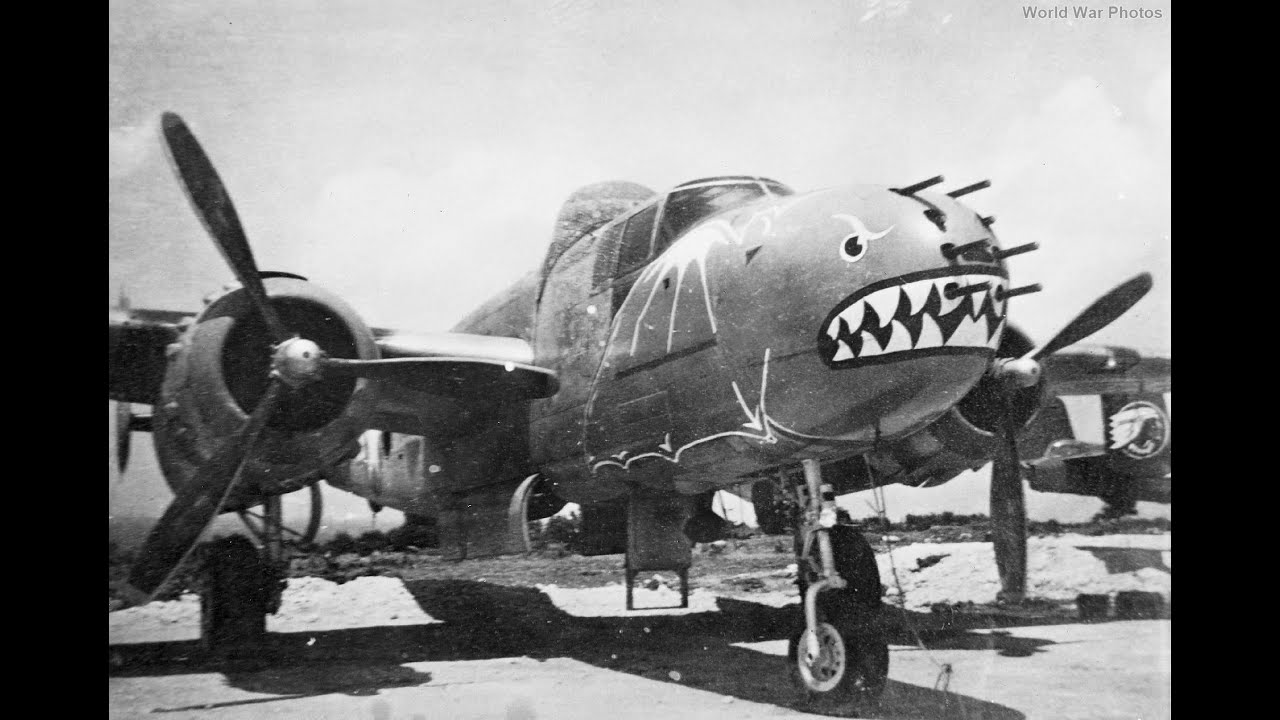
Gunn stripped it down without sentiment. The bombardier was removed. The nose glass went opaque. Four .50 caliber guns went into the nose. Four more were mounted in cheek packs along the fuselage. The top turret was rotated forward. Then more guns were added along the sides. Fourteen forward-firing weapons in total, hurling over 200 pounds of lead every second.
The ground crews named it Pappy’s Folly. They said it half as a joke, half as a prayer. The aircraft looked wrong. It felt wrong. On takeoff, it tried to settle back onto the runway. Gunn flew it anyway, forcing the yoke back with full pressure. Once airborne, the machine transformed. It was stable, fast, and terrifying in a straight line.
Kenney ordered conversions immediately. In Townsville, mechanics worked 18-hour days cutting, welding, reinforcing, improvising. By early 1943, dozens of strafers were ready.
Then the institutional reflex caught up. Blueprints were sent back to engineers in the United States. They studied them carefully, methodically, safely. Three days later, they declared the entire concept impractical. The aircraft was too heavy. The balance unacceptable. Every converted B-25 should be grounded.
Kenney was in Washington when the message arrived. He did not argue aerodynamics. He told them that twelve of those impossible aircraft had just destroyed a Japanese convoy in the Bismarck Sea. Every transport sunk. Sixty more conversions were already underway. The conversation ended there.
The battle that proved everything had begun with intelligence, not guns. Allied codebreakers learned that a convoy was leaving Rabaul. Eight transports, eight destroyers, nearly 7,000 troops. Reinforcements that would decide the ground war in New Guinea.
High-altitude bombers struck first as doctrine required. They dropped more than 100 bombs and achieved nothing. The convoy pressed on. That night, the ships tightened their formation, hugging the coast, convinced dawn would bring safety.
Instead, it brought strafers. At first light, B-25s and modified A-20s came in at mast-head height. They did not dive. They did not circle. They flew straight at the ships. Fourteen guns per aircraft created a moving wall of fire that erased bridges, deck crews, and gun mounts before the Japanese could react. Bombs were released at point-blank range, skipping across the water, detonating inside hulls below the waterline.
Transports burned, broke, and sank in minutes. Destroyers tried to screen, tried to rescue survivors, and were hit in turn. In three days, the convoy ceased to exist. Thousands of troops never reached land. The Japanese never again attempted daylight reinforcement by sea. The operational balance of the entire Southwest Pacific shifted in a single engagement.
Back in Australia, engineers were still drafting reports about why the gunship could not work. The victory forced the system to adapt reluctantly. Production lines in the United States were altered. Field improvisations became factory standards.
Gunn was sent to California to explain what he had built with scrap metal and instinct. He stood in clean offices surrounded by slide rules and stress charts. He had not calculated everything. He had tested it by flying. When aluminum peeled from muzzle blast, he added blast tubes. When balance shifted, he moved weight aft.
The factories refined what he had improvised. Reinforced structures replaced welded frames. Gun mounts were standardized. Center of gravity shifts were calculated precisely. Then they went further. They added a 75 mm cannon to the nose. A tank gun mounted in an aircraft, capable of punching holes through ships with a single shell. The recoil shook the entire airframe. The navigator reloaded it by hand between shots. It was slow, awkward, and devastating.
Hundreds of these aircraft followed. Then thousands. Variants multiplied. More guns, better recoil systems, heavier payloads. The Mitchell evolved into the most heavily armed bomber ever put into mass production.
Gunn returned to the Pacific as promised. His family was still imprisoned in Manila. The strafers kept flying. They hunted barges, convoys, harbors, airfields. They attacked in daylight and then learned to attack at night. Japanese supply routes withered. Daylight movement became impossible. Even darkness offered little protection.
By late 1943, the modified B-25s were everywhere. They struck Rabaul itself, turning a fortress harbor into wreckage in minutes. Gunn flew that mission despite his age, despite his rank, despite the fact that he no longer had to. He flew because every mile forward shortened the distance to Manila.
The public image of success hid the cost. Crews flew at 50 feet above the water through tracer fire and debris, knowing that one engine failure meant no margin for recovery. They trusted machines born from defiance rather than approval.
The rupture did not come in the air. It came on the ground in the early hours before dawn. By late 1944, the strafers were routine instruments of destruction. Their presence shaped Japanese behavior, forced supply movements into darkness, fractured command decisions before they were issued.
On November 27th, the Japanese struck Tacloban airfield in the Philippines. They came low and fast. Fifty-six bombers with fighter escort, exploiting gaps in radar coverage and fatigue. The first bombs fell while Gunn was in the operations tent reviewing plans for the next day’s missions.
The blast wave threw him across the tent. Shrapnel tore through canvas and flesh with equal indifference. A fragment cut into his leg, severing an artery. Another tore into his shoulder. Gunn tried to stand. His first words were not for a medic, but for his airplane. He made it 30 feet before his strength left him.
The surgeon’s verdict was calm and final. He would not fly for months, possibly never again. The wound qualified him for medical retirement. At 45, he could step away. Gunn refused. His family remained behind wire at Santo Tomas internment camp. Food rations were shrinking. Disease was spreading. Intelligence reports grew darker with each week.
When American forces landed in the Philippines, the fighting moved into cities. Manila became a slaughterhouse of stone and fire, defended street by street, room by room. Gunn could not fly combat, but he watched every report, every map, every fragment of information that hinted at the camp’s fate.
On February 3rd, 1945, Santo Tomas was liberated. Three thousand seven hundred prisoners stepped into the light. They were skeletal. They were alive. Gunn flew to Manila the next day against medical orders, legs still bandaged, cane in hand.
He walked through makeshift wards filled with bodies that barely resembled the people who had entered the camp years earlier. His wife weighed less than 90 pounds. His children were thin, sick, exhausted. At first, she did not recognize him. When he spoke her name, the years collapsed at once. The reunion lasted four hours. Then he returned to duty.
His war, however, was already over. The leg wound ended his operational career. Others flew the aircraft he had conceived. Others refined the tactics he had borne. By war’s end, thousands of Japanese vessels lay at the bottom of the Pacific, sunk by bombers that had once been declared unflyable.
Gunn retired quietly. No promotion followed. No parade corrected the record. Some officers still believed his contributions were technical rather than tactical. He did not argue. He had what he wanted. His family was free. The war was ending.
Yet even in peace, movement defined him. He returned to the Philippines and rebuilt an airline from war surplus aircraft, stitching an archipelago back together with flight routes instead of gunfire. He flew constantly, as if standing still might allow the past to catch up.
On a routine flight in 1957, weather closed faster than forecast over the mountains. The aircraft entered cloud and turbulence, climbing for air that was not there. When it struck the ridge, the impact was instantaneous. Paul Gunn died as he had lived, in motion, inside an aircraft, pursuing a destination just beyond the visible horizon.
The institutional conflict did not explode in a single argument. It unfolded slowly across desks and offices far removed from burning seas and jungle airstrips. At its core, the conflict was not about guns. It was about control.
Military aviation doctrine had been built on predictability. Engineers designed aircraft within strict envelopes. Pilots were trained to fly within them. Anything outside those limits was a liability. Gunn’s strafers violated that order. They were born in mud and heat, assembled from wreckage, balanced by feel and flight rather than equations. They worked not because they were elegant, but because they were brutal.
In California, North American Aviation’s engineers approached Gunn’s designs as they would any anomaly. They asked for stress calculations. He had none. They asked for wind tunnel data. He had flown instead. They asked for recoil absorption figures. He pointed to reinforced mounts and said the metal either held or it didn’t.
This was not arrogance. It was field logic shaped by consequences that arrived immediately and without appeal. The engineers did not dismiss him. They translated him. They turned improvisation into process. What Gunn had made survivable, they made repeatable.
But even as production absorbed his ideas, the broader doctrine resisted their implications. Bombers were supposed to bomb. Fighters were supposed to strafe. The strafer erased that distinction. It proved that bombers could hunt ships directly, suppress defenses, and deliver ordnance with surgical violence. It proved that low-altitude attacks, once considered suicidal, could be decisive if the aircraft itself became the suppressive weapon.
This challenged careers, assumptions, entire training pipelines. If doctrine had been wrong, then years of losses had not been inevitable. They had been avoidable. That truth was harder to accept than any technical flaw.
The Battle of the Bismarck Sea forced the issue into the open. There was no way to explain away the results. Entire convoys vanished. Thousands of enemy troops died without firing a shot on land. Japanese command altered strategy permanently.
The strafers spread beyond the Pacific. Other theaters adapted the concept. B-25s hunted German shipping in the Mediterranean. In Burma, they cut supply lines through jungle corridors where ground forces could not reach. Each adaptation added local modifications, further drifting from the original manuals that had once forbidden such designs entirely.
By 1944, the Fifth Air Force’s strafers had destroyed hundreds of ships, thousands of aircraft on the ground, tens of thousands of enemy troops. These were campaign-defining effects. The Southwest Pacific advanced because the enemy could no longer move, resupply, or reinforce at scale.
Gunn continued to innovate even as the system caught up. He added fuel tanks for range, modified cooling systems for sustained fire, refined ammunition feeds to increase reliability. Some aircraft carried rockets, others napalm. None of this existed in manuals. It existed because the enemy adapted and survival required staying ahead by weeks, sometimes days.
War did not reward perfection. It rewarded responsiveness. The same institutions that once warned Gunn’s aircraft would not fly now depended on them. Yet recognition lagged behind reliance. Promotion stalled. Recommendations vanished into bureaucratic silence. Gunn did not fight this. He had never been motivated by rank. Every ship sunk shortened the war. Every airfield destroyed reduced the time his family spent behind wire.
The legacy remained unmistakable. Gunships of later wars carried forward the same logic. Concentrated forward fire, low-altitude precision, overwhelming suppression before the enemy could react. The AC-130, orbiting in darkness decades later, was a direct descendant of those first angry aircraft over Buna and the Bismarck Sea. The A-10, built around a gun rather than a bomb bay, followed the same philosophy. Kill the threat first, then survive long enough to do it again.
After the Bismarck Sea, Japanese commanders rewrote their assumptions. Convoys fragmented at the first hint of daylight. Transports hugged coastlines, crept at night, unloaded in darkness. Fighter cover was increased, then stretched thin, then rendered irrelevant. None of it restored what had been lost, because the threat was not a formation. It was a concept.
Strafers did not need surprise. They generated it. They arrived too low to track, too fast to avoid, too heavily armed to confront. Japanese after-action reports spoke of aircraft that behaved like destroyers, of bombers that killed gun crews before they could fire, of attacks so sudden that crews never reached their stations.
The enemy adapted tactics. The allies adapted faster. As Japanese fighters attempted to intercept low-level attackers, P-38s climbed higher, waiting. As anti-aircraft guns were concentrated forward, strafers attacked from multiple axes. As night movements increased, radar-guided approaches followed. Each countermeasure created a new vulnerability. Each vulnerability was exploited within weeks.
Harbors once considered secure were rendered unusable. Rabaul, the keystone of Japanese power in the region, was neutralized without invasion. Japanese naval planners stopped sending capital ships forward. They could not afford to lose them in shallow water under air attack. Sea lanes that had fed armies now starved them.
Numbers told part of the story. Hundreds of ships destroyed. Thousands of aircraft burned on the ground. Entire divisions denied reinforcement. But the true measure lay in absence. Japanese offensives that never happened. Counterattacks that stalled for lack of ammunition. Garrisons that surrendered without relief because help could no longer reach them.
Factories in the United States fully embraced what had once been dismissed. Forward gun packages became standard. Nose-mounted weapons multiplied. Bombers were redesigned around attack roles rather than altitude alone. The B-25H and J models embodied the philosophy completely, carrying more forward-firing guns than any bomber before or since.
Gunn did not stand on a stage to receive this moment. He watched it unfold from the periphery, injured, aging, quietly aware that the argument was over. When an adversary changes how it fights, it is admitting defeat at a conceptual level. Japanese commanders never again attempted daylight convoy reinforcement in the Southwest Pacific. They never again trusted surface movement under Allied air dominance.
The war’s momentum shifted permanently, not through attrition alone, but through denial. Denial of movement, denial of choice, denial of time. The impossible had not merely functioned. It had forced an empire to concede a theater without a decisive naval battle.
When the war finally ended, the numbers were written down and filed away. Nearly 5,000 B-25 strafers built with forward gun packages descended from one field modification. More than 800 Japanese ships sunk. Thousands of aircraft destroyed on the ground. Tens of thousands of soldiers killed not by infantry or naval guns, but by bombers flying so low that pilots could see faces on decks before they vanished in fire.
But numbers were never the point. Paul Gunn did not change the war by inventing a new weapon. He changed it by refusing to accept a false choice. Altitude or accuracy. Bombing or survival. Doctrine or defeat. He proved that the aircraft itself could become the suppressive force, that survival could be engineered, and that innovation did not require permission when time was measured in lives.
After the war, he did not seek fame. He rebuilt an airline from wreckage, stitching the Philippines together with civilian routes where strafers once hunted ships. He flew constantly, as if motion itself was a defense against memory. His death years later came quietly in bad weather over mountains he had flown many times before. No enemy fire, no explosion, just a reminder that flight, no matter how familiar, always carries risk.
The Philippines honored him. Veterans remembered him. Institutions recorded him imperfectly. History moved on. Yet his legacy never left the sky. Every modern attack aircraft that prioritizes forward firepower carries his logic. Every gunship that suppresses first and strikes second follows the same chain of thought forged in Brisbane.
The engineers were right about one thing. It should not have worked. By every calculation available at the time, it was unstable, overweight, and unsafe. But war does not reward what should work. It rewards what does.
Gunn never complained about the promotions he did not receive or the honors that stalled in paperwork. He measured success differently. His family survived. The Philippines were liberated. The enemy’s supply lines collapsed. That was enough.
History often remembers the generals who give orders and the pilots who fly missions. But it forgets the men who change what missions are possible at all. Men who look at failure and refuse to accept it as inevitable. Men who understand that sometimes the most dangerous thing in war is not innovation, but obedience.