The morning of June 27, 1874, began not with a scream but with a crack—the sound of a cottonwood ridge pole snapping under the weight of a heavy dirt roof. Billy Dixon, a 23-year-old buffalo hunter who would become a legend before sundown, was among the first awake. He stepped out of Hanrahan’s saloon into the pre-dawn gray of the Texas Panhandle to find the source of the noise. Instead, he saw the horizon moving.
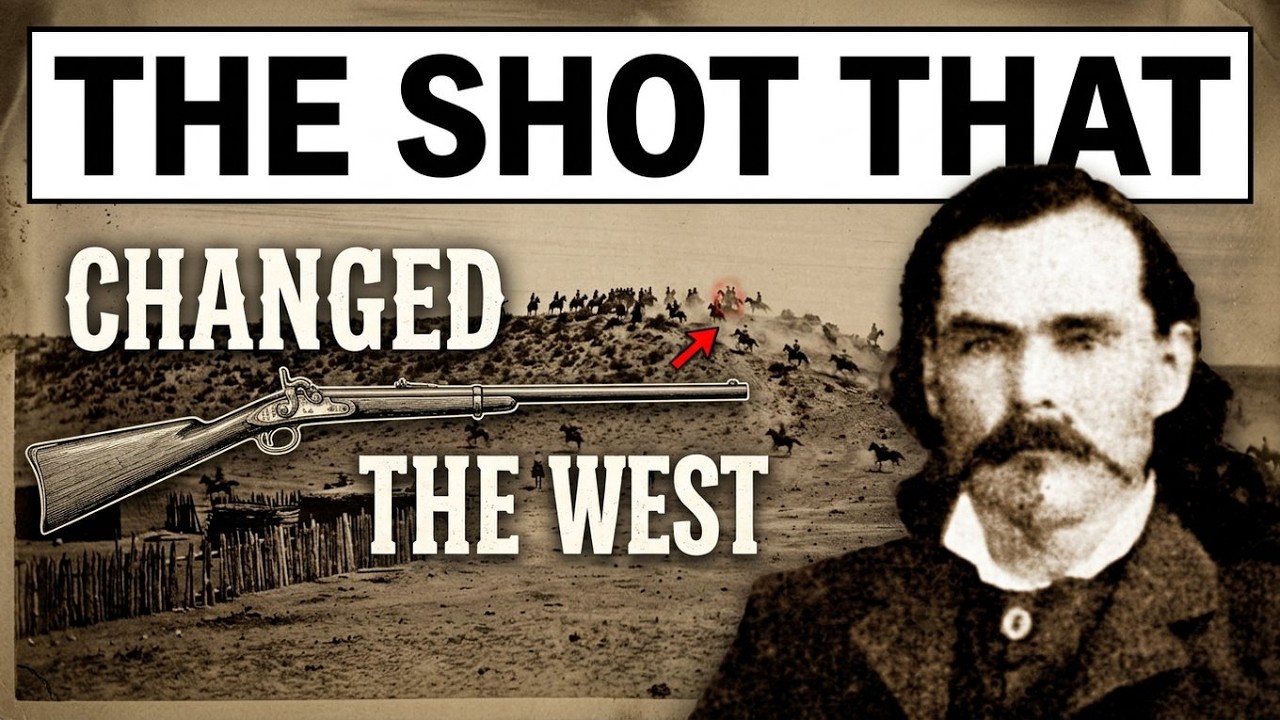
It was not a dust storm or a herd of bison. It was a solid, vibrating line of color—reds, yellows, and whites—stretching from one side of the valley to the other. Nearly 700 Comanche, Cheyenne, and Kiowa warriors were advancing in a formation the American frontier had never seen before: a literal wall of horsemen, shoulder to shoulder, moving at a dead gallop. Dixon later wrote that the sight was so incredible it did not look like war.
It looked like a pageant. The warriors wore full regalia, their horses painted, the morning sun catching the polished brass of their shields and the feathers of their war bonnets. Behind that beauty lay a terrifying tactical reality. The wall was not just a charge; it was a psychological and mechanical hammer designed to flatten the tiny outpost of adobe walls before a single man could find his boots.
To understand Adobe Walls, one must understand the buffalo. By 1874, the great southern herd was being systematically erased by professional hunters like Dixon and Bat Masterson, who killed thousands of animals a week for their hides. For the Comanche and Cheyenne, this was not just an economic loss. It was an existential threat.
The buffalo was their life, their religion, and their food supply. If the buffalo died, the people died. Adobe Walls was a small, illegal trading post sitting in the heart of Comanche hunting grounds, consisting of only a few buildings: a store, a saloon, and a blacksmith shop. It was a target that should not have existed.
The attack was led by a Comanche prophet named Isatai and a young leader named Quanah Parker. Isatai had promised the warriors that his medicine would make their bodies immune to the white man’s bullets. He told them the hunters would be caught asleep, and the wall would crush them before they could reach their rifles. When the charge began, the 28 men and one woman inside the buildings had only seconds to prepare.
The Comanche intended the wall for impact. They did not plan to circle and shoot from a distance, their usual tactic. They meant to ride into the buildings, smash the doors, climb the roofs, and overwhelm the hunters with sheer numbers. As the line swept across the valley, witnesses described a continuous roar.
The warriors blew eagle bone whistles, a high, piercing sound that cut through the thunder of hooves. Inside the sod buildings, the hunters grabbed their Big 50 Sharps rifles. These were not standard military carbines. They were specialized tools designed to kill a 2,000-pound buffalo at half a mile.
Heavy, powerful, and firing a bullet the size of a man’s thumb, they were the first great mismatch of the battle. The Comanche were built for speed and the whirlwind style of fighting where motion was their shield. At Adobe Walls, they were charging a fixed position held by the best marksmen in the world, armed with weapons that could punch through a horse and the rider behind it. The wall hit the buildings with a literal thud.
Warriors backed their horses against the doors, trying to kick them in. They leaned off their saddles to poke lances through the window openings. Billy Dixon described the scene as a living sea of horses and men. For the first two hours, it was a desperate, close-quarters struggle.
The hunters fired through cracks in the doors at men so close they could smell the paint on their faces. After the initial impact failed to break the buildings, the warriors did not retreat. They regrouped and attacked again, then again. Quanah Parker was everywhere.
He had his horse shot out from under him and was wounded by a bullet that grazed his side, yet he kept the wall moving. When news of the battle reached the U. S. Army, officers were stunned by two things.
First, they were shocked by the discipline of the charge. Standard cavalry doctrine taught that the tribes fought in disorganized swarms. But reports from Adobe Walls described a coordinated, synchronized movement that rivaled the best Napoleonic cavalry in Europe. The wall was a sophisticated tactical formation that required immense skill to maintain at a gallop.
Second, the cavalry was baffled by the endurance of the attackers. The Comanche stayed on the field for days, laying a systematic siege to the outpost rather than hitting and running. The real shock came when Isatai’s medicine failed. As the Sharps rifles began to pick off riders at distances that seemed impossible, the psychological wall began to crumble.
This set the stage for the most famous moment of the battle: the shot that changed Western history. On the third day, the Comanche pulled back to a ridgeline nearly a mile away, believing they were well beyond the range of any weapon they had ever encountered. A group of 15 warriors sat on their horses, watching the buildings and planning their next move. Billy Dixon took out his Sharps, rested the heavy barrel on a window ledge, and adjusted the sights.
He was not aiming at a man. He was aiming at a spot in the air, calculating the massive drop of the heavy lead bullet over the distance. He pulled the trigger. The deep boom of the Big 50 echoed for miles.
For several seconds, nothing happened. The warriors on the ridge did not move, likely not thinking the shot was meant for them. Then one of the warriors simply fell off his horse. The distance was later measured by a U.
S. Army survey team at 1,538 yards—roughly nine-tenths of a mile. To the Comanche, this was not just a lucky shot. It was bad medicine, a violation of the laws of nature.
If a white man could kill you from a mile away before you even heard the shot, then the wall was useless. The shot killed more than a warrior. It killed the Comanche’s tactical advantage. The Comanche withdrew, having lost perhaps 30 of their best men, but the psychological cost was much higher.
Adobe Walls marked the beginning of the end for the free-ranging tribes of the Southern Plains. When the U. S. Cavalry arrived at the site a few weeks later, they did not find a textbook military victory.
They found 28 exhausted hunters who had survived simply because they had better tools and the cold-blooded patience to use them. The officers who walked the ground were stunned by the evidence of Comanche bravery. They found horse carcasses piled up against the walls, and lances splintered against the heavy doors. They realized that if the hunters had been armed with standard Army carbines—shorter ranged and less accurate—the Comanche wall would have swept over Adobe Walls in less than 10 minutes.
The Comanche wall was a final brilliant expression of a horse culture that had dominated the American West for 150 years. It was a tactic built on courage, speed, and the belief that a man and a horse were a single invincible unit. But Adobe Walls proved that the era of the horse was being eclipsed by the era of the machine. The Sharps rifle was a factory-made, precision-engineered tool that could eliminate a human being at a distance where the human eye could barely see him.
The U. S. Cavalry took the lessons of Adobe Walls back to headquarters. They stopped thinking of the Comanche as disorganized and began treating them as a sophisticated military force.
Realizing they could not outride the Comanche, they decided to out-logistics them. They stopped trying to win against the warriors on horseback and began attacking the buffalo and the horse herds—the things that made the wall possible. Billy Dixon went on to win the Medal of Honor a few months later at the Buffalo Wallow Fight. Quanah Parker eventually became a successful businessman and a bridge between the old world and the new.
But both men, for the rest of their lives, remembered that June morning in the Panhandle—the sound of the whistles, the thunder of the 700, and the moment the Comanche wall met the reality of a changing world.