In the spring of 1873, a mail carrier named Elias Crowder topped a hill in the Missouri Ozarks and found a church that was not on any map he had ever carried. He had ridden that route for six years. He knew every hollow, every ford, every leaning barn between Rolla and the county line. He knew which dogs would chase him and which farmers would wave.
And he knew, as well as he knew the back of his hand, that there had never been a church in that wilderness. But there it was. Dark stone, blackened by time. A tower rising higher than anything else for forty miles in any direction.
A rose window catching the last red light of evening like a great unblinking eye. It did not look new. It did not look built. It looked as though it had grown there over a thousand years and the forest had simply been asked to step back and make room.
Elias Crowder was not a fanciful man. He convinced himself he had taken a wrong turn. He convinced himself the light was playing tricks on his eyes. Then he saw the church doors were open and candlelight was moving inside.
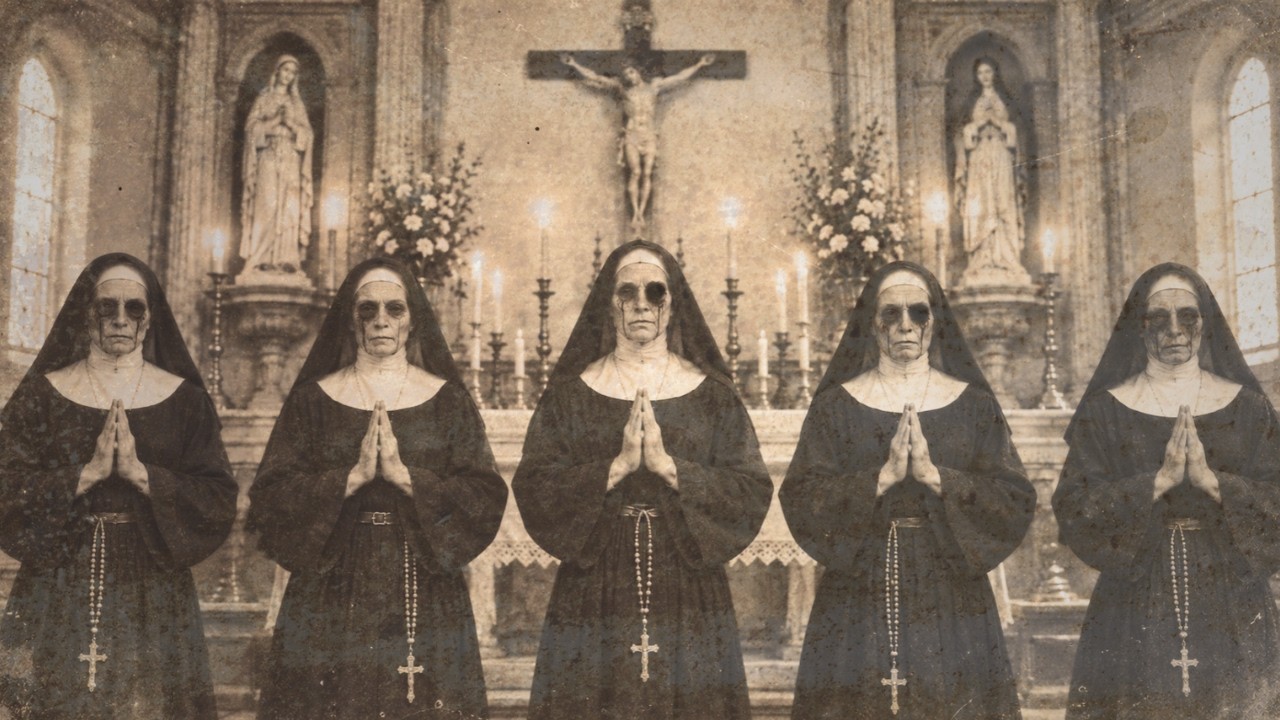
And he did what any decent man in 1873 would have done. He dismounted and went in to see if someone needed help. Inside he found seven women. They sat in the pews as if at morning prayer, hands folded in their laps, heads bowed.
Their clothes were pressed and clean, not a thread out of place. And every one of them had had her eyes removed—not torn, not gouged, but taken with precision, as if something had reached into each face, lifted the eyes away, and then closed the lids behind them with something close to tenderness. There was no blood on the floor. No overturned candlestick.
No sign of any struggle at all. The candles still burned, tall and steady, as if they had been lit only minutes before. Above the altar, carved deep into a stone slab that no frontier mason could have cut with the tools of that century, was a single line of writing. It was not English.
It was not Latin. It was not any alphabet Elias Crowder had ever seen in a Bible, a newspaper, or a court record. The letters were sharp and flowing at once, and the longer he looked at them, the more he felt they were looking back at him. Elias Crowder could not read that line, but he spent the rest of his life trying to forget it.
He never succeeded. He rode hard to the nearest town that dark night, something no sensible man did in that country, because the thought of staying anywhere near that place until morning was worse than any hollow his horse might stumble into. When he finally reached a lit window, knocked on the door, and told a farmer what he had found, the farmer looked at him for a long moment and said something Elias repeated quietly for the rest of his life. The farmer said: “Mister, there is no church in that direction.
There never was. And I’d ask you not to speak that name aloud in my home. ” Elias had not spoken any name. He was sure of that.
The Ozarks of Missouri in the early 1870s were not empty, but they were close to it. This was rough country—steep wooded hills folding into one another, clear cold streams running through hollows so deep the sun reached their bottoms only a few hours a day. The people who lived there were loggers, lead miners, subsistence farmers, and a few hunters who preferred no company at all. Towns were small and far apart.
A settlement of two hundred souls was considered a metropolis. Most people lived their entire lives within a day’s walk of where they were born. The old maps left one particular valley completely blank—not marked as dangerous, simply unmarked, a smooth emptiness where the topographical lines should have been, as if the surveyors had reached the edge of that place and quietly decided to survey somewhere else. That blank spot on the map was where Elias Crowder found the church.
The church was far too large. Later accounts, the few that survived, describe a structure of dressed limestone and dark fired brick, with a bell tower, a vaulted roof, flying buttresses, and a stained-glass rose window. That is a cathedral. That is the kind of building European cities took two hundred years and workforces of thousands to raise.
No one remembered it being built. In a county where the arrival of a single strange wagon was news that traveled fifty miles, and where raising a barn brought together every able-bodied man in three valleys, no one could name the year, the season, or the crew that built Holling Chapel. There were no stories of quarry wagons arriving, no memories of scaffolding, no tales passed down of the day the great bell was hauled to the tower. The building simply appeared, finished, in a place people were afraid to go.
When investigators later tried to trace the structure’s origin, they hit a wall that appears again and again in this story. The records had vanished. Not lost. Removed.
Deliberately, comprehensively, in a way that required real effort and real authority. Before that erasure, there were the Sisters. The seven women who died in Holling Chapel belonged to an order that did not officially exist. When twentieth-century researchers searched for the “Sisters of the Eternal Watch” in the Catholic Church’s American archives, in the records of the Missouri diocese, and in the order registries kept in Rome, they found nothing.
No founding charter. No mother house. No list of professed sisters. No bishop who had ever approved them.
By every official measure, the order that sent seven women to their deaths in that valley was never sanctioned by any church that kept records. And yet they were real. We know they were real because many people saw them, and because a handful of letters survived that should not have survived, hidden in a false bottom of a trunk a family in Arkansas did not open for four generations. Those letters, written in meticulous convent hand, are among the only direct testimony we have from inside Holling Chapel.
They are, frankly, terrifying. The Sisters arrived in the valley in the autumn of 1871, about eighteen months before Elias Crowder found their remains. They came, according to the letters, not to found a mission, not to convert the mountain folk, not to run a school—though they would later take in orphans as a kind of cover. They came, in the words of the sister who wrote most of the surviving letters, “to keep the watch that has continued unbroken since before the sinking of the old world.
” The sister who wrote those words called herself Sister Agnes, though we will never know if that was her real name. Her letters describe a duty she believed had passed down through her order for longer than the order could remember. The Watch. Someone always had to be watching.
Not quite prayer, though there was prayer. Watching. Keeping their eyes, literally, on something that lived beneath Holling, in the sealed lower chamber the Sisters were forbidden to enter and forbidden to leave unwatched. Sister Agnes did not describe the church as a place of worship.
She described it as a covering, a stopper, a seal placed over an opening in the world, the way one might lay a stone over the mouth of a well so that a child does not fall in—or so that something does not crawl out. The seven nuns were not there to serve the church. They were there to serve the seal. And the seal, she wrote, was unimaginably old.
It was not made by the people who now claimed the land. In her oldest surviving letter, dated just a few weeks after their arrival, Sister Agnes wrote a sentence that reads differently once you know how the story ends. She wrote: “The others believe the danger is that the thing below will wake and rise. But I have begun to fear the opposite.
I fear it is never asleep. I fear it has been awake this whole time, watching us, waiting for us to see it in turn. ” Every one of those women lost her eyes. The genius of what happened at Holling Chapel—if horror can have genius—is that it inverts every expectation.
We expect the monster to burst out and devour us. But this thing was perhaps imprisoned to keep anyone from looking at it. We expect the victims to squeeze their eyes shut in terror. But these women had their eyes taken, as if the whole point was the eyes.
The mountain people always knew, deep down, that something was wrong in that valley long before the Sisters arrived. But the Sisters knew what it was. Around the church a settlement grew. It had a name, though you will not find it in any modern atlas.
The people who lived there called it Holling, after the valley, or sometimes just “Downunder the Church,” which tells you something about how they regarded the place. There was lead in those hills, and mining brought men, and, unbelievably, there was work at the church, and that brought families. Because here is another strange fact: the church, though no one remembered who built it, was not empty before the Sisters came. It employed people.
It needed workers, caretakers, a man to ring the bell, women to tend the linens and candles, and it paid them in coin that was good everywhere, coin that seemed to come from nowhere and never ran out. If you were a poor Ozark family in 1870 and a great stone church in a forbidden valley offered steady wages, and asked only that you tend the place and never, ever go down the stairs behind the altar, you took the work. You convinced yourself the stories were only stories. You fed your children on that coin and tried not to hear what came up the stairs at night.
A man named Josiah Bean was one of those workers, and his account, given to a traveling preacher years later and recorded in the preacher’s journal, is the closest thing we have to a description of daily life at Holling Chapel before the end. Bean said the Sisters were kind but distant, and that they slept in shifts so that two of them were always awake in the sanctuary at any hour of the day or night. He said the church had a sound, a low tone that was always present, so deep you felt it in your teeth more than you heard it with your ears. And that the tone changed on certain nights, rising, almost forming words, and on those nights the Sisters would gather at the top of the cellar stairs and sing against it until dawn.
Singing against it, as if the singing were a wall they had to hold up with their hands, and the thing below was pushing from the other side. Bean also said something the preacher underlined twice in his journal. He said that in all his years working at the church, he never saw a bird land on it—not on the tower, not on the sills, not in the yard. He said the birds flew around it in a wide arc, the way water flows around a stone.
And the one time he saw a dog wander into the churchyard, it stopped at the threshold and refused to enter. It made a sound he had never heard a dog make, a sound he declined to describe. Then it turned and ran, and was never seen in the valley again. The animals knew.
The animals always know. And the people of Holling convinced themselves to stay because the money was good and the country was poor. Hunger is the oldest argument on earth. But they developed habits, a kind of fine tradition that a place grows the way a body grows a scar.
No child in Holling was allowed out after the evening bell. No door in the settlement was left unbarred at night, though there was nothing to steal and no stranger within forty miles to steal it. And there was a rule, passed mother to child, that no one in the settlement ever explained and no one ever broke. If you woke in the night and heard the ringing in your house, you did not get out of bed.
You did not light a lamp. You did not go to the window to see what carried the sound so far from the church. You lay still and closed your eyes and waited for it to pass, and in the morning you did not speak of it—not to your family, not to your neighbors, not to yourself. They, too, were keeping the watch.
They did not know that was what they were doing. They thought they were merely cautious, as the poor learn to be cautious in strange country. But the Sisters watched in the church, and everyone watched in their cabins with barred doors and closed eyes and a silence handed down like an heirloom. The whole valley was one held breath, a collective refusal to look, year after year, at something buried that fed on being seen.
The trouble began, according to the letters, in the bitter cold of the winter of 1872. It began small, as these things always do. The tone changed. For as long as anyone in the hollow could remember, the low sound that inhabited the church had held a single steady pitch.
You stopped hearing it, the way you stop hearing a river you have lived beside for years. But that winter, Sister Agnes wrote, the sound began to waver. Just slightly. A tremor in it, like a held breath beginning to shake.
The Sisters noticed it first, because noticing was the essence of their calling. And when they gathered at the top of the cellar stairs to sing against it, as they had done a thousand times before, they found for the first time that the singing did not soothe it. The tremor remained. And beneath the tremor, faint but unmistakable, there was something new.
A second sound answering them. Sister Agnes wrote: “I have spent twenty years in this watch, and the thing below has been silent as a buried stone. Tonight it answered our singing. Not in words, but in a sound like a deep, slow breath drawn through a wet throat.
Sister Beatrice cried and could not stop. I did not cry, only because I understand what that sound means. And understanding it has taken something from me I do not think I will ever get back. It means the seal has begun to thin.
It means that after all these years, it has begun to want to come out. Or worse, it has begun to want us to come in. ” During January and February, the failures multiplied. The candles on the altar, which had always burned steady and tall, began to flicker and lean as if a draft moved through a sealed room.
Milk soured in the Sisters’ storehouse an hour after it was brought in. The orphans they had taken in—six children by then—stopped sleeping at night and began drawing the same picture over and over. The Sisters burned the pictures each time they found them, and the children drew them again the next day without knowing why. Sister Agnes described the picture only once, and briefly.
She wrote that it showed a large circular shape filled with lines branching out from it. “The children call it the sun,” she wrote. “It is not the sun. I have seen what it is.
God forgive me. I looked down the stairs and saw it open, and it is not the sun. ” That is the line that the few historians of this case always return to. Because up to that point in her letters, Sister Agnes had been exact about the single rule governing the entire order.
Do not look down. Keep the watch. Keep your eyes on the seal. Stand with it in the watch, but never descend the stairs, never look directly at what waits below.
The watch was never about seeing the thing. The watch was about preventing the thing from being seen, because being seen, being witnessed, was its way of feeding and growing, its way of entering our world. The watchers’ eyes were exactly what the thing wanted, and so the watchers protected their eyes above all, looking only at the seal, never through it. And Sister Agnes broke that rule.
She went down the stairs. She looked. And in her final letters you can see, in the handwriting itself, the price she paid. The steady convent hand became agitated.
The lines slant downward. Words are crossed out and rewritten. She wrote that after she looked, she still saw it when she closed her eyes—not a memory of it, but it present in the dark behind her lids, looking at her from inside her own head, as if by looking at it she had given it a door, and it had come through, and now lived in the one place she could not stop taking with her. She wrote that she had stopped sleeping entirely, because sleeping meant closing her eyes, and closing her eyes meant being alone in the dark with the thing she had let in.
She wrote that she had begun to understand, too late, the nature of the mercy the order had always promised its watchers. In her last surviving letter, dated the second week of March 1873, just days before Elias Crowder crossed that hill, she wrote: “I know now why the old rites end the way they do. I always thought it cruelty. I see at last that it is the only kindness left to us.
When one of us looks and cannot stop seeing, and carries that thing’s eye behind her own eyes, there is only one way to close that door again. You cannot close it with prayer. You cannot close it with song. You can only remove the door itself.
Tomorrow the Sisters will do for me what I can no longer bear to carry. And then, God willing, they will do it for themselves, one after another, until the watch is broken entirely and the seal is left to hold alone for as long as it can. If you are reading this, it is over. Do not come to the valley.
Do not enter the church. And whatever you do, whatever they tell you, however they try to justify it, do not let them tell you we were killed. We were not killed. We were the last watchers and we did the only thing left to do.
We closed the doors. We closed our own doors on ourselves. We removed the eyes so that the thing could not use them to cross over. ” Seven women, one after another, removing the eyes of the next in line.
An act of desperate mercy dressed in the robes of atrocity—because they believed, truly believed, that their eyes had become windows through which something old and patient was slipping into this world, and that the only way to close those windows was to remove them. The last of them, with no sister left to help her, sat on the pew, folded her hands, and did that last terrible thing herself. Or left it unfinished and allowed the thing to take what it had come for. We do not know which happened.
Elias Crowder found seven bodies with folded hands and closed lids, eyeless, bloodless, without struggle. That image never resolved into a simple explanation. Because there is no simple explanation. There is only the account the Sisters left in their own words, and the choice each of us must make about whether to believe them.
When Elias Crowder reached that farmhouse in the dark and told his story, word spread as it does in isolated places—fast and misshapen. By the second day, a party of men had gone up the hill to see for themselves. They found the church exactly where he said it would be, and they found the seven Sisters exactly as he described them. By every account, those hard mountain men went down off that hill changed.
Many left the valley within a month and never returned. One of them, a man named Tal, was said to have never spoken another word for the rest of his life—thirty more years of silence. The county sheriff was called in. Here the paper trail should begin.
A crime, or what appeared to be a crime, with seven victims. There should have been an inquest, depositions, a coroner’s report, newspaper coverage. The newspapers of Rolla, Springfield, and St. Louis ran stories on far smaller horrors.
There is no record of an investigation. No coroner’s report. No newspaper coverage. Nothing at all.
Researchers have searched more than once, over more than a century. They have searched county court archives, state records, the files of every regional newspaper publishing in 1873, church records, land records, census records, tax records. What they find, again and again, is not exactly silence. Silence would be one thing.
What they find is a gap. A place where records should be, but are not. Census pages that listed a settlement called Holliston in 1870 simply absent in 1880, its residents folded into a neighboring county as if they had never had a name of their own. Land patents referencing a tract that does not appear in the index.
A county whose boundaries were quietly redrawn in the late 1870s in a way that placed the hollow and everything in it under a jurisdiction that lost most of its early records in a courthouse fire. There is always a courthouse fire. Notice how often a courthouse fire appears in stories like this. Someone did this.
That is the unavoidable conclusion. Records do not delete themselves in matched sets across multiple institutions. A settlement does not vanish from the census by accident. Boundaries do not redraw themselves to isolate an unwanted site.
Everyone of those actions required someone with authority acting deliberately, and the coordination across county lines and record types suggests authority well above the level of a local sheriff. Someone with influence, someone with an interest in Holling Chapel not becoming a story outsiders could investigate. They almost succeeded. Were it not for a hidden-bottom trunk in Arkansas, a preacher’s underlined journal, and the faded memory of a mail carrier who could not forget, there would be no story at all.
Only the blank where the story had been. What became of the church itself? This is the part that chills the spine, because it connects Holling to the largest and strangest part of the entire pattern. It was buried—not demolished, buried.
Within a few years of the deaths, the great stone cathedral that had topped everything for forty miles vanished from sight. It was not torn down stone by stone, which would have taken a crew months and left a huge pile of building material someone would have used, sold, or at least remembered. It was covered. People said the hollow had filled in.
They said it was a landslide—a flood of mud that slid down from the surrounding hills in a single season, rose to cover the church’s walls, and kept rising until only the tip of the tower showed above the new ground, and then not even that. Where a cathedral had stood, there was now a new, smooth slope of raw earth, a few years of grass and saplings, and nothing to tell you anything had ever been there except a slight rise in the ground that hikers still walk over today without a second thought. A flood of mud rising against the walls until it swallowed the building to the roofline and beyond. It is the exact signature of something many people are beginning to notice all over the world—buildings buried to their second story in soil with no business being there, ground-floor windows opening below ground level and finding themselves blocked with earth, entire civilizations drowned in mud that geology cannot easily explain and history does not mention at all.
The mud flood, the great burial, the reset. Holling Chapel did not just match the pattern of old-world engineering. It shared the old world’s fate. It was built by hands history cannot name, it sealed something history will not discuss, and when it had served its final purpose it was sunk into the earth and erased from the records—exactly like ten thousand other structures we are asked to justify with a convenient courthouse fire every time.
There is one thread not yet tied. The children. Sister Agnes mentioned six orphans in her letters. Children the Sisters had taken in partly out of charity, and partly, one suspects, as cover—so the church would look to the outside world like a mission and school rather than the strange watchtower it really was.
Six children who stopped sleeping, drew the circular shape with branching lines over and over, and were, as the Sisters said, beginning to hear the same tone the Sisters heard. When the men went up the hill and found the seven bodies in the pews, there were no children in the church. There were no children anywhere in the valley. The six orphans simply vanished, and no account, no letter, no journal, no fragment we possess explains where they went or what became of them.
There are only two possibilities, and both are disturbing. Either the Sisters, in their final hour, sent the children away—out of the valley, to the care of some family or institution far from whatever was coming—in which case those six children grew up carrying something, and their descendants may walk among us today with a family story they think is just a story. Or the children never left the valley at all. They went down, not out.
In the early 2000s, a survey crew conducted an aerial mapping pass over a large area of the Missouri Ozarks using lidar, a laser scanning technique that can strip away vegetation and trees to reveal the true shape of the ground beneath. The survey was routine, for forestry and watershed purposes, and had nothing to do with old horror. But when a local researcher later obtained the data and began looking, out of idle curiosity at that empty valley, he found something in the bare-earth image that made him freeze. Beneath the smooth rise in the ground, beneath the grass and saplings and a century and a half of neglect, the shape of the land was no natural slope at all.
It was a building footprint. The lasers, piercing the vegetation to the true terrain, had drawn the ghost of a great rectangular structure, oriented east to west as churches are, with a long nave and a wider crossing, and at one end a base that could only be the foundation of a tower. The mud had buried Holling Chapel, but it had not erased it. The cathedral was still there, full-size and impossible, holding its shape beneath the hill exactly as the accounts described.
The modern eye, armed with an instrument the builders never anticipated, could see the outline of the thing history had tried to remove. The researcher did what any of us would have done. He went to see for himself. Here the modern accounts become sparse and strange, because the people who have entered that hollow in recent years do not return with clear stories.
They return with fragments. One man reported that his equipment failed on the site—the compass spun, the phone died, the camera recorded nothing but a low rushing sound across a frame of pure black. Another said he found the rise easily enough and the depression at one end where the earth had settled over what he took to be the buried entrance, but he could not bring himself to dig, could not even stay past midday, because the longer he stood on that ground the more certain he became that something beneath his feet was aware of his presence, patient, pleased he had come. And more than one visitor to the hollow has reported the same specific detail, the detail that convinces me something is genuinely wrong with that place and it is not merely a good story attached to it.
They mention that for weeks afterward, sometimes months, they could not stop drawing a particular shape. A large circular shape filled with lines radiating from within it. They draw it without meaning to, on the corners of grocery lists, on the backs of receipts, on the fog of bathroom mirrors. And when they realize what they are doing, they feel a cold drop in the stomach they cannot explain.
The children of the church drew that shape in 1872. Sister Agnes said it was not the sun. And a hundred and fifty years later, people who have never read her letters, never heard her name, stand for one hour on the ground above the buried church and leave driven to draw the very same thing. The image is a signature.
It is the mark the thing leaves on everyone who comes close enough to notice. Before the modern visitors, there were the men who saw it before it was buried. Elias Crowder left his route within the year. He could no longer ride that road—not because of distance or danger, but because it took him within a few miles of that edge, and he could not bear to be that close.
He moved his family east, worked as a stable hand, and lived, as his grandson recalled in an interview in the 1930s, as a man always listening for something. He slept with a lamp burning. He never entered a church again of any kind. When his wife asked why, the only thing he would say was that he did not like the way the ceilings rose.
He never described what he found in detail to anyone in his family. But the grandson remembered one thing the old man said near the end, in the loose, unguarded way of the very old. He said the old man told him: “It wasn’t the faces that were worst. It was that the candles were still burning.
Someone had just been there. Maybe someone was still there. And whatever took their eyes, it did it gently, boy. It did it gently, like it loved them.
Like it loved them. ” Josiah Bean, the caretaker, fared little better. The preacher recorded in his journal that Bean was a broken man when he found him—living alone at the far end of a different county, refusing to keep any animal on his property because, he said, animals can feel things, and he could not bear to watch them be afraid. Bean told the preacher he had not entered the church on the final night, that his shift had ended and he had gone home, and that he had always believed he survived for that reason.
But he also told the preacher that he sometimes wondered whether he had truly survived or had simply been passed over, left for later, because more than once in the years since he had woken in the pitch dark of his cabin absolutely certain that the low tone was in the room with him, that it had followed him out of the valley and across two counties to his very bed. And on those nights, if he opened his eyes, he felt the darkness thicken, as if something were leaning close to check whether he was looking now. At the end of their conversation, the preacher wrote, Bean asked him to pray for him. Then he asked the preacher something the preacher did not clearly know how to answer, and recorded in his journal with a note that his hand was shaking.
Bean asked: “Preacher, when we close our eyes to pray, are we hiding from it, or bowing to it? ” The preacher wrote: “I have no answer to that question. ” I am not sure anyone else does either. A few years ago, a man went to that valley with a camera and a small crew intending to make a short film about the lidar anomaly.
He was not a believer. He was a skeptic, the kind who goes to a haunted place specifically to prove there is nothing there. He announced this online before he went. He posted his plan.
He posted the coordinates. He posted a small, jaunty message about his intention to dig a test hole over the buried entrance to prove to everyone that the great Holling Chapel was nothing but a slab of ordinary limestone and a lot of overheated imagination. He drove there. He posted a photo from the site, the rise in the ground behind him, that shallow depression at the eastern end where the earth had settled.
Then he posted one more thing, a video clip only a few seconds long. And then he never posted anything again. The clip shows the depression at the eastern end of the rise. The man is not in front of the camera.
You can hear his breathing behind the lens and hear his shovel. He has begun to dig. For the first few seconds it is exactly what he promised—a skeptic digging a hole in a field in midday light. Then the sound changes.
A low tone rises from underneath everything, so deep that on most speakers you feel it in your chest before you notice it with your ears, and the man’s breathing changes with it. It quickens, becomes ragged, and the shovel stops. In the last second and a half of the clip before the screen goes black, the camera tilts down toward the hole he has been digging, and you see at the bottom of the raw earth the top edge of something dark and regular and precise—a row of that ringing brick or blade-edged limestone, the first inch of a church buried for a hundred and fifty years—and you hear the man say one word. He says it very quietly, not quite in fear, but with a kind of wonder, the way you might speak in a great cathedral without deciding to lower your voice.
He says: “Oh. ” That is all. That is the last thing anyone has from him. The searches that followed found his vehicle, his tent, his equipment—all untouched, neatly arranged, as if he had simply set everything down and walked away, or as if something had set it down for him.
They found the hole he had dug, though the searchers reported that it had partly filled back in. The raw earth had already settled over that dark, regular edge, the way a wound closes, the way the hollow closed over the entire church in 1873—patiently, precisely, with no hurry at all. They never found him. The case, like every case connected to that hollow, went quiet.
The records grew thin, and within a year or two you would have to work hard to find any official trace that a man had entered that place and not come out. I keep returning to the shape he was digging toward, that dark, regular edge at the bottom of his hole. Because the Sisters gave their eyes to close a door, and the man with the shovel spent the last afternoon of his life opening it. I do not think he had any idea which of those things he was doing.
I think he believed he was debunking a story. I think he believed there was nothing there but rock and rumor. And the last sound he made was not a scream. It was that quiet, wondering “Oh”—the sound a person makes not when they are attacked, but when they finally see something they have been told all their lives is not real.
He looked, after a hundred and fifty years of no one watching, someone finally looked. And whatever the Sisters were guarding, whatever they gave their eyes to keep unseen, it had been waiting all that time in the dark beneath the hill, patient as stone, for exactly that.