On January 20, 1953, the president-elect’s car stopped at the North Portico. Dwight Eisenhower did not get out. Inside the White House, Harry Truman waited in the Red Room, coffee ready for a man who remained in the vehicle. Officially, it looked like a normal transition: the general returning power to the commander who had elevated him.
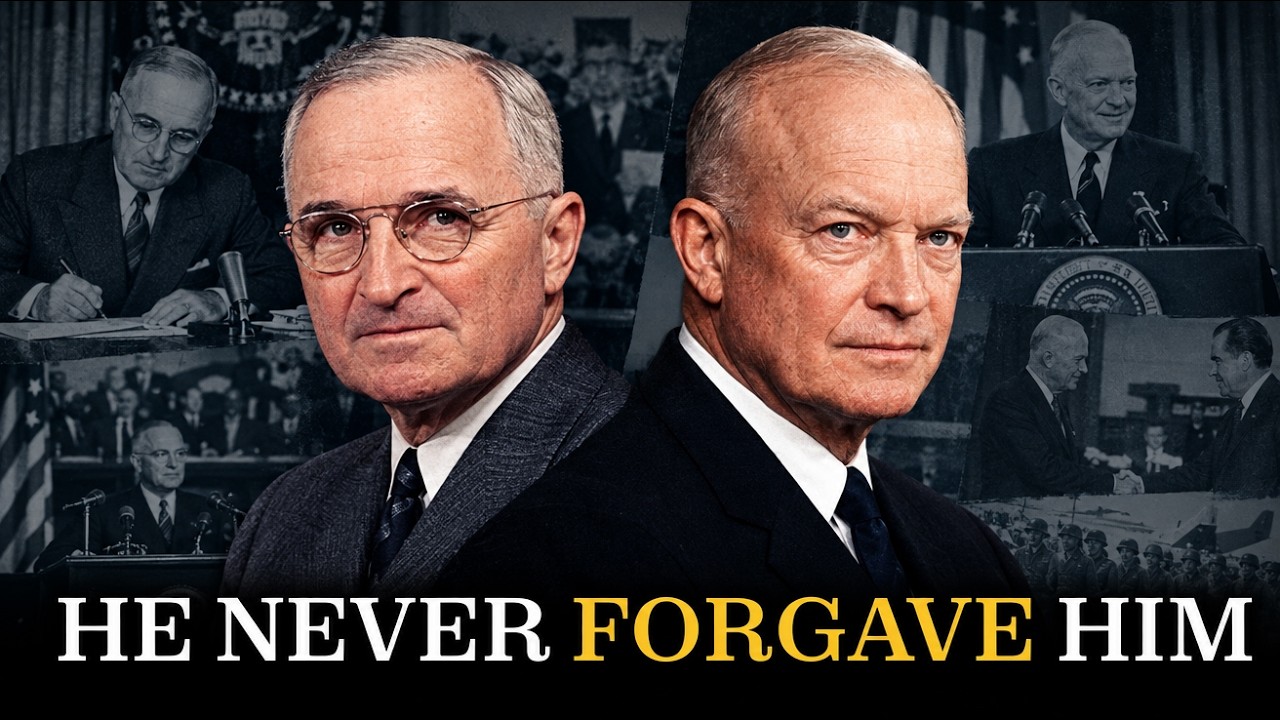
Seven years earlier, Truman had offered Eisenhower anything he wanted, including the presidency. On Truman’s desk sat a globe from Eisenhower’s wartime headquarters, a gift the president had once tried to return. But the breach between them was not about elections. It began with a single paragraph cut from a speech in Milwaukee.
The tradition was simple and old. The outgoing president received the incoming president at the White House, they shared coffee, posed for photographs, and rode together to the Capitol. Herbert Hoover had done it for Franklin Roosevelt in 1933 despite their obvious dislike. Eisenhower did not enter the room.
He sat in the car with Richard Nixon and waited for Truman to come out to him. Eisenhower’s staff later claimed a scheduling misunderstanding. Truman never believed it, and neither did the journalists standing in the cold on Pennsylvania Avenue. There was also the matter of the hat.
Eisenhower’s team hinted he would wear a homburg instead of the traditional top hat, read in protocol-obsessed Washington as a deliberate refusal to inherit anything from the man he was replacing. Truman wore a homburg too, unwilling to be the only man in Washington dressed for a funeral that was not his own. Then came the ride. Two men in the back seat of a car, three quarters of a mile, photographers lining the route, and, according to Truman, nearly total silence until Eisenhower brought up his son.
Major John Eisenhower was serving in Korea and had been ordered back to Washington for his father’s inauguration. Truman claimed Eisenhower asked who had pulled John from the battle zone, suggesting the order was designed to embarrass him. Truman said he answered that the President of the United States had done it, that the President believed a son should watch his father take the oath, and that if Eisenhower thought someone was trying to humiliate him, the President took full responsibility. Eisenhower remembered the conversation differently.
In his account, he raised the matter of John’s orders and mentioned no mutual insult. Both men were writing for history and knew it. The version that stuck was Truman’s, partly because it was sharper, partly because Truman repeated it for twenty years to anyone with a notebook. But the fact that does not depend on memory is this: after that car ride, Harry Truman never entered the White House while Dwight Eisenhower lived there.
Eight years, two full terms. A living former president, a Missourian neighbor, never received a single invitation. Truman’s first return came in November 1961 under John Kennedy, who invited him back and let him play the piano in the East Room. This was not mere coldness.
This was policy. The question that dominates everything is not whether these two men disliked each other. Everyone could see that. The question is why the hostility burned for so long between two men who spent the 1940s writing about how much they admired each other, because they genuinely did.
The correspondence exists. Truman wrote to Eisenhower with a warmth he showed almost no one outside his family. Eisenhower replied with formality occasionally touched by something like affection. They were not natural enemies.
They were something more combustible. Truman was Eisenhower’s patron, and to understand what that meant to Truman, and why a broken obligation could become a two-decade grudge, you have to know where he learned the arithmetic of service. Truman learned it in Jackson County, Missouri, inside a political machine run by a man named Tom Pendergast. Truman came from a string of failures that would have ended most political careers before they began.
He wanted West Point and could not go; his eyesight prevented it, which is why he wore thick glasses in every photograph and spent the rest of his life in awe of men who had received the education he was denied. He farmed. He invested in a zinc mine and a dubious oil venture and lost money in both. In 1919, after returning from France, he opened a men’s haberdashery in Kansas City with an army friend named Eddie Jacobson.
The store failed in the 1922 slump, leaving him in debt. He refused bankruptcy and paid his debts over more than a decade. People who knew him then said it was not about the money but about a ledger he kept in his head. What you owed, you paid.
And he never forgot the men who stood by him while he did. Eddie Jacobson remained a lifelong friend, and in 1948 he walked into the Oval Office to argue the President of the United States into recognizing Israel. He received a hearing that professional diplomats could not get. The war gave Truman the other half of his identity.
Captain Harry Truman, Battery D, 129th Field Artillery, France, 1918. He led about 190 men, mostly tough Irishmen from Kansas City who had deposed their previous officers, and he brought nearly all of them home. He stayed in touch with those men for fifty years. Some marched in his 1949 inaugural parade.
He admired soldiers with the eagerness of a convert, especially those who had received the training he never got. Then came Pendergast and his machine, which made Truman a county judge in 1922, rebuilt him after defeat in 1924, and sent him to the U. S. Senate in 1934, where he arrived as “the Pendergast senator” and spent years trying to shed the label.
He never pretended otherwise. He said plainly that he had never lied to Tom Pendergast and Pendergast had never lied to him. He also said the machine never asked him to do anything dishonest, a generous interpretation historians have debated ever since. What matters is not whether Truman was clean.
He was personally clean by every scrutiny anyone ever made. What matters is what the arrangement taught him. In a political machine, promotion is a deal with moral weight. Someone spends their capital on you.
You do not have to agree with them on everything. But you have to remember who paid. In January 1945, Pendergast died in Kansas City, disgraced, out of prison, politically ostracized. Truman was then the vice president-elect.
Every advisor told him to stay away from the funeral. He flew on an army bomber, sat in the church, and told reporters that Tom Pendergast had always been his friend and he had always been Pendergast’s friend. Remember that, because it is the clearest window into the man’s character. Harry Truman would accept public insult before he would let people see him abandon those who had raised him.
He considered debt permanent and repayment non-negotiable. Now add the final piece: the one man Truman revered above all others, George Catlett Marshall. Truman called him the greatest living American. He said Marshall won the war.
He recalled him from retirement twice, first as special envoy to China, then as Secretary of State in January 1947. Then, at sixty-nine, as Secretary of Defense in September 1950, when Korea was collapsing and Truman needed the one man in America whose integrity no one questioned. Marshall was, for Truman, living proof that the professional soldier he had failed to become actually existed. And Marshall, not coincidentally, was the man who made Dwight Eisenhower.
Everyone knows Eisenhower rose fast. Few know how unnaturally fast. In 1939 he was a lieutenant colonel without combat command, just a staff officer, one of hundreds. Marshall summoned him to the War Plans Division in Washington in December 1941, watched him for six months, then elevated him above more than 300 senior officers to command U.
S. forces in Europe. Marshall made him. Marshall protected him.
Marshall gave up his own chance to command the invasion of Normandy, the job every professional soldier in the world wanted, and Eisenhower got it instead. This is not a minor fact. It is the cornerstone of the entire story. Because in October 1952, Dwight Eisenhower stood on a platform in Milwaukee next to a senator who called George Marshall part of a conspiracy so immense it rivaled anything in human history, and did nothing about it.
And Harry Truman, the man who spent twelve years paying off a clothing store debt and flew to a corrupt boss’s funeral against all advice, decided he had finally seen the core of Dwight Eisenhower’s character. But in the summer of 1945 none of that existed yet. There was only an un-elected new president sitting in a borrowed villa outside a destroyed German capital, looking for allies with more standing than his own. Harry Truman had been in office eleven weeks.
He had not even been told about the atomic bomb until after he became president. Roosevelt’s men treated him as a temporary caretaker. He had never been to Europe except as an artillery officer, and now he had come to Potsdam to divide a continent with Stalin and Churchill. Somewhere in the motorcade was the most popular man in America, assigned to show him what remained of Berlin.
The flag had been raised over the American sector on July 20, 1945, and the new president stood amid the ruins of a city he had only read about in books. Eisenhower was there as theater commander, and at some point during those days the two men sat together in a car and drove through what was left of Berlin. In Truman’s account, the general listened while the president made an extraordinary offer. Truman said he told Eisenhower that there was nothing the general might want that the president would not help him get, and that this included, certainly and specifically, the presidency in 1948.
Eisenhower’s version in his memoirs is not a denial. He remembered the offer and his reply: he did not know who the president’s opponent would be, but it would not be him. Two things deserve attention. Truman meant what he said.
His own Potsdam diary from those same weeks is full of frank assessments of everyone around him, and the entries about Eisenhower read like a man who had found someone he could trust in a job he had not asked for. He wrote that Eisenhower was a fine companion and a good man, and that he would be happy to help him get anywhere he wanted. And Truman had been in office eleven weeks and was already thinking about who would be strong enough to take over. That is not the psychology of a power-hungry man.
It is the psychology of a man who inherited a throne he suspected belonged to someone else. Look at what each man actually needed from the other in that car, because that was the original agreement, and every rupture that followed was a violation of terms set in Berlin. Truman needed borrowed legitimacy. He had no popular base outside Missouri, no war record in this war, no mandate, and a cabinet full of Roosevelt men who considered him an administrative mistake.
Eisenhower was the most popular man in the Western world. Four million people had lined the streets of New York for his parade. His name in a Truman appointment conferred something Truman could not manufacture: the sense that the adults were still in charge. Eisenhower needed a protector.
This part is lost because we remember him as inevitable. He was not. He was a five-star general in a country about to discharge twelve million soldiers, dismember the army, and fight a fierce internal war over whether the air force and navy would swallow the ground forces entirely. The army needed a president who would not allow that, and Eisenhower needed a civilian patron who would let him say unpopular things publicly without being destroyed for it.
They were useful to each other. That is not a cynical reading. Genuine warmth and mutual benefit rode in the same car. In November 1945, Truman made it official.
Marshall was finally allowed to retire, and Eisenhower succeeded him as Chief of Staff of the Army. Eisenhower hated the job. He said so at the time and never stopped saying it. The chief of staff in 1946 was not a strategist; he was the man who had to stand before Congress and explain why soldiers were not coming home.
There were troop demonstrations in Manila, Frankfurt, and Honolulu. Mothers mailed baby shoes to congressmen. The army Eisenhower had led in Europe, the largest force America had ever fielded, was being dismantled around him at a pace he considered reckless. He spent two years defending a policy he believed in his core was undermining the country’s ability to fight.
Meanwhile, Truman was collapsing. The 1946 midterms were a slaughter; Republicans took both houses of Congress for the first time since Hoover. Meat shortages, strikes, inflation. The joke was that “to err is Truman.
” His approval fell into the low thirties and kept falling. Senator William Fulbright, a Democrat, publicly suggested Truman appoint a Republican Secretary of State and resign so that man could take over. Put those two facts side by side, because they define the relationship for the next six years. The most admired man in America worked directly for the least admired man in America, and both knew exactly which one the public preferred.
Truman never acted as though it threatened him. That is the strange and generous thing about that period. He gave Eisenhower unusual freedom, supported him in the unification battles that produced the National Security Act of 1947, and treated him like a colleague he was grooming more than a subordinate. He also did Eisenhower a financial favor, which matters in this story more than it seems.
When Eisenhower left the army in February 1948, he wrote Crusade in Europe, dictated it quickly, sold it massively, and had it taxed under a ruling that treated the proceeds not as ordinary income but as capital gains on something he had created once and sold once. The Truman administration’s Treasury Department granted that treatment. The practical result was that Eisenhower kept a fortune that would otherwise have been eaten by wartime tax rates. Estimates of his earnings run to around half a million dollars, enough to make a man who had lived his entire adult life on an army salary financially independent for the first time in 1948.
Four years later, the Republicans ran against the Truman administration on corruption and favoritism in tax decisions. No one on the platform mentioned that particular case. Independence is what to watch. Book money bought Eisenhower something no general had: the ability to say no.
Almost immediately, people began asking him to say yes. In 1948, the Democratic Party tried to draft him against the president who had already promoted him. This is one of the strangest episodes in American political history, usually told as an aside. It was no aside to Harry Truman.
Liberal Democrats concluded Truman was a certain loser. Jimmy Roosevelt, the late president’s son, organized a campaign for Eisenhower. Hubert Humphrey, Claude Pepper, and big-city bosses joined. Americans for Democratic Action, the liberal conscience of the party, searched for a general with no known political opinions to replace the sitting Democratic president on the Democratic ticket.
They did not know if he was a Democrat. No one knew. That was the secret of his appeal. Clark Clifford had seen it coming.
His long strategy memo of November 1947, the famous document that mapped the 1948 campaign, treated Eisenhower as a present danger and the only candidate against whom Truman’s approach would not work. Truman read the memo. He knew his party was shopping. Eisenhower ended it twice in July 1948 with statements of refusal so categorical that his draft movement died within days of the convention.
He said he could not accept the nomination for any public office or participate in partisan political contests. Here the records divide in a way that poisoned everything afterward. In Eisenhower’s memoirs and the accounts of those around him, there is a claim that Truman himself made a second offer during this period, telling Eisenhower he could have the Democratic nomination and Truman would run for vice president on his ticket. Truman denied it categorically for the rest of his life, calling it a lie.
Historians remain divided. Eisenhower’s diary entry exists, and Eisenhower was a habitual diarist at the time, which is strong evidence of what he believed happened. Truman’s denial is a later denial by a man with every reason to deny, and it is weaker evidence. The interesting thing is what the debate reveals.
Both men, years apart, chose to remember a 1948 conversation in the way that made the other look worse. Truman wanted a record proving he never begged. Eisenhower wanted a record showing the presidency was offered to him twice and he refused it twice. Then Truman won.
Against every poll, every columnist, and the liberal wing of his own party, he beat Thomas Dewey in November 1948 and earned the office for the first time. That win changed the relationship in a way no one noticed at the time. It ended Eisenhower’s usefulness to Truman and began Eisenhower’s usefulness to Truman. Before the election, Eisenhower was the man who might have to save the Democratic Party.
After it, he was a retired general running Columbia University in New York, writing a book, and available. Columbia was never a real solution. Eisenhower arrived in 1948 as president of a great institution with no academic background, and the faculty treated him roughly. He was bored.
He spent his time raising money and giving speeches about what he called middle-of-the-road Americanism, and the men who came to see him at 60 Morningside Drive were not professors. They were Lucius Clay, his old colleague from the occupation of Germany. Thomas Watson of IBM, a Columbia trustee. Oilmen, publishers, and a Pennsylvania governor named James Duff.
The question they kept asking was whether he could be persuaded, and to which party he belonged. Truman knew all of this. He had an intelligence-approaching view of American politics and a strong memory of who was raising money for whom. He was also, in 1949 and 1950, watching the postwar order he had built collapse.
The Soviet bomb. The fall of China. The invasion of South Korea in June 1950, and an army that he and Eisenhower had together allowed to be gutted. He needed a name in Europe big enough to make the alliance real.
There was only one. In December 1950, Harry Truman recalled Dwight Eisenhower to active duty and sent him to Paris. Reward, rescue, and fortification all in one stroke. The appointment came from a decision Truman had already made in principle: NATO, signed in April 1949, was just paper until someone backed it with a real army.
Congress had ratified the alliance. No one in Europe believed in it. The French doubted the Americans would stay. The Germans were not yet allowed to rearm.
The British wanted guarantees that Washington would not repeat 1919 and go home. What the alliance needed was not a strategist. They had plenty of those. The alliance needed a name that would make the French, Belgians, and Dutch accept unified command again.
There was one name on earth with that authority, because he had done it before. Truman announced it in December 1950. Eisenhower flew to Paris in January 1951 as Supreme Allied Commander Europe. He established SHAPE headquarters at Rocquencourt outside Versailles and went on a rapid tour of capitals to convince them Western Europe could be defended.
Now consider the timing. Truman made that decision while things were going badly in Korea, with Chinese intervention pushing American forces back down the peninsula and MacArthur’s open insubordination beginning, leading to his dismissal the following April. Truman needed stability in Europe and wanted someone in charge whose judgment he trusted more than MacArthur’s. That is the honest and sufficient explanation for the appointment.
It is also true that the appointment returned Dwight Eisenhower to military service fourteen months before the New Hampshire primary. A serving officer cannot campaign. He cannot make partisan speeches, accept a nomination, or answer political questions without violating the rules he had lived under for forty years. Truman had just put the most attractive potential candidate in America into the one position in the world that would make running for president look like dereliction of duty.
Was that the plan? No document exists in which Truman says so. Many biographers have noted the convenient timing and refused to jump to conclusions, and they are right to be cautious. Truman’s letters from that period reflect a man genuinely worried about Europe, not a man setting a trap.
But Truman was a seasoned politician who had spent thirty years watching how men are pushed into corners through promotion. He understood better than almost anyone alive what a prestigious overseas post did to a domestic political future. The appointment was a genuine necessity. And the side effect was not hidden from him.
The result was entirely the opposite, because Paris became the best campaign headquarters ever built. Consider what the Allied command actually gave Eisenhower. It gave him his own command, his own staff, his own press corps, and daily front-page coverage of a man doing noble, nonpartisan work. It kept him out of Washington, where every politician gets soiled by the fray.
It made him unavailable for the ugly primaries of 1951 while his supporters organized without him. And it put him in a place where visitors from home could come to pledge loyalty in secret, where the transatlantic flight itself acted as a filter. Only the serious ones crossed the ocean. They crossed it.
Lucius Clay came. Pennsylvania Governor James Duff came. Senator Henry Cabot Lodge came and left believing he had secured a candidate. Harold Stassen came.
Thomas Dewey’s aides came. In September 1951, Eisenhower met a delegation of businessmen who had raised money for an undeclared candidacy. He told them repeatedly that he would seek nothing. Meanwhile, another group of men were flying to Paris for a different reason.
The conservative wing of the Republican Party wanted Robert Taft, and Taft’s men knew only Eisenhower could stop him. Taft himself came in 1951 and asked Eisenhower the question that proved decisive: whether he would commit to the collective defense of Europe. Taft refused to commit. Eisenhower later said that conversation convinced him the isolationists might take over the Republican Party, and that he might be the only man who could prevent it.
That was his stated motive for running, and it is supported in his diary and letters from the period. It is also the motive that let him tell himself he was not breaking any promises to anyone. By December 1951, Truman had heard enough. Lodge was organizing openly.
“Eisenhower for President” committees were multiplying. So the president did something that looks almost naive to us today. He wrote to the general and asked directly. The letter is dated December 18, 1951.
Truman said the political situation was in chaos, that he did not know what Eisenhower’s ambitions were, and that if the general wanted the Republican nomination, Truman would not stand in his way, but he wanted to know. He also noted, in wording that has divided historians for seventy years, that he was ready to do whatever was best for the country, which many biographers read as another implicit offer to step aside for an Eisenhower Democratic candidacy. Eisenhower replied on January 1, 1952. He thanked Truman, said he had never sought a political nomination and never would, and that he was carrying out a military mission he considered vital.
Then he added the reservation that would become the fracture in the whole affair. He did not believe any American could ignore an unambiguous call to political duty. Read that again. He would not seek it.
He would not refuse it. Five days later, Henry Cabot Lodge held a press conference in Washington and announced that General Eisenhower’s name had been entered in the Republican primary in New Hampshire, that he was a Republican, and that he would not withdraw. Lodge stated plainly that he was authorized to say so. Eisenhower confirmed it from Paris on January 7.
He said Lodge’s statement about his political affiliation was accurate, that he would not seek the nomination, but that he would not stop anyone from voting for him. Check the calendar. January 1: I will not seek a nomination. January 6: my name is on the ballot and my agent is authorized to say I am a Republican.
January 7: that is correct. Truman read that sequence as a lie told to his face in writing. And here, for once, we do not have to guess his interpretation, because he began telling people immediately. He complained that Eisenhower wrote one thing and did the opposite within a week.
In his later writings he was harsher, describing a man who had allowed himself to be captured by people he had been warned about. Eisenhower’s defenders have a real answer, and it should be stated. Nothing in the January 1 letter is technically false. He did not seek the nomination.
Lodge did it for him. He never asked to be on the New Hampshire ballot. Under the law, he could not easily have withdrawn even if he wanted to. And he remained in uniform until June, costing him five months of campaigning he desperately needed.
All of that is accurate. It is also almost a perfect demonstration of the thing people who dealt with Eisenhower for decades had noticed. His genius was in arranging events so that other men pushed him toward what he wanted while his own hands remained technically clean. He had done it with generals during the war.
He did it here. Truman, who had spent his life in a system where you announced your candidate plainly and bore the consequences, found the style contemptible. Not just wrong. Contemptible.
That difference is what made the quarrel personal rather than political. The winter of 1952 was the worst period of Truman’s presidency. Korea had settled into a bloody stalemate at the 38th parallel with truce talks stalled. His approval rating fell to 22 percent, the lowest of any president to that point, and corruption stories were spreading like a cancer.
This part matters to the relationship because it became the central charge of the campaign against him. Charges were brought against Internal Revenue collectors. A White House assistant had accepted a deep freezer. Another figure in his orbit had received a mink coat.
The Reconstruction Finance Corporation had handed out loans to well-connected people. Truman had to fire his Attorney General in April 1952 after he obstructed the investigation into the mess. None of it touched Truman personally, and no serious historian has ever claimed otherwise. He left office almost broke, moved back into his mother-in-law’s house in Independence, and had to sell farmland to stay solvent.
But the man who insisted loyalty was a permanent debt had a matching flaw. He was loyal to men who did not deserve it and defended them long past reason, because abandoning a friend under pressure was, in his moral system, the real sin. On March 29, 1952, at a Jefferson-Jackson Day dinner in Washington, Truman announced he would not run again. He had made the decision privately as early as 1950 and recorded it in writing.
So this was not a collapse. But the effect was immediate and structural. A president who is not a candidate has no future to trade on. His remaining assets were his record, his party’s control of the nomination, and the respect of the men he had himself promoted.
Within three months, the last of those evaporated. Eisenhower resigned his command, came home in June, and won the Republican nomination in Chicago in July after a bitter credentials fight against Taft. Then the campaign began, and it was not what Truman expected. The Republican formula that fall reduced to three words: Korea, Communism, and Corruption.
Every one of them was an indictment of Harry Truman by name, not of an abstract Democratic Party, not of the candidate Adlai Stevenson, but of the administration in which Eisenhower had served, whose army he had run, whose alliance he had built, and whose president had offered him the presidency twice. Eisenhower spoke of the mess in Washington. He accused the administration of losing China, fumbling Korea, and tolerating thieves. He said the men who made the Yalta and Potsdam agreements had abandoned Eastern Europe, a striking irony from a field commander who had been in those rooms.
Truman did what Truman always did. He went out on a train in a campaign that was not his and attacked the man he had himself promoted. He said the general had been deceived by professional politicians. He said in one speech that he regretted Eisenhower had allowed himself to become the candidate of men who had opposed everything he had spent his career building.
He told crowds that the Republican candidate had supported the Marshall Plan and NATO when he worked for Truman, and was now running with the men who had voted against them. That last charge was fair and it landed. It was the closest Truman ever came to naming the real grievance. His argument was never that Eisenhower held wrong opinions.
It was that Eisenhower stood with men who held wrong opinions because those men could secure the nomination. Which brings us to Wisconsin, and to a paragraph written by a speechwriter, whose deletion was advised by a governor’s aide, and which nonetheless remained in the advance text handed to reporters when the deletion occurred. The senator waiting at the Milwaukee arena that night had stood eighteen months earlier on the Senate floor and read a sixty-thousand-word speech accusing George Catlett Marshall of participating in a conspiracy so vile that its leaders, once exposed, would deserve forever the curses of all honest men. Eisenhower had been asked to comment on Marshall for months.
In Denver that August he defended him unequivocally, saying that if Marshall was not a loyal American, he had never met one. He told his staff he would not yield on this matter. He was scheduled to say it again in McCarthy’s home state, on McCarthy’s platform, with McCarthy sitting behind him. The Wisconsin problem had been building since the primary.
McCarthy was running for reelection in 1952 and would win. The state’s Republican organization was built around him. The national ticket needed Wisconsin’s twelve electoral votes, and Eisenhower, who privately despised McCarthy in terms his aides recorded, had to campaign across the state on the same train, the same platforms, before the same crowds. The compromise his staff reached was that Eisenhower would appear with McCarthy but would defend Marshall while doing so.
He would take the hit in McCarthy’s own backyard. That was the plan, and it was his plan. The paragraph was written because he asked for something like it. Emmet John Hughes drafted it.
The language was direct. It called Marshall a man of genuine patriotism and said the idea of disloyalty in such a man was a manufactured and unjustified charge. Eisenhower approved it. The paragraph went into the advance text of the Milwaukee speech, which meant it reached the reporters on the train, and by the time the train arrived in Milwaukee on October 3, dozens of journalists already knew what the general would say and were waiting to see McCarthy’s reaction as he heard it.
Then it was cut. The sequence of events is reasonably well established because so many people were involved that secrecy was impossible. Wisconsin’s Republican governor, Walter Kohler, read the advance text and objected. His argument was tactical and not clearly unreasonable.
Marshall’s name had nothing to do with Wisconsin. Cutting the paragraph would read as a deliberate insult delivered on home turf, and state candidates would pay for it. Kohler suggested the cut. Sherman Adams, who managed the train, took the matter to Eisenhower.
Eisenhower agreed to the deletion. Adams’s later account in his book Firsthand Report is the closest thing to an inside explanation, and it clearly conveys his discomfort with the decision. Hughes was said to be furious. Whatever was said in that car, the paragraph was gone by the time Eisenhower stood on the Milwaukee platform that night and delivered a hardline speech about communist infiltration in government, with Joseph McCarthy seated behind him and no mention of George Marshall’s name.
This is the part that made it permanent rather than merely disappointing. The reporters had the original text. They could see exactly what had been removed and from where. The New York Times and other papers reported the deletion within a day.
It was not a private compromise. It was a documented act of deletion, printed in the general’s own advance draft, with the excised words available for all to see. Eisenhower’s defenders have argued for seventy years that it has been blown out of proportion. They point out that he defended Marshall in Denver weeks earlier, that he would do so again, that he never said a word against him, and that he hated McCarthy and helped destroy him from the White House two years later, backing the Army’s side in the 1954 hearings and cutting off his access to executive information.
All of this is true. They also note that Marshall himself refused to appear affected. Marshall was the least self-pitying man in American public life, and there is no record of him complaining. None of that mattered to Harry Truman, and the reason goes to the core of what this story has been about.
Truman did not interpret the Milwaukee speech as an electoral tactic. He interpreted it as a man refusing to pay a debt. Marshall had chosen Eisenhower from a crowd of obscure lieutenant colonels and raised him above 300 senior officers. Marshall had given up the Normandy command, the one thing he wanted in his life, so Eisenhower could have it.
And when a senator from Wisconsin called that man a traitor, Eisenhower’s protégé looked at the electoral math and cut the paragraph. Truman attacked him with everything he had. He said publicly he could not understand how a man could do that to the general who had made his glory. He repeated it in speech after speech for the rest of the campaign and the rest of his life.
He used the word he reserved for the worst thing he could think about anyone. He said Eisenhower was a coward on that platform. Notice what Truman had become by October 1952. He had no nomination, no campaign, no influence, no approval rating to speak of, and only six weeks left.
His only weapon was the accusation itself: the claim that he saw something in Dwight Eisenhower that the admiring public did not. That is what the relationship became from that moment on. Not rivals. A man in power and a man with a story.
On November 4, Eisenhower won 39 states. Then something happened that almost no one remembers, and it is the best evidence we have that Harry Truman, whatever he said publicly, still believed the original agreement could be respected. Two weeks after the election, on November 18, 1952, the president-elect came to the White House for a transition meeting. Truman had prepared seriously.
He was there with Acheson, Snyder, Lovett, and Harriman. He had briefing papers on Korea, the budget, the atomic stockpile, and the entire apparatus one man was about to inherit. Before the substance came a gesture. In the Oval Office stood the large globe from Eisenhower’s wartime headquarters in Europe.
Truman offered to return it. He told Eisenhower it was his and he should keep it. Eisenhower refused. According to accounts from inside the room, he said it belonged to the White House now.
It is a small moment, but it sums up the entire story. Truman was trying to return the thing that represented the wartime relationship, the one in which they had ridden through Berlin together and exchanged offers of the presidency. Eisenhower treated it as government property. Truman later described the meeting in words he never softened.
He said the president-elect sat there like a block of ice. He said the man seemed to think he had learned everything in the army and had nothing to hear from anyone. Others in the room had a more moderate interpretation. Acheson thought Eisenhower seemed stunned by the scale of what he faced, a reasonable reaction from a man who had just inherited the atomic stockpile and a war he had promised to end.
Eisenhower’s own account is that he found the meeting a useless formality and had no intention of appearing to receive instructions from the outgoing administration. Both can be true. A man can be stunned and cold at the same time. But there is a detail in the records that tips the balance.
Eisenhower had already, in the preceding weeks, refused most of what Truman had offered. After his “I will go to Korea” speech in Detroit on October 24, the promise that effectively ended the election, Truman sent a telegram. He offered the presidential plane, the Independence, to fly him to Korea, and offered him a full briefing from government intelligence so he would not go there uninformed. The telegram’s tone was not warm.
Truman was needling him about grandstanding. Eisenhower’s reply was polite, formal, and declining. Then Truman offered something else, an invitation to receive periodic intelligence briefings during the transition, which Eisenhower accepted in modified form. Institutionally, the transition was competent.
Personally, there was nothing left. Which brings us back to the North Portico and the coffee poured in the Red Room. By January 20, 1953, both men were operating on grievances that had nothing to do with politics anymore. Truman believed he had made Eisenhower, and his reward was a campaign run against him personally, along with a deleted paragraph about the man they both revered.
Eisenhower believed Truman had spent the fall calling him a coward and a puppet before the country, and had dragged his son’s military orders into the affair. That second grievance was real and not manufactured. The recall of John Eisenhower from Korea for the inauguration was, whatever the intent, the kind of favor that invites the suspicion Eisenhower voiced in the car. So they rode to the Capitol in silence.
The general took the oath. Truman boarded a train at Union Station before a crowd of five thousand singing “Auld Lang Syne,” and went home to Independence, to his mother-in-law’s house on North Delaware Street. He had no pension. There was no presidential pension until 1958.
He had his army retirement pay of about $112 a month and the proceeds from the farmland he had sold. He was sixty-eight, out of power, nearly broke, and outside Washington, while a Republican administration systematically described his eight-year record as a period of treason and theft. What he had was memory and a typewriter. He spent the Eisenhower years writing.
Two volumes of memoirs, published in 1955 and 1956, which he found grinding work and which subjected him to heavy taxes. He built a library in Independence. He gave interviews. He took a morning mile-long walk at 120 steps a minute with reporters jogging beside him, answering questions about the man in the White House with a frankness that made editors nervous.
He also watched history being written without him. And here begins the final and ugliest phase of the relationship. At some point, and the timing matters enormously, Harry Truman began telling a story about letters. The story, in its full form, goes like this.
During the war, Eisenhower wrote to George Marshall saying he intended to divorce Mamie and marry the young Englishwoman who had been his driver and assistant, Kay Summersby. Marshall replied in anger, threatening that if Eisenhower tried it, Marshall would not only cashier him from the army but ensure he never had a moment’s peace for the rest of his life. And as president, while reviewing files, Truman found this correspondence, ordered it removed from the records, and destroyed it. The story appeared in print in 1974 in Merle Miller’s Plain Speaking, a posthumously published oral biography of Harry Truman drawn from interviews Miller conducted in 1961 and 1962 for an uncompleted television project.
The book caused a sensation. It sold enormously. It gave the world the Truman of popular memory, profane, blunt, scathing toward pretension. And the Summersby letter story became one of the most repeated tales in American political folklore.
It does not survive scrutiny. Start with the physical claim, because that is the one that can actually be tested. Truman supposedly found the correspondence in the files, removed it, and burned it. Presidential and War Department records do not work that way.
Archivists and researchers have examined the Marshall papers at the George C. Marshall Foundation in Lexington, Virginia, and the Truman papers in Independence specifically looking for this, and they have found nothing. No copy, no accession record, no file notation, no mention in appointment books, no aide who remembered the task. The Marshall office itself kept meticulous records, precisely because Marshall was the type who assumed history would judge him.
Then there is the source problem, which is worse. The Merle Miller tapes have been examined. Robert Ferrell, who edited Truman’s diaries and letters and wrote one of the authorized biographies, examined them and concluded that Plain Speaking contained material that does not appear on the tapes as Miller printed it. Quotations were assembled, polished, and in some places fabricated.
Francis Heller, who actually worked with Truman on his memoirs in Independence in the early 1950s and knew how the man spoke in official records, made a similar argument. Their critiques, published in the 1990s, are now broadly accepted by Truman scholars. Plain Speaking is not a reliable text. It is a construction based on real interviews with a real man, shaped by a professional writer who understood that Truman’s sharp personality sold better than his cautious one.
This does not mean Truman never said anything about Summersby. He may have repeated the Washington gossip that circulated from 1945 onward. The Eisenhower-Summersby rumor was old and widespread, and Summersby herself, dying of cancer, published a book in 1976 claiming an unconsummated affair, a late and motive-questionable account that historians treat with caution and that contradicts her own earlier 1948 memoir. But there is a large difference between an old man in a rocking chair repeating what people were saying and a former president claiming he personally destroyed the evidence.
The second version is the one that lodged in public culture. It appeared two years after Truman’s death in a book he could not correct, about a man who had died in 1969 and could no longer sue. Here is the part that really tells you something about the relationship. Even if Truman never said a word of it, look at what the story was designed to do.
It does not accuse Eisenhower of adultery. It accuses him of asking George Marshall for permission to behave dishonorably, and of being saved from himself only by Marshall’s threat. In the story, Marshall is the moral authority, and Eisenhower is the man who owes his career to him twice. It is the Milwaukee grievance translated into a bedroom story.
Whether Truman told it or Miller shaped it into its final form, the structure of the tale is pure Truman. Debt, patron, and the protégé who never dared take a stand. He lost the election. He lost the office.
He lost the argument over his own record. He lost any ability to make the country see what he saw. All he had left was the claim that he knew something. He fought with the only ammunition available to a man out of power.
He fought with a story, and it worked the crooked way such things work. The Summersby letters have been repeated in a thousand articles and dozens of books. Ask people today what Harry Truman knew about Dwight Eisenhower, and that is the thing they will tell you. The least well-sourced claim in the entire dispute has survived best.
Meanwhile, the two men continued not speaking, and Truman continued receiving no invitations. He tried. In 1956 he wrote to Eisenhower about the presidential library he was building, asking for documents and support. The reply came from a subordinate.
When the Truman Library opened in Independence on July 6, 1957, Herbert Hoover attended. Hoover, the Republican Truman had rehabilitated by sending him to Europe on relief missions, came and gave a speech about there being a wonderful organization for former presidents with strict membership requirements. Eleanor Roosevelt came. Chief Justice Warren came.
Eisenhower did not come and sent a message instead. Two years later came a meeting that almost happened, which is almost amusing. Both men ended up at the same funeral. That became the pattern.
The only rooms that brought them together were those containing a coffin. In 1961, Kennedy brought Truman back to the White House for the first time in eight years. He played the piano. Photographs from that evening show a man who is happy in a way that is slightly painful to look at, because you can see the price of his exclusion.
Then came November 1963 and Dallas, the one thing neither of them had arranged. Both former presidents came to Washington for the state funeral. Both were in the cathedral, and afterward Truman invited Eisenhower to Blair House for a drink, and Eisenhower went. Accounts of that conversation are sparse and indirect.
It is said there was no apology from either side, no discussion of Milwaukee or the globe or the car ride, but they sat together for over an hour and talked. Margaret Truman’s account describes it as a genuine thaw. Others describe two very old men trying to be decent in the shadow of a young man’s murder. They were both in their eighties now, and neither had anything left to gain.
There were a few more letters after that, one or two of the polite kind, and in 1964 Eisenhower visited the Truman Library in Independence, where Truman personally walked him through the building and showed him the replica of the Oval Office. And there, finally, was the globe. The one from the wartime headquarters, which Eisenhower had given to Truman, which Truman tried to return in November 1952, and which Eisenhower refused, saying it belonged to the White House. It had not stayed there.
It went to Independence with Truman’s papers, and it sits now in the Truman Library, in the museum, inside the recreated office, catalogued as a gift from Dwight D. Eisenhower. So when Eisenhower walked through that replica in 1964, he passed the thing he had refused to take back from a man who would not accept coffee with him. It had been reclassified in the meantime.
It was no longer a personal gift, and no longer government furniture either. It had become an exhibit. It was evidence inside a building that Harry Truman had built specifically so that his account of his eight years would remain available forever to anyone who drove to Missouri. Because that was the final point, and both men knew it.
Eisenhower left office in January 1961 and moved to a farm in Gettysburg, the first home he ever owned, bought in 1950 with the Crusade in Europe money that a Truman administration Treasury ruling had let him keep. He wrote his own volumes, Mandate for Change and Waging Peace, and then At Ease, the warmest of them, in which the Potsdam offer appears in his own words. His library was built in Abilene, Kansas, next to his childhood home. Truman had Independence.
Eisenhower had Abilene. Two small Midwestern towns about two hundred miles apart, each with an archive, a replica office, and a carefully prepared account of the same war, the same alliance, the same appointments, the same fall of China, the same Korea. They stopped arguing with each other and began building institutions that would argue on their behalf after they were gone. Eisenhower died in March 1969.
Truman was too weak to travel to the funeral. He sent a statement calling him a great general and a great president, which was more generous than anything he had said in twenty years and which he was not obligated to say at all. Truman died in December 1972 in Kansas City at the age of eighty-eight. Neither man’s public assessment of the other at the end matched what he had said in midstream.
What was this, stripped of the insults? It was a patronage relationship between two men who genuinely admired each other in 1945 and had a working arrangement with specific terms. Truman provided the position, the promotion, the protection, the freedom of action, and one tax ruling of immense value. Eisenhower provided the prestige, the competence, and the credibility a transitional president could not generate alone.
Each made the other historically possible. Truman is considered a great president largely because of the Marshall Plan and NATO, and NATO was real because Eisenhower went to Paris. Eisenhower became president largely because Truman placed him in the two jobs that kept him nationally visible from 1945 to 1952. Then one ran against the other and won, and the patron discovered that the protégé who became the principal no longer needed the ledger.
The cruelty was not in the campaign. Campaigns are inherently brutal, and Truman had thrown plenty of punches himself. The cruelty was in the form the aftermath took. Eight years in which a president could have picked up the phone and ended it with a single invitation to the Red Room, but chose not to, term after term, while the man in Missouri sold his farmland and wrote his memoirs by hand and waited.
That is what makes the refused coffee worth returning to. For years the story has been told as Eisenhower being petty on his first morning, a small mean piece of theater at the North Portico. It was not small, and it was not a beginning. It was the final move in a sequence that began with a globe in a car in Berlin, and passed through a promotion, a Paris command, a letter answered on New Year’s Day, and a paragraph cut from a speech in Wisconsin.
Eisenhower stayed in the car because he had already decided he owed nothing to the man in that house. Truman stood at the entrance because he had spent his whole life believing debts of that kind are never settled. They are either honored or denied. Both men got what they built.
Eisenhower got the presidency, eight years, and a library in Abilene that tells you he was called to duty. Truman got a library in Independence with a globe in the office and a story about burned letters that may never have been real, and that outlived both their official accounts anyway. Ask which man won, and the answer depends entirely on which building you are standing in.